
A rental property may produce positive operating income and still struggle to support the loan used to finance it. Debt service coverage ratio, usually shortened to DSCR, measures the relationship between the income available to service debt and the property's required debt payments. Instead of asking only whether a property makes money, DSCR asks whether that income provides enough coverage for the financing attached to it.
The Office of the Comptroller of the Currency describes DSCR as NOI divided by annual debt-service requirements and notes that the appropriate level depends partly on the loan's amortization and the stability of the property's cash flow. Lenders may use their own underwriting definitions, adjustments, and minimums, so DSCR is best understood as a framework rather than one universal lending rule.
What Does DSCR Measure?
At its simplest, DSCR measures how many dollars of qualifying property income are available for each dollar of required debt service. A ratio of 1.00 indicates that the modeled income and debt payments are equal. A ratio above 1.00 indicates some coverage beyond the required debt payment, while a ratio below 1.00 indicates that the modeled property income does not fully cover the debt obligation.
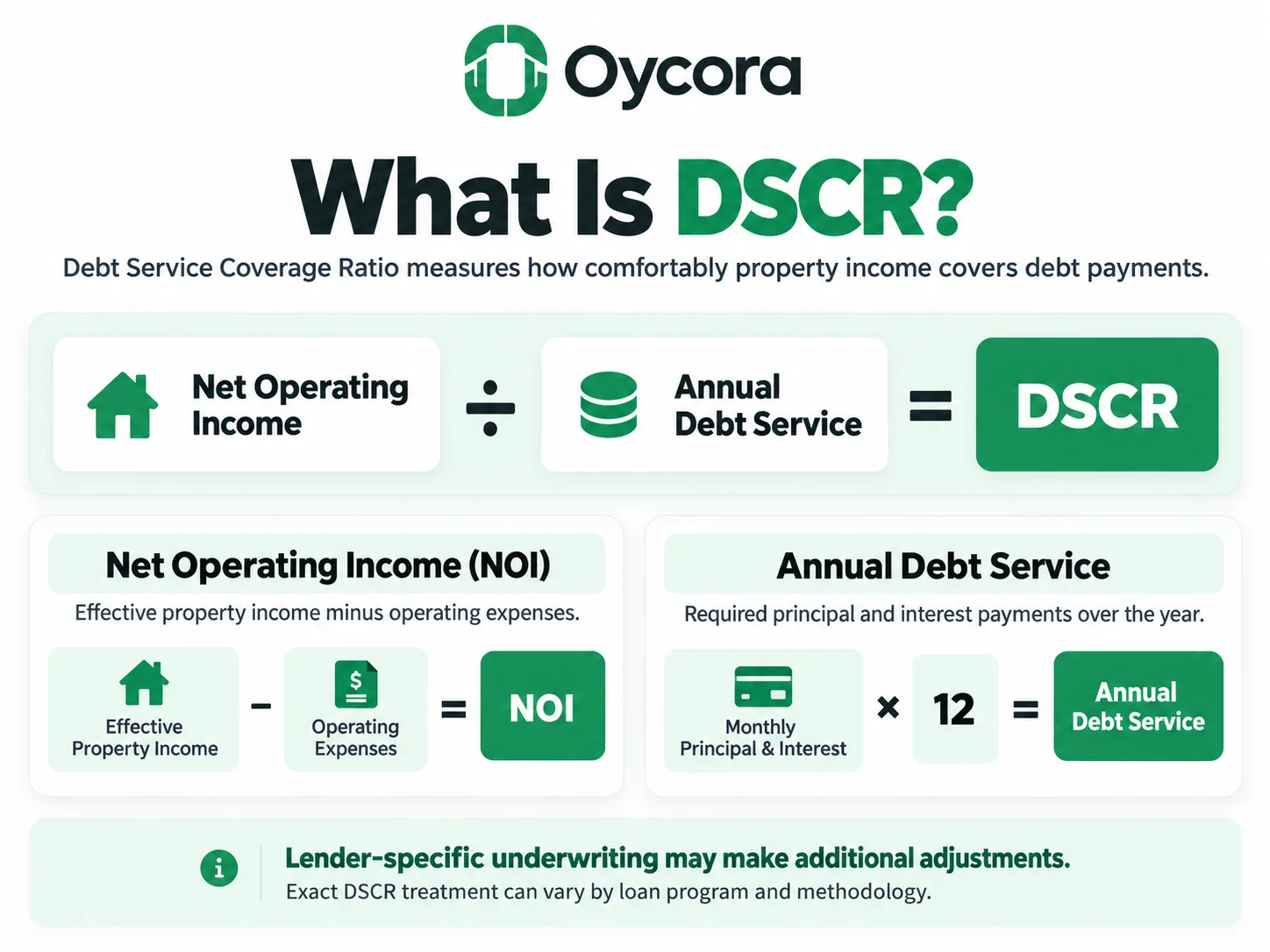
A common simplified property-level formula is:
DSCR = Net Operating Income ÷ Annual Debt Service
If a rental property produces $30,000 of annual NOI and requires $24,000 in annual principal and interest payments, its simplified DSCR is 1.25. In other words, the property produces $1.25 of NOI for every $1.00 of modeled debt service. The OCC uses this NOI-based formulation when discussing commercial real-estate lending, while some loan programs use a more specifically defined underwritten net cash flow instead.
Why Lenders Care About DSCR
DSCR helps a lender evaluate how much cushion exists between property income and the payment the loan requires. A property barely covering its debt has less room for lower rent, unexpected vacancy, rising expenses, or other financial pressure than one producing substantially more income relative to the same payment. The ratio therefore helps connect the property's operating performance directly to its financing burden.
That does not mean DSCR is the only thing a lender considers. Property value, loan-to-value ratio, borrower strength, reserves, market conditions, property type, and other underwriting factors can matter as well. OCC guidance specifically states that banks should establish DSCR guidelines appropriate to different loan types and consider the expected volatility of the property's cash flow when determining suitable coverage.
The practical lesson is that a 1.20, 1.25, or any other ratio should not automatically be treated as a universal approval threshold. It needs to be interpreted within the specific loan program and underwriting methodology being used.
What Counts as Debt Service?
For a straightforward amortizing rental-property loan, annual debt service generally refers to the required principal and interest payments over the year. If the monthly principal-and-interest payment is $2,000, annual debt service would be $24,000. Taxes and insurance may be collected through an escrow account as part of the borrower's total monthly payment, but they are property operating expenses in the NOI calculation rather than debt service itself under a conventional property-level framework.
More complex financing can require a more detailed definition. Fannie Mae's multifamily definition, for example, measures DSCR using defined Net Cash Flow relative to principal, interest, and certain required mezzanine or preferred-equity payments. Fannie Mae also incorporates replacement reserves into some of its monitored net-cash-flow calculations, illustrating why a lender's actual underwriting DSCR may differ from a simplified NOI-based calculation.
For an investor using Oycora, the important thing is consistency. The calculation should follow Oycora's DSCR Methodology for analytical purposes, while an actual loan application should follow the lender's required definition.
How Debt Service Changes DSCR
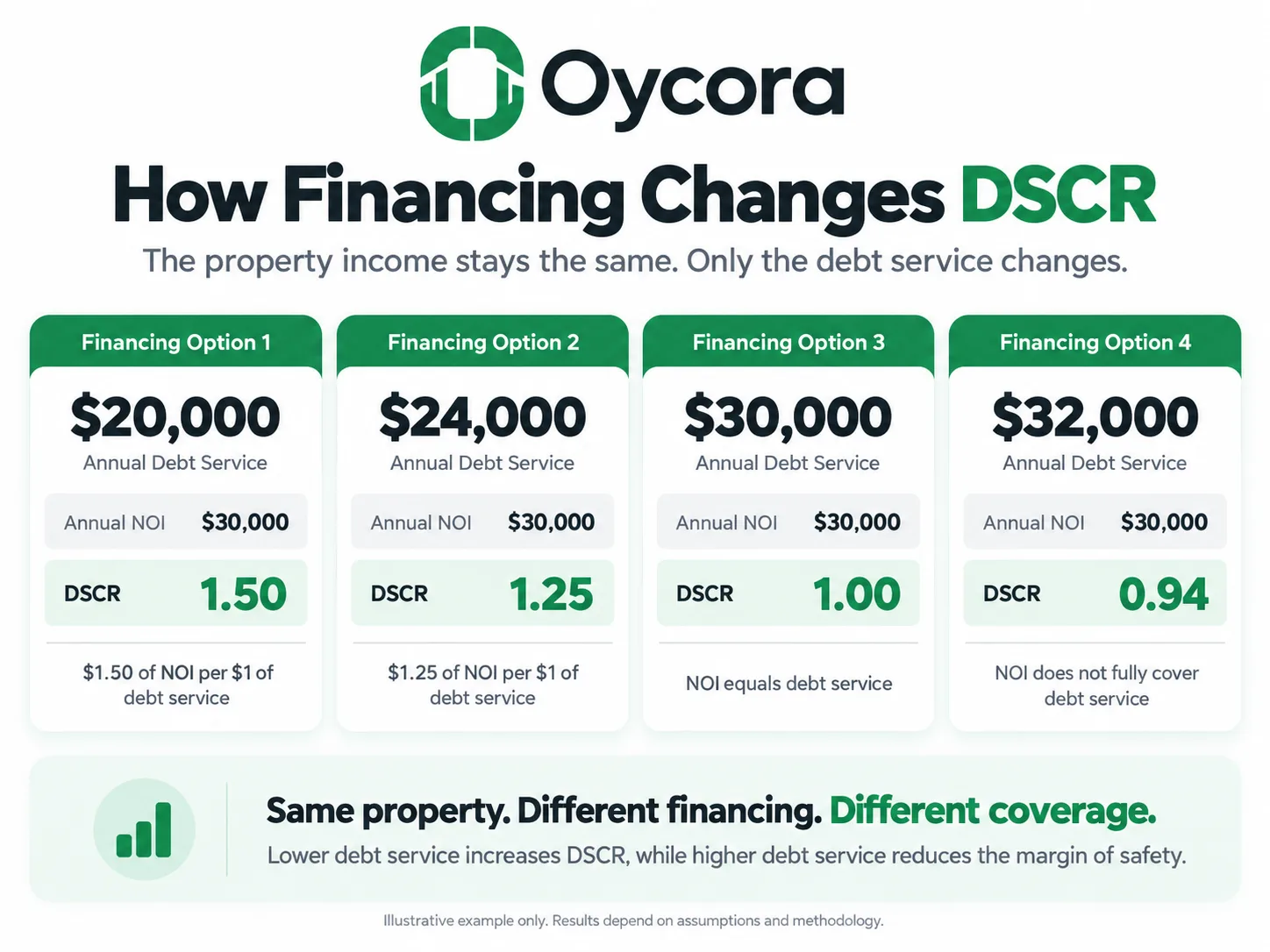
Assume a fictional rental property produces $30,000 of annual NOI. The property itself remains unchanged in each scenario; only the financing and resulting annual debt service change.
| Annual NOI | Annual Debt Service | DSCR | Interpretation |
|---|---|---|---|
| $30,000 | $20,000 | 1.50 | $1.50 of NOI per $1 of debt service |
| $30,000 | $24,000 | 1.25 | $1.25 of NOI per $1 of debt service |
| $30,000 | $30,000 | 1.00 | NOI equals debt service |
| $30,000 | $32,000 | 0.94 | NOI does not fully cover debt service |
The 1.25 scenario is calculated as:
$30,000 ÷ $24,000 = 1.25 DSCR
Nothing about the property's NOI changed across the four scenarios. The difference comes entirely from the amount of debt service required by the financing structure. A lower payment creates more coverage, while a higher payment compresses the ratio.
This is why DSCR is financing-sensitive even though NOI itself is measured before financing. The numerator describes the property's operating income, while the denominator introduces the loan obligation that income must support.
How to Interpret a DSCR Above or Below 1.00
A DSCR above 1.00 means the income measure used in the calculation exceeds the modeled debt service. At 1.25, for example, the property produces 25% more qualifying income than the annual debt payment requires. At 1.50, that cushion is larger.
A DSCR of exactly 1.00 means all of the income being measured is needed to cover the debt service. That leaves no coverage margin within the calculation for weaker income or higher expenses. A ratio below 1.00 means the measured property income is insufficient to cover the modeled debt payment without relying on another source of funds.
These interpretations do not automatically make a property good or bad. They simply describe the relationship between income and debt. A lender may reject a ratio that another loan program permits, and an investor may personally want more coverage than a lender requires.
What Is a Good DSCR?
There is no single DSCR threshold that applies to every rental loan. Requirements depend on the lender, loan type, property, leverage, amortization, and other underwriting factors. The OCC explicitly says appropriate DSCR should consider the amortization period and cash-flow volatility rather than being viewed in isolation.
Current Freddie Mac multifamily materials illustrate how requirements can vary even within one lending platform. Its general guidelines show 1.25x for many conventional fixed-rate and small-balance transactions, while certain products or lower-leverage structures may permit different ratios, and exceptions can be considered individually. Those are program-specific underwriting standards, not a universal rule for all rental-property lending.
For an investor analyzing a property before speaking with a lender, DSCR is most useful as a coverage measure. Once financing options become real, the relevant question becomes whether the property satisfies the specific lender's DSCR methodology and minimum requirement.
DSCR vs. Cash Flow
DSCR and cash flow both involve NOI and debt service, but they express the relationship differently. Cash flow shows the number of dollars remaining after debt service, while DSCR expresses the income-to-debt relationship as a ratio.
Suppose a property produces $30,000 in NOI and has $24,000 of annual debt service. Simplified annual pre-tax cash flow is $6,000, while DSCR is 1.25. Both numbers describe the same underlying financing situation, but one tells you the remaining dollars and the other tells you the amount of coverage.
Neither metric makes the other unnecessary. Cash flow is more intuitive when asking how much money might remain for the investor, while DSCR is especially useful when evaluating whether property income provides sufficient coverage for a loan.
DSCR vs. Cap Rate
Cap rate ignores financing entirely:
Cap Rate = NOI ÷ Property Value
DSCR specifically incorporates financing:
DSCR = NOI ÷ Annual Debt Service
A property could have an attractive cap rate but a weak DSCR if it is financed with an expensive loan. The opposite could also occur: a modest-cap-rate property financed conservatively may have strong debt-service coverage. The two metrics therefore answer different questions and should not be used interchangeably.
This distinction also explains why two buyers can calculate the same cap rate on a property but different DSCRs. If their debt service differs, their coverage ratios differ even though the property's NOI and value remain the same.
Common DSCR Mistakes
One of the most common mistakes is putting gross rent in the numerator. DSCR is intended to compare an income measure after appropriate property expenses with debt service, not compare the full rent roll with the mortgage payment. Ignoring vacancy, management, insurance, taxes, maintenance, or other expenses can make the property appear much more capable of supporting debt than it really is.
Another mistake is mixing monthly income with annual debt service or vice versa. The numerator and denominator must cover the same period. Using annual NOI divided by one month's mortgage payment produces a meaningless ratio even though the arithmetic itself works.
Investors can also assume that their own DSCR calculation will exactly match a lender's. Fannie Mae's definitions demonstrate that underwriting may use specially defined net cash flow and include adjustments such as replacement reserves rather than relying on a simplified investor formula. Finally, avoid treating the lender's minimum ratio as an investment recommendation. A loan being financeable does not by itself mean the property fits the investor's return requirements or risk tolerance.
Stress-Test Debt Coverage Before Relying on It
A DSCR calculated from one set of assumptions is only as reliable as those assumptions. If NOI falls because of vacancy, lower rents, higher insurance, or unexpected operating costs, DSCR falls even when the mortgage payment stays exactly the same. A property with very little coverage above the lender's minimum may therefore respond differently to a modest setback than one with substantially more room.
A useful analysis can test what happens when NOI is reduced by 5% or 10%, or when alternative loan terms increase annual debt service. This does not predict the future, but it shows how dependent the financing is on the base-case assumptions being correct. The same stress-testing principle applies throughout rental analysis: a precise ratio is most useful when you also understand how easily it can change.
DSCR ultimately answers a narrow but important question: How comfortably does the property's qualifying income cover its required debt payments? Use that answer alongside cash flow, cap rate, cash-on-cash return, leverage, reserves, property condition, and the lender's actual underwriting requirements rather than treating the ratio as a stand-alone verdict.