
When you analyze a rental property, one of the first questions worth answering is simple: How does the property perform on its own, before considering how you choose to finance it?
Net operating income, usually shortened to NOI, is designed to help answer that question. It takes the income generated by the property, subtracts the expenses required to operate it, and leaves you with a property-level measure of operating income.
That distinction matters because a mortgage is specific to the buyer. Two people can purchase the exact same property using different down payments, interest rates, and loan terms. Their cash flow may be very different, but the underlying property's operating income does not change simply because one person borrowed more money.
Understanding NOI makes several other real-estate metrics easier to understand as well. Cap rate starts with NOI. Debt-service coverage compares NOI with debt payments. Property valuation and underwriting frequently rely on it. But NOI is only useful when the income and expenses going into the calculation are classified correctly.
What Is Net Operating Income?
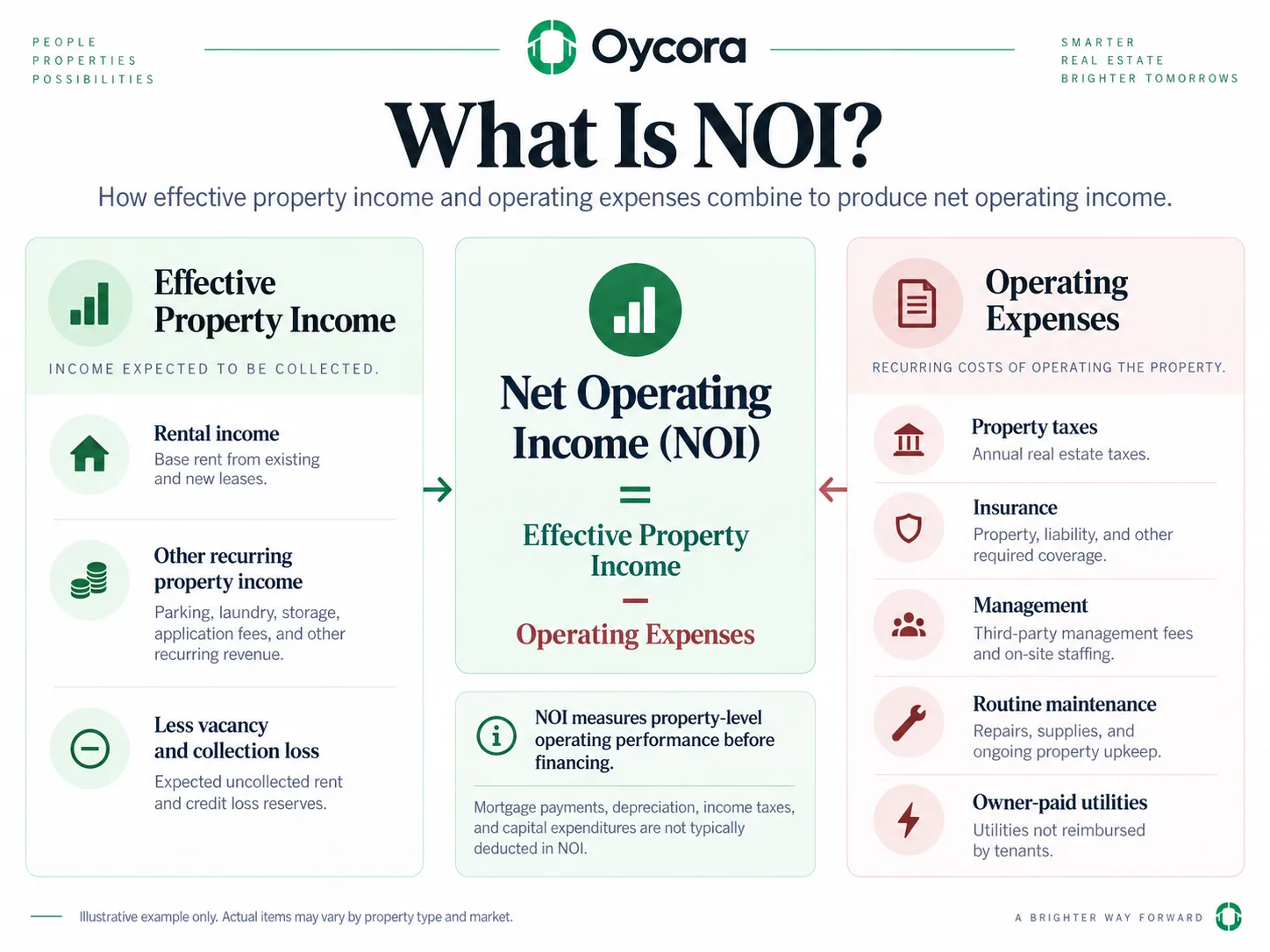
Net operating income is the income a property generates after operating expenses are deducted, but before financing costs and certain other non-operating items are considered. The basic formula is:
NOI = Effective Property Income − Operating Expenses
Fannie Mae's Multifamily Guide similarly defines NOI as a property's effective gross income minus operating expenses. Nareit describes NOI as property revenue less operating expenses while excluding financing and capital costs.
Suppose a rental property is expected to collect $36,000 per year after accounting for vacancy and other income adjustments. If the property requires $13,000 per year in operating expenses, the NOI would be:
$36,000 − $13,000 = $23,000 NOI
That $23,000 is not the owner's final profit, nor is it the same as cash flow. It is a measure of what remains from property operations before the owner's financing structure is layered into the analysis. This makes NOI useful when comparing properties because it separates the performance of the real estate from the way a particular investor chooses to pay for it.
What Income Is Included in NOI?
The income side of the calculation should represent income generated by the property itself. For many residential rentals, rent makes up nearly all of it, but some properties have additional recurring sources of income.
Depending on the property, income may include rent from residential units, parking fees, laundry income, storage fees, pet-related fees, or other recurring property-generated income. Fannie Mae's definition of effective gross income similarly incorporates rental income along with qualifying commercial and other income when calculating NOI.
The key is to use realistic effective income, not simply the maximum amount the property could theoretically generate. Imagine a duplex with two units renting for $1,500 each. Gross potential rent would be:
$1,500 × 2 units × 12 months = $36,000
But an investor may not expect to collect every possible dollar every year. Vacancy, turnover, nonpayment, concessions, or other losses can reduce actual collected income. If the analysis assumes a 5% vacancy and collection allowance:
$36,000 × 5% = $1,800
Effective rental income would become: $36,000 − $1,800 = $34,200
That $34,200, rather than the theoretical $36,000, provides a more useful starting point for NOI under those assumptions. The 5% figure is purely illustrative; there is no universal vacancy percentage that applies to every rental property.
Which Operating Expenses Are Included?
Operating expenses are the recurring costs associated with running and maintaining the property. Common examples include property taxes, property insurance, property management, routine repairs and maintenance, owner-paid utilities, landscaping, HOA expenses when applicable, and similar ongoing property costs.
The IRS lists many of the same categories among common rental expenses, including maintenance, insurance, taxes, management fees, repairs, and utilities. Tax treatment and NOI classification are not identical concepts, however, so a tax return should not simply be copied into an investment analysis without considering how each item is classified.
Operating expenses also need to reflect economic reality. For example, an owner who plans to self-manage a property may have no immediate property-management bill. That does not necessarily mean management has no economic cost, especially when comparing the property with alternatives or considering what would happen if professional management were eventually needed.
The same principle applies to maintenance. A property may have had an unusually inexpensive year without suddenly becoming maintenance-free. NOI should be built from reasonable assumptions rather than whichever expense history produces the most attractive result.
What Is Not Included in NOI?
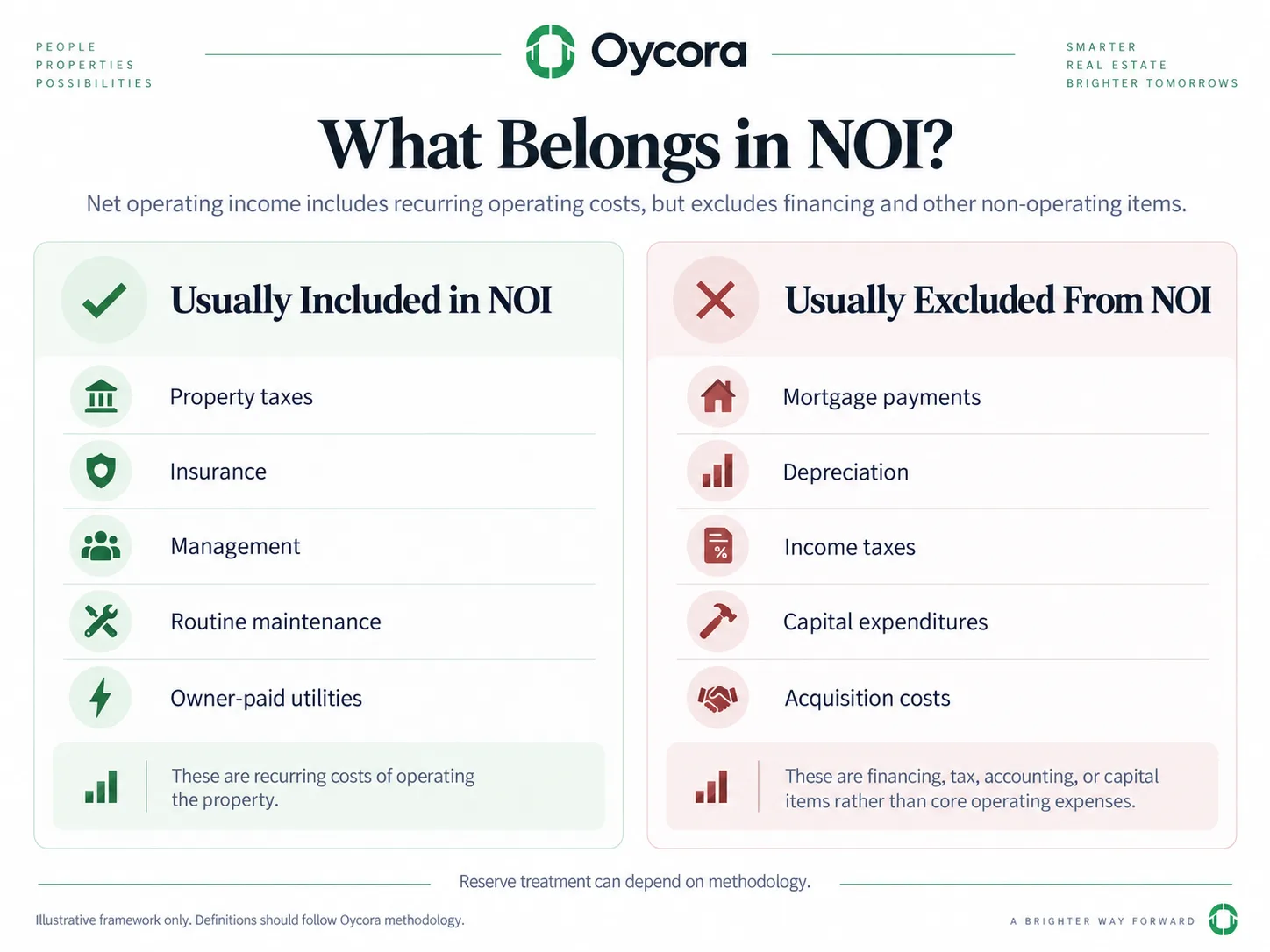
This is where NOI is most often confused with cash flow or taxable income. Under a conventional property-level NOI framework, several major items are not deducted when calculating NOI:
- Mortgage principal and interest: Financing depends on the individual owner rather than the property's operating performance.
- Depreciation: Depreciation is an accounting and tax expense, not a current property operating cash expense.
- Owner income taxes: These depend on the owner's tax situation rather than the property itself.
- Major capital expenditures: A new roof, HVAC replacement, major structural improvement, or similar capital item is generally distinguished from routine operating expenses.
- Acquisition and financing costs: Down payments, loan fees, and closing costs relate to buying or financing the property rather than operating it.
Capital expenditures deserve additional care because reserves and underwriting treatment can vary by methodology. Setting aside money for a future roof replacement may be financially prudent even when the reserve is displayed separately from conventional NOI. Oycora's calculator and Methodology should therefore be used consistently when deciding where modeled reserves appear in an analysis.
This distinction between repairs and improvements also exists in tax accounting. The IRS generally treats ordinary repairs differently from improvements that must be capitalized, such as certain substantial replacements or betterments.
A Complete NOI Example
Suppose an investor is evaluating a fictional four-unit residential property. The property rents each unit for $1,250 per month, producing gross potential rent of:
$1,250 × 4 × 12 = $60,000 per year
Assume the analysis uses a 5% allowance for vacancy and collection loss: $60,000 × 5% = $3,000
Effective rental income becomes: $60,000 − $3,000 = $57,000
The property also produces $1,200 per year in laundry income, bringing total effective property income to: $57,000 + $1,200 = $58,200
Now estimate the annual operating expenses:
- Property taxes: $7,200
- Insurance: $2,400
- Property management: $4,656
- Routine maintenance and repairs: $3,500
- Owner-paid utilities: $2,400
- Landscaping and other recurring costs: $1,200
Total operating expenses are: $21,356
The property's NOI is therefore: $58,200 − $21,356 = $36,844
That is the property's projected annual net operating income under these assumptions. Notice what has not yet been considered: there is no mortgage payment in the calculation. Whether the buyer pays cash, puts 25% down, or uses another financing structure, the projected NOI remains $36,844 as long as the property's operating assumptions remain unchanged.
Once financing is introduced, the buyer can move from NOI toward projected cash flow.
Why NOI Matters
NOI is useful partly because so many other real-estate calculations build on it. One of the clearest examples is cap rate:
Cap Rate = NOI ÷ Property Value
If the four-unit property in our example were valued at $500,000: $36,844 ÷ $500,000 = 7.37% cap rate
The cap rate uses NOI specifically because it is intended to examine the property's operating income relative to value without allowing one buyer's financing choices to change the result. NOI also plays a major role in debt-service coverage ratio, or DSCR:
DSCR = NOI ÷ Annual Debt Service
The Office of the Comptroller of the Currency describes DSCR as NOI divided by annual debt-service requirements and notes that appropriate coverage depends on factors such as amortization and the stability of the property's cash flow. Suppose the property generates $36,844 of NOI and requires $28,000 in annual debt service:
$36,844 ÷ $28,000 = 1.32 DSCR
That tells a lender or investor something different from cap rate. Cap rate relates operating income to property value; DSCR relates operating income to debt obligations. This is why NOI is so foundational. It becomes a common starting point from which several different financial questions can be answered.
NOI Is Not the Same as Cash Flow
NOI and cash flow are sometimes used as though they mean the same thing, but they describe different stages of the analysis. If the example property produces $36,844 of NOI and has $28,000 of annual debt service, a simplified pre-tax cash-flow calculation would be:
$36,844 − $28,000 = $8,844
The property therefore has $36,844 of NOI but only $8,844 remaining after the modeled debt service.
Another buyer using less debt might have substantially higher cash flow. A cash buyer would have no mortgage debt service at all. Yet all three buyers could begin with the same NOI because they are analyzing the same property's operations. That distinction is one of the most useful concepts in rental-property analysis:
NOI measures the property before financing. Cash flow reflects what remains after financing and other applicable investor-level costs are considered.
Common NOI Mistakes
The formula itself is simple. Most mistakes come from the assumptions placed inside it.
Using gross rent without accounting for vacancy can overstate effective income. Omitting management or maintenance because the current owner handles those tasks personally can understate the property's economic operating costs. Deducting mortgage payments inside NOI mixes property performance with financing. Treating a major roof replacement exactly like routine maintenance can blur the distinction between operating expenses and capital costs.
Another mistake is treating NOI as though it were guaranteed. NOI is an estimate when it is based on projected rents, vacancy, and expenses. If those assumptions change, NOI changes with them. For that reason, a precise NOI such as $36,844 should not create false confidence. The arithmetic may be exact while the underlying inputs remain estimates.
What NOI Really Tells You
Net operating income gives you a cleaner view of a rental property's operating economics.
Start with realistic property income, account for vacancy and collection loss, subtract the recurring expenses required to operate the property, and the result is NOI. From there, you can use that figure to calculate cap rate, evaluate debt coverage, compare properties, and eventually layer in financing to estimate cash flow.
NOI does not tell you whether a property is automatically worth buying. It does not account for every risk, future capital need, financing term, tax consequence, or market condition.
What it does provide is a consistent answer to a narrower and very useful question: How much operating income does this property produce before financing?
Getting that number right makes nearly every calculation that follows more useful.