
Rental income is only half of a rental-property analysis. A property may collect thousands of dollars each month and still produce disappointing cash flow if the costs of operating it are underestimated.
That is why operating expenses matter. They represent the recurring costs required to keep a rental property functioning and producing income, and they directly affect net operating income (NOI). The lower the operating expenses, all else equal, the higher the NOI. The higher the operating expenses, the lower the NOI.
The challenge is not simply remembering every bill. It is correctly separating operating expenses from financing costs, capital expenditures, tax/accounting items, and other costs that belong elsewhere in the analysis. Mixing those categories can make a property's performance look better or worse than it really is.
What Counts as a Rental Property Operating Expense?
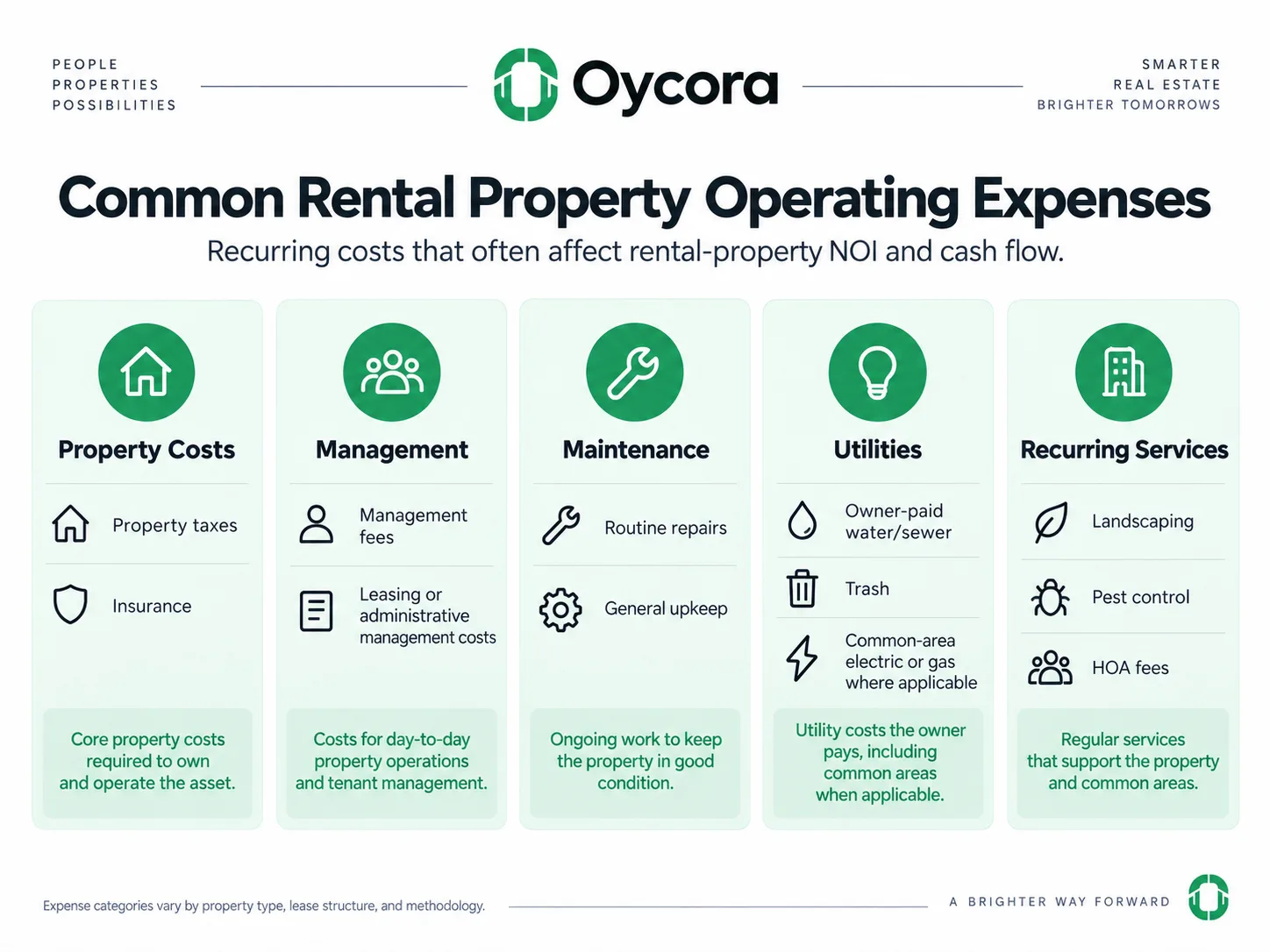
An operating expense is generally a recurring cost associated with owning, operating, and maintaining the property as a rental. These costs are deducted from effective property income when calculating NOI.
Common examples include property taxes, property insurance, management fees, routine repairs and maintenance, owner-paid utilities, HOA dues, landscaping, snow removal, pest control, and certain recurring administrative or professional costs.
The IRS lists many similar categories among common rental expenses, including cleaning and maintenance, insurance, management fees, repairs, taxes, and utilities. Tax reporting and investment analysis are not the same thing, however. The fact that something may be deductible for tax purposes does not automatically mean it belongs inside an NOI calculation.
The guiding question for rental analysis is usually: Is this an ordinary recurring cost of operating the property?
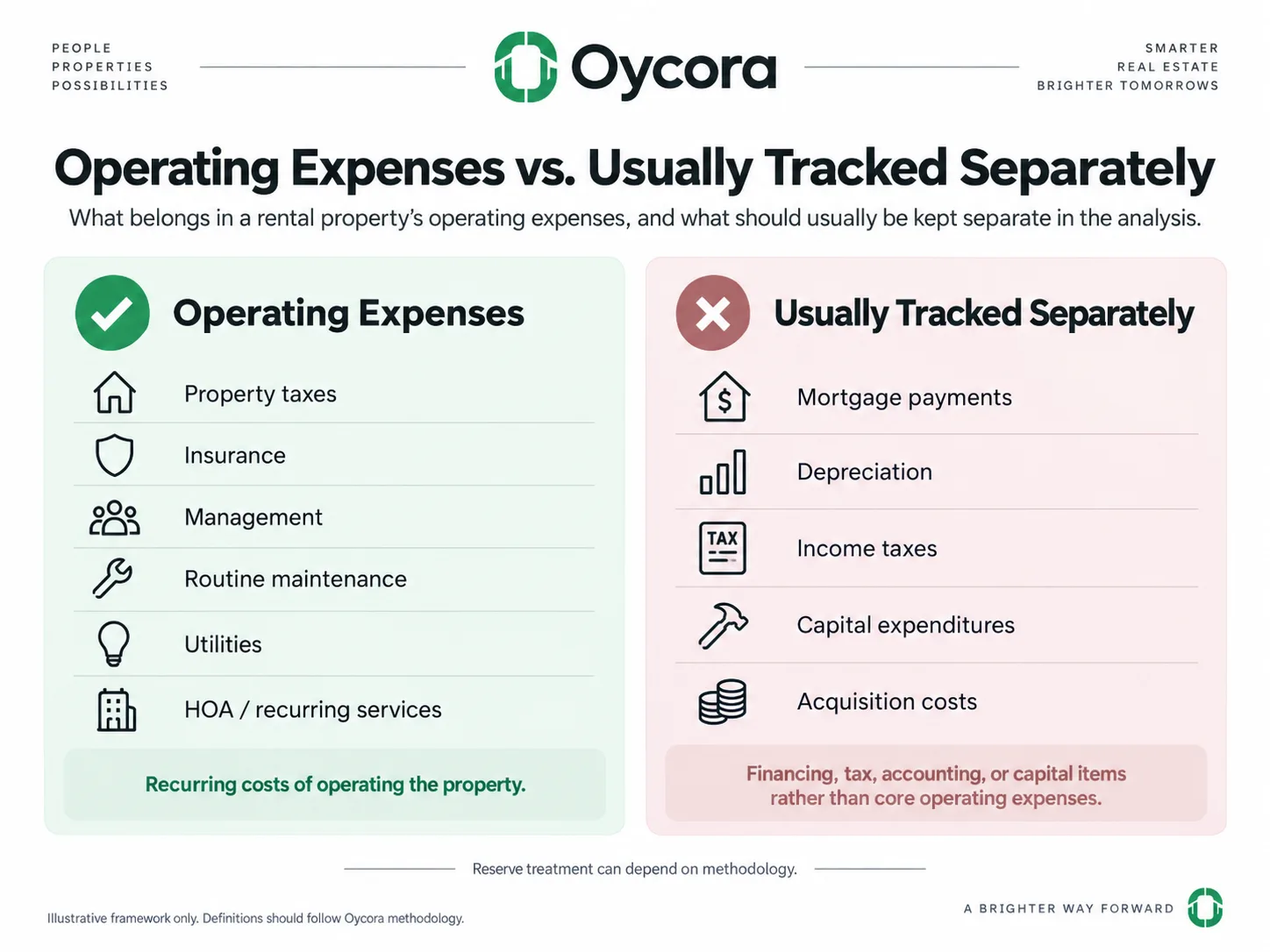
If the answer is yes, it is likely an operating expense. If the cost relates primarily to financing the property, purchasing it, paying the owner's income taxes, or making a major capital improvement, it generally belongs somewhere else in the analysis.
The Main Operating Expense Categories
Property taxes and insurance are among the most obvious operating expenses. These costs can vary significantly by location and property, which is why using actual or reasonably estimated figures is preferable to relying on a generic percentage.
Property management is another important category. If a third-party manager charges a percentage of collected rent, that expected fee should be modeled. Even when an owner intends to self-manage, it can still be useful to consider the economic cost of management, especially when comparing properties or considering how the investment would perform if professional management were eventually required.
Routine maintenance and repairs also belong in the analysis. Examples might include minor plumbing repairs, appliance servicing, patching drywall, replacing damaged hardware, seasonal HVAC servicing, or similar ongoing work required to keep the property usable. The IRS generally distinguishes repairs and maintenance from improvements that materially better, restore, or adapt a property.
Owner-paid utilities can include water, sewer, trash, gas, electricity, or other services that are not reimbursed by tenants. Other recurring property-specific costs may include HOA dues, lawn care, snow removal, pest control, security monitoring, common-area expenses, or recurring licensing and inspection fees where applicable.
Not every property will have every expense. A single-family home with tenant-paid utilities may have a very different cost structure from a four-unit property where the owner pays water, landscaping, hallway electricity, and trash service.
That is why a useful expense estimate should be property-specific rather than copied from a generic template.
What Should Not Be Mixed Into Operating Expenses?
Several important costs affect an investor's overall return without being conventional property operating expenses.
The most important is mortgage debt service. Principal and interest payments depend on how the investor finances the property, not on the property's operating performance. Including mortgage payments inside operating expenses would make NOI change simply because one investor used a different loan than another.
Depreciation is also generally kept outside NOI. It is an accounting and tax mechanism for recovering the cost of qualifying property over time, rather than a recurring cash expense required to operate the rental. The IRS specifically describes depreciation as a capital expense recovered over the property's applicable life.
Owner income taxes are also separate because they depend on the individual investor's financial and tax situation. Acquisition costs such as a down payment, certain closing costs, and financing fees relate to purchasing or funding the investment rather than operating it month to month.
Major capital expenditures should also be distinguished from routine repairs. A $250 plumbing repair and a $12,000 roof replacement may both involve the physical property, but they serve very different roles in an analysis.
Repairs, Maintenance, and Capital Expenditures
The line between an ordinary repair and a capital expenditure is one of the most important distinctions in rental-property analysis.
Routine repairs generally maintain the property in its existing operating condition. Fixing a leaking faucet, repairing a damaged door, servicing an HVAC unit, or patching a section of drywall may fall into this category depending on the circumstances.
Capital expenditures, often shortened to CapEx, generally involve major replacements, improvements, or long-lived components. A new roof, full HVAC replacement, major electrical upgrade, or substantial renovation would more commonly fall into this category.
The IRS similarly distinguishes deductible repairs from improvements that better the property, restore it, or adapt it to a new use. Examples of improvements include items such as new roofs, heating systems, central air-conditioning systems, major plumbing systems, and substantial interior improvements.
For investment analysis, the practical issue is that a property can appear profitable in an ordinary month while still requiring expensive components over time. Ignoring those future costs entirely can make projected performance overly optimistic.
This is where reserves become useful. An investor might set aside an estimated amount each month or year for future replacements. Whether those reserves are included directly in NOI or displayed separately can depend on the methodology being used, so Oycora should apply its own classification consistently.
The important point is not to pretend major future expenses do not exist simply because the roof is not being replaced this year.
Estimating Annual Operating Expenses
The property's estimated annual operating expenses are:
| Expense | Annual Amount |
|---|---|
| Property taxes | $3,400 |
| Property insurance | $1,600 |
| Property management | $2,189 |
| Routine maintenance and repairs | $1,800 |
| Owner-paid utilities | $720 |
| HOA dues | $600 |
| Landscaping / recurring services | $600 |
| Total Operating Expenses | $10,909 |
Using those assumptions, NOI becomes:
| Calculation | Amount |
|---|---|
| Effective property income | $27,360 |
| Less operating expenses | −$10,909 |
| Net Operating Income | $16,451 |
The property therefore produces a projected $16,451 of annual NOI before financing.
Notice that the table does not include a mortgage payment. It also does not include depreciation, the investor's income taxes, or a major roof replacement. Those items may matter elsewhere in the analysis, but placing them inside operating expenses would mix different financial categories together.
The exact expense numbers above are illustrative. The purpose of the example is to show how individual operating costs combine into one total that directly affects NOI.
Why Expense Assumptions Matter So Much
A rental analysis can be mathematically perfect and still be misleading if the expense assumptions are unrealistic.
Suppose an investor analyzes the property above but includes only taxes and insurance. Operating expenses would appear dramatically lower, NOI would appear substantially higher, and every metric based on NOI would improve.
Nothing about the actual property changed. Only the assumptions did.
The same problem occurs when investors use unusually low historical expenses as though they will continue indefinitely. A property that required almost no repairs last year has not necessarily become a maintenance-free asset. Likewise, an owner who performs all management and maintenance personally may spend less cash but still contributes real labor and time.
Some investors use percentage-based rules of thumb for maintenance, vacancy, or reserves. These can be useful as rough starting points when detailed information is unavailable, but they should not be treated as universal standards. A newer property with recently replaced systems may have a very different expense profile from an older property with aging mechanical components.
Whenever possible, build the analysis from actual taxes, actual insurance quotes, actual utility responsibilities, realistic management assumptions, and property-specific maintenance needs.
Common Operating Expense Mistakes
Several mistakes show up repeatedly in rental-property analysis. One is leaving out management because the owner plans to self-manage. Another is assuming repairs will remain unusually low because the property recently had a quiet year. Investors may also forget owner-paid utilities, HOA expenses, recurring lawn or snow service, pest control, or other smaller costs that become meaningful when added together.
The opposite mistake is adding expenses that do not belong inside NOI, particularly mortgage payments. That makes it harder to distinguish the property's operating performance from the investor's financing choices.
Another problem is treating repairs and capital expenditures as though they are interchangeable. Routine maintenance belongs naturally within operating expenses, while large replacements may need their own CapEx or reserve treatment.
Finally, avoid confusing tax deductions with investment-analysis categories. The IRS lists mortgage interest, depreciation, repairs, taxes, utilities, and other items as potential rental expenses for tax purposes, but tax reporting answers a different question from NOI analysis.
Build the Expense Side Before Trusting the Return
Rental-property analysis tends to attract attention toward the exciting numbers: cash flow, cap rate, cash-on-cash return, and potential profit.
Those numbers are only as reliable as the expense assumptions underneath them.
Start by identifying the recurring costs required to operate the property. Use property-specific numbers wherever possible. Keep financing, taxes, acquisition costs, and major capital items in the appropriate parts of the analysis rather than forcing everything into one expense category.
Most importantly, do not build an analysis around the expenses you hope the property will have. Build it around the costs the property is reasonably likely to require.
A realistic operating-expense estimate makes NOI more meaningful, and once NOI is more meaningful, every calculation built from it becomes more useful.