

A rental property does not necessarily collect 100% of its potential rent every year. Tenants move out, units take time to prepare and re-lease, applications fall through, and sometimes rent that was expected is never collected. A vacancy allowance gives those income losses a place in the analysis instead of assuming the property will remain perfectly occupied and fully collected forever.
There is no single vacancy percentage that works for every rental. A stabilized property in a tight market with long-term tenants may justify a relatively low assumption, while a property with frequent turnover or weaker demand may require substantially more. The goal is not to pick the percentage that creates the best cash flow. It is to estimate the income loss the property can reasonably experience.
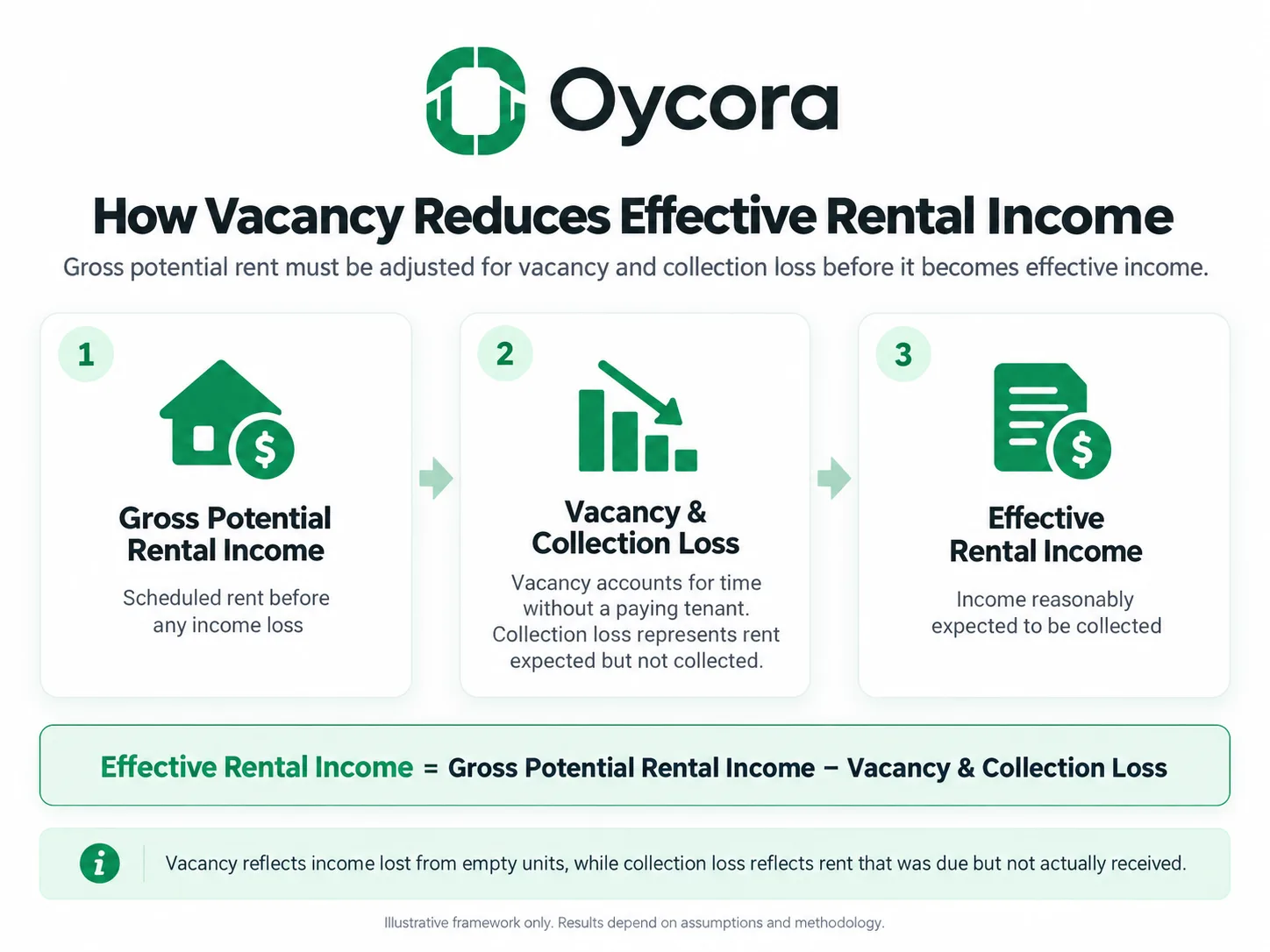
What Does a Vacancy Allowance Actually Represent?
In a rental-property analysis, a vacancy allowance reduces gross potential income to reflect the fact that some rent may not be collected. Physical vacancy is the most obvious example: a tenant leaves, the unit sits empty during turnover, and no rent is received. Depending on the methodology, the same allowance may also incorporate some collection loss or credit loss from rent that was scheduled but never collected.
This analytical concept is slightly different from a published market vacancy rate. The U.S. Census Bureau defines the rental vacancy rate as the share of rental inventory that is vacant and available for rent. Market vacancy data can be useful for understanding local supply and demand, but an individual property's underwriting assumption also needs to consider its own turnover, lease history, condition, and tenant profile.
For example, a rental generating $2,000 per month has $24,000 of gross potential annual rent. If the analysis assumes 5% vacancy and collection loss, it reduces projected income by $1,200 before operating expenses are considered. That does not mean the property is expected to sit completely empty for exactly 18.25 days; the percentage is simply translating expected income loss into the model.
Why Using 0% Vacancy Can Distort the Analysis
A 0% vacancy assumption effectively says the property will collect every dollar of scheduled rent with no downtime or collection problems during the period being modeled. That can happen for a particular year, especially with a stable long-term tenant, but treating it as a permanent underwriting assumption leaves no margin for ordinary turnover. Even a good rental can lose income when a tenant moves out and the unit needs cleaning, repairs, advertising, showings, screening, and a new lease.
The effect becomes more noticeable when projected cash flow is already thin. A property expected to produce $300 per month in cash flow may appear comfortable when vacancy is ignored, but one empty month represents roughly 8.3% of a year's potential rent. A single longer-than-expected turnover could therefore absorb a meaningful portion of the projected annual cash flow.
This is why vacancy should be modeled before deciding whether a property appears financially resilient. The question is not whether the property is currently occupied. The question is whether the analysis reasonably accounts for the fact that occupancy and collections can change over time.
What Vacancy Percentage Should You Use?
There is no universal percentage that every rental should use. A reasonable assumption depends on the local rental market, the specific property, tenant turnover, unit condition, rent level, lease structure, and the quality of management. A generic percentage can be a useful placeholder when better information is unavailable, but it should eventually be replaced or supported by property-specific and local evidence.
Start with the property's actual history when reliable records exist. If a property has experienced predictable turnover every few years and units typically re-lease quickly, that history tells you more than a broad national statistic. For a new acquisition without useful records, local market data, comparable rentals, property managers, leasing agents, and realistic expected turnover times can help form the assumption.
Published vacancy data can provide context, but the geographic level matters. The Census Bureau notes that rental vacancy rates reflect housing supply relative to demand and can vary across housing markets. A national average therefore does not automatically describe the conditions surrounding one duplex, single-family rental, or small apartment building.
How Vacancy Changes Rental Income
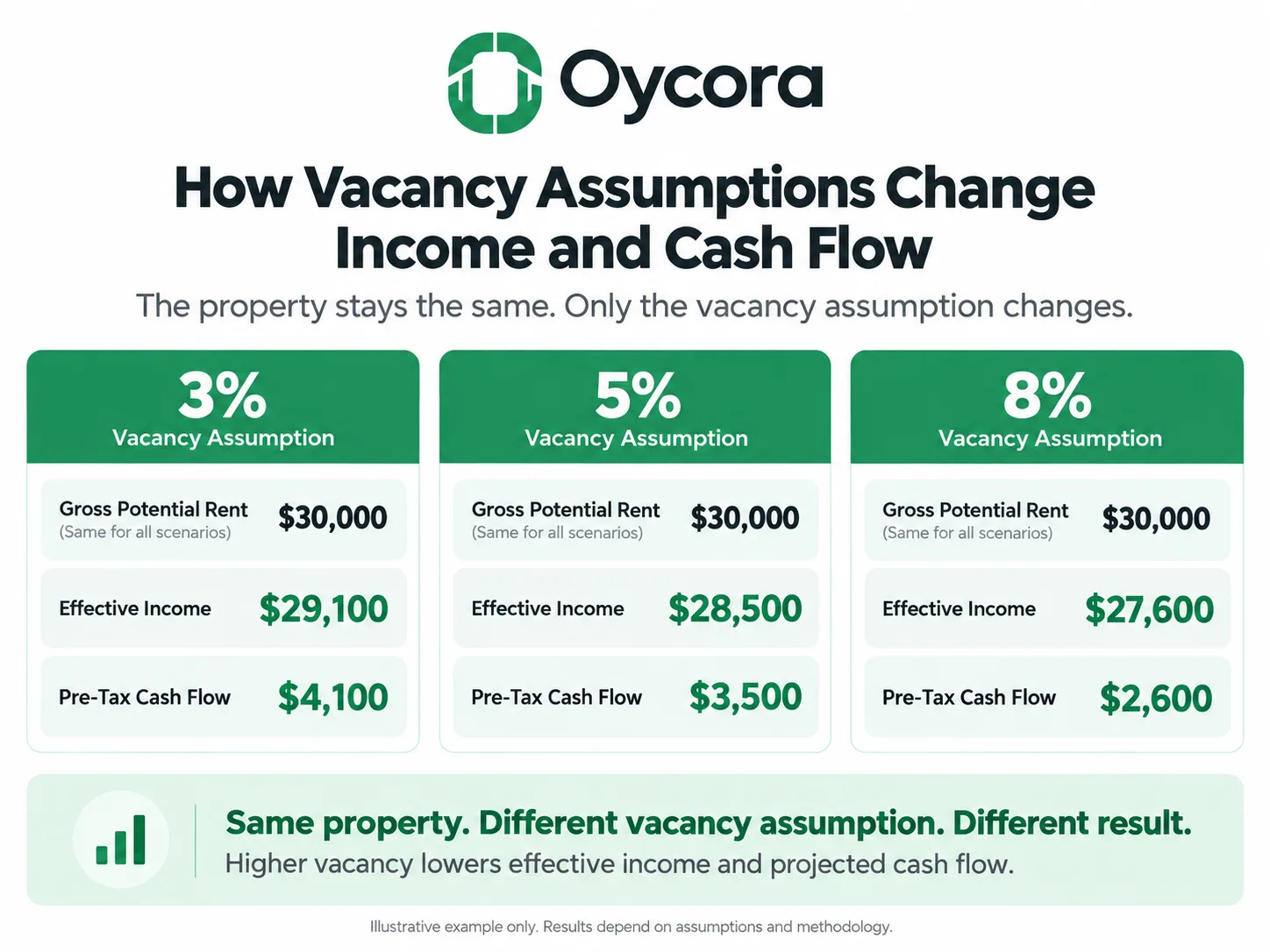
| Vacancy Assumption | Vacancy & Collection Loss | Effective Rental Income |
|---|---|---|
| 3% | $900 | $29,100 |
| 5% | $1,500 | $28,500 |
| 8% | $2,400 | $27,600 |
The difference between a 3% and 8% assumption is $1,500 per year, even though the rent itself never changed. If the property's operating expenses and debt service remain constant, that entire $1,500 difference ultimately reduces projected pre-tax cash flow.
Suppose the property has $10,000 of annual operating expenses and $15,000 of annual debt service:
| Vacancy Assumption | Effective Income | NOI | Pre-Tax Cash Flow |
|---|---|---|---|
| 3% | $29,100 | $19,100 | $4,100 |
| 5% | $28,500 | $18,500 | $3,500 |
| 8% | $27,600 | $17,600 | $2,600 |
The 8% scenario still produces positive projected cash flow, but it leaves considerably less margin than the 3% scenario. That is why vacancy is not a cosmetic input. It can materially change NOI, debt coverage, cash flow, and any return metric built from those numbers.
Turnover Matters Even in Strong Rental Markets
Market demand can be strong while an individual property still experiences vacancy. A tenant may give notice at an inconvenient time, repairs may take longer than expected, or the owner may intentionally leave the unit empty for upgrades before re-leasing it. Vacancy assumptions should therefore consider the actual mechanics of turnover rather than looking only at how quickly comparable listings appear to rent.
Imagine a property that typically changes tenants once every three years and loses three weeks of rent during each turnover. Averaged over several years, that downtime creates an economic vacancy cost even though the unit may be fully occupied during most individual calendar years. Modeling a reasonable allowance smooths that irregular loss across the analysis instead of pretending it never occurs.
Properties with shorter tenant stays or more management-intensive leasing may require a different assumption. Multifamily properties can also behave differently from single-family rentals because one vacant unit may represent only a portion of the property's total rent rather than all of it. Vacancy therefore needs to be interpreted in the context of the property being analyzed.
Physical Vacancy and Collection Loss Are Not Always the Same
A unit can be physically occupied while still failing to produce all of the rent expected from it. Late payments, partial payments, concessions, or uncollected balances can reduce actual income even when the property is technically occupied. Some underwriting approaches combine vacancy and collection loss into one percentage, while others model them separately.
The distinction matters because a property with excellent occupancy can still experience weak collections. Conversely, a property may have occasional physical vacancy but very reliable payment history while occupied. Oycora's methodology should determine exactly how those losses are classified in its calculators, but the underlying lesson remains the same: scheduled rent and collectible income are not necessarily identical.
Keeping this distinction visible also makes it easier to diagnose a problem. If lost income comes primarily from long turnovers, the response may involve leasing speed or property readiness. If it comes primarily from poor collections, the operational issue is different even though both reduce effective income.
Common Vacancy-Budgeting Mistakes
One mistake is blindly applying the same percentage to every property. A 5% assumption may be reasonable in one situation and inappropriate in another, so it should be treated as an assumption to investigate rather than a universal standard. Another mistake is using the current tenant's occupancy as proof that vacancy does not need to be modeled. Today's occupied unit says little about what happens after that tenant eventually leaves.
Investors can also double-count vacancy by reducing rent once for a vacancy allowance and then separately subtracting the same expected loss elsewhere in the analysis. The opposite problem occurs when turnover costs such as cleaning or routine make-ready work are assumed to be covered by the vacancy percentage even though the model also needs those expenses accounted for independently. Vacancy represents lost income; physical turnover expenses can still create additional costs.
Finally, avoid choosing the percentage based on the return you want the property to show. If changing vacancy from 8% to 3% is the difference between acceptable and unacceptable projected cash flow, that sensitivity itself is important information. The appropriate response is to investigate which assumption is better supported, not simply choose the more attractive result.
Stress-Test Vacancy Instead of Relying on One Number
A good rental analysis does not need absolute certainty about the exact vacancy percentage. It needs to show what happens across a reasonable range of assumptions. If you believe 5% is a sensible base case, you can still test 3% and 8% to understand how much the property's performance depends on occupancy and collections.
A property whose cash flow remains comfortable under a more conservative vacancy scenario has a different financial profile from one whose cash flow disappears after a small increase. Neither result automatically determines whether the property should be purchased, but the comparison reveals how much margin exists in the model.
Vacancy is ultimately one of many uncertain inputs in rental-property analysis. Treat it the same way you would rent growth, maintenance, insurance, or financing: use the best information available, make the assumption explicit, and then test what happens if reality turns out less favorable than expected.