
Oycora Guide · Property Analysis
The Complete Guide to Analyzing a Rental Property
A complete rental-property analysis starts long before the final return percentage. This Guide walks through how to build realistic assumptions, measure operating performance, account for financing, interpret the major metrics, and stress-test the result before relying on it.

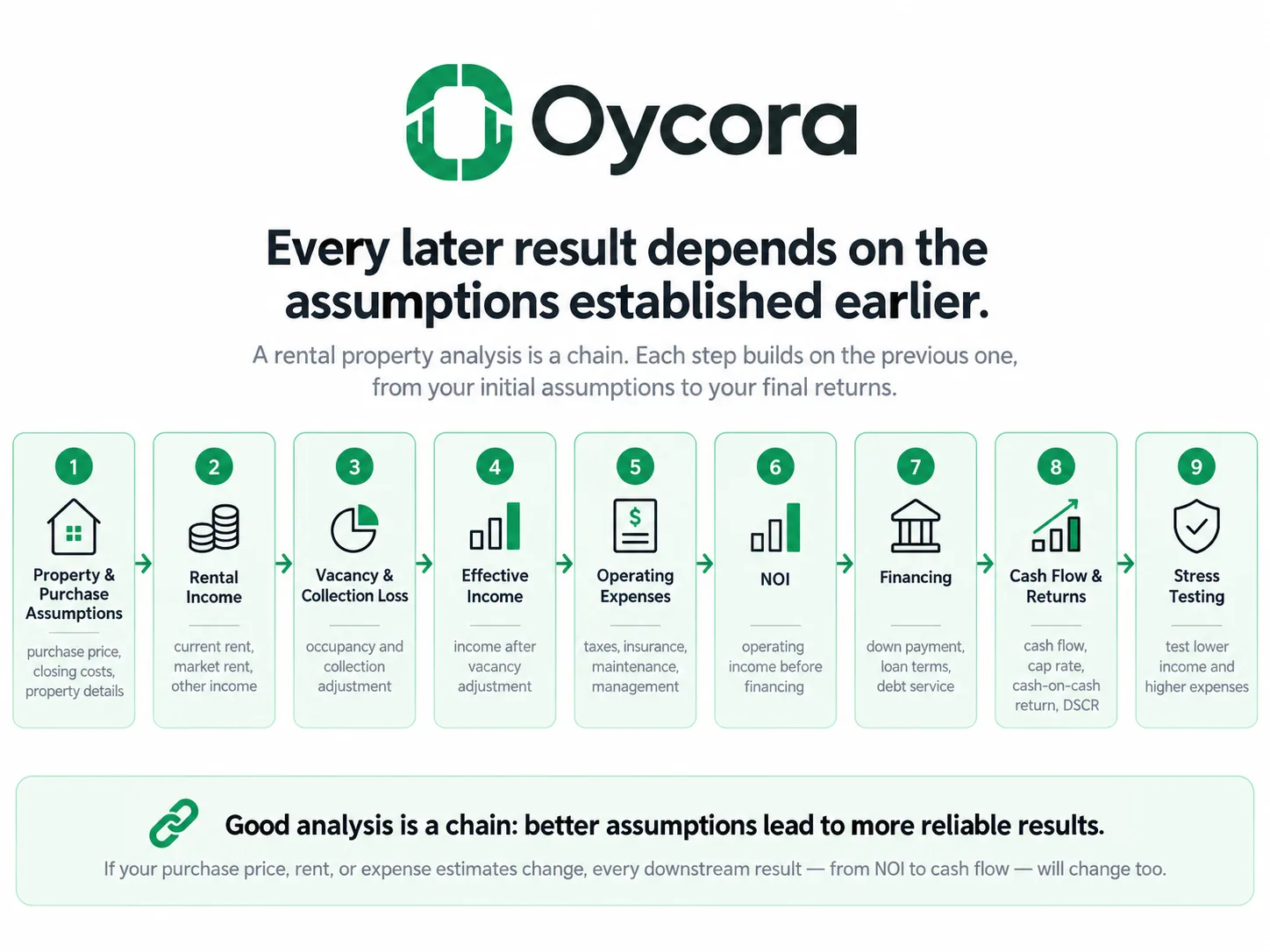
A rental property analysis is not really a collection of formulas. It is a chain of assumptions. The rent you expect to collect affects income, vacancy reduces that income, operating costs determine how much remains, financing changes investor-level cash flow, and each return metric interprets a different part of the result. If the assumptions at the beginning of that chain are weak, precise calculations at the end do not make the analysis reliable.
That is why a useful analysis begins before cap rate, cash-on-cash return, or DSCR ever appear on the page. The first job is to understand what is actually being purchased, what the property can reasonably earn, and which assumptions are based on known information versus expectations about the future. Institutional underwriting frameworks follow the same general principle: Fannie Mae directs underwriters to use objective measures, historical performance, anticipated operations, and the best information available when evaluating property income and expenses.
This Guide will build a rental analysis from the ground up, then carry those assumptions through operating performance, financing, investor returns, and stress testing. The purpose is not to establish one universal definition of a “good deal.” It is to make the economics transparent enough that the reader can see what is producing the result, which assumptions matter most, and what would need to remain true for the property to perform as modeled.
Build the Inputs Before Running the Numbers
The first stage of analysis is less about calculation than information quality. Before judging a property's return, you need a clear picture of what you are buying, what income already exists, what income is merely projected, and where uncertainty remains. A strong model makes those distinctions visible rather than allowing optimistic assumptions to blend into known facts.
This does not mean every input must be certain before an analysis can begin. Real estate decisions are always made with some uncertainty. The goal is to separate verified information, reasonable estimates, and speculative upside so the model does not accidentally treat all three as equally reliable.
Start With the Property and Purchase Assumptions
The purchase price is an obvious starting point, but the amount shown on the listing is only one part of the acquisition. A complete analysis should also recognize the cash required to close the transaction, any immediate work needed before the property can operate as intended, and the basic physical and lease characteristics that shape the rest of the model.
Start with the property's unit count, current occupancy, lease structure, current rents, and known recurring income sources. Then identify the acquisition assumptions: purchase price, expected closing costs, planned initial repairs or renovations, and any other cash required before stabilization. If the property is already occupied, review the actual leases rather than relying solely on listing information. A stated monthly rent has much more analytical value when it can be tied to a current lease and payment history.
Property condition matters at this stage because it can change several later assumptions at once. A lower-priced rental that needs a roof, HVAC system, flooring, and substantial turnover work may require more initial cash and larger future reserves than a more expensive property in better condition. Those differences will eventually affect cash invested, expenses, financing needs, and return metrics, so they should be identified before the analysis begins rather than added as an afterthought.
The same principle applies to items that are not yet known. If the insurance premium has not been quoted, mark it as an estimate. If property taxes may reset after a sale, investigate that risk rather than simply copying the seller's current tax bill. A good model is not one in which every input looks certain. It is one in which the reader can tell which inputs are certain and which still need verification.
Estimate Rental Income Realistically
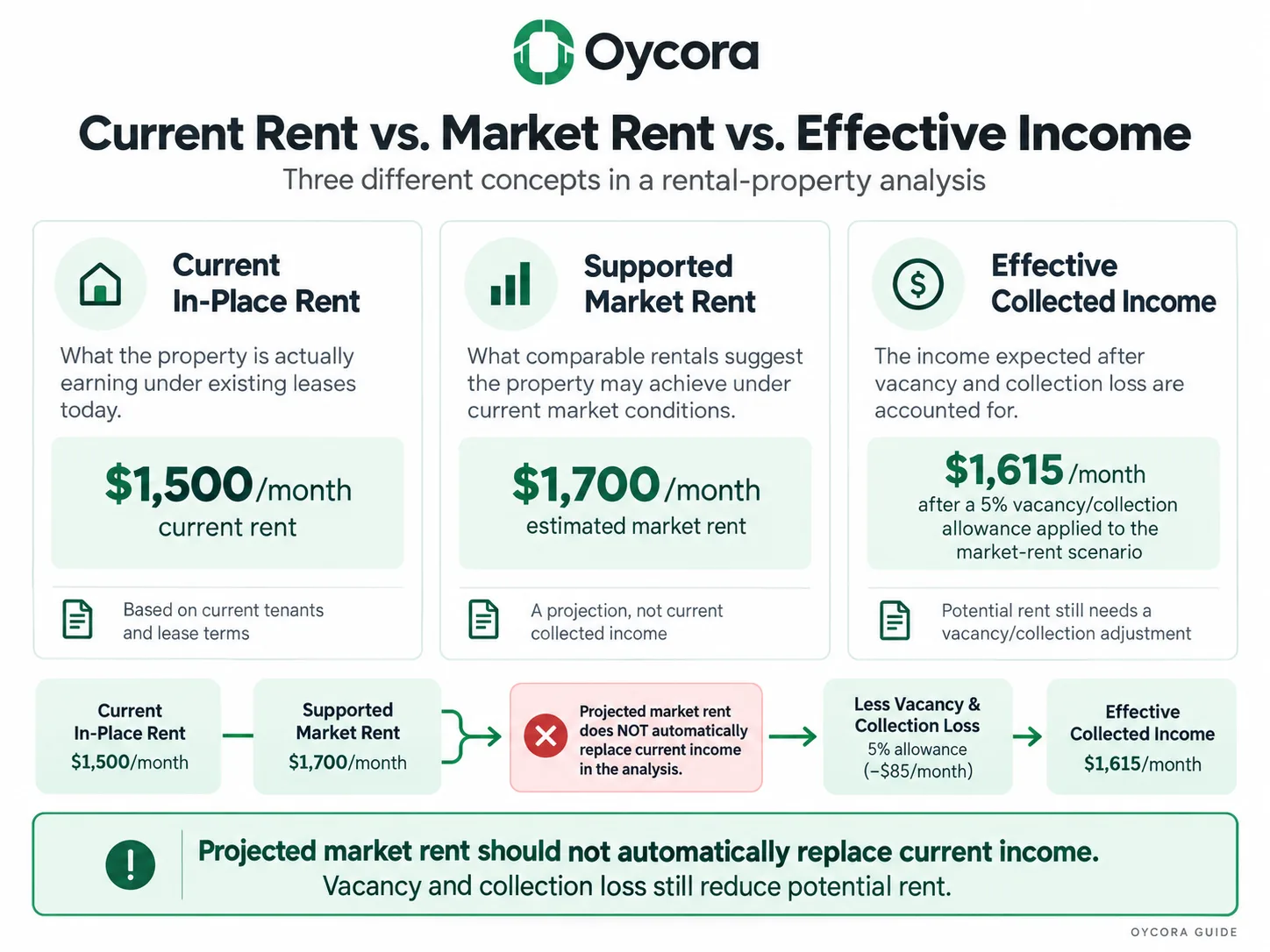
Rental income is usually the largest input in the analysis, which makes small errors especially important. The first distinction to make is between current rent and market rent. Current rent describes what the property is actually earning under existing leases. Market rent is an estimate of what the property may be able to command under current market conditions.
Both numbers can be useful, but they should not be silently substituted for one another. If a unit currently rents for $1,500 and comparable properties suggest $1,700 may be achievable after turnover, the base analysis should make it clear whether it is using $1,500, $1,700, or a staged increase. Treating the higher figure as though it were already in place can make every downstream metric look stronger before the property has actually achieved the rent.
Fannie Mae's current multifamily underwriting guidance illustrates the same general discipline by distinguishing actual in-place rents, market rents for vacant units, vacancy, concessions, and bad debt when moving from gross rental income toward net rental income. A small residential investor does not need to copy institutional underwriting rules, but the underlying lesson is useful: potential rent is not the same thing as collectible rent.
Rent comparisons should also be genuinely comparable. A recently renovated three-bedroom rental with a garage should not be used casually to justify the rent assumption for an older two-bedroom property without similar features. Look at location, unit size, condition, parking, utilities, amenities, and lease terms. When possible, use several relevant comparables rather than one unusually high listing.
Other recurring property income can be included when it is realistic and supported. Parking, storage, laundry, or other charges may contribute to total property income, but speculative future fees should be clearly identified as projections. The goal is not to discover every possible dollar the property could someday earn. It is to create an income assumption that a reasonable analysis can actually defend.
Account for Vacancy and Collection Loss
A property can be fully occupied today and still deserve a vacancy assumption in a forward-looking analysis. Tenants eventually move, units may need work between leases, leasing can take longer than expected, and some scheduled rent may never be collected. Ignoring those possibilities effectively assumes perfect occupancy and perfect collection for the entire period being modeled.
Vacancy is best understood as an income adjustment rather than a prediction of exactly how many days a unit will sit empty. If a property has $36,000 of gross potential annual rent and the model applies a 5% vacancy and collection-loss assumption, the calculation reduces expected income by $1,800. The exact percentage should depend on the property and market rather than being treated as a universal standard.
Fannie Mae separates physical vacancy, concessions, and bad debt when calculating net rental income and requires underwriters to consider historical performance and current rent-roll information. For an individual rental property, the analysis may combine some of these items into one vacancy/collection-loss assumption, but the economic principle is the same: scheduled rent is not necessarily collected rent.
Historical performance is especially useful when the property has reliable records. If a small multifamily property has experienced frequent turnover or recurring collection problems, those patterns should influence the assumption. If records are unavailable, local vacancy conditions, leasing times for comparable units, property condition, and expected tenant turnover can provide a starting point. A generic percentage is better than pretending vacancy does not exist, but property-specific evidence is better than a generic percentage.
Vacancy assumptions should also be stress-tested later rather than treated as fixed. A property whose projected cash flow disappears when vacancy rises from 5% to 7% has a different margin for error from one that remains resilient under the same change. That sensitivity becomes useful only if the initial assumption is clearly separated from the property income that existed before the adjustment.
By the end of this stage, the analysis should have a reasonably defensible picture of the property, acquisition cost, rental income, and expected income loss. The next step is to determine what it actually costs to operate the property and convert that effective income into net operating income, which is where the financial structure begins to become much more revealing.
Back to Guide contentsMeasure the Property’s Operating Performance
Once the income assumptions are established, the next step is determining what it actually costs to operate the property. This is where a rental analysis begins to separate the building’s economics from the way a particular buyer chooses to finance it. Effective income tells you what the property is expected to collect; operating expenses show how much of that income is required simply to keep the rental functioning.
The result is net operating income, or NOI, one of the most important building blocks in rental-property analysis. NOI helps isolate the performance of the real estate itself before mortgage payments enter the picture. That makes it useful not only for understanding the property’s operations, but also for calculating metrics such as cap rate and evaluating how much income is available to support debt later in the analysis.
Build the Operating Expense Model
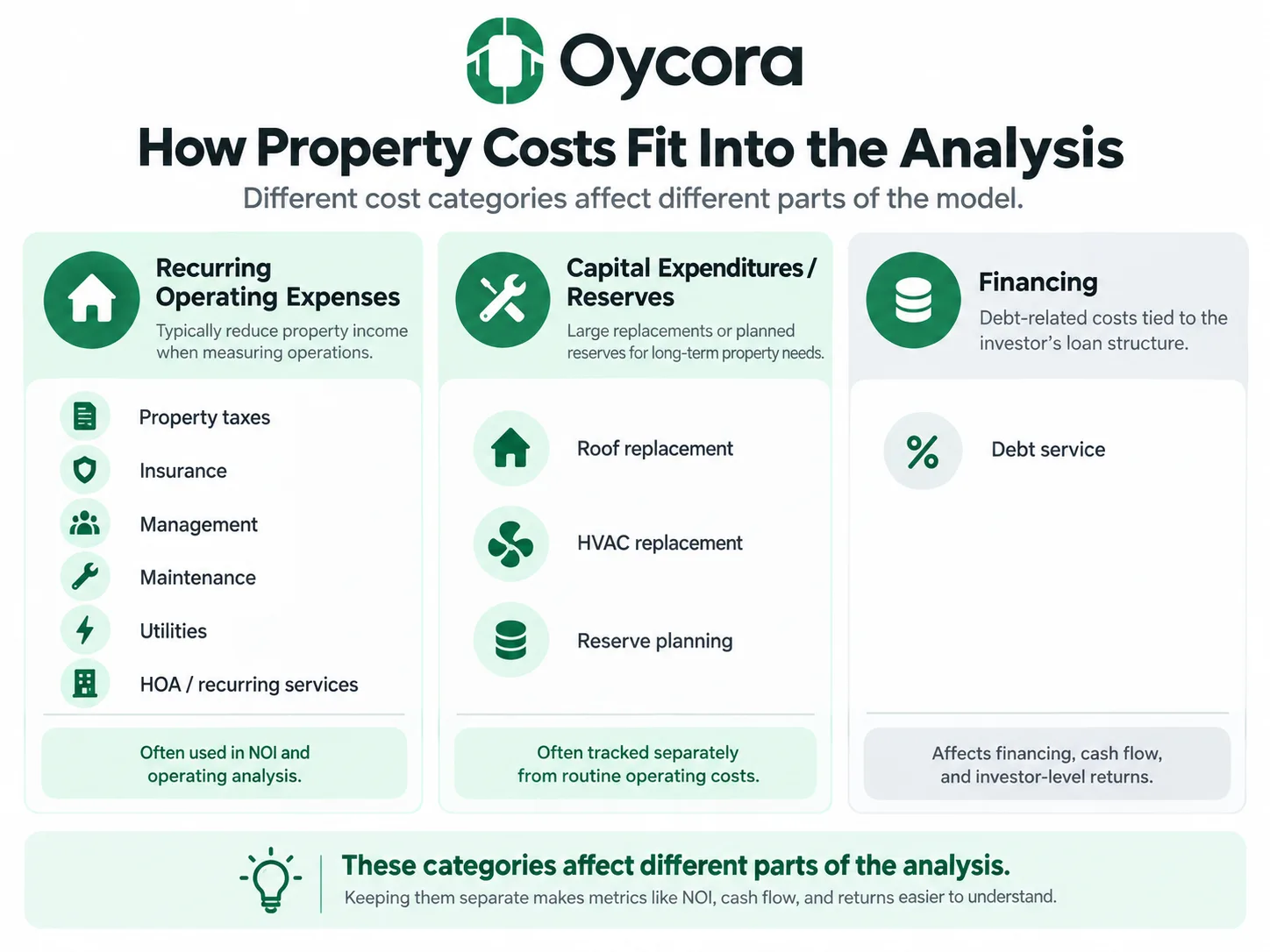
Operating expenses are the recurring costs required to own, operate, and maintain the rental property. Typical categories include property taxes, insurance, property management, routine maintenance and repairs, owner-paid utilities, HOA dues where applicable, landscaping, pest control, and other recurring services tied to the property.
The strongest expense model starts with property-specific information whenever possible. Actual tax records are more useful than a generic percentage. A real insurance quote is better than a rough online estimate. If the owner pays water, trash, lawn care, or common-area utilities, those costs should be included rather than assumed away. When reliable historical records exist, they can help reveal patterns, although unusually low past spending should not automatically be assumed to continue.
Maintenance deserves particular care because it rarely arrives evenly. A property may have an inexpensive year followed by several repairs in a short period. A reasonable maintenance assumption should reflect the age and condition of the property, major systems, turnover history, and known recurring needs rather than simply copying one quiet year of expenses.
Management is another area where analysis can become overly optimistic. An owner who plans to self-manage may have no immediate management invoice, but professional management still represents an economic cost the property may eventually need to support. Whether Oycora’s model includes a management assumption for a self-managed property depends on the analysis being performed, but the decision should be explicit rather than accidental.
Major capital expenditures should also be distinguished from routine operating costs. Replacing a roof or HVAC system is not the same as fixing a leaking faucet or servicing equipment. Oycora’s reserve and CapEx treatment should follow its methodology consistently, but the larger principle is simple: large future property needs should not disappear from the analysis just because they are not monthly bills.
Calculate NOI and Understand What It Actually Measures
After effective property income and operating expenses are established, NOI can be calculated. In its simplest form:
NOI = Effective Property Income − Operating Expenses
NOI measures the property’s operating performance before financing. Mortgage principal and interest are not deducted because the loan belongs to the buyer’s financing structure, not to the underlying real estate. Two investors can buy the same property with different down payments and loan terms while starting from the same NOI.
That distinction is what makes NOI so useful. If financing were mixed directly into operating expenses, the property would appear to become more or less profitable simply because one buyer borrowed more money than another. By keeping financing separate, NOI gives you a cleaner way to compare the operating economics of different properties.
NOI should not be confused with cash flow. A property can produce strong NOI but weak investor cash flow if the debt service is expensive. Likewise, two properties with similar NOI can produce very different cash flow depending on financing. NOI is the point where the analysis finishes evaluating the property’s operations and prepares to evaluate the investor’s capital structure.
The quality of NOI still depends entirely on the inputs behind it. Understated maintenance, unrealistic rent, ignored vacancy, or missing utilities can all inflate the result. An NOI of $25,000 is only meaningful if the income and expense assumptions used to produce it are defensible.
Assume a fictional duplex is being analyzed with the following operating assumptions. The purpose of this example is to consolidate the income and expense calculation into one place rather than scattering equations throughout the Guide.
| Income Calculation | Annual Amount |
|---|---|
| Gross potential rent | $42,000 |
| Other recurring property income | $1,200 |
| Gross potential property income | $43,200 |
| Vacancy & collection loss | −$2,160 |
| Effective property income | $41,040 |
Now estimate the annual operating expenses:
| Operating Expense | Annual Amount |
|---|---|
| Property taxes | $5,200 |
| Insurance | $2,000 |
| Property management | $3,283 |
| Routine maintenance & repairs | $2,400 |
| Owner-paid utilities | $1,200 |
| Landscaping / recurring services | $900 |
| Total operating expenses | $14,983 |
The resulting NOI is:
| NOI Calculation | Annual Amount |
|---|---|
| Effective property income | $41,040 |
| Less operating expenses | −$14,983 |
| Net Operating Income | $26,057 |
The property therefore produces $26,057 of projected annual NOI under these assumptions. That number tells us how much operating income remains before mortgage payments or other financing costs are introduced.
It also gives the next stage of the analysis a clean starting point. If the investor later changes the down payment, interest rate, or loan term, NOI remains $26,057 unless one of the property-level income or expense assumptions changes. The financing section can then show how much of that NOI survives after debt service and how the investor’s actual cash contribution affects the return.
A useful review at this point is to ask whether any major assumption is doing too much work. If the property only produces attractive NOI because maintenance is unusually low, management is excluded, or rent is based on an unsupported future increase, those issues should be corrected before financing is added. Otherwise, the later cash-flow and return calculations will simply make an unrealistic operating model look more precise.
The property analysis now has its core operating result. The next stage is to add the investor’s financing structure and determine how NOI turns into cash flow, debt coverage, and investor-level returns.
Back to Guide contentsAdd Financing and Measure the Investor’s Return
Once NOI is established, the analysis shifts from the property itself to the way the investor plans to acquire it. Financing can materially change cash flow, debt coverage, and the return on the investor’s cash even when the property’s operating performance stays exactly the same.
That is why this stage should come after NOI, not before it. The property first needs to stand on its own operationally. Only then does it make sense to ask how a specific down payment, interest rate, loan term, and debt-service requirement change the investor’s outcome.
Model the Financing Structure
The main financing inputs are usually the down payment, loan amount, interest rate, amortization period, loan term, and resulting principal-and-interest payment. Closing costs and other acquisition cash also matter because they affect the total amount of investor capital tied up in the property, even though they do not change NOI.
A larger down payment generally reduces the loan balance and debt service, which can improve monthly cash flow and DSCR. At the same time, it also increases the amount of investor cash committed to the deal, which can reduce cash-on-cash return depending on how much additional cash flow is gained. More leverage can sometimes increase investor-level returns, but it also increases financing pressure and reduces the margin for error.
Interest rate and amortization matter for the same reason. A higher interest rate raises debt service even if the property’s income and expenses remain unchanged. A longer amortization period can reduce the required payment, while a shorter one may increase debt service but build principal more quickly. The property itself has not changed, but the financing structure can make the investor experience look very different.
This is why financing should be modeled with realistic loan terms rather than a vague mortgage estimate. If the property only appears attractive under unusually favorable financing that the investor is unlikely to obtain, the analysis is not really describing the deal that can actually be purchased.
Understand the Core Performance Metrics
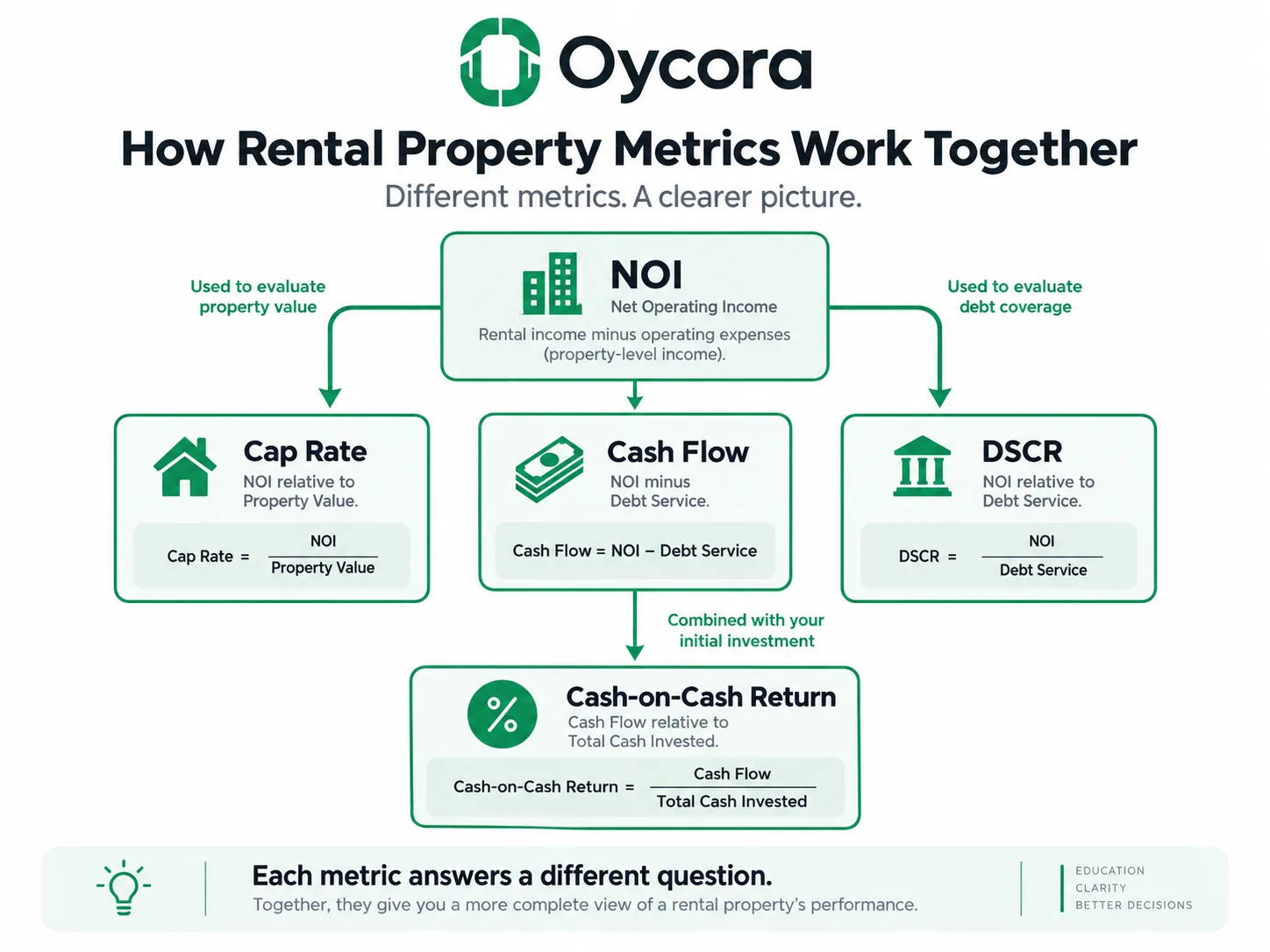
Once financing is added, several important metrics become available. Each answers a different question, so they should be read together rather than treated as interchangeable.
Cash flow shows how much projected money remains after debt service and other applicable investor-level costs are accounted for. It is the most direct measure of the property’s expected spendable cash under the assumptions being modeled.
Cash-on-cash return compares annual pre-tax cash flow with the investor’s total cash invested. This makes it sensitive to both financing and acquisition cash. Two buyers can purchase the same property and calculate different cash-on-cash returns if their down payments, loan terms, closing costs, or initial improvement costs differ.
DSCR compares qualifying property income with annual debt service. It helps show how comfortably the property supports its financing. A ratio above 1.00 means the income measure used in the calculation exceeds the debt payment, while a ratio below 1.00 means it does not fully cover it.
Cap rate sits slightly differently from the other metrics because it remains a property-level measure. It compares NOI with property value and excludes financing. That makes cap rate useful for comparing the underlying real estate even while cash flow, cash-on-cash return, and DSCR change with the loan structure.
From NOI to Investor Returns
Continue with the same fictional duplex from the previous section, which produced $26,057 in annual NOI. Assume the property is purchased for $360,000 with the financing and acquisition assumptions below.
| Financing & Cash Invested | Amount |
|---|---|
| Purchase price | $360,000 |
| Down payment | $72,000 |
| Loan amount | $288,000 |
| Annual debt service | $23,040 |
| Closing costs | $9,000 |
| Initial improvements | $6,000 |
| Total cash invested | $87,000 |
Now carry NOI through the main investor-level calculations:
| Metric | Calculation | Result |
|---|---|---|
| Annual pre-tax cash flow | $26,057 − $23,040 | $3,017 |
| Monthly cash flow | $3,017 ÷ 12 | about $251 |
| Cap rate | $26,057 ÷ $360,000 | 7.24% |
| Cash-on-cash return | $3,017 ÷ $87,000 | 3.47% |
| DSCR | $26,057 ÷ $23,040 | 1.13 |
These results describe different parts of the same deal. The 7.24% cap rate reflects the property’s NOI relative to value before financing. The $3,017 annual cash flow shows what remains after debt service. The 3.47% cash-on-cash return relates that cash flow to the investor’s actual cash contribution, while the 1.13 DSCR shows the amount of NOI available relative to annual debt service.
None of these numbers, by itself, decides whether the investment is attractive. The cash flow may be too thin for one investor and acceptable for another. The DSCR may or may not satisfy a particular lender’s underwriting requirement. The cap rate may compare favorably or poorly with similar properties in the same market.
What the calculations do provide is a coherent picture. The property generates respectable operating income, but the financing consumes a large share of it, leaving a relatively modest cash return on the investor’s $87,000 of contributed capital. That is useful information because it shows exactly where the return is being compressed rather than simply labeling the property good or bad.
The next step is to test whether those results are durable. A base-case analysis can look precise while depending heavily on optimistic rent, low vacancy, inexpensive maintenance, or favorable financing. Stress testing reveals how much room the property actually has when reality moves away from the original assumptions.
Back to Guide contentsTest the Analysis Before Trusting the Result
A rental analysis becomes much more useful once the base case is treated as a starting point rather than a prediction. Rent can come in lower than expected, vacancy can last longer, insurance can rise, repairs can cluster together, and financing terms can change before closing. None of those possibilities means the original analysis was pointless. They mean the model should show how the property behaves when reasonable assumptions move.
Stress testing helps answer a question that a single cash-flow number cannot: how much room does the property have for the analysis to be wrong? A deal that remains financially workable after several assumptions deteriorate has a different risk profile from one whose projected cash flow disappears after a small change.
Stress-Test the Assumptions That Matter Most
Not every input deserves equal attention. Start with the assumptions capable of materially changing income, expenses, or debt service: rent, vacancy, maintenance, insurance, property taxes, major owner-paid costs, and financing. A useful stress test does not need dozens of extreme scenarios. A base case and one or two more conservative scenarios will usually reveal where the model is most sensitive.
Suppose the duplex analyzed earlier produces about $251 per month in projected pre-tax cash flow. A modest reduction in effective income combined with higher maintenance could consume much of that amount. The property might still operate successfully, but the original projection would clearly have less margin than the base case suggested.
Changes should also be tested together when that combination is plausible. Vacancy may increase during the same period that repairs rise, or a lower-than-expected rent may coincide with a more expensive insurance renewal. Testing only one variable at a time can miss the effect of several ordinary setbacks arriving together.
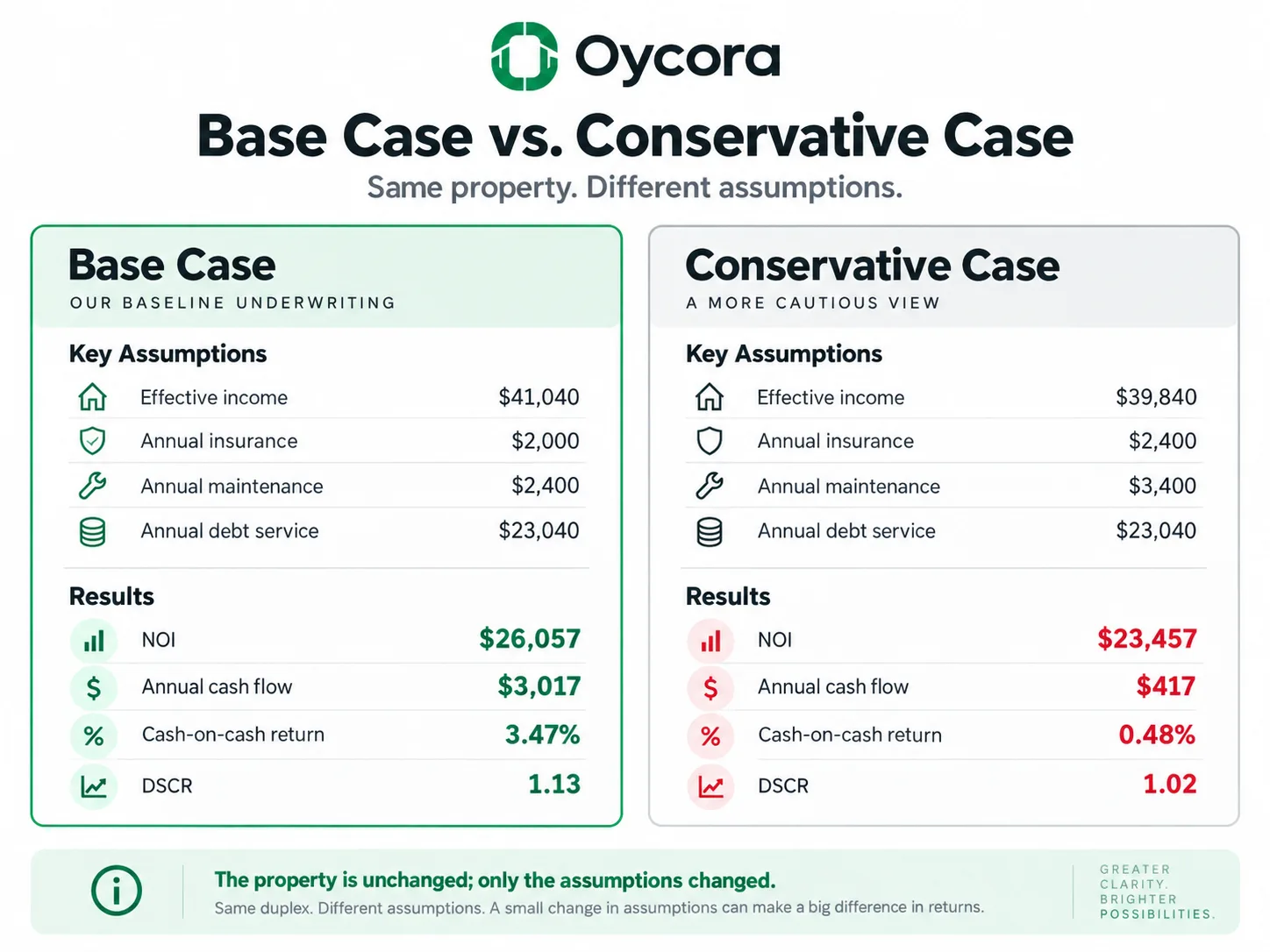
The purpose is not to make every scenario pessimistic. It is to identify which assumptions the investment depends on most heavily. If a small adjustment to rent or maintenance changes the conclusion dramatically, that sensitivity should be understood before capital is committed.
Interpret the Metrics Together, Not as Pass/Fail Rules
Rental-property analysis becomes misleading when one metric is treated as the final verdict. A high cap rate may come with greater repair needs or weaker income stability. Positive cash flow may be too small to absorb ordinary setbacks. A strong DSCR may result from a large down payment that also lowers the investor’s cash-on-cash return.
The metrics make more sense when each is used for the question it actually answers. NOI describes property-level operating performance. Cap rate relates that NOI to property value. Cash flow shows what remains after financing. Cash-on-cash return relates that cash flow to the investor’s contributed capital, while DSCR measures how comfortably qualifying income covers debt service.
There is no universal percentage that makes all properties attractive. Market, strategy, financing, condition, growth expectations, and investor objectives affect how the numbers should be interpreted. Comparing the property with similar alternatives is generally more useful than forcing every investment to meet a generic target taken from another market.
This is also why a seemingly weaker metric may have a reasonable explanation. A lower cash-on-cash return could result from a larger down payment and lower leverage. A lower cap rate might accompany stronger location or more stable income. The analysis should reveal those tradeoffs rather than reduce them to a green or red score.
Move From Financial Analysis Into Due Diligence
A spreadsheet can tell you what happens if the assumptions are correct. It cannot verify that the assumptions are true.
Before acquisition, important inputs should be checked against real documents and physical conditions. Existing leases can confirm rent and tenant obligations. Tax records can verify current property taxes, while the buyer should still investigate whether those taxes could change after transfer. Insurance should be based on an actual quote when possible, and utility responsibilities should be confirmed rather than inferred from a listing.
Physical due diligence matters just as much. An inspection may reveal roof, foundation, electrical, plumbing, HVAC, drainage, or other issues that materially change the repair and reserve assumptions. A property that looked attractive with $5,000 of initial work may look very different if the inspection supports $25,000.
Market assumptions deserve verification too. Rent comparables should reflect genuinely similar units, and local leasing conditions should support the vacancy assumptions used in the model. Legal and regulatory questions, including zoning, rental licensing, lease requirements, and landlord-tenant rules, can also vary by jurisdiction and should be reviewed separately where relevant.
The analysis therefore should not be viewed as the end of the acquisition process. It is a framework for identifying what needs to be verified. When new information arrives, update the model rather than defending the original result.
Back to Guide contentsPractical Takeaways
A strong rental-property analysis is built in layers. Begin with the facts you can verify, then clearly label assumptions where certainty is not possible. Use supported rent rather than the most optimistic rent you can imagine, account for vacancy, and build operating expenses from the actual property rather than from a generic template.
Keep the analytical categories separate. NOI should measure property operations before financing. Financing should then determine debt service, cash flow, cash-on-cash return, and debt coverage. Major future expenses and reserves should be handled consistently with the methodology rather than disappearing simply because they do not occur every month.
Most importantly, do not judge the property from one base-case result. Change the assumptions that matter, compare the property with realistic alternatives, and investigate why a metric looks unusually strong or weak. The objective is not to make the model produce the return you want. It is to understand what the property must actually do for the modeled return to occur.
When the information is available, replace estimates with verified figures. A real insurance quote is better than a percentage assumption, actual tax information is better than a national average, and an inspection is more useful than guessing at the condition of major components.
Back to Guide contentsConclusion
Rental-property analysis works best when it is treated as a connected process rather than a collection of isolated formulas. Purchase assumptions influence the amount of capital required. Rent, vacancy, and expenses determine NOI. Financing then determines how much of that operating income reaches the investor, and the resulting cash flow and return metrics help describe different parts of the same investment.
The calculations themselves are usually the easy part. The difficult part is deciding which numbers deserve to go into them.
A useful analysis therefore makes its assumptions visible, keeps financial categories consistent, and tests the result when those assumptions change. It also recognizes what the model cannot answer on its own: property condition, market quality, legal issues, tenant risk, and the accuracy of the information supplied.
The goal is not to predict a rental property's future perfectly. It is to build a model clear enough that you can see where the projected return comes from, what could change it, and which facts need to be verified before relying on it.
Back to Guide contentsHow Oycora calculates this
Calculation methodology
Related articles

Property Analysis
Rental Property Operating Expenses: What Should You Include?
Operating expenses can make or break a rental-property analysis. Learn which recurring costs belong in the calculation, which costs should be treated separately, and how realistic expense assumptions affect NOI and cash flow.

Property Analysis
What Is Net Operating Income (NOI) in Real Estate?
Net operating income measures how much income a property produces after operating expenses but before financing. Learn the NOI formula, what belongs in the calculation, what does not, and how to use it when analyzing a rental property.
Related Guides

Oycora Guide · Getting Started
How to Buy Your First Rental Property: A Beginner’s Guide
Buying your first rental property involves more than finding a house that rents for more than the mortgage. This Guide walks through preparing financially, defining what you are looking for, evaluating your buying capacity, and understanding the responsibilities that come with becoming a landlord.
Read Guide →