Oycora Guide · Getting Started
How to Buy Your First Rental Property: A Beginner’s Guide
Buying your first rental property involves more than finding a house that rents for more than the mortgage. This Guide walks through preparing financially, defining what you are looking for, evaluating your buying capacity, and understanding the responsibilities that come with becoming a landlord.

Buying a first rental property can feel like one decision, but it is really a sequence of smaller ones. You need to decide what kind of property fits your strategy, determine how much cash you can realistically commit, understand how financing affects the purchase, evaluate potential rentals, verify the condition and economics of the property, and eventually take responsibility for operating it. Skipping one of those steps can create problems that a strong purchase price or attractive rent cannot fix later.
For a first-time buyer, the biggest advantage is not finding a secret market or perfect property. It is having a repeatable process that separates what you can afford, what the property can support, and what you are actually prepared to manage. A lender may approve a certain purchase amount, a listing may advertise an attractive rent, and a calculator may produce positive cash flow, but those facts still need to fit together in one realistic acquisition plan.
This Guide follows that process from preparation through ownership. It will cover how to define the type of rental you want, prepare your finances, search and screen properties, analyze the numbers, evaluate financing, complete due diligence, close the purchase, and transition from buyer to landlord without treating the acquisition itself as the finish line.
Prepare Before You Start Shopping
The first rental-property decision should usually happen before opening a listing site. Without a defined strategy and a realistic understanding of your finances, almost any property can be made to look interesting for one reason or another. A disciplined search begins by narrowing what you are actually willing and able to buy.
Preparation also gives you a clearer way to reject properties quickly. If you know your available cash, financing constraints, desired property type, management capacity, and basic investment criteria, you do not need to seriously analyze every rental that appears affordable. You can focus on the properties that have a realistic chance of fitting the plan.
Decide What Kind of Rental You’re Actually Looking For
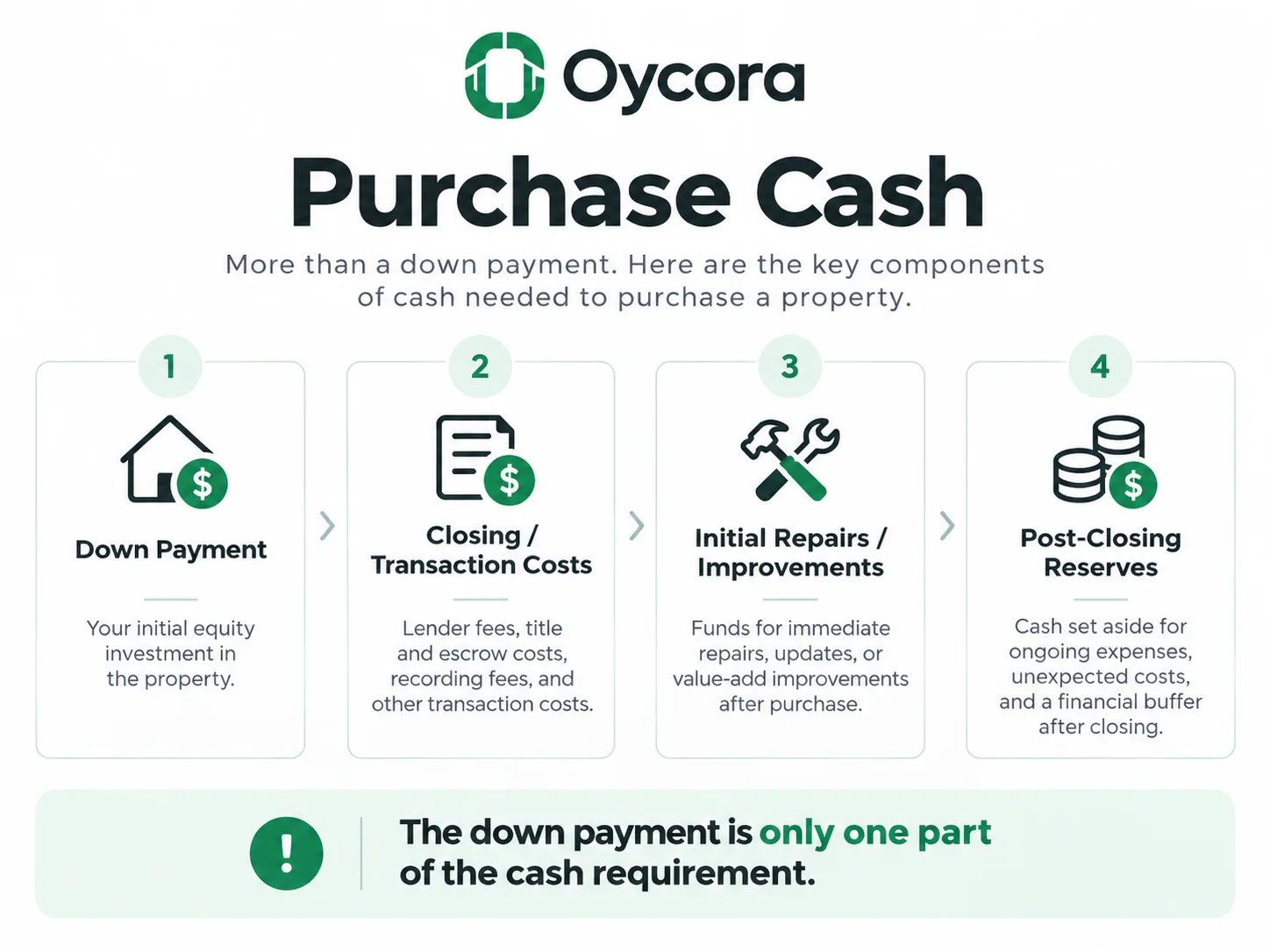
“Rental property” covers several very different ownership experiences. A single-family home with one tenant behaves differently from a duplex, triplex, or four-unit property. An owner-occupied house hack has different financing and lifestyle implications from a non-owner-occupied investment property, and a recently renovated turnkey rental creates a different workload from a property purchased specifically for improvement.
The first step is therefore choosing a reasonably narrow buy box. That does not mean deciding that you will only buy one exact type of house on one exact street. It means defining enough boundaries that your search becomes intentional: property type, approximate price range, number of units, geographic area, expected condition, and whether you intend to live in the property.
A first-time investor should also think about the operating strategy behind the property. Someone who wants a relatively straightforward long-term rental may prefer stable residential demand and a property requiring limited renovation. Someone willing to live in one unit of a small multifamily property may consider house hacking, where the other units help offset housing costs. A buyer comfortable managing a renovation may accept more initial work in exchange for a different purchase opportunity, but that also introduces construction cost, timeline, and execution risk.
The important part is avoiding a search in which the strategy changes every time an attractive listing appears. If you begin looking for a stable duplex and suddenly justify a heavily distressed single-family renovation because the asking price looks low, the criteria are no longer guiding the decision. The property is guiding the criteria.
A simple first buy box might define a two- to four-unit property within a certain purchase range, in rentable condition or needing only moderate work, located within a manageable distance from the owner. Another buyer may intentionally choose a single-family rental because tenant management and maintenance are easier for them to understand. Neither choice is inherently superior; the useful choice is the one that aligns with the buyer's finances, experience, time, and goals.
Get Your Finances and Buying Capacity in Order
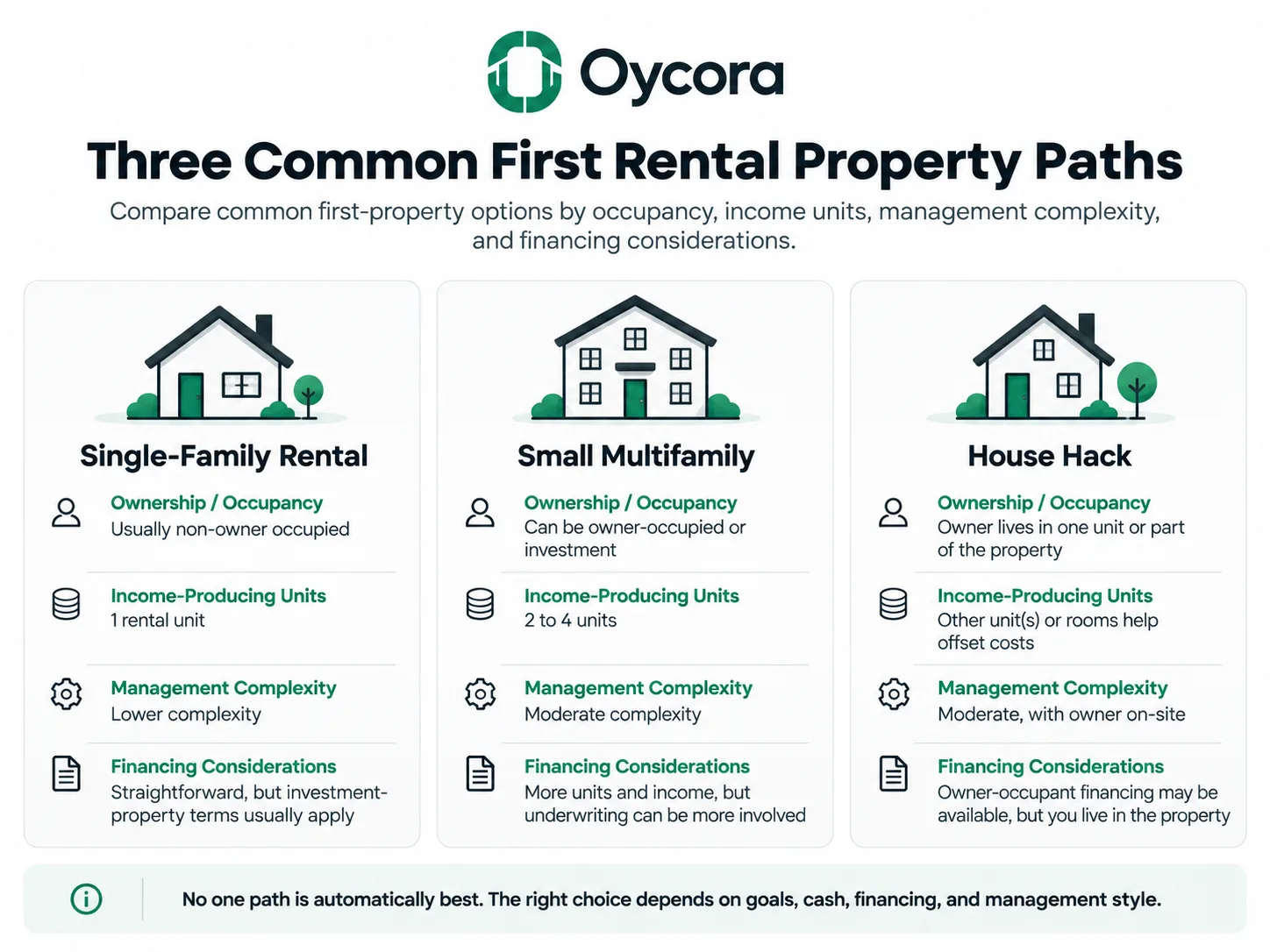
The price of the property is not the same as the amount of cash required to buy it. A first rental purchase may require a down payment, closing costs, lender-required reserves, inspection and appraisal expenses, immediate repairs, and enough liquidity to handle the first months of ownership. Planning only for the down payment can leave a buyer technically able to close but financially exposed immediately afterward.
Start by separating cash available for the transaction from cash that should remain available after closing. If purchasing a $250,000 property would consume nearly every dollar in savings, the problem is not necessarily that the buyer cannot complete the transaction. The problem is that the property begins ownership with very little capacity to absorb vacancy, repairs, an insurance deductible, or an unexpected expense.
Lenders may impose reserve requirements of their own. Under current Fannie Mae guidance, reserve requirements vary by transaction, occupancy, units, and other financed properties; certain investment-property and two- to four-unit principal-residence transactions can require six months of reserves under specified underwriting scenarios. Those are lending requirements rather than universal recommendations for how much liquidity an investor personally should want, but they illustrate why the funds needed for a rental purchase often extend beyond the advertised down payment.
Credit, income, existing debt, and employment also influence buying capacity because they affect the financing available. Before seriously shopping, it is useful to speak with lenders familiar with the type of property being considered and understand the likely loan structure, approximate payment, cash requirement, and documentation. Owner-occupied financing and investment-property financing can have materially different requirements, and sources of funds that may be permitted for a primary residence are not necessarily permitted for an investment property. For example, Fannie Mae's current rules allow qualifying personal gift funds for principal residences and second homes but not for investment properties.
The lender's maximum approval should still not become the investment budget automatically. Loan qualification asks whether the borrower meets underwriting requirements. Investment analysis asks whether the property works financially and whether the buyer is comfortable with the capital and risk involved. Those are related questions, but they are not identical.
A useful first-purchase budget therefore includes three buckets: cash required to acquire the property, cash required to make it ready, and cash intentionally retained after closing. Keeping those separate makes it harder to mistake “I can close” for “I can comfortably own this property.”
Understand the Responsibilities You’re Taking On
Buying a rental property also means taking responsibility for an operating business attached to a physical building. Rent needs to be collected, expenses tracked, maintenance handled, tenant communication managed, leases documented, and legal obligations followed. Even when a professional property manager performs much of the day-to-day work, the owner remains responsible for overseeing the asset and paying for what it requires.
Fannie Mae's landlord guidance for one- to four-unit rental properties highlights several of these responsibilities directly: landlords may need to comply with applicable health and safety standards, follow federal, state, and local landlord-tenant laws, find and manage tenants, maintain records of income and expenses, and continue making mortgage payments regardless of whether units are occupied or tenants pay on time. The exact legal obligations vary by jurisdiction, so a beginner should become familiar with state and local requirements rather than assuming that general landlord advice found online applies everywhere.
Management is another decision to make before buying. Self-management can reduce direct management fees, but it requires time and systems for leasing, communication, rent collection, maintenance coordination, bookkeeping, and emergencies. Professional management reduces some of that workload but introduces an operating expense and still requires the owner to supervise the manager and make larger property decisions.
The property itself also demands ongoing attention. Appliances break, roofs age, plumbing leaks, tenants turn over, insurance renews, and taxes change. Some years may be uneventful while others produce several expenses close together. The first rental should therefore be evaluated not only for projected return but also for whether the owner can realistically handle the financial and operational consequences when the property does not behave exactly like the spreadsheet.
This does not mean a first-time investor needs to become an expert in every part of property management before buying. It means the responsibilities should be visible before the purchase rather than discovered afterward. The goal of preparation is to enter the search knowing what you want to own, what you can realistically afford, and what owning it will require from you.
Once those boundaries are established, the search becomes much more useful. The next stage is finding potential properties, screening them efficiently, and deciding which ones deserve a full financial analysis rather than spending hours underwriting every listing that looks interesting.
Back to Guide contentsFind and Screen Potential Properties
Once the buy box and financial boundaries are clear, the search becomes much more efficient. The goal is not to find a property that looks interesting; it is to identify properties that fit the strategy well enough to justify deeper analysis. That requires looking at both the surrounding rental market and the economics of the individual property.
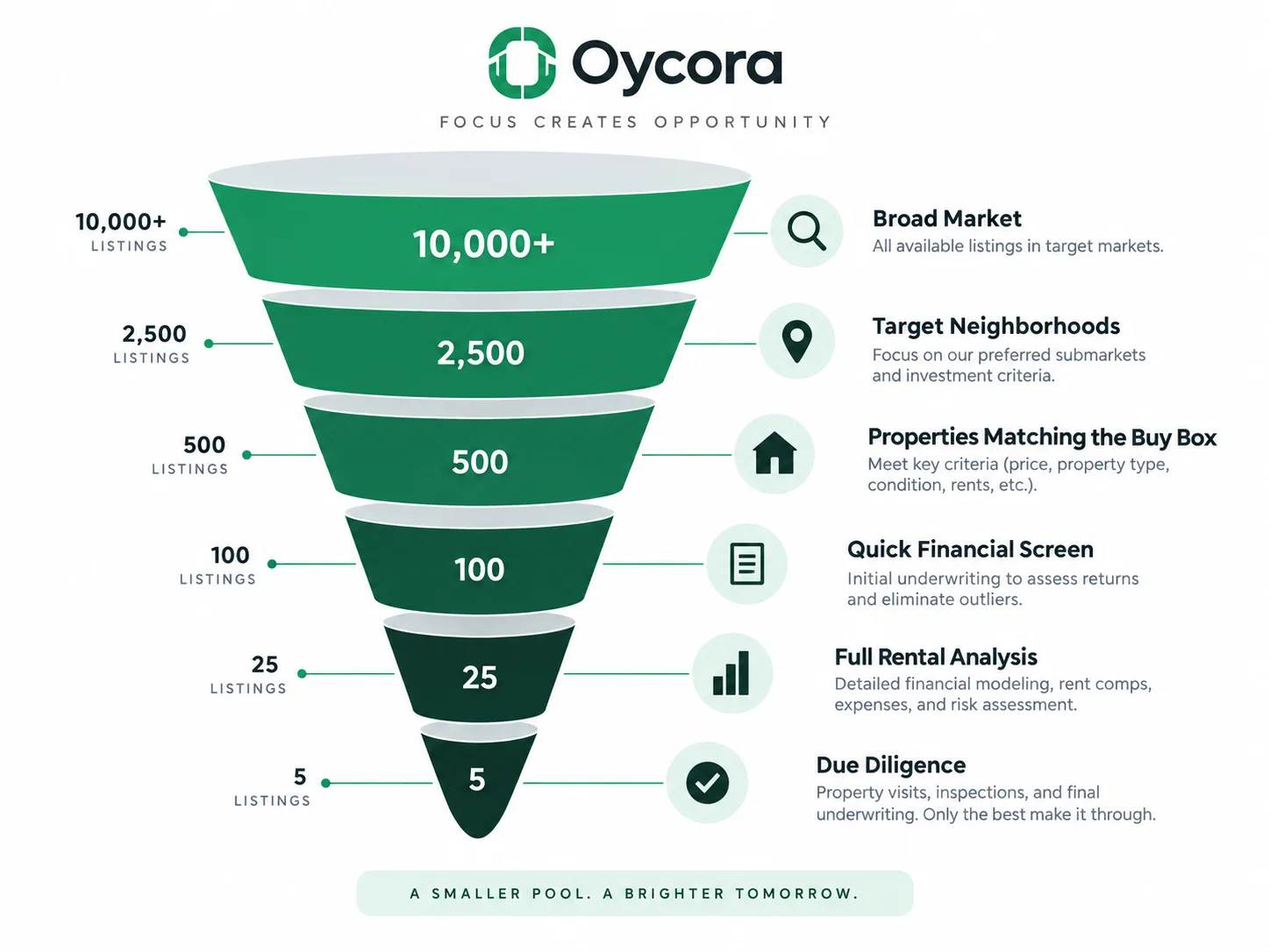
A useful search process moves from broad to narrow. First evaluate whether the market and property type support the rental strategy. Then screen listings quickly for obvious strengths or problems. Only the smaller group that survives those filters should receive a complete financial analysis.
Choose a Market and Property Type With Rental Demand in Mind
Rental demand is local. National housing statistics can provide context, but they do not tell you how easily a particular three-bedroom house or duplex will rent in one neighborhood. HUD's housing-market resources illustrate how much rental conditions can differ by region and metropolitan area, tracking variables such as rents, vacancy, employment, home prices, and new housing supply at more useful geographic levels.
For a first purchase, focus on factors that directly affect the rental rather than trying to predict which city will appreciate the fastest. Look at comparable rents, typical vacancy, the amount of competing rental inventory, access to employment and transportation, property taxes, insurance costs, and any local regulations that materially affect operating the property. HUD publishes current Fair Market Rent and Small Area Fair Market Rent data that can provide another point of reference for local rent conditions, although those figures should not replace actual comparable listings and property-specific research.
Property type should fit the market as well. A single-family rental may appeal to a different tenant pool from a small multifamily building, and the vacancy dynamics can differ when one empty unit represents 100% of the rental income instead of one unit out of several. The best choice is not necessarily the market with the highest advertised rent. High rents can be offset by high acquisition prices, taxes, insurance, maintenance, or weak rent relative to property value.
For a beginner, familiarity also has practical value. A market close enough to inspect properties, understand neighborhoods, speak with local contractors, and observe rental demand directly can reduce the number of assumptions being made from a distance. Remote ownership can work, but it creates additional dependence on managers, vendors, and information supplied by other people.
Screen Listings Without Mistaking Screening for Analysis
A first screening pass should answer one question: Is this property worth spending more time on? It does not need to calculate every possible return metric. Price, current or potential rent, obvious taxes and HOA costs, property condition, unit count, and major known repairs are usually enough to determine whether a listing deserves deeper attention.
Simple metrics can help at this stage. Gross rent multiplier or basic price-to-rent comparisons can show whether one property is priced unusually high or low relative to its gross rental income. Those tools are intentionally incomplete, however. They ignore important variables such as vacancy, operating expenses, financing, and capital needs, so they should narrow the search rather than make the purchase decision.
Listing information should also be treated as unverified until supported. Phrases such as market rent, turnkey, low expenses, or great investment property are descriptions, not underwriting evidence. If a listing claims the current rent is $2,000 but nearby comparable properties support only $1,750, that discrepancy deserves investigation. Likewise, a property advertised as needing “minor cosmetic work” may warrant a very different repair assumption once someone actually sees it.
Condition can eliminate a property before a complete analysis is necessary. Visible roof deterioration, foundation concerns, outdated mechanical systems, extensive water damage, or obvious deferred maintenance can signal additional capital needs that do not fit the buyer's strategy or cash position. That does not automatically make the property unattractive; it simply changes the type of investment being considered.
A good screening process should therefore be quick and slightly conservative. If a property only appears interesting after assuming maximum future rent, minimal repairs, and unusually low expenses, it probably does not belong at the top of the shortlist.
Analyze the Shortlist Properly
Once a property survives the first screen, switch from quick comparison to full analysis. This is where the shortcuts should stop. Estimate gross potential income, account for vacancy and collection loss, build the operating expense model, calculate NOI, add realistic financing, and examine cash flow and investor-level returns.
The purpose is to see how all of the assumptions interact rather than chase one attractive metric. A low purchase price may be offset by high repairs. Strong gross rent may be weakened by property taxes and insurance. Positive cash flow may depend on financing terms that are not actually available to the buyer. A complete model makes those relationships visible.
This is also the stage where stress testing becomes useful. If the property works only when rents reach the top of the local range, vacancy stays extremely low, and maintenance remains minimal, the analysis is telling you that the margin for error is thin. A more resilient property does not need every assumption to land at the optimistic end of the range.
Keep the shortlist small enough that each property can be researched properly. Three carefully analyzed candidates are more useful than twenty listings compared only by rent and asking price. The earlier screening process exists specifically to preserve time for the properties that deserve this level of attention.
Once one of those properties survives a complete financial analysis, the process becomes more concrete. Financing needs to be confirmed, an offer has to be structured, and the assumptions that looked reasonable on a spreadsheet must begin surviving inspections, documents, lender underwriting, and actual due diligence.
Back to Guide contentsFinance, Inspect, and Verify the Deal
Once a property survives the financial analysis, the process shifts from modeling a hypothetical purchase to verifying whether the transaction can actually work. Financing has to be confirmed, the offer has to reflect the property’s condition and economics, and assumptions that looked reasonable on paper need to survive inspections, documents, and lender underwriting.
This stage matters because a property can look strong in an early model and still fall apart once real numbers replace estimates. Insurance may cost more than expected, repairs may be larger, the lender may offer different terms, or the current rent may not be as secure as the listing suggested. The analysis should keep changing as better information becomes available.
Understand Your Financing Options
Financing affects both how much cash you need and how the property performs after closing. The major variables are the down payment, loan amount, interest rate, amortization, loan term, and resulting debt service. For a first-time buyer, the most important distinction is usually whether the purchase will be owner-occupied or non-owner-occupied, because that can affect available loan programs, underwriting, and required cash.
A house hack may qualify for owner-occupant financing if the borrower legitimately plans to live in the property and meets the loan program’s requirements. A non-owner-occupied rental is generally financed as an investment property, which can involve different pricing, reserve requirements, and qualification standards. The exact terms depend on the lender and program, so the analysis should use the financing that is realistically available rather than assuming the best possible terms.
Rental income may also affect qualification, but lenders do not automatically count every projected dollar of rent. Fannie Mae’s current selling guidance requires documented rental income and applies different treatment depending on the property, lease status, borrower experience, and transaction type. That means a listing’s advertised market rent is not necessarily the same rent a lender will use for qualification. (selling-guide.fanniemae.com)
Before making a serious offer, the buyer should know roughly what financing structure is achievable and what it does to the property’s cash flow. A property that works at one rate or down payment may look very different when the actual loan terms are inserted.
Make an Offer Without Abandoning the Analysis
An offer should not be disconnected from the underwriting that led you to the property. If the analysis only works at $240,000, offering $260,000 because of competition changes the economics and should trigger an updated model before the decision is finalized.
The same applies when credits, repairs, or concessions enter the negotiation. A seller credit toward closing costs can reduce cash needed at closing, while a price reduction changes the purchase basis and often affects financing. These are different economic effects, so they should be reflected accurately rather than treated as interchangeable.
Contingencies also matter because they preserve the ability to verify what was previously assumed. Inspection, financing, appraisal, and other contingencies vary by transaction and local practice, but the broader principle is straightforward: a buyer should understand what rights they retain if the property, loan, or valuation turns out differently than expected.
Do not let the emotional pressure of getting an accepted offer replace the original investment criteria. The purpose of a buy box and financial model is partly to protect against that shift. If the negotiated terms move outside the range the property can support, walking away can be a rational outcome rather than a failed purchase.
Due Diligence Before Closing
Due diligence is where estimates begin turning into verified facts. The property inspection is one of the most visible parts of this process, but it should not be the only one. The buyer also needs to verify the income, expenses, leases, title, insurance, taxes, utilities, and any local requirements that affect operating the rental.
If the property is tenant-occupied, review the actual leases, rent amounts, security deposits, renewal dates, and payment history when available. Confirm which utilities are paid by the owner and which are paid by tenants. Compare the listing’s expense information with actual bills or records where possible. If taxes may change after transfer, that risk should be reflected rather than assuming the seller’s current bill will continue indefinitely.
The physical inspection can materially change the analysis. Roof age, HVAC condition, electrical systems, plumbing, drainage, foundation issues, moisture, windows, appliances, and other components can create costs that were invisible during the initial screen. A property modeled with $5,000 of initial work may require a different decision if inspection findings support $20,000 or more.
Insurance should also move from estimate to quote before closing when possible. Recent changes in property-insurance costs have made this input increasingly important in many markets, and a materially higher premium can affect both operating expenses and lender requirements.
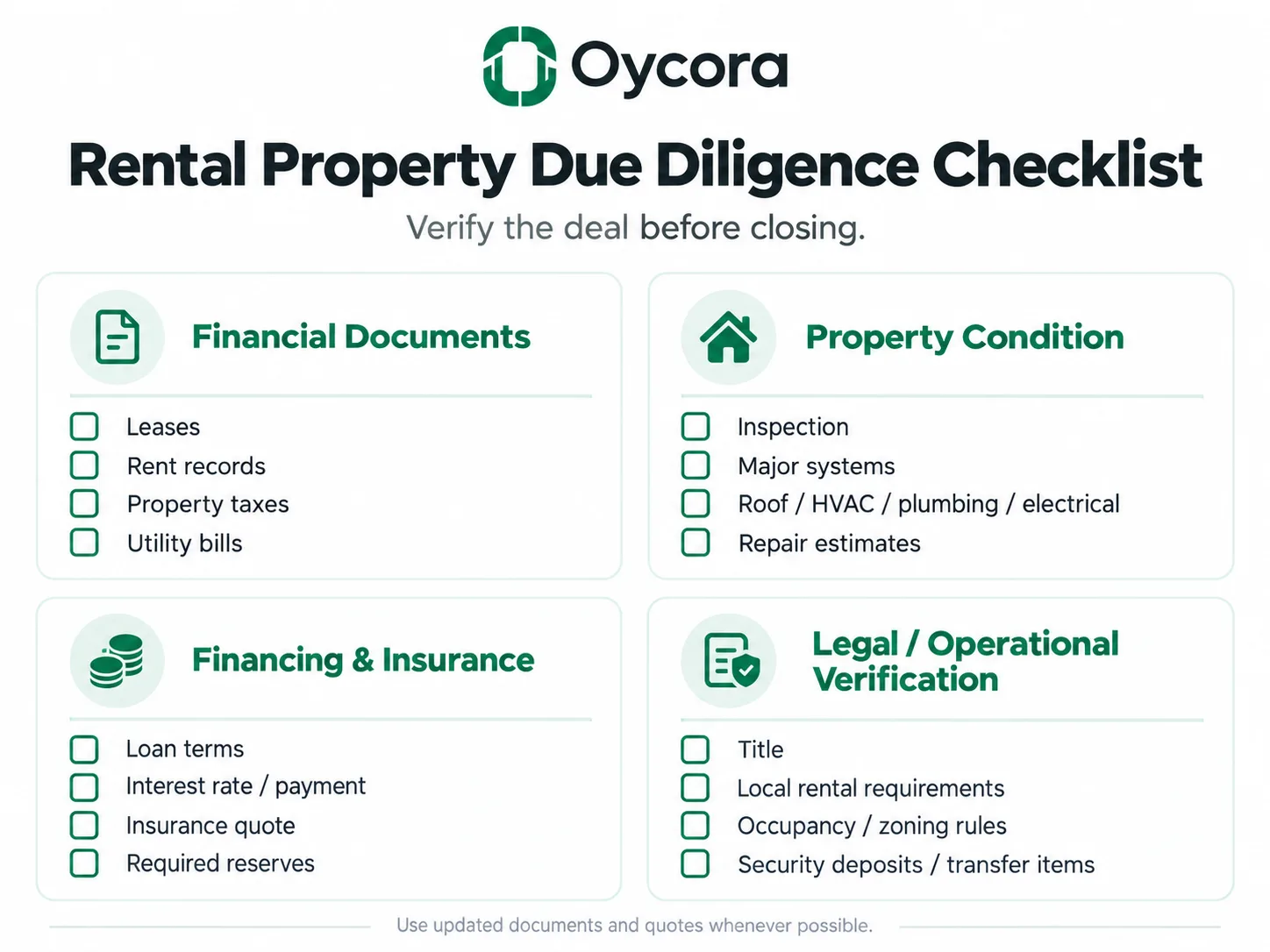
The strongest habit is to update the analysis as each item is verified. If repairs increase, change the repair assumption. If insurance comes in lower, update it. If the lender’s rate changes, recalculate debt service. The underwriting should become more accurate as the transaction progresses, not remain frozen at the numbers used to justify the initial offer.
By the time due diligence is complete, the property should be much less theoretical. The buyer should know what they are buying, what it is expected to cost, what financing is available, and which remaining risks are still uncertain. The next step is closing the transaction and turning the analysis into an actual operating plan.
Back to Guide contentsClose the Property and Transition Into Ownership
Closing is the point where the purchase stops being theoretical. The financing, repair assumptions, reserve plan, and operating responsibilities now become real obligations. A first-time buyer should arrive at closing knowing not only how much cash is required to complete the transaction, but also what needs to happen immediately afterward to keep the property operating smoothly.
The work does not end when the deed transfers. Tenant communication, rent collection, maintenance systems, insurance, records, utilities, and reserves all need to be organized quickly. The first months of ownership are also the best time to begin comparing the original analysis with the property’s actual performance.
Know What Cash You Actually Need at Closing
The final cash requirement is usually broader than the down payment. Depending on the transaction, the buyer may need funds for closing costs, prepaid taxes or insurance, lender-required reserves, inspections, appraisal fees, immediate repairs, and other acquisition expenses. Some of these amounts become clearer only after the loan and closing disclosure are finalized.
This is why post-closing liquidity matters. A buyer who uses nearly every available dollar to complete the purchase may own the property but have little flexibility left for an early repair, vacancy, insurance deductible, or unexpected operating cost. The property should not begin ownership in a position where one ordinary problem immediately creates a cash shortage.
Initial improvement money should also remain separate from long-term reserves. If $10,000 is expected to be spent on flooring, paint, or deferred repairs immediately after closing, that money is already committed. It should not simultaneously be counted as the emergency reserve protecting the property from future problems.
The final pre-closing review should therefore compare the original cash budget with the actual transaction. If closing costs, repairs, or lender requirements increased materially, update the investment analysis before treating the original projected return as unchanged.
Take Over the Rental Operation
For an occupied property, ownership may begin with tenants already in place. The new owner should understand the leases, rent due dates, security deposits, utility responsibilities, renewal dates, and any existing maintenance issues. Tenant communications should clearly explain where rent should be paid and how maintenance requests will be handled without creating confusion about which lease terms remain in effect.
Records should be organized from the beginning. Keep rental income, invoices, repairs, insurance documents, lease records, deposits, and property-related expenses separate and easy to retrieve. Good records improve day-to-day management and make it easier to compare the property’s actual performance with the original underwriting.
Maintenance systems matter even if nothing is broken on closing day. Decide how tenants will report issues, who will handle routine repairs, which contractors or vendors are available, and how emergencies will be managed. If a professional property manager is involved, understand their authority, fee structure, reporting process, and how larger expenses are approved.
Insurance should already be active at closing, and utility transfers should be handled wherever the owner is responsible for service. Local rental licensing, registration, inspection, or occupancy requirements may also apply depending on the jurisdiction. The first weeks should focus on creating a stable operating system rather than immediately trying to optimize every part of the property.
Compare Actual Performance With the Original Analysis
The original underwriting should not disappear into a folder after closing. It becomes a benchmark.
As actual rent is collected and real expenses begin appearing, compare them with the assumptions used before purchase. If insurance was modeled at $1,800 but the actual premium is $2,250, update the model. If maintenance is lower than expected, record that too. If turnover takes longer than assumed, the vacancy model should reflect the experience.
This process helps distinguish between a bad assumption and a random one-time event. One expensive repair does not automatically mean the maintenance model was wrong, but repeated differences between projected and actual costs may reveal that future underwriting needs to change. The same principle applies to rent growth, management, utilities, vacancy, and financing-related costs.
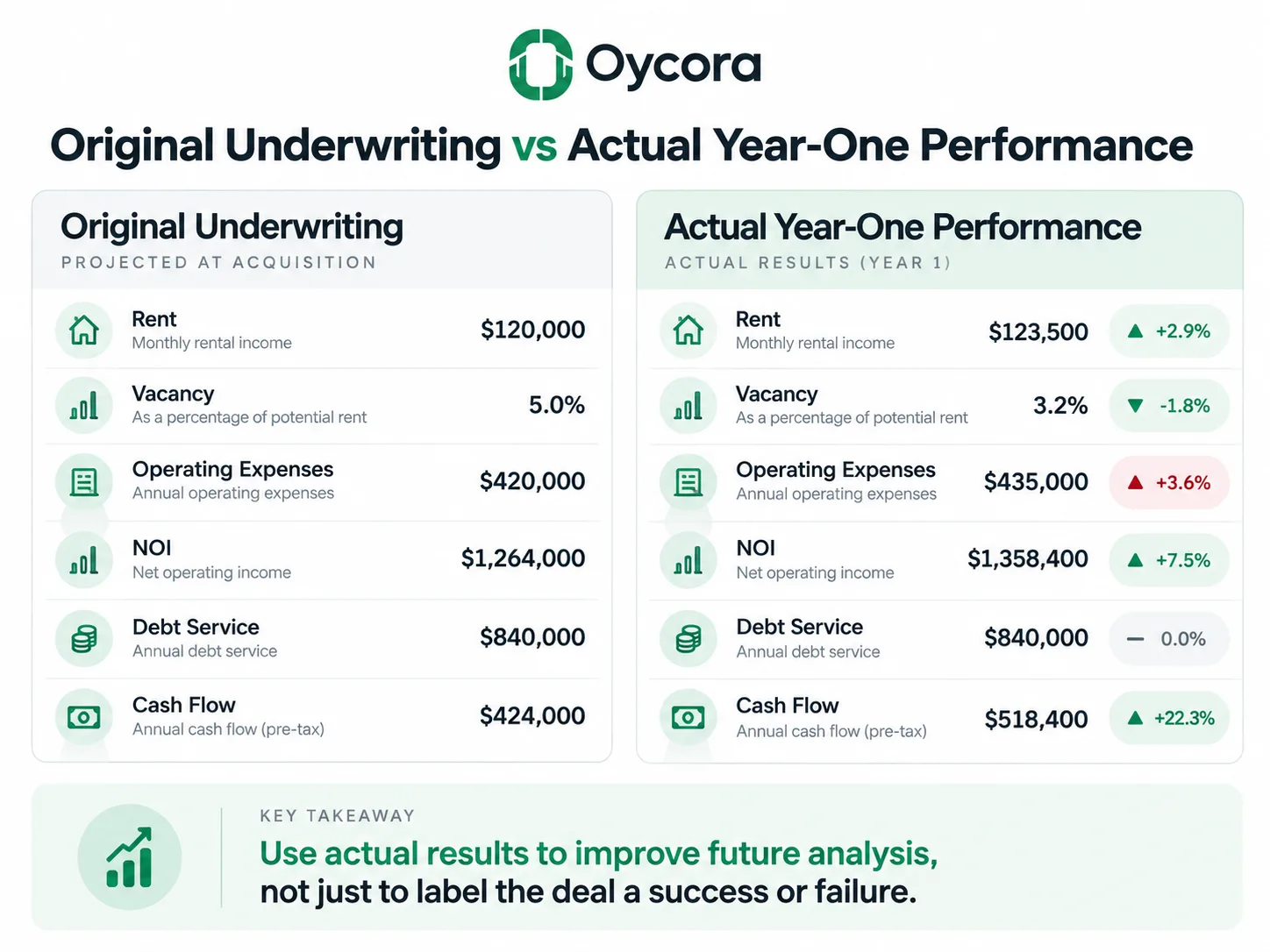
A first rental property therefore serves two purposes. It is an investment, but it is also a source of information. The buyer now has real operating history, real maintenance experience, and a much better understanding of which assumptions were accurate and which were too optimistic or too conservative.
Back to Guide contentsPractical Takeaways
Buying a first rental property becomes much easier to manage when the process is broken into stages. Start with the buyer rather than the listing: define the type of property you want, understand how much cash you can realistically commit, and decide whether the responsibilities of ownership fit your time and capabilities.
Screen widely, but analyze narrowly. Most listings do not deserve a complete underwriting model. Use the buy box and quick screening process to identify a small number of properties worth deeper analysis, then evaluate those properties using realistic rent, vacancy, expenses, financing, and reserves.
Once a property is under contract, replace estimates with verified information wherever possible. Inspection findings, leases, tax records, insurance quotes, lender terms, and repair estimates should continuously update the analysis. The model should become more accurate as closing approaches, not remain frozen at the assumptions used to justify the original offer.
After closing, keep using the analysis. Actual performance is one of the best tools for improving future underwriting because it shows where the model matched reality and where it did not.
Back to Guide contentsConclusion
The first rental-property purchase is not one decision. It is a sequence that begins with preparation, moves through property selection and financial analysis, then becomes progressively more concrete through financing and due diligence.
A beginner does not need perfect information or years of experience before buying. What matters more is having a process that separates verified facts from assumptions, protects enough cash for ownership after closing, and forces the deal to survive deeper scrutiny as better information becomes available.
The goal is not simply to become a property owner. It is to buy a rental that you understand well enough to operate, finance, and evaluate after the excitement of the purchase is over.
A disciplined first acquisition should leave you with more than a building. It should leave you with a repeatable framework for evaluating the next one.
Back to Guide contentsHow Oycora calculates this
Calculation methodology
Related articles

Property Analysis
Rental Property Operating Expenses: What Should You Include?
Operating expenses can make or break a rental-property analysis. Learn which recurring costs belong in the calculation, which costs should be treated separately, and how realistic expense assumptions affect NOI and cash flow.

Property Analysis
What Is Net Operating Income (NOI) in Real Estate?
Net operating income measures how much income a property produces after operating expenses but before financing. Learn the NOI formula, what belongs in the calculation, what does not, and how to use it when analyzing a rental property.
Related Guides

Oycora Guide · Financing
The Complete Guide to Rental Property Financing
Rental property financing affects much more than the monthly mortgage payment. This Guide explains how occupancy, down payment, leverage, interest rate, amortization, qualifying rental income, DSCR, refinancing, and reserves shape both the purchase and the property’s long-term performance.
Read Guide →
Oycora Guide · Property Analysis
The Complete Guide to Analyzing a Rental Property
A complete rental-property analysis starts long before the final return percentage. This Guide walks through how to build realistic assumptions, measure operating performance, account for financing, interpret the major metrics, and stress-test the result before relying on it.
Read Guide →