Rental property maintenance rarely arrives as a neat monthly bill. A property may go several months with almost no repair costs and then need a plumbing repair, appliance replacement, and HVAC service within the same few weeks. That uneven pattern is exactly why maintenance needs to be budgeted before the expense actually occurs.
There is no universal percentage that every landlord should set aside. A newer property with recently replaced systems may reasonably need less near-term maintenance than an older home with aging plumbing, appliances, roofing, and mechanical equipment. The most useful budget reflects the specific property, while percentage-based rules of thumb can serve as a temporary starting point when better information is not yet available.
Why Maintenance Needs a Budget Even When Nothing Is Broken
A quiet year does not mean a property has become maintenance-free. Normal wear continues even when no invoice arrives, and many components deteriorate gradually before eventually requiring repair or replacement. Building an analysis from last year's unusually low repair bill can therefore make projected expenses look more favorable than the property's long-term economics justify.
Maintenance budgeting is partly about smoothing irregular expenses across time. If a property averages several thousand dollars of repairs over a five-year period, it is often more useful to recognize that expected cost gradually rather than assume four inexpensive years followed by one disastrous year. Fannie Mae uses the same underlying principle at a larger institutional scale by requiring replacement reserves sufficient to cover anticipated capital replacements and major maintenance needs.
That does not mean a reserve estimate predicts exactly what will happen. Its purpose is to keep the analysis from assuming that future repairs and replacements will somehow cost nothing simply because their exact timing is unknown.
Routine Maintenance, Repairs, and CapEx Are Different
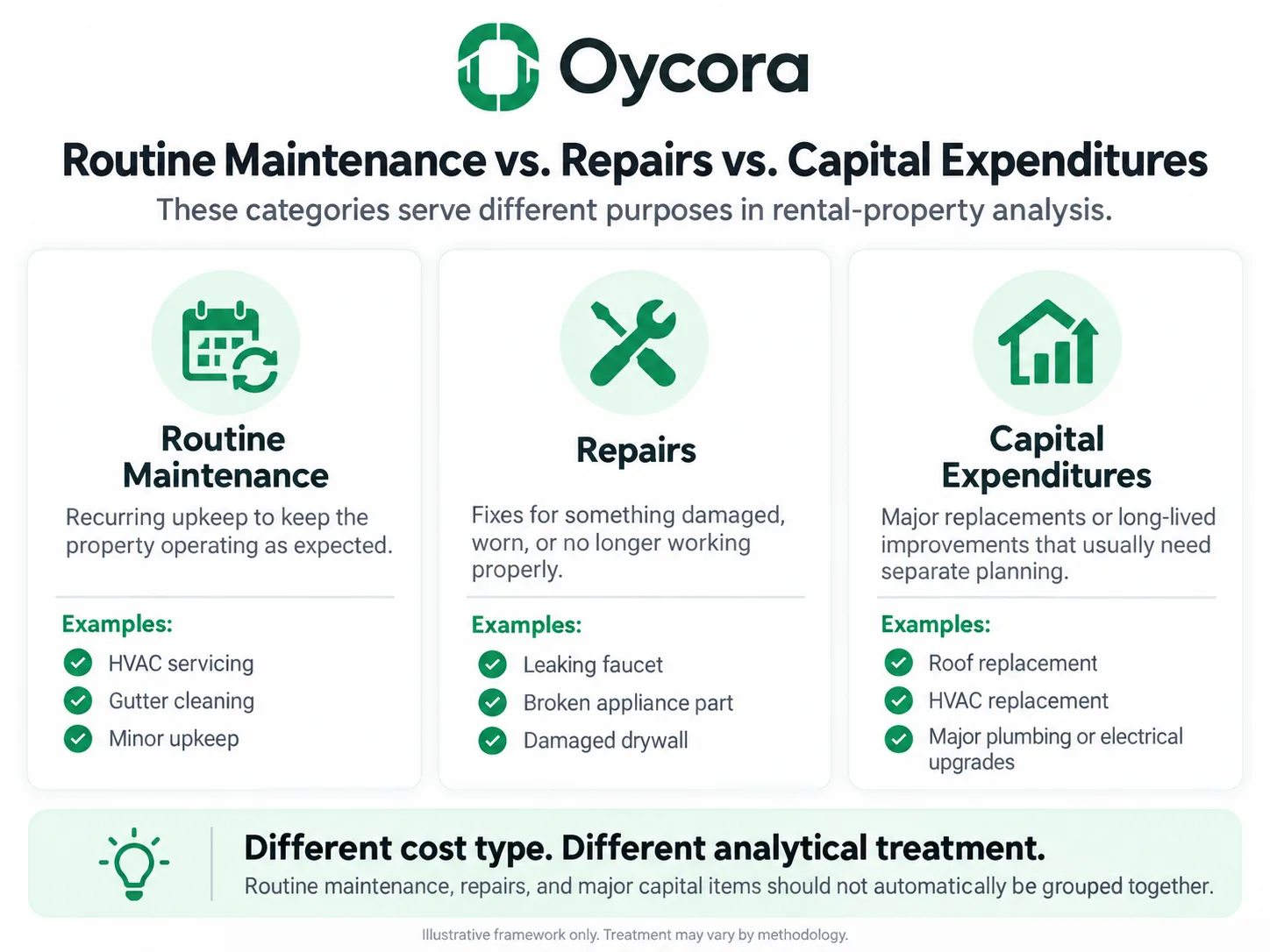
Routine maintenance generally involves recurring work that keeps the property operating in its existing condition. HVAC servicing, cleaning gutters, servicing equipment, pest treatment, replacing worn hardware, and similar upkeep may fall into this category. Repairs generally address something that has failed or been damaged, such as fixing a leaking pipe, repairing a broken appliance component, or patching damaged drywall.
Capital expenditures, or CapEx, are different because they typically involve major components, long-lived replacements, or substantial improvements. A new roof, complete HVAC replacement, major plumbing system, electrical upgrade, or significant renovation would normally be treated differently from ordinary maintenance in both financial analysis and tax accounting. The IRS similarly distinguishes repairs and maintenance from improvements that better, restore, or adapt a property and generally requires qualifying improvements to be capitalized rather than immediately treated as ordinary repair expenses.
Keeping these categories separate helps prevent two opposite mistakes. If every major replacement is treated like an ordinary annual repair, routine operating expenses may look artificially high. If large future components are ignored entirely, projected cash flow may look artificially strong.
Should You Use a Percentage Rule of Thumb?
Percentage-based rules can be useful when you need an initial estimate and do not yet have complete property records. One commonly cited approach is to budget around 1% of the property's value per year for maintenance, while other approaches use a percentage of rental income. Landlord Studio, for example, presents the 1% method as a maintenance-estimating rule of thumb, while Stessa discusses percentage-based approaches for CapEx reserves but stresses that property age and circumstances can justify materially different amounts.
The important phrase is rule of thumb. A $400,000 newly renovated property and a $200,000 century-old house do not automatically need maintenance budgets of exactly $4,000 and $2,000 merely because their market values differ. Property value can be influenced heavily by land, location, and market conditions that have little to do with how frequently the furnace or plumbing will fail.
Percentage rules are most useful as a screening tool or temporary placeholder. Once you know the property's age, condition, major systems, repair history, and expected turnover, the budget should become more property-specific.
What Should Influence the Maintenance Budget?
Property age matters, but age alone is not enough. A 40-year-old property with a new roof, furnace, water heater, electrical panel, and renovated plumbing may have fewer near-term needs than a 15-year-old property where several original systems are approaching replacement at the same time. The useful question is not simply how old the building is, but how old its individual components are and what condition they are in.
Tenant turnover can also influence repair spending. A long-term tenant may generate fewer make-ready expenses, while frequent turnover can mean more cleaning, paint, minor repairs, lock changes, and wear between leases. Climate also matters because extreme heat, freezing temperatures, heavy precipitation, snow, humidity, and other environmental conditions can place different stresses on roofing, HVAC equipment, plumbing, exterior finishes, and landscaping.
Finally, maintenance history is valuable when it is reliable. Several years of invoices can reveal which systems repeatedly cause problems and whether costs are trending upward. Historical numbers should not be accepted blindly, however, because unusually low spending may indicate deferred maintenance rather than an unusually inexpensive property.
Comparing Maintenance Budgets
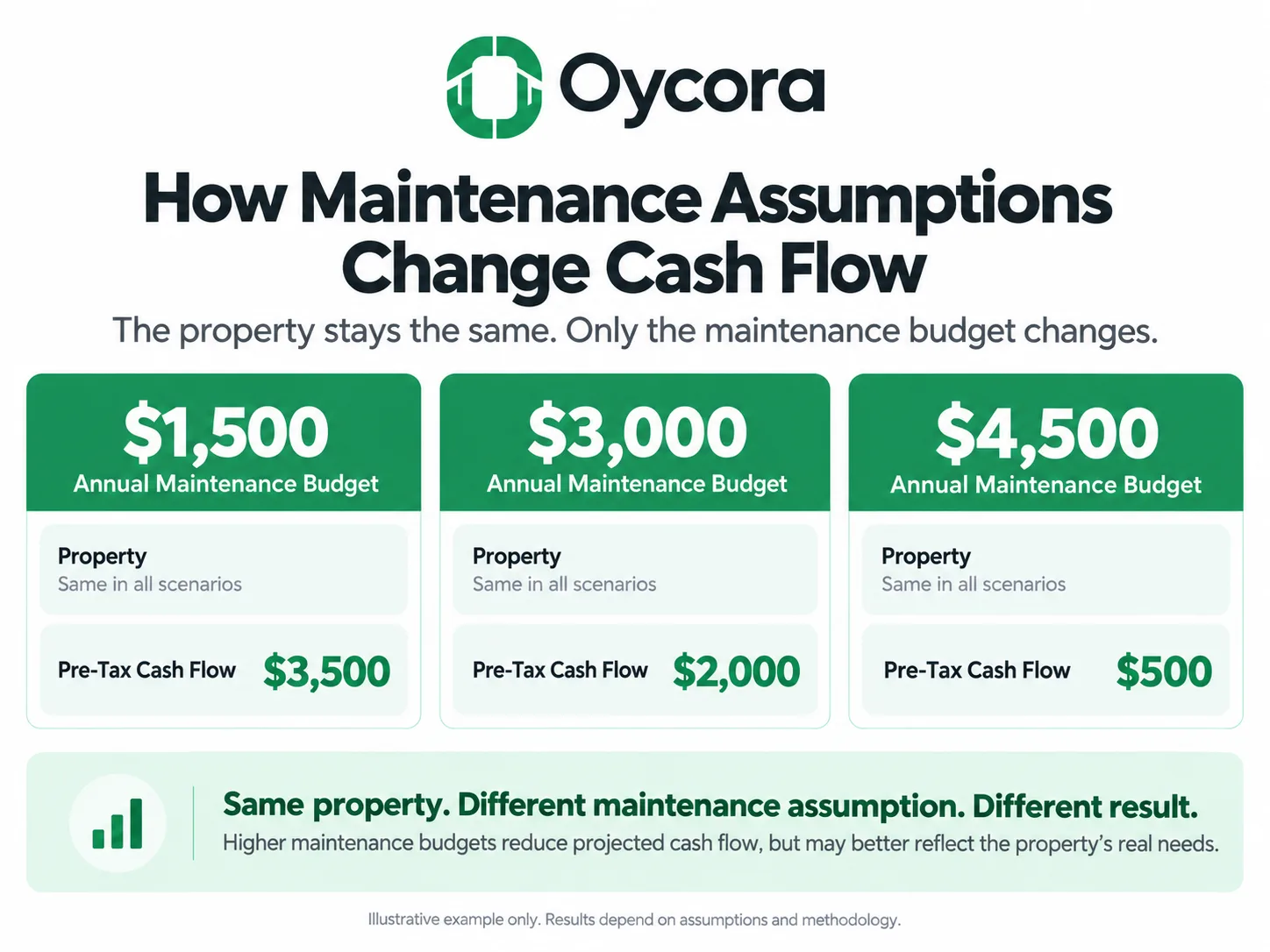
Assume a fictional rental property produces $30,000 in annual effective income before operating expenses. Excluding maintenance, the property has $10,000 in other annual operating expenses and $15,000 in annual debt service. The table below shows how three different maintenance assumptions affect NOI and projected pre-tax cash flow.
| Maintenance Assumption | Annual Maintenance Budget | NOI | Pre-Tax Cash Flow |
|---|---|---|---|
| Lower estimate | $1,500 | $18,500 | $3,500 |
| Base estimate | $3,000 | $17,000 | $2,000 |
| Higher estimate | $4,500 | $15,500 | $500 |
The difference between the lower and higher maintenance assumptions is $3,000 per year, and that same $3,000 flows directly through to projected cash flow when everything else remains unchanged. Under the lowest estimate, the property appears to produce $3,500 of annual pre-tax cash flow. Under the higher estimate, the projected margin falls to only $500.
That does not prove the $4,500 assumption is more accurate. It shows why the assumption deserves investigation, especially when the property's apparent cash flow depends heavily on keeping maintenance unusually low.
When Component-Based Reserves Are Better
A percentage estimate becomes less useful once you know enough about the property's major components to estimate them individually. A component-based approach identifies large items such as the roof, HVAC system, water heater, appliances, exterior finishes, and other major systems, then estimates their remaining useful life and expected replacement cost. The annual reserve can then be built from those individual future obligations rather than from one broad percentage.
For example, if a component is expected to cost $8,000 to replace in eight years, setting aside roughly $1,000 per year toward that item creates a simple sinking-fund estimate. Avail describes the same general approach for items such as paint, carpet, and appliances by spreading expected replacement costs across their anticipated useful lives. Actual timing and prices will vary, but the method forces the analysis to acknowledge specific components rather than hiding them inside a generic percentage.
This is especially useful for older properties or properties with several expensive systems approaching the end of their expected service lives. It also explains why Oycora's Component Reserve Calculator can provide a different perspective from a simple percentage reserve.
Maintenance Reserves and CapEx Reserves Should Not Be Blurred Together
Routine maintenance and long-term capital reserves may both involve setting money aside, but they do not represent the same type of cost. Maintenance is associated with ongoing upkeep and smaller repairs, while a capital reserve is intended to prepare for large, less frequent replacements. Keeping them separate makes it easier to understand how much the property costs to operate today and how much should be planned for future components.
Stessa similarly distinguishes ongoing maintenance from capital expenditures such as roofs, HVAC replacements, and significant renovations, while recommending that owners plan ahead for those larger outlays. Oycora's exact calculation treatment should follow its own Methodology, particularly when determining whether a reserve appears inside NOI, outside NOI, or as a separate analytical adjustment.
The classification matters less than consistency and transparency. An expense should not disappear from the analysis simply because it is inconvenient to categorize.
Common Maintenance-Budgeting Mistakes
One common mistake is assuming that a recently renovated property requires no maintenance budget. Renovation can reduce near-term risk, but appliances still fail, tenants still cause wear, plumbing still leaks, and newer systems eventually age. Another mistake is relying on one percentage without checking the property itself, which can understate costs for older or neglected properties and overstate them for properties with substantial recent improvements.
It is also easy to confuse maintenance reserves with emergency savings. A maintenance budget should reflect expected property costs, while an emergency fund provides additional liquidity when events exceed those expectations. Likewise, setting aside money for maintenance does not eliminate the need to separately plan for major CapEx items such as roofs or full HVAC replacements.
Finally, do not lower the maintenance assumption simply because the resulting cash flow looks uncomfortable. If a realistic maintenance estimate removes most of the property's projected return, the problem is not the estimate. The sensitivity is telling you something important about how little margin exists in the deal.
Build the Budget Around the Property
There is no percentage that can perfectly predict rental-property maintenance. Rules of thumb can help fill an information gap, but they should become less important as better property-specific information becomes available. A physical inspection, age of major systems, maintenance history, turnover pattern, climate, and actual replacement costs provide a stronger foundation than a generic percentage by itself.
A practical approach is to start with a reasonable percentage estimate when necessary, then refine it with component-level information and historical costs. Keep routine maintenance distinct from major capital expenditures, and test the analysis using a more conservative maintenance scenario to see how much projected cash flow depends on the assumption.
The goal is not to predict every repair in advance. It is to make sure the property still makes financial sense when repairs inevitably happen.