
Rental property cash flow is one of the most practical numbers in a rental analysis because it estimates how much money remains after the property's income, operating expenses, and financing costs are accounted for. A property can collect substantial rent and still produce very little cash flow if taxes, insurance, maintenance, vacancy, and debt service consume most of that income. The calculation itself is not especially complicated, but the assumptions behind it determine whether the result is actually useful.
Cash flow should not be treated as a prediction of exactly how much money will appear in your bank account each month. Repairs do not occur evenly, tenants move out unexpectedly, insurance premiums change, and major expenses can arrive in clusters. Instead, projected cash flow gives you a structured way to estimate how the property performs under a defined set of assumptions and then test how sensitive that result is when those assumptions change.
What Is Rental Property Cash Flow?
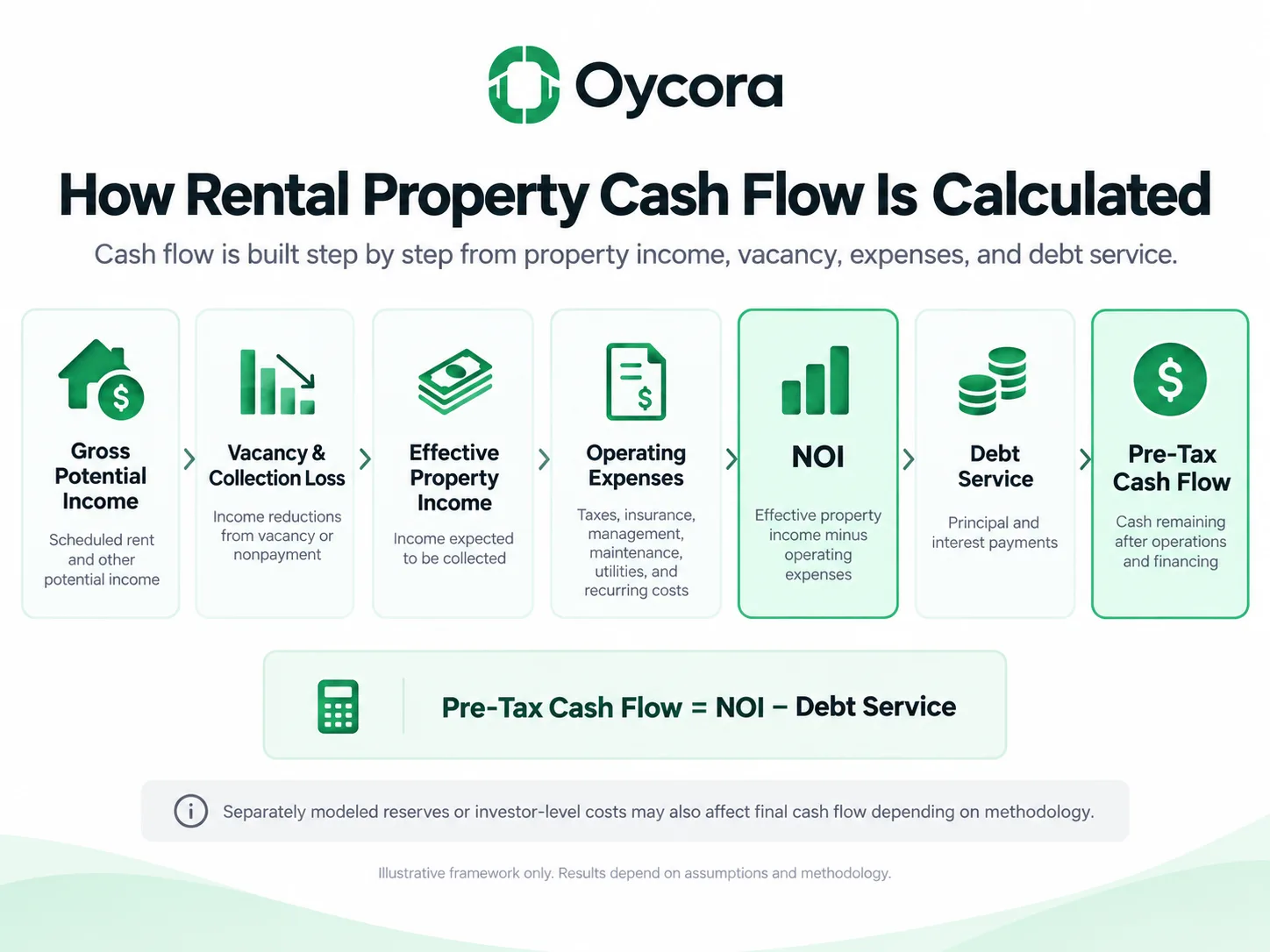
Rental property cash flow is the money remaining from property operations after the expenses included in the analysis have been paid. For a financed property, a common starting point is to calculate net operating income first and then subtract annual debt service.
Because NOI excludes principal and interest payments, financing is added only after the property's operating performance has been measured. Nareit defines NOI as property revenue minus operating expenses while excluding financing and capital costs, which is why NOI and cash flow represent different stages of the analysis.
In simplified form:
Pre-Tax Cash Flow = NOI − Debt Service
Depending on the methodology, cash flow may also reflect separately modeled reserves or other recurring investor-level costs. The important point is that cash flow is not simply rent minus mortgage payment. Income first has to be adjusted for vacancy and other losses, operating expenses need to be accounted for, and then financing can be deducted from what remains.
Start With Realistic Property Income
Cash-flow analysis begins with the income the property can reasonably be expected to collect. For most residential rentals, rent is the largest source, but parking, laundry, storage, pet-related charges, or other recurring property income may also contribute. The key is to distinguish gross potential income from effective income, because a property capable of producing $30,000 in rent at full occupancy will not necessarily collect every dollar each year.
Vacancy and collection loss should therefore be considered before treating rent as usable income. If annual potential rent is $30,000 and the analysis assumes a 5% vacancy and collection allowance, expected rental income would be $28,500. That 5% is only an example rather than a universal recommendation; the appropriate assumption can vary significantly by property, market, tenant turnover, and management quality.
Overestimating income is one of the easiest ways to create attractive-looking cash flow on paper. Projected rent increases may be reasonable, but they should be clearly identified as assumptions rather than quietly replacing the property's current economics. A useful cash-flow model should make it obvious whether the analysis is based on current rents, market rents, or a future stabilized scenario.
Subtract Operating Expenses Before Financing
Once effective income is estimated, the property's recurring operating expenses need to be deducted. Typical costs include property taxes, insurance, management, routine maintenance, owner-paid utilities, HOA dues, landscaping, pest control, and other recurring services. These expenses reduce NOI before financing enters the analysis.
Mortgage payments should not be included in operating expenses because financing depends on the individual owner. Nareit's NOI framework includes expenses such as property taxes, maintenance, insurance, utilities, and management fees while excluding principal and interest payments on debt. Keeping those categories separate makes it possible to understand whether weak cash flow is being caused by the property itself or by the financing structure used to acquire it.
This distinction is especially important when comparing properties. Two properties could generate similar NOI while producing very different cash flow because one requires much more expensive financing. Likewise, two investors could buy the same property and produce different cash-flow projections if their down payments, interest rates, or loan terms differ.
Calculating Rental Property Cash Flow
Consider a fictional rental property purchased for $260,000. It rents for $2,600 per month and has no additional property income. Assume the analysis uses a 5% vacancy allowance and the operating-expense estimates shown below.
| Income and Operating Calculation | Annual Amount |
|---|---|
| Gross potential rent | $31,200 |
| Less vacancy & collection loss | −$1,560 |
| Effective property income | $29,640 |
| Property taxes | −$3,800 |
| Insurance | −$1,500 |
| Property management | −$2,371 |
| Maintenance and repairs | −$1,900 |
| Owner-paid utilities / other expenses | −$600 |
| Net Operating Income (NOI) | $19,469 |
Now assume the property is financed with a loan requiring approximately $15,600 in annual principal and interest payments.
| Cash Flow Calculation | Annual Amount |
|---|---|
| Net Operating Income | $19,469 |
| Less annual debt service | −$15,600 |
| Annual pre-tax cash flow | $3,869 |
| Average monthly cash flow | about $322 |
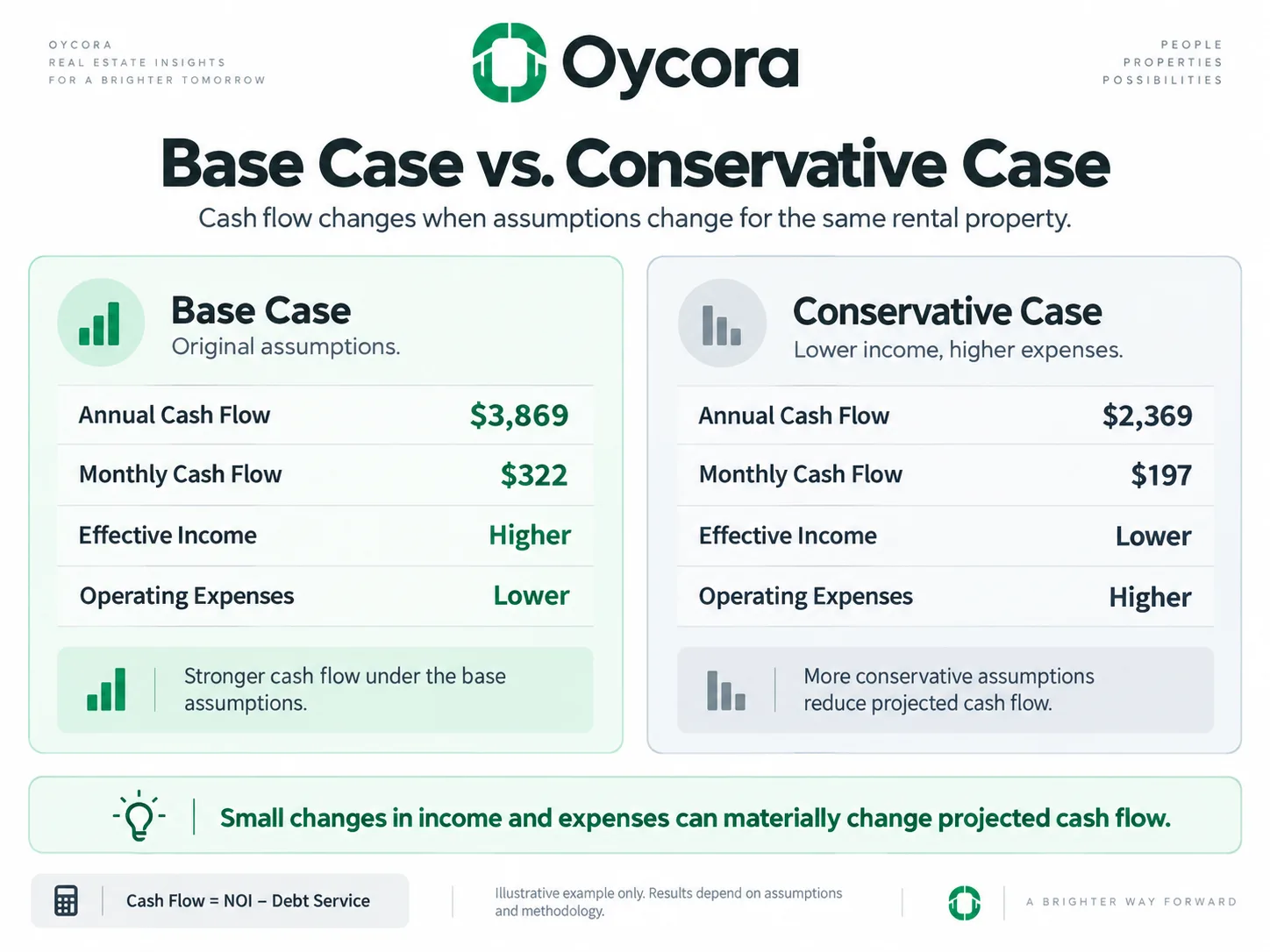
Under these assumptions, the property produces approximately $3,869 per year, or about $322 per month, in projected pre-tax cash flow. That does not mean the owner will receive exactly $322 every month. A repair could make one month negative while several quiet months produce more cash, so the monthly number is best understood as an annual projection divided by 12.
The example also shows why the order of operations matters. The property's NOI is $19,469 before financing, while the cash available after debt service falls to $3,869. Mixing those figures together would hide whether the property's economics or the loan structure is responsible for the final result.
Positive Cash Flow Does Not Automatically Mean a Good Investment
Positive cash flow means the modeled income exceeds the expenses and financing costs included in the analysis. Negative cash flow means the modeled costs exceed income. That distinction is useful, but it is not enough to determine whether a property is attractive because the size and durability of the cash flow matter just as much as its direction.
A property projected to produce $50 per month technically has positive cash flow, but a minor repair or slightly longer vacancy could eliminate it. Another property producing substantially more cash flow may have a larger cushion, although it could also carry different risks, require more cash upfront, or have weaker long-term prospects. Cash flow should therefore be interpreted alongside the property's price, condition, financing, reserves, expected capital needs, and other return metrics.
Negative cash flow is not automatically proof that a property is worthless either. Some strategies intentionally accept weak current cash flow in exchange for renovation potential, expected future income growth, or another specific investment thesis. Oycora's role is not to label either result good or bad; it is to make the assumptions and resulting economics clear enough to evaluate.
How Financing Changes Cash Flow
Financing can dramatically change cash flow even when the property's operations stay exactly the same. A larger down payment typically reduces the loan balance and debt service, leaving more NOI available as cash flow. A smaller down payment may preserve investor cash but usually increases debt payments, which reduces the cash remaining each month.
Interest rates and loan terms matter for the same reason. A higher rate increases debt service, while a longer amortization period may reduce the required payment even though the borrower remains in debt longer. This is why evaluating a property with a generic mortgage estimate can produce a very different answer from analyzing the financing terms actually available to the buyer.
It is useful to separate the two questions: Does the property generate reasonable operating income? and Does the financing leave enough of that income available as cash flow? Keeping NOI and debt service separate lets the analysis answer both rather than hiding them inside one number.
Cash Flow Should Include More Than the Obvious Bills
One of the most common cash-flow mistakes is modeling only the expenses that arrive as predictable monthly bills. Taxes, insurance, and mortgage payments are easy to remember because their amounts are visible, while vacancy and repairs are irregular and therefore easier to underestimate. A property can go months without a significant repair and then require several thousand dollars of work at once.
Reserves are one way investors account for costs that do not occur evenly. Maintenance reserves, capital-expenditure reserves, or other future-cost assumptions may be modeled separately depending on the analytical methodology. A roof does not become free simply because it is not being replaced during the first year of ownership, so an analysis that ignores major future components entirely may overstate how much cash is truly available for the investor to spend.
The goal is not to predict the exact date and cost of every future repair. It is to avoid constructing a cash-flow projection that assumes almost nothing will ever go wrong.
Stress-Test the Cash Flow
A base-case projection is only one version of the future. Cash flow becomes more useful when you change the assumptions and see how quickly the result moves. Lower rent, higher vacancy, rising insurance, increased maintenance, or different financing terms can each reduce the amount of cash left over.
Consider the $322 monthly projection from the worked example. An additional $1,500 of annual expenses would reduce projected annual cash flow from $3,869 to $2,369, or roughly $197 per month. A few changes occurring simultaneously could reduce the margin even further, which is why an apparently precise cash-flow number should not create false confidence.
Common Rental Property Cash Flow Mistakes
The most basic mistake is calculating rent minus mortgage payment and calling the remainder cash flow. That ignores vacancy, taxes, insurance, management, repairs, utilities, HOA costs, and other expenses that may be necessary to operate the property. Another common problem is using gross rent where effective income should be used, which assumes perfect occupancy and collection.
Investors can also overstate cash flow by using unrealistically low maintenance assumptions, ignoring management because they intend to do the work themselves, or failing to consider major future components. The opposite error is mixing every possible investment cost into operating expenses and making NOI impossible to interpret. A clean analysis keeps operating performance, financing, reserves, and investor-level costs distinct while still allowing all of them to influence the final decision.
Finally, projected cash flow should not be confused with profit, total return, or wealth creation. Cash flow does not automatically capture appreciation, future sale proceeds, mortgage principal reduction, or tax effects. It measures a narrower but very practical question: how much cash is expected to remain from the property's operations under the assumptions being modeled.
Use Cash Flow as a Range, Not a Promise
Rental property cash flow is valuable because it forces the analysis to connect income, expenses, and financing instead of looking at each piece in isolation. Start with realistic effective income, subtract the recurring costs required to operate the property, calculate NOI, and then account for debt service and any other items included by the methodology. The resulting figure provides a useful estimate of the property's ability to generate spendable cash under those assumptions.
The strongest analysis does not stop there. Adjust the rent, vacancy, expenses, maintenance, and financing to see how sensitive the property is to less favorable conditions. A projected cash-flow number is most useful when you understand not only what the number is, but what has to remain true for the property to keep producing it.