

Ask what a good cap rate is and you will often hear a percentage range presented as though it applies everywhere. That sounds convenient, but cap rates do not work that way. A 5% cap rate can make sense for one property while an 8% cap rate on another reflects risks that justify the higher income yield.
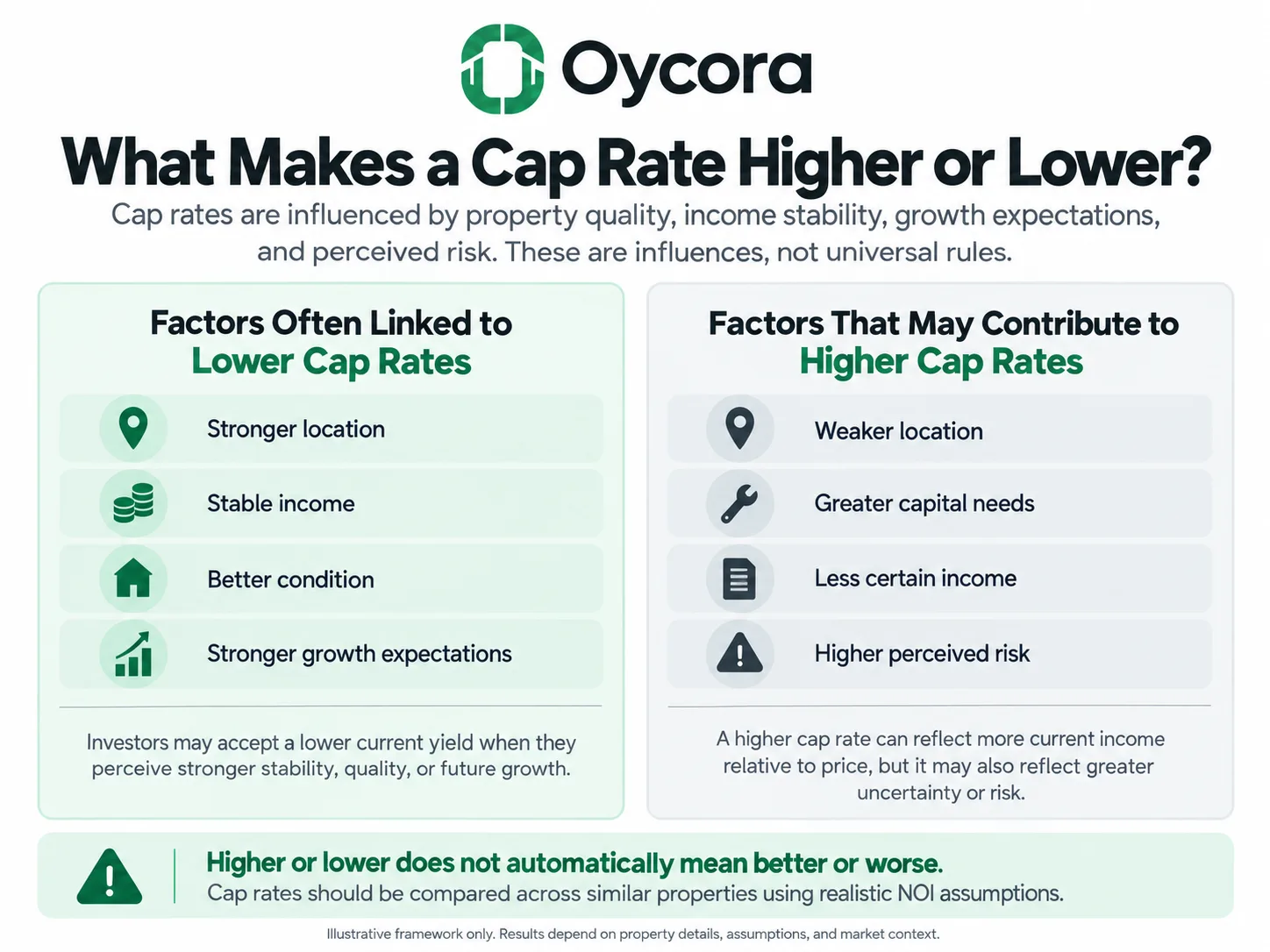
Cap rate compares a property's net operating income with its value, so the number is influenced by both the property's income and the price buyers are willing to pay for that income. Location, property quality, future growth expectations, lease stability, condition, and perceived risk can all affect how the market prices a property. Nareit specifically cautions that cap rates are not fully comparable across property types and geographies because risk, growth expectations, and market conditions differ.
The better question is therefore not simply,
What cap rate should I target?
It's: What does this cap rate imply about this property, and how does it compare with similar alternatives?
There Is No Universal “Good” Cap Rate
A cap rate is calculated by dividing net operating income by property value. If a $300,000 rental produces $21,000 of annual NOI, its cap rate is 7%. The arithmetic is objective, but deciding whether 7% is attractive requires context.
Consider two properties that each sell for $300,000. One is a recently renovated rental in a strong location with stable tenants and relatively predictable expenses. The other is an older property in a weaker location with aging systems and uncertain future rents. If both offered the same cap rate, an investor might reasonably view the risks behind those identical percentages very differently.
Current market data reinforces this point. CBRE's H1 2026 Cap Rate Survey includes approximately 3,600 cap-rate estimates across more than 50 U.S. markets and shows substantial variation by market, sector, asset quality, and investment profile rather than one national number that defines an attractive deal.
That does not mean cap rate targets are useless. It means targets should be formed from the specific market and property type being analyzed, not borrowed from a generic rule.
Why Higher Cap Rates Are Not Automatically Better
A higher cap rate means the property is producing more NOI relative to its value. Everything else equal, that sounds appealing because you are receiving more current operating income for each dollar of property value. In reality, everything else is rarely equal.
A higher cap rate can partly reflect risk. Buyers may demand more income relative to price when a property has greater capital needs, weaker demand, less certain rents, higher vacancy risk, inferior location, or some other characteristic that makes future income less predictable. CBRE's recent research, for example, found greater expectations for cap-rate expansion among Class C assets and linked that sentiment to higher capital-expenditure requirements and greater lease-up risk.
This does not mean every high-cap-rate property is risky or unattractive. A property could simply be mispriced, efficiently operated, or located in a market where higher yields are normal. The important point is that the percentage should prompt another question: Why is the market offering this much income relative to the price?
The same reasoning applies in reverse. A low cap rate does not automatically mean a property is overpriced. Buyers may accept less current income relative to price because they expect stronger rent growth, value the stability of the income stream, perceive less risk, or simply place a premium on a particular market or property type.
Compare Cap Rates With the Right Properties
Cap rate becomes much more informative when it is used comparatively. A duplex in one neighborhood should generally be compared with similar residential properties facing similar economic conditions rather than with an office building, hotel, or apartment complex in another region.
The NOI assumptions also need to be consistent. If one property's cap rate uses aggressive future rents while another uses actual trailing income, the percentages may appear directly comparable even though the calculations are based on different realities. Nareit notes that both trailing and forward NOI are used in cap-rate analysis, with forward NOI common in acquisition pricing, which makes understanding the income basis especially important when comparing deals.
Property condition matters as well. Imagine two otherwise similar rentals with the same cap rate, but one has a recently replaced roof, HVAC system, and electrical service while the other may require substantial work soon. The cap-rate calculation alone does not capture those differences, even though they may materially affect the investment.
A useful comparison therefore goes beyond lining up percentages. Look at how the NOI was calculated, the physical condition behind the income, the location, lease and tenant characteristics where relevant, and whether the properties genuinely represent similar alternatives.
Why the Highest Cap Rate Does Not Automatically Win
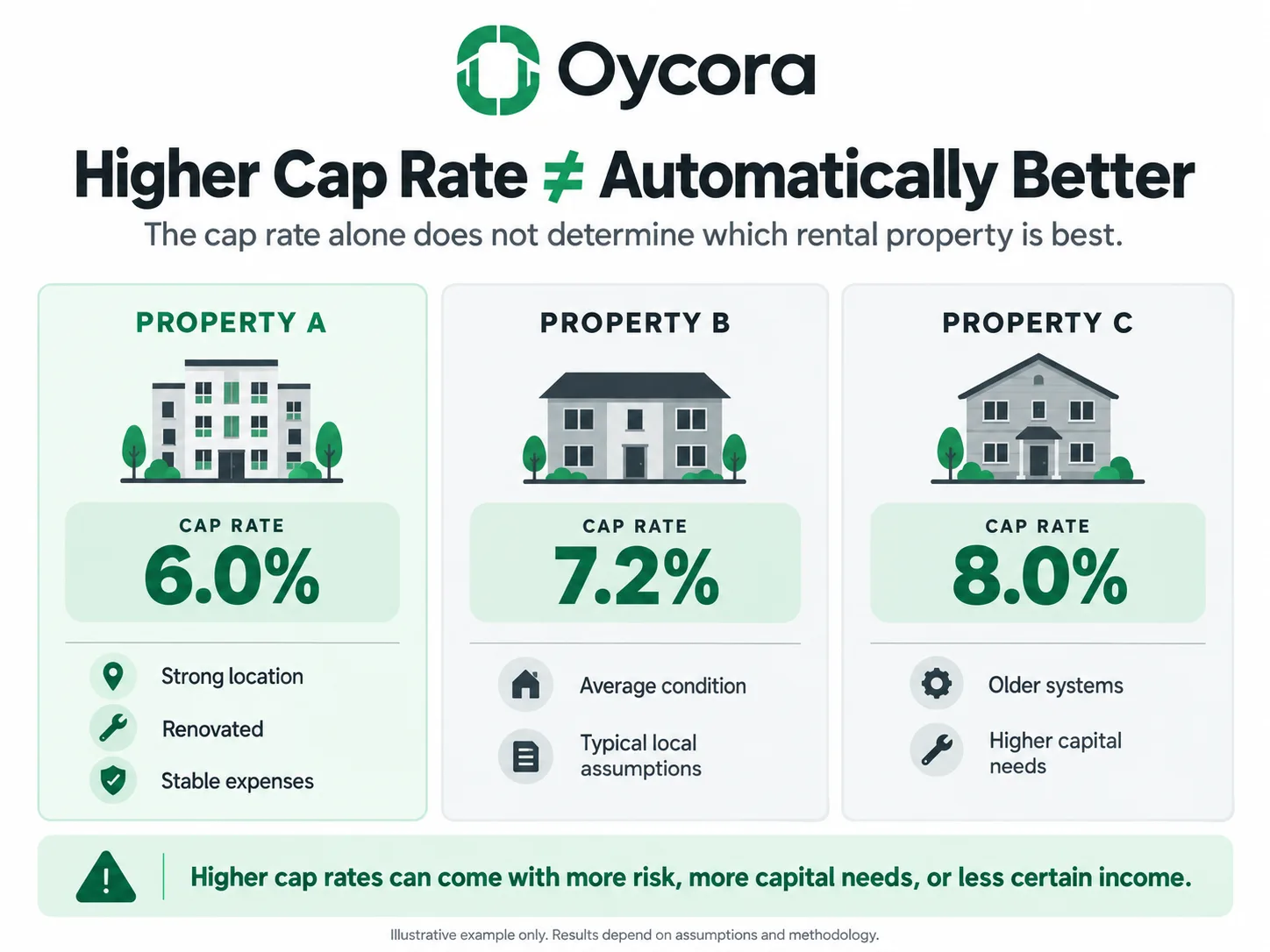
Suppose an investor is comparing three fictional rentals. Each produces income, but the properties differ in price, condition, and expected stability.
| Property | Annual NOI | Property Value | Cap Rate | Additional Context |
|---|---|---|---|---|
| Property A | $18,000 | $300,000 | 6.0% | Strong location, renovated, stable expenses |
| Property B | $21,600 | $300,000 | 7.2% | Average condition, typical local assumptions |
| Property C | $24,000 | $300,000 | 8.0% | Older systems, higher expected capital needs |
If cap rate were the only consideration, Property C would appear strongest because it produces the most NOI relative to the same $300,000 value. But the higher current income may need to compensate for the property's aging systems or greater uncertainty. Property A produces less current operating income, yet its condition and location may make that income more predictable.
The table does not establish which property is best because there is not enough information to make that decision. That is precisely the lesson: cap rate measures the relationship between NOI and value, not the entire investment.
An investor evaluating these properties would still need to examine expected repairs, capital expenditures, financing, cash flow, rent growth assumptions, market demand, and other risks. The highest cap rate may ultimately be the preferred option, but the percentage itself does not prove it.
Market Conditions Affect What Cap Rates Look Like
Cap rates do not exist independently from the broader capital markets. Property pricing, investor expectations, financing conditions, and required returns can all shift over time, causing market cap rates to move even when an individual building has changed very little.
CBRE's H1 2026 survey found that the overall average cap rate across the properties and markets it tracks was essentially flat during the first half of the year, even as Treasury yields moved substantially. The report also showed wide variation underneath that average, with different movements by geography, asset class, and quality.
This is another reason evergreen advice such as “anything above 8% is good” is unreliable. A percentage that looks ordinary in one market environment may look unusual in another. Even within the same year, different cities and property categories can price at meaningfully different yields.
For a small residential investor, this does not mean you need to become a capital-markets economist. It simply means market context matters. Comparing the subject property with recent, relevant local alternatives is generally more informative than comparing it with an arbitrary national cap-rate target.
Financing Does Not Change the Property's Cap Rate
Cap rate deliberately excludes financing. If a property produces $20,000 of NOI and is valued at $250,000, the cap rate is 8% whether the buyer pays cash, puts 20% down, or puts 50% down.
What financing changes is the investor's cash flow and investor-level returns. A larger mortgage may leave less NOI available after debt service, while a larger down payment can reduce debt service but tie up more investor cash. Those differences are better captured with metrics such as cash flow and cash-on-cash return.
This separation is useful because it lets cap rate answer one specific question: How much operating income does the property produce relative to its value? Once that relationship is understood, financing can be evaluated separately rather than allowing a particular loan structure to change the apparent economics of the real estate itself.
Common Mistakes When Setting a Cap-Rate Target
One mistake is deciding in advance that every property must exceed a single percentage. That can cause an investor to reject lower-cap-rate properties without understanding why the market prices them that way or chase high-cap-rate properties without investigating the risks supporting the yield.
Another problem is comparing cap rates calculated from inconsistent NOI assumptions. If the income or expenses are unrealistic, the cap rate is unrealistic too. The OCC's commercial real estate guidance emphasizes developing stabilized NOI from supported rents, expenses, vacancy, and comparable-property information before applying capitalization analysis.
It is also easy to confuse cap rate with an investor's actual return. Cap rate ignores financing, appreciation, principal paydown, future sale proceeds, tax effects, and the timing of cash flows. A 7% cap rate does not mean an investor is guaranteed to earn 7% on their cash.
The cleanest approach is to treat cap rate as what it is: a property-level pricing and income metric that becomes more useful when paired with other information.
Use Cap Rate as Context, Not a Verdict
A good cap rate is not a fixed percentage. It is a cap rate that makes sense relative to the property's income, price, condition, location, risk, growth expectations, and comparable opportunities.
Start by calculating NOI carefully. Compare the resulting cap rate with genuinely similar properties, then investigate why differences exist rather than assuming the highest number wins. After that, layer in financing, cash flow, cash-on-cash return, capital needs, and the rest of the investment analysis.
Cap rate is valuable precisely because it simplifies one relationship: income relative to value. It becomes misleading only when that simple relationship is treated as the answer to every question about the property.