
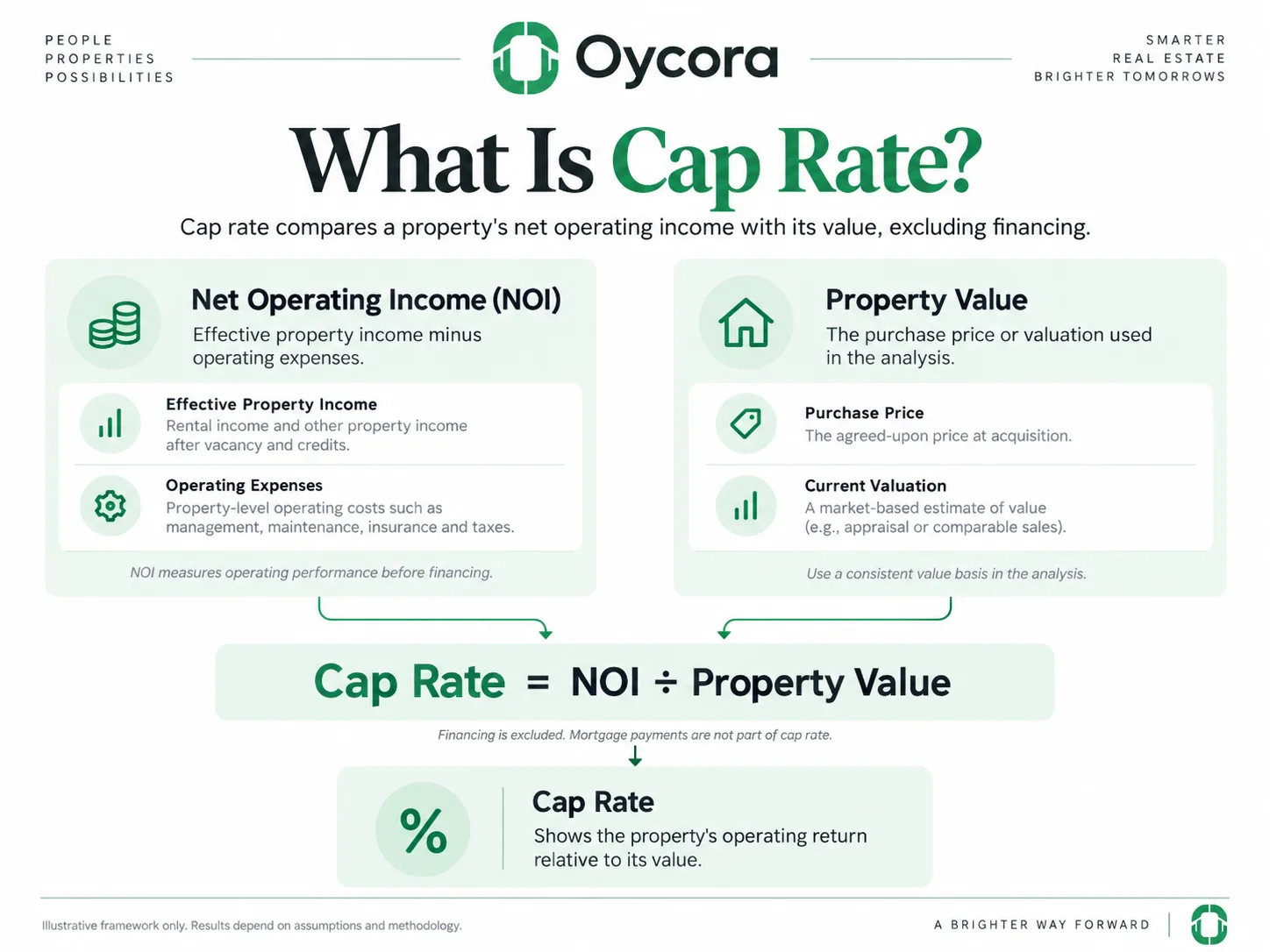
Cap rate is one of the most common metrics used to evaluate income-producing real estate. It gives investors a way to compare a property's net operating income with the value or price of the property itself.
The calculation is simple:
Cap Rate = Net Operating Income ÷ Property Value
What makes cap rate useful is that it focuses on the property before financing. Mortgage payments are not part of the calculation, so two buyers using different down payments or loan terms can still evaluate the same property's cap rate on the same basis.
But cap rate is also easy to misuse. A higher percentage is not automatically better, a lower percentage is not automatically worse, and cap rate does not represent an investor's total return. The metric becomes most useful when the underlying NOI is realistic and the property is being compared with relevant alternatives.
What Does Cap Rate Measure?
Capitalization rate, usually shortened to cap rate, measures a property's net operating income relative to its value. Nareit describes cap rate as a pricing and valuation metric calculated by dividing NOI by current market value or purchase price, while the OCC describes direct capitalization as converting stabilized NOI into property value using an appropriate capitalization rate.
Suppose a property generates $24,000 in annual NOI and is valued at $300,000. Its cap rate would be 8%.
That 8% is not the same thing as cash flow, cash-on-cash return, appreciation, or total return. It is simply the relationship between the property's operating income and the value assigned to the property.
Because financing is excluded, cap rate is useful for comparing the operating economics of properties without allowing one buyer's mortgage structure to distort the comparison. NOI itself is property revenue minus operating expenses and generally excludes financing and capital costs.
Cap rate can also be rearranged as a valuation formula:
Property Value = NOI ÷ Cap Rate
This is one reason capitalization rates matter so much in commercial and multifamily valuation. If an appraiser or market participant believes a stabilized property should trade at a particular cap rate, that rate can be applied to NOI to estimate value. The OCC specifically describes direct capitalization as dividing NOI by an appropriate capitalization rate.
Why NOI Matters So Much
A cap rate is only as reliable as the NOI used to calculate it.
If rental income is overstated, vacancy is ignored, or operating expenses are underestimated, NOI will be too high. The cap rate will then appear stronger even though nothing about the actual property improved.
For that reason, cap rate analysis should begin with a realistic estimate of effective property income and recurring operating expenses. Typical NOI expenses may include property taxes, insurance, maintenance, management, and owner-paid utilities, while debt service, depreciation, and major capital expenditures are usually kept outside conventional NOI.
There is also an important difference between historical NOI and projected NOI. A trailing calculation may use the property's previous 12 months of performance, while a forward-looking analysis may estimate the next 12 months based on expected rents, vacancy, and expenses. Nareit notes that both trailing and forward NOI are used in cap-rate analysis and that forward NOI is common in acquisition pricing.
The important thing is consistency. Comparing one property using an optimistic forward NOI against another using conservative historical numbers can make the comparison misleading.
Calculating Cap Rate
Consider a fictional rental property being evaluated at $300,000. Assume the following annual figures:
| Item | Amount |
|---|---|
| Effective property income | $34,200 |
| Operating expenses | $12,600 |
| Net operating income | $21,600 |
| Property value | $300,000 |
| Cap rate | 7.2% |
The calculation is:
$21,600 ÷ $300,000 = 0.072, or 7.2%
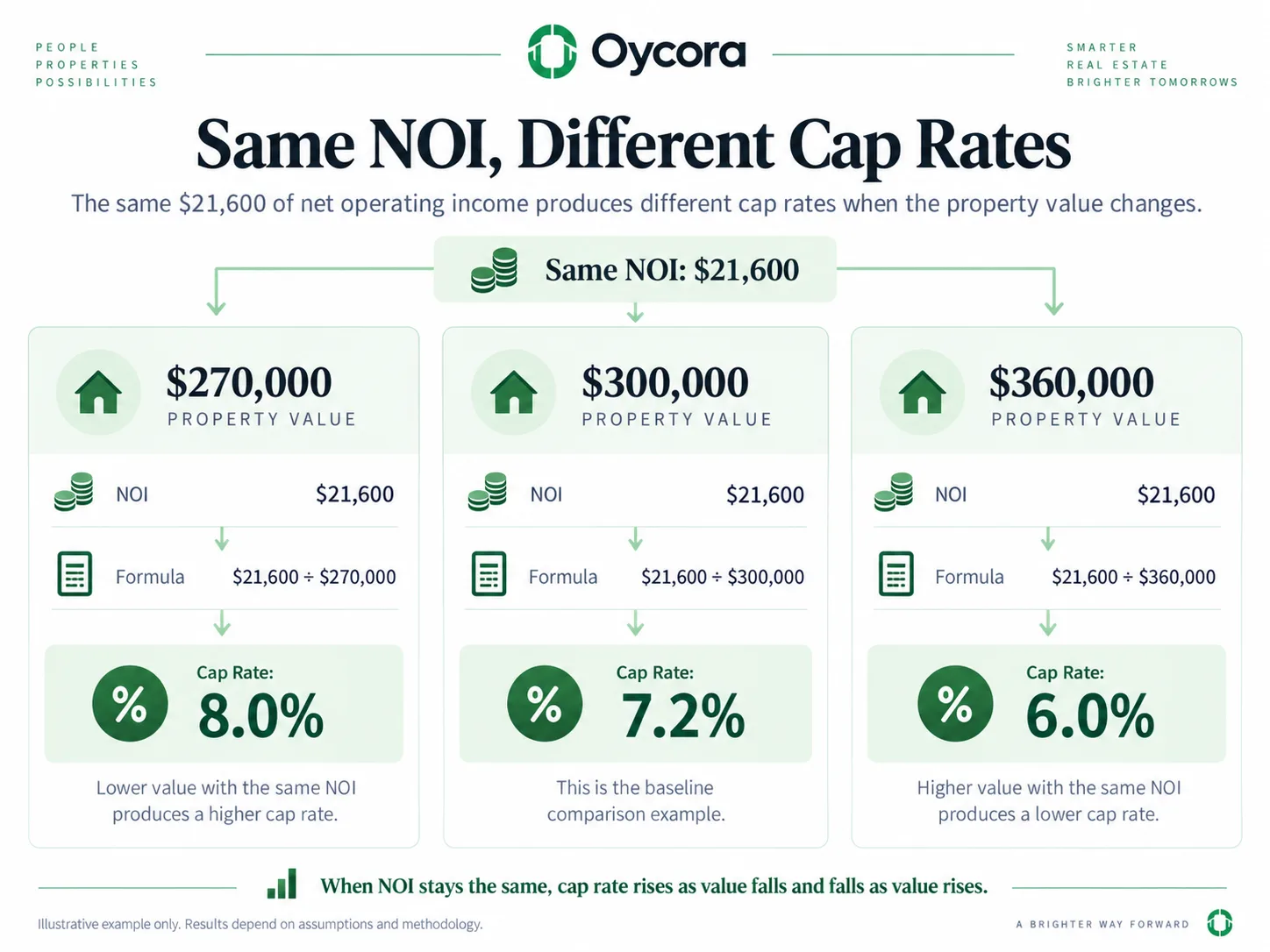
Now hold NOI constant and change only the property value:
| Property Value | NOI | Cap Rate |
|---|---|---|
| $270,000 | $21,600 | 8.0% |
| $300,000 | $21,600 | 7.2% |
| $360,000 | $21,600 | 6.0% |
This illustrates an important relationship: when NOI stays the same, cap rate falls as property value rises and rises as property value falls.
That does not mean the $270,000 property is automatically a better investment. The lower price may reflect weaker location, deferred maintenance, lower expected rent growth, higher risk, or other factors. The table only shows how the math responds when value changes.
What Makes Cap Rate Rise or Fall?
Cap rate changes when either NOI or property value changes. If NOI rises while value stays constant, cap rate rises. That might happen if rents increase, vacancy falls, or operating expenses decline. If NOI falls while value stays constant, cap rate falls.
Value works in the opposite direction. If property value rises while NOI stays the same, cap rate falls. If value falls while NOI remains unchanged, cap rate rises.
In the real market, however, income and value often move together rather than independently. A property with stronger expected rent growth or more stable income may command a higher price, which can result in a lower observed cap rate. Another property may trade at a higher cap rate because buyers perceive greater risk, weaker growth prospects, poorer condition, or less desirable market characteristics.
Nareit notes that cap rates are not fully comparable across property types and geographies because risk, growth expectations, and market conditions differ. This is why interpreting cap rate requires context rather than a universal cutoff.
Is There a “Good” Cap Rate?
There is no single cap rate that is automatically good for every rental property.
A 5% cap rate might make sense for one property and be unattractive for another. An 8% cap rate might reflect strong current income, or it might reflect significant risk that buyers are demanding compensation to accept.
Location matters. Property type matters. Condition matters. Lease quality, tenant stability, expected rent growth, supply and demand, and local market pricing all matter.
The most useful comparison is usually between similar properties in similar markets using similar NOI assumptions. Comparing the cap rate of a small stabilized duplex in one city with a value-add apartment building in another market tells you far less than comparing two properties with similar characteristics and risk profiles.
Cap rate should therefore be treated as a comparison and valuation metric, not as a pass/fail rule.
A higher cap rate may indicate more current income relative to price, but it can also be associated with greater perceived risk. A lower cap rate may indicate less current income relative to price, but it can also reflect stronger demand, better location, more stable income, or higher expected growth.
Cap Rate vs. Cash Flow
Cap rate and cash flow answer different questions. Cap rate looks at the property before financing. Cash flow looks at what remains after debt service and other applicable investor-level costs are considered.
Suppose two people buy the same property for $300,000. The property generates $21,600 in NOI, so the cap rate is 7.2% for both buyers.
One buyer puts 20% down and uses a relatively large mortgage. The other puts 50% down and has much lower debt service. Their cap rate is the same because the property is the same. Their cash flow may be very different because their financing is different. This is one reason cap rate is useful for property-level comparison but should not be mistaken for the investor's actual cash return.
Cap Rate vs. Cash-on-Cash Return
Cash-on-cash return goes a step further by comparing annual pre-tax cash flow with the investor's actual cash invested. Cash-on-Cash Return = Annual Pre-Tax Cash Flow ÷ Total Cash Invested
Because both cash flow and cash invested depend on financing and acquisition structure, cash-on-cash return can vary between two buyers of the same property. Cap rate does not.
That makes the two metrics complementary rather than interchangeable. Cap rate tells you about the property's operating income relative to value. Cash-on-cash return tells you about the investor's annual cash flow relative to the cash they actually put into the deal.
What Cap Rate Does Not Tell You
Cap rate is useful, but it leaves a lot out.
It does not tell you how much mortgage debt the investor is using. It does not measure monthly cash flow. It does not include future appreciation or depreciation in market value, mortgage principal paydown, tax consequences, future sale proceeds, or the timing of cash flows across a multi-year holding period.
Nareit also notes that cap rate generally assumes stabilized income and expenses, which can make it less informative for properties with significant near-term leasing changes or value-add plans.
A property undergoing renovation may have temporarily weak NOI even if the business plan is expected to increase income later. Likewise, a property with unusually high current rents or unusually low expenses may show an attractive cap rate that proves difficult to sustain. Cap rate tells you something specific and useful. Problems begin when it is asked to tell you everything.
Common Cap Rate Mistakes
One common mistake is using gross rent instead of NOI. Cap rate is based on net operating income, not total rental revenue. Another is deducting mortgage payments before calculating NOI. That mixes financing with property-level operating performance and defeats one of the main reasons cap rate is useful.
Investors can also create misleading comparisons by using different NOI periods or assumptions. A property calculated from aggressive projected rents should not be compared casually with another property using conservative trailing income.
Another mistake is assuming that higher always means better. A high cap rate may represent attractive current income relative to price, but it may also be the market's response to higher perceived risk. Finally, cap rate should not be confused with total investment return. A 7% cap rate does not mean the investor earns exactly 7% on their money each year.
Use Cap Rate as One Part of the Analysis
Cap rate is valuable because it reduces a complicated property to a simple relationship:
How much net operating income does the property produce relative to its value?
That makes it useful for comparing properties, understanding pricing, and connecting NOI with property value. But the simplicity is also its limitation. Cap rate says nothing about how the property is financed, how much cash the investor actually contributes, what future appreciation may look like, or what happens when assumptions change.
Use cap rate alongside NOI, cash flow, cash-on-cash return, debt coverage, property condition, and the rest of the analysis rather than treating it as a verdict. A cap rate is not an answer to whether a property is worth buying. It is one piece of evidence about how the property is priced and how much operating income that price is currently associated with.