Oycora Guide · Financing
The Complete Guide to Rental Property Financing
Rental property financing affects much more than the monthly mortgage payment. This Guide explains how occupancy, down payment, leverage, interest rate, amortization, qualifying rental income, DSCR, refinancing, and reserves shape both the purchase and the property’s long-term performance.

Rental property financing changes far more than how much the monthly payment costs. It affects how much cash is required upfront, how much leverage the investor uses, how much NOI remains after debt service, whether the property satisfies lender coverage requirements, and how quickly equity builds over time. Two buyers can acquire the same property at the same price and end up with very different cash flow and investor-level returns simply because their financing structures are different.
That makes financing part of the investment itself, not an administrative step that happens after the property has already been analyzed. A strong rental may become difficult to hold under expensive debt, while conservative financing can improve coverage and cash flow but require substantially more investor capital. The goal is not to maximize or minimize leverage automatically. It is to understand what the debt is doing to the property’s economics.
This Guide explains the financing process from the ground up: how occupancy affects loan options, how down payment and LTV connect, how interest rate and amortization shape debt service, how lenders evaluate rental income, how DSCR fits into underwriting, and how refinancing can change the investment later. Throughout the Guide, the focus stays on one question: how does the financing structure change the risk, cash requirement, and performance of the rental property?
Understand the Financing Foundation
Before comparing rates or lenders, the investor needs to understand the basic structure of the loan being considered. Occupancy, down payment, loan amount, interest rate, amortization, and term determine not only what the lender requires but also how the property behaves after closing.
For a first-time investor especially, these variables should be modeled together. A lower down payment may make the purchase easier to fund but increase debt service. A longer amortization may improve current cash flow while slowing principal reduction. A lower rate can materially improve the numbers without changing anything about the property itself.
Owner-Occupied vs. Investment Property Financing
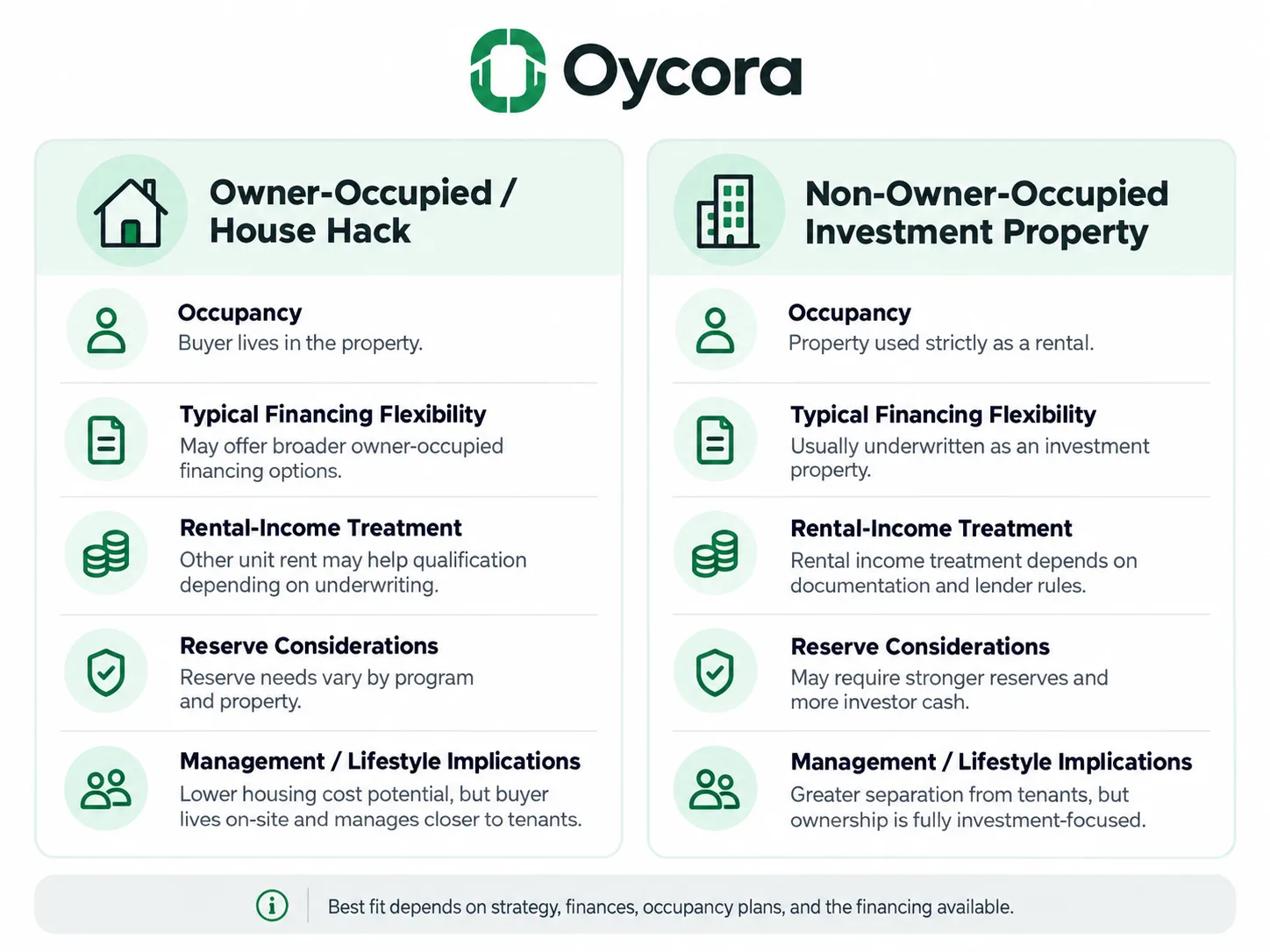
One of the first financing questions is whether the borrower will live in the property. That distinction can materially affect the loan options available.
An owner-occupied property is one the borrower intends to use as a primary residence. For rental investors, the most common example is a house hack, where the buyer lives in one unit of a duplex, triplex, or four-unit property while renting the others. Depending on the loan program and borrower qualification, owner-occupancy can make financing structures available that would not apply to a non-owner-occupied investment property.
A non-owner-occupied investment property is purchased strictly as a rental. The borrower does not live there, and lenders generally underwrite it as an investment property rather than a primary residence. That can affect required down payment, pricing, reserves, debt-to-income treatment, and how rental income is documented.
Current agency guidance reflects that distinction. Freddie Mac supports financing for two- to four-unit primary residences as well as one- to four-unit investment properties, but the underwriting framework is not identical across occupancy types. The same building could therefore be financed differently depending on whether the buyer plans to live in one of the units.
Occupancy is not merely a box to check for better financing. The borrower has to satisfy the actual occupancy requirements of the loan program. A buyer should never structure a transaction as owner-occupied unless they genuinely intend to meet those requirements.
Down Payment, Loan Amount, LTV, and Cash Required
Down payment and loan amount are closely connected, but they are not the same thing as total cash required to buy the property. If a $300,000 rental is purchased with 25% down, the down payment is $75,000 and the starting loan amount is $225,000. The buyer may still need additional funds for closing costs, lender reserves, inspections, immediate repairs, and other acquisition expenses.
Loan-to-value ratio, or LTV, expresses the loan amount relative to the property value or purchase price used by the lender. A $225,000 loan on a $300,000 property represents 75% LTV. Higher leverage means a larger portion of the purchase is financed, while lower leverage means the investor contributes more equity upfront.
More leverage is not automatically better or worse. A smaller down payment preserves investor cash and can increase cash-on-cash return when the additional debt remains affordable. It also increases the loan balance and usually increases debt service, which reduces cash flow and debt coverage. A larger down payment generally produces the opposite tradeoff: lower debt service and stronger coverage, but more cash tied up in the property.
The most useful way to think about leverage is therefore as a risk and capital-allocation decision. The investor is choosing how much of the property to fund with debt and how much to fund with equity. That choice affects both the return calculation and the property’s margin for error.
Cash required at closing should also be kept separate from the down payment in the analysis. A property that requires $75,000 down, $8,000 in closing costs, $10,000 of immediate repairs, and $12,000 in retained reserves requires a very different capital commitment from one that simply advertises a $75,000 down payment.
Interest Rate, Amortization, and Loan Term
Interest rate receives most of the attention in mortgage discussions because even a modest change can materially affect debt service. For a rental investor, that matters directly because every additional dollar of annual debt service is one less dollar of pre-tax cash flow, assuming property operations stay unchanged.
The amortization period determines how quickly the loan principal is scheduled to be repaid. A longer amortization generally lowers the required payment because repayment is spread over more years. A shorter amortization raises the payment but builds equity more quickly. This tradeoff affects cash flow, DSCR, and principal paydown at the same time.
The loan term is a separate concept. A mortgage may amortize over 30 years while having a different contractual term depending on the loan product. Some loans are fully amortizing through maturity, while others may require refinancing or payoff before the amortization schedule would naturally reach zero. Investors should understand both the payment schedule and what happens at the end of the term.
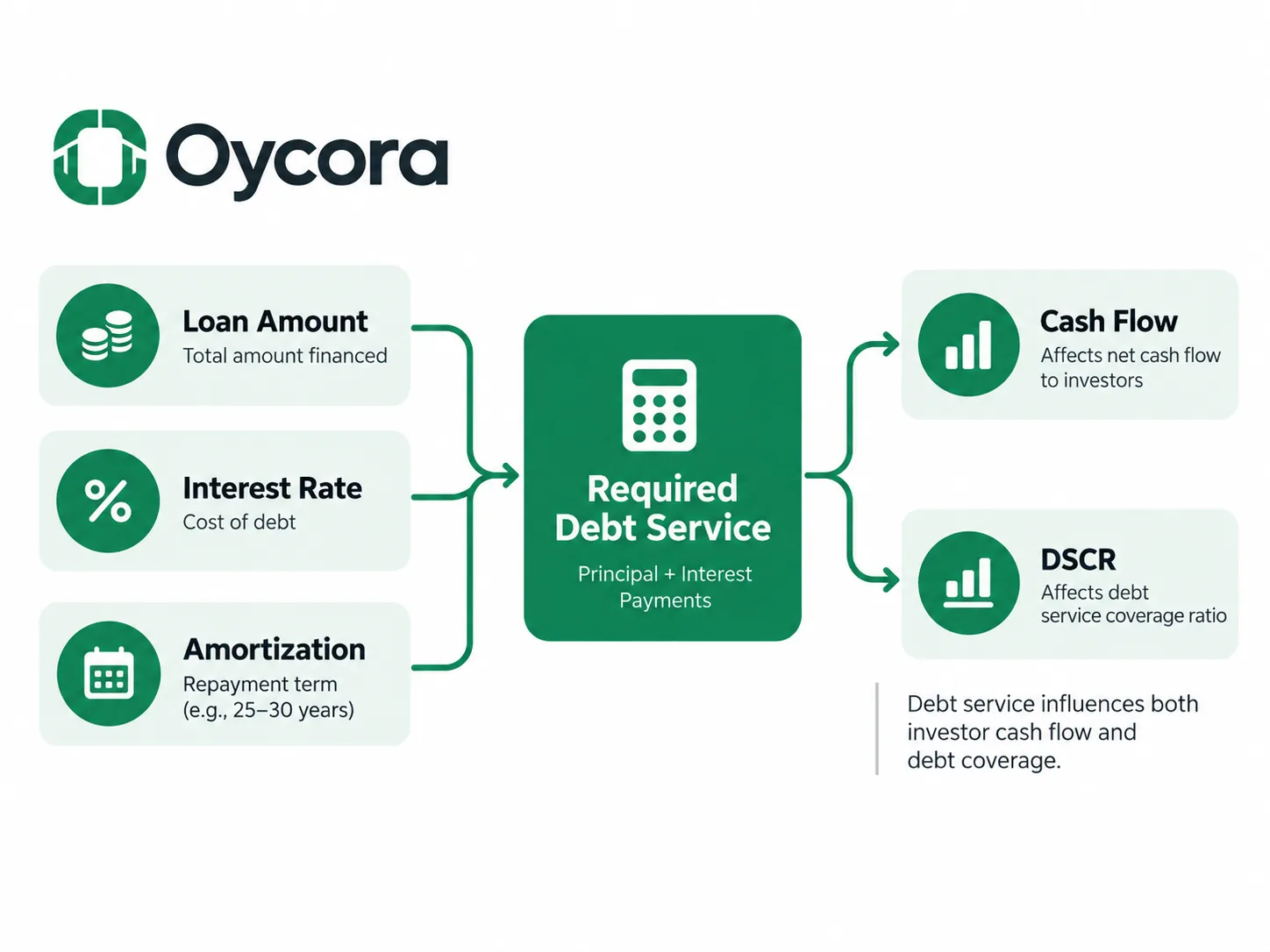
The important point is that these variables should not be evaluated independently. A lower rate with a much shorter amortization can still create a higher payment. A longer amortization may improve near-term cash flow while increasing total interest over the life of the loan. A larger down payment may compensate for a higher rate by reducing the amount borrowed.
Rental financing therefore works best when the entire structure is modeled rather than focusing on one attractive loan feature. The next stage is understanding how lenders determine whether the borrower and property actually qualify for that financing, especially when rental income is part of the underwriting.
Back to Guide contentsUnderstand Qualification and Rental Income
Once the basic loan structure is understood, the next question is whether the borrower and property can actually qualify for it. Rental-property underwriting is not just about the mortgage payment. Lenders may evaluate the borrower’s income and debts, the property’s documented rental income, reserves, occupancy, and sometimes the property’s own ability to support the proposed debt.
The important distinction is that an investor’s analysis and a lender’s underwriting are related but not identical. You may believe a unit can rent for a certain amount based on current market conditions, while the lender may require a signed lease, appraisal-supported rent, or another documented figure before using it for qualification. A property can therefore look workable in your model but qualify differently under the lender’s rules.
How Lenders Evaluate Rental Income
Rental income can help support qualification, but lenders usually want evidence rather than a projection alone. Depending on the transaction and loan program, that evidence may include existing leases, rent schedules, appraiser-supported market rent, tax returns, or other documentation. Fannie Mae’s current selling guidance distinguishes between rental income from subject and non-subject properties and applies specific documentation and calculation rules depending on the borrower’s history and the property involved.
This matters because market rent is not automatically qualifying rent. If an investor believes a vacant unit could rent for $2,000, that assumption may be perfectly reasonable for the investment analysis, but the lender may use a different figure or apply a haircut before counting it. The exact treatment depends on the loan product and underwriting method.
Existing leases can make the process more concrete. A signed lease shows what a tenant is contractually obligated to pay, while an appraisal may provide a separate market-rent estimate. If the property is owner-occupied and part of a house hack, the rent from other units may help qualification in some programs, but the amount and treatment still depend on the lender’s rules.
The practical lesson is simple: keep investment rent assumptions and lender-qualifying rent conceptually separate. They may end up being similar, but they are not automatically the same number.
Personal Qualification vs. Property Qualification
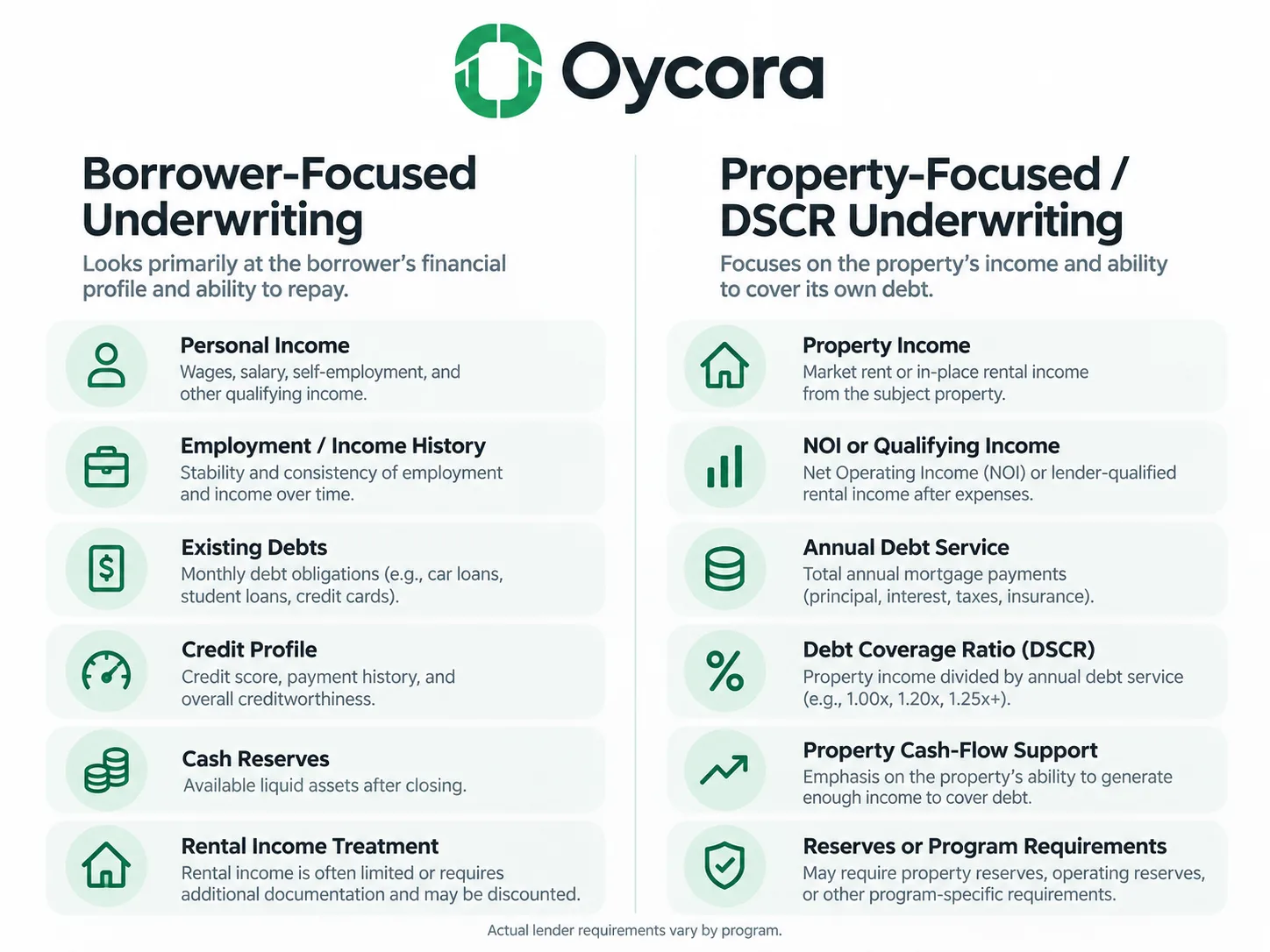
Some rental financing is primarily centered on the borrower. Conventional underwriting may evaluate personal income, employment, credit, existing debts, cash reserves, and the treatment of rental income when calculating whether the borrower can support the loan. In that framework, the property matters, but the borrower’s financial profile remains central.
Other lending structures place more emphasis on the property’s income relative to the debt. DSCR-style lending is the clearest example conceptually. Instead of relying primarily on personal income, the lender focuses on whether the property generates enough qualifying income to cover the required debt service.
That difference can matter for investors who own several properties or whose personal income does not fit conventional underwriting neatly. It does not mean property-focused lending is automatically easier or cheaper. Loan pricing, leverage limits, reserves, prepayment terms, property requirements, and DSCR thresholds can all differ from conventional financing.
The right financing structure depends on the borrower, property, and strategy. A first-time owner-occupant house hacker may fit naturally into borrower-focused conventional financing, while a more experienced investor with multiple rentals may eventually consider property-focused options. The useful distinction is understanding what the lender is actually underwriting.
How Financing Changes Buying Power
Assume an investor is considering a $320,000 rental property. The property is expected to produce $2,800 per month in gross rent, but the lender uses $2,600 per month as qualifying rental income after applying its underwriting rules.
Now compare two financing structures:
| Financing Input | Option A | Option B |
|---|---|---|
| Purchase price | $320,000 | $320,000 |
| Down payment | $64,000 | $96,000 |
| Loan amount | $256,000 | $224,000 |
| LTV | 80% | 70% |
| Interest rate | 7.00% | 6.75% |
| Amortization | 30 years | 30 years |
| Approx. monthly principal & interest | $1,703 | $1,453 |
| Annual debt service | $20,436 | $17,436 |
| Qualifying monthly rent used by lender | $2,600 | $2,600 |
The property is the same in both cases, but the financing is not. Option B requires $32,000 more upfront equity, yet the lower loan balance and slightly lower rate reduce annual debt service by about $3,000.
That difference affects several downstream metrics. Lower debt service can improve cash flow and DSCR, but the larger down payment also means more investor capital is tied up in the property. Depending on the rest of the deal, that can improve some metrics while lowering others, especially cash-on-cash return.
The example also shows why qualifying rental income and investor-projected rent should not be casually mixed. The investor may still model $2,800 if that figure is well supported for the property, but the lender may underwrite with $2,600. Both figures can be useful, as long as they are used for the correct purpose.
By this point, the financing structure is no longer abstract. The next step is understanding how the debt changes the property’s risk, cash flow, and coverage once the loan is actually attached to the investment.
Back to Guide contentsMeasure the Cost and Risk of the Financing
Once the loan is approved and the property qualifies, the next step is understanding what that debt actually does to the investment. Financing can improve buying power and preserve cash, but it also creates a fixed obligation that must be paid whether the property performs exactly as expected or not.
The most useful way to evaluate financing is to look at how debt service affects cash flow, coverage, and the investor’s margin for error. A loan can make a deal possible while simultaneously making the property more sensitive to vacancy, repairs, or declining income.
Debt Service and Cash Flow
Debt service is the required principal and interest payment tied to the loan. Once NOI is calculated, debt service determines how much of that operating income remains available to the investor.
A simplified relationship is:
Pre-Tax Cash Flow = NOI − Debt Service
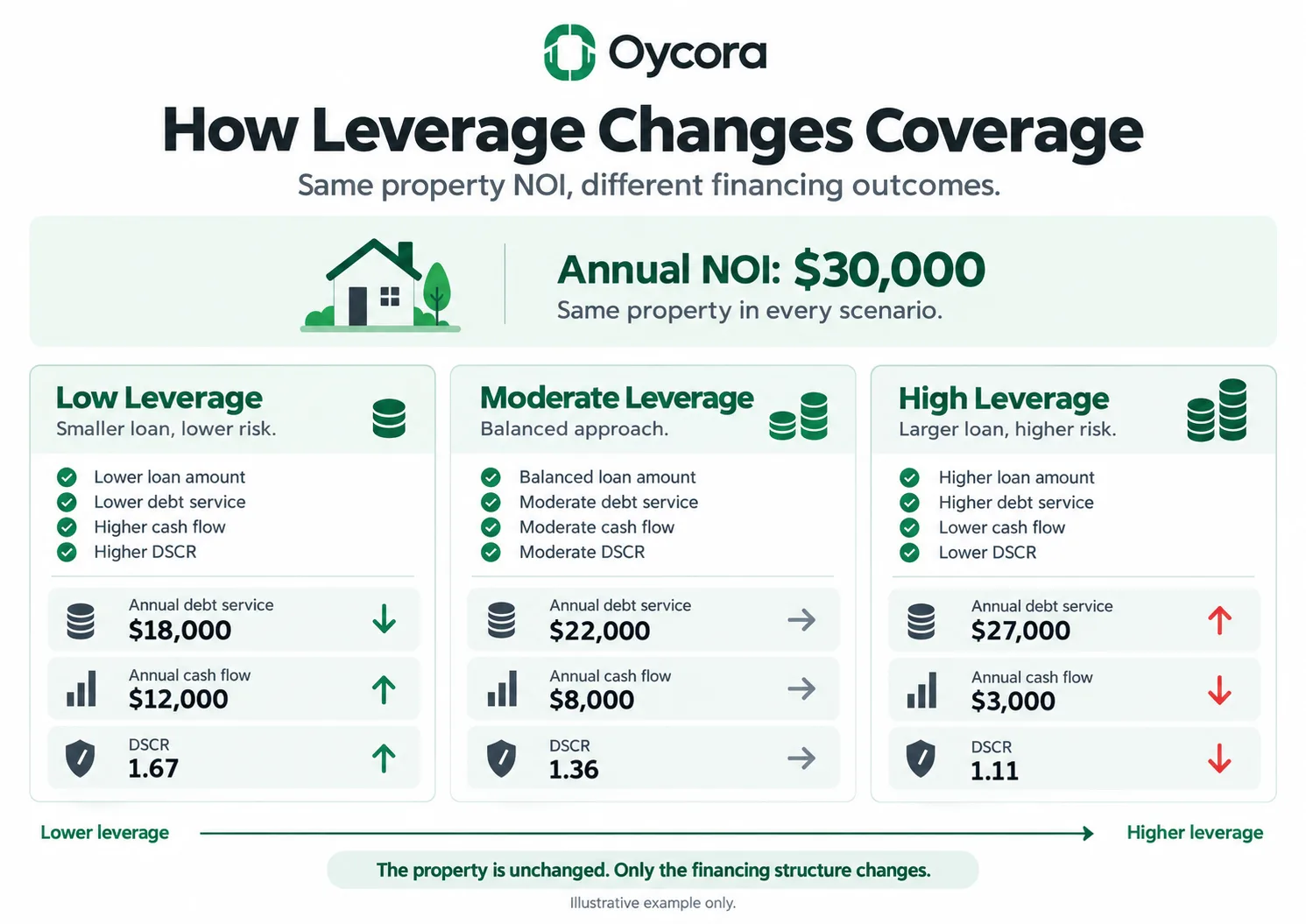
If a property produces $30,000 in annual NOI and requires $22,000 in annual debt service, the simplified pre-tax cash flow is $8,000. If the same property is financed more aggressively and debt service rises to $27,000, cash flow falls to $3,000 even though nothing about the property’s rent or operating expenses changed.
This is why a financing offer should never be evaluated only by whether the monthly payment is affordable. The payment needs to be viewed relative to the property’s operating income. A loan that consumes most of NOI may still be technically workable, but it leaves less room for repairs, vacancy, insurance increases, or other setbacks.
The same concept applies when interest rates change. A property can move from comfortable cash flow to very thin cash flow solely because borrowing costs increased. The real estate did not become worse overnight; the financing became more expensive.
DSCR and the Property’s Margin for Error
Debt service coverage ratio, or DSCR, expresses the relationship between property income and required debt service. In a simplified property-level framework:
DSCR = NOI ÷ Annual Debt Service
A DSCR of 1.00 means NOI equals debt service. A ratio above 1.00 indicates that the modeled income exceeds the required debt payment, while a ratio below 1.00 means the property does not fully cover the debt from the income measure being used.
That makes DSCR useful as a margin-of-error metric. A property with a 1.40 DSCR has more income relative to debt than one at 1.05. If income falls or expenses rise, the first property has more room before coverage becomes insufficient.
Lender requirements vary, however. Different loan programs may use different definitions of qualifying income, debt service, reserves, or minimum coverage, so an investor’s internal DSCR calculation may not match the lender’s exact result. The ratio should therefore be used both as an analytical tool and as a reminder to understand the lender’s own methodology.
Leverage: More Buying Power, Less Cushion
Leverage allows an investor to control a larger asset with less cash. That can improve capital efficiency when the property performs well, but it also increases the amount of debt that must be serviced from the same property income.
A smaller down payment means more of the purchase is financed. That may preserve cash for reserves, future investments, or other opportunities, but it usually increases debt service and reduces the amount of NOI available as cash flow. A larger down payment lowers leverage and often improves DSCR and cash flow, but it also commits more investor capital to the property.
This creates a genuine tradeoff rather than a simple rule. More leverage can increase cash-on-cash return in some situations because less investor cash is tied up in the deal. In other situations, the additional debt service overwhelms that advantage and lowers the return instead. The result depends on the spread between property performance and borrowing cost.
Leverage also magnifies downside risk. If the property underperforms, the debt payment does not automatically shrink with the rent. Higher leverage therefore leaves less room for error when vacancy rises, repairs increase, or rents fail to grow as expected.
The practical goal is not to minimize debt or maximize it. It is to choose a financing structure that leaves enough cash flow, coverage, and reserves for the investor to remain comfortable if the property performs below the base-case model.
By this point, the financing decision can be evaluated as part of the investment rather than merely as a method of paying for it. The final stage is understanding how refinancing, changing loan terms, and long-term financing decisions can alter the property’s performance after the initial purchase.
Back to Guide contentsRefinance and Manage the Financing Over Time
The financing decision does not end at closing. Interest rates change, property values move, loan balances decline, rents grow, and an investor’s strategy can evolve. A loan that made sense when the property was purchased may eventually become expensive relative to the options available later.
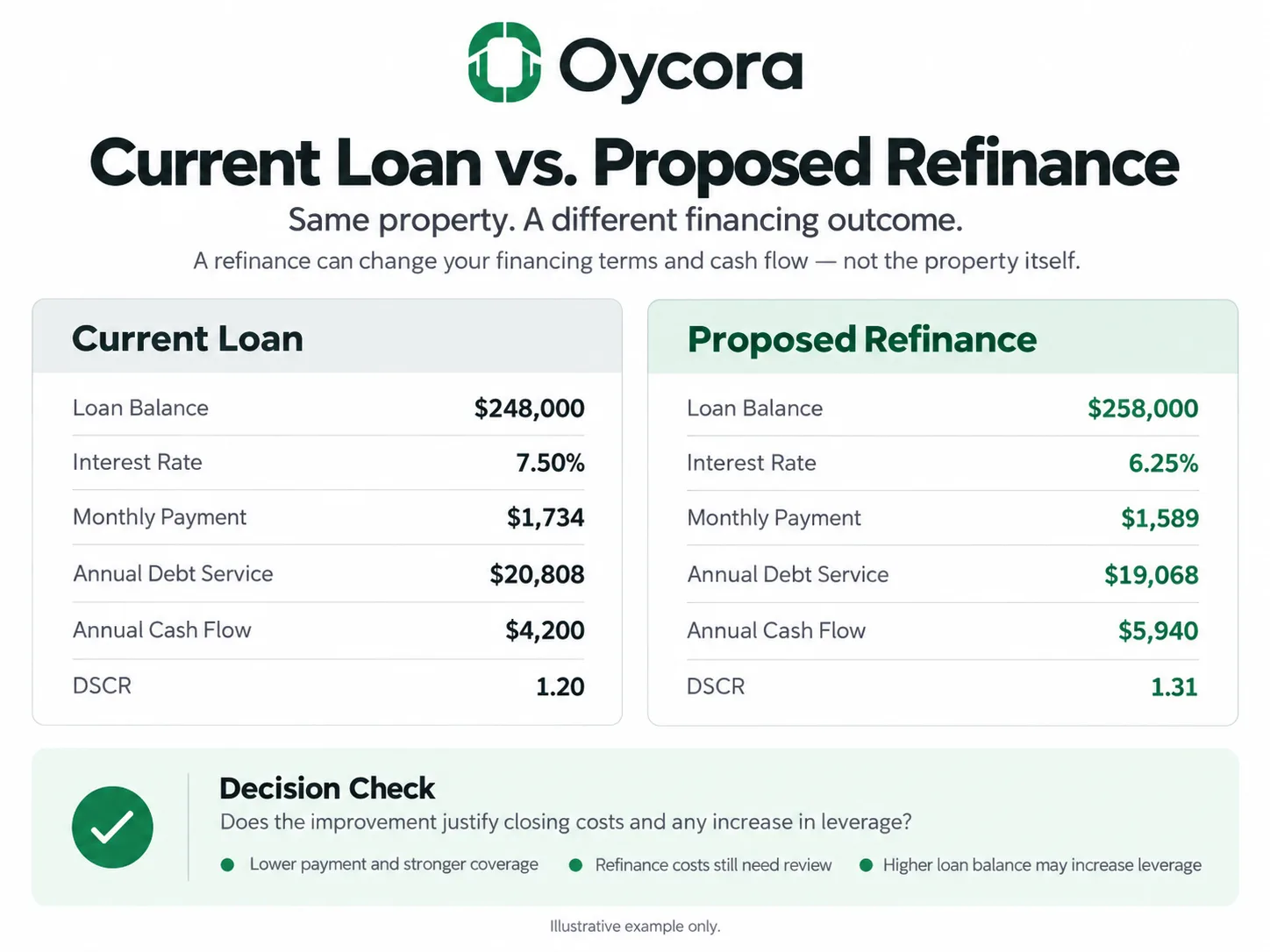
Refinancing can change monthly debt service, release equity, alter the amortization schedule, or restructure the property for a different phase of ownership. Those benefits can be meaningful, but refinancing also creates new costs and can increase risk. The right question is not simply whether a new loan has a lower rate. It is whether the new financing improves the investment enough to justify replacing the existing debt.
When Refinancing Can Change the Investment
A refinance replaces the existing loan with a new one. Investors commonly consider refinancing to reduce the interest rate, change the loan term, lower the monthly payment, alter the amortization period, remove an unfavorable loan structure, or access equity through a larger new loan.
A lower payment can improve both cash flow and DSCR because less property income is required for debt service. If a rental generates $30,000 of NOI and refinancing reduces annual debt service from $24,000 to $20,000, simplified annual cash flow increases by $4,000 and DSCR improves from 1.25 to 1.50. Nothing about the building changed; the improvement came entirely from restructuring the debt.
A cash-out refinance works differently. Instead of simply replacing the old balance, the investor takes a larger new loan and receives some of the property's equity in cash. That capital might be used for improvements, reserves, another acquisition, or another purpose, but the larger loan can increase debt service and reduce future cash flow.
Refinancing can therefore improve one part of the investment while weakening another. Lowering the rate may improve cash flow, while pulling out equity may raise leverage. An investor should model the new debt structure in full rather than judging the refinance by one attractive feature.
Refinancing Is Not Automatically an Improvement
A lower interest rate does not guarantee that refinancing is worthwhile. New loans can involve lender fees, appraisal costs, title charges, recording fees, points, and other transaction expenses. Those costs need to be compared with the expected savings.
One useful concept is the break-even period. If refinancing costs $6,000 and reduces the payment by $250 per month, the simple break-even period is approximately 24 months. If the investor expects to sell the property before then, the refinance may not have enough time to recover its upfront cost.
Amortization also deserves attention. Replacing a loan that has already been amortizing for several years with a new 30-year loan may reduce the required payment, but it also resets the repayment schedule. The investor may pay less each month while extending the amount of time the property remains financed.
Cash-out refinancing adds another layer because the investor is deliberately increasing the loan balance. Receiving equity in cash can be useful, particularly when that capital can be productively redeployed, but the extracted equity is not free money. It becomes additional debt that the property must support.
Other loan terms can matter as much as the rate. Prepayment penalties, adjustable-rate provisions, balloon payments, reserve requirements, recourse terms, and lender-specific fees can all affect whether the replacement loan is genuinely better. Comparing only the advertised interest rate can hide those differences.
Match the Financing to the Property and Strategy
There is no single financing structure that fits every rental strategy. A house hack may prioritize owner-occupant financing and low initial cash requirements. A stabilized long-term rental may place greater emphasis on predictable debt service and durable cash flow. A BRRRR project may begin with short-term acquisition or renovation financing and later depend on a successful refinance into permanent debt.
The expected holding period matters as well. An investor planning to own a property for decades may value long-term payment stability differently from someone planning a shorter renovation-and-sale strategy. The amount of leverage that feels reasonable can also change as a portfolio grows and the investor becomes responsible for several simultaneous debt obligations.
Financing should therefore be matched to both the property's economics and the investor's plan. The cheapest payment today is not always the best long-term structure, and the highest available leverage is not automatically the best use of debt.
The most useful habit is to continue treating financing as part of the analysis after the purchase. Track the loan balance, payment, coverage, equity, and available refinance options over time. When a new opportunity appears, compare it with the existing structure using the same discipline that was used when the property was first purchased.
Back to Guide contentsPractical Takeaways
Rental property financing affects the investment from the moment the purchase is structured. Occupancy can change available loan options, the down payment determines how much equity is contributed upfront, and the interest rate and amortization schedule determine how much of the property's operating income is consumed by debt service.
Keep borrower qualification separate from property performance. A lender may approve a loan because the borrower meets its underwriting requirements, but that does not mean the financing produces attractive cash flow. Likewise, a property may perform well economically while the borrower does not qualify for a particular loan program.
Leverage should be treated as a tradeoff. More debt preserves investor cash and can sometimes improve capital efficiency, but it also raises fixed obligations and reduces the margin for error. Lower leverage generally strengthens coverage and cash flow while requiring more capital upfront.
Finally, financing should be revisited over time. Refinancing can lower debt service, restructure risk, or release equity, but closing costs, reset amortization, and additional leverage need to be included before deciding whether the change genuinely improves the investment.
Back to Guide contentsConclusion
Rental property financing is not simply the mechanism that gets a buyer to closing. It determines how much cash is required, how much debt the property must carry, how much operating income survives as cash flow, and how sensitive the investment becomes when performance falls below expectations.
The strongest financing structure is not necessarily the one with the smallest down payment, lowest monthly payment, or highest leverage. It is the one that fits the property, the investor's financial position, and the strategy while leaving enough room for the property to operate through normal uncertainty.
That requires looking beyond the interest rate. Down payment, LTV, amortization, debt service, DSCR, reserves, rental-income treatment, refinancing costs, and long-term objectives all belong in the same decision.
When financing is evaluated as part of the investment rather than separately from it, the investor can see not only whether the property can be purchased, but whether the debt attached to it actually makes sense.
Back to Guide contentsHow Oycora calculates this
Calculation methodology
Related articles

Financing
DSCR Explained: How to Calculate Debt Service Coverage Ratio for Rental Property
DSCR measures how comfortably a rental property's income can cover its required debt payments. Learn how to calculate debt service coverage ratio, interpret the result, and understand why lender requirements can vary.

Property Analysis
Rental Property Operating Expenses: What Should You Include?
Operating expenses can make or break a rental-property analysis. Learn which recurring costs belong in the calculation, which costs should be treated separately, and how realistic expense assumptions affect NOI and cash flow.
Related Guides

Oycora Guide · Getting Started
How to Buy Your First Rental Property: A Beginner’s Guide
Buying your first rental property involves more than finding a house that rents for more than the mortgage. This Guide walks through preparing financially, defining what you are looking for, evaluating your buying capacity, and understanding the responsibilities that come with becoming a landlord.
Read Guide →
Oycora Guide · Property Analysis
The Complete Guide to Analyzing a Rental Property
A complete rental-property analysis starts long before the final return percentage. This Guide walks through how to build realistic assumptions, measure operating performance, account for financing, interpret the major metrics, and stress-test the result before relying on it.
Read Guide →