Oycora Guide · Investment Strategies
The Complete Guide to House Hacking
House hacking lets an owner live in part of a property while rental income from other units or spaces helps offset housing costs. This Guide explains how the strategy works, which property types fit it, how financing and qualifying rental income can work, how to analyze the numbers, and what ownership is actually like.

House hacking combines two decisions that are usually considered separately: where you live and what you invest in. Instead of purchasing a home solely for personal use or buying a rental property that you never occupy, you live in part of the property while collecting rent from another unit, room, or eligible living space.
The strategy can reduce the amount of housing cost that ultimately comes from your own income while giving you direct experience operating a rental property. It can also create access to owner-occupied financing structures that may differ from financing a traditional non-owner-occupied investment property. But house hacking is not simply a trick for getting someone else to “pay your mortgage.” You still own the building, remain responsible for the loan, handle maintenance and vacancies, and have to live with the practical consequences of sharing a property with tenants.
A useful house-hack analysis therefore has two sides. One side asks whether the property works as housing: Is the living arrangement acceptable? Is there enough privacy? Does the location fit your life? The other asks whether it works as real estate: Are the rents realistic? Are expenses and reserves accounted for? Does the financing make sense? A strong house hack has to survive both tests.
Understand How House Hacking Works
House hacking can take several forms, but the common feature is owner occupancy combined with rental income. That combination changes how the property is experienced, how the numbers should be analyzed, and potentially which financing options are available.
The strategy is often introduced as a beginner-friendly way to enter real estate because it can combine a primary residence with an income-producing asset. That can be useful, but the lower barrier to entry does not remove the need for normal rental-property discipline. Tenants still create management responsibilities, repairs still happen, and rent should still be analyzed conservatively rather than treated as guaranteed.
What House Hacking Actually Is
The clearest example of house hacking is buying a duplex, living in one unit, and renting the other. A triplex or four-unit property can work similarly, with the owner occupying one unit and renting the remaining units. The owner receives housing utility from one part of the property while the other units produce rental income.
The idea can extend beyond traditional multifamily property. A single-family home with a legally rentable accessory dwelling unit may create a similar structure. Some owners rent individual bedrooms while continuing to occupy the home themselves. The legal, operational, and financing treatment of those arrangements can differ substantially, so they should not be assumed to work exactly like a conventional duplex.
That distinction matters because “house hack” is an investment strategy, not a standardized property type. A duplex with two fully separate units offers a different living experience from renting bedrooms inside your own home. A detached ADU may provide more privacy but could involve zoning, permitting, utility, or appraisal considerations that do not apply in the same way to a conventional two-unit building.
House hacking also changes the way rental income should be viewed. If a tenant pays $1,400 per month to occupy the other half of a duplex, that does not mean the owner simply subtracts $1,400 from the mortgage and calls the difference profit. Taxes, insurance, utilities, vacancy, repairs, maintenance, reserves, and financing all still matter. The rent helps offset the cost of owning the property, but the building should still be analyzed with the same care as any other rental.
The Main House-Hacking Property Types
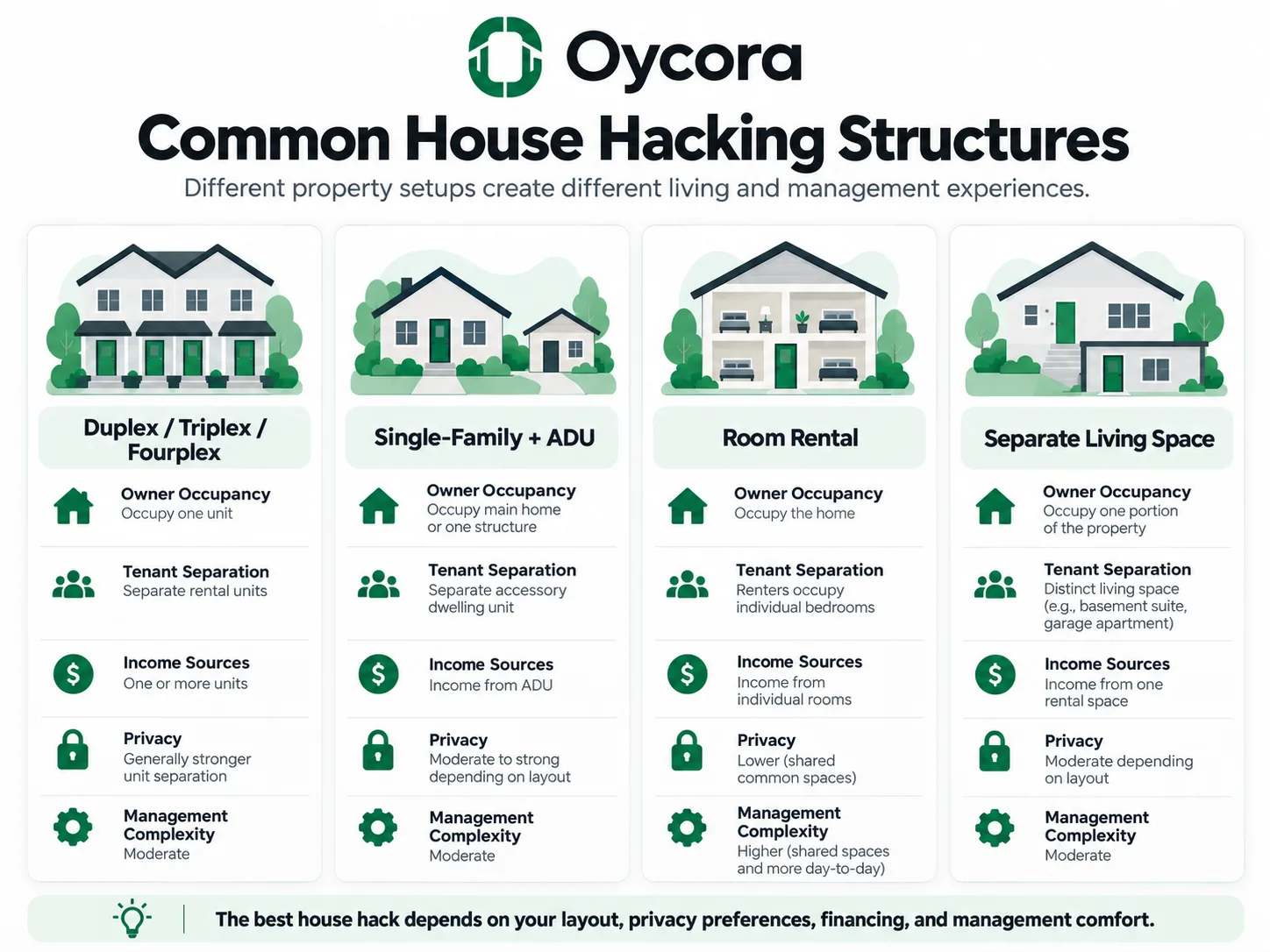
A duplex, triplex, or four-unit property is often the most straightforward version conceptually because the rental units are already distinct parts of the building. Each household may have its own kitchen, bathroom, entrance, utilities, and lease. That separation can make both tenant management and financial analysis cleaner, although additional units also mean more tenants, more turnover possibilities, and more systems to maintain.
A single-family property with an ADU can create a similar income structure while allowing more separation between owner and tenant. A detached backyard unit, basement apartment, or other accessory space may produce meaningful rent, but legality needs to be verified. A finished basement is not automatically a legal rental unit simply because someone is willing to live there.
Room rental is another form of house hacking. Instead of renting a separate dwelling unit, the owner rents bedrooms and shares some common areas with tenants. This can produce significant rent relative to the purchase price in the right property, but it also creates the most direct overlap between personal life and property management. Screening, privacy, household rules, parking, cleaning, guests, shared utilities, and interpersonal compatibility matter more when everyone uses the same kitchen or living room.
The property layout should therefore be evaluated almost like another financial input. Separate entrances, sound insulation, laundry access, parking, storage, utility metering, outdoor space, and bedroom/bathroom configuration can materially change the experience even when two properties generate similar rent.
A property that maximizes theoretical rental income but makes everyday life miserable may not be a successful house hack for that particular owner. Likewise, a property offering excellent privacy but very little rentable space may provide less financial benefit. The best structure depends on how much housing-cost reduction the buyer wants and how much inconvenience or management involvement they are willing to accept.
The Real Tradeoff: Housing Cost vs. Privacy and Management
The financial appeal of house hacking is easy to understand. If you were going to pay for housing anyway, owning a property that produces rental income can reduce the amount of that cost you personally absorb. Depending on the property and financing, the rent may offset part of the mortgage, taxes, insurance, utilities, or other ownership costs.
But that benefit comes with tradeoffs that do not appear in a return percentage. Your tenant may live on the other side of the wall, upstairs, downstairs, or down the hallway. Maintenance requests can arrive while you are home. Parking disputes, noise, yard use, laundry schedules, shared utilities, or guest issues can become both landlord problems and personal-life problems at the same time.
Owner proximity can also be an advantage. You can see the condition of the property more easily, notice maintenance issues quickly, and learn how the building actually operates. For a new landlord, that immediate feedback can be valuable. On the other hand, some owners find that living near tenants makes it harder to establish professional boundaries.
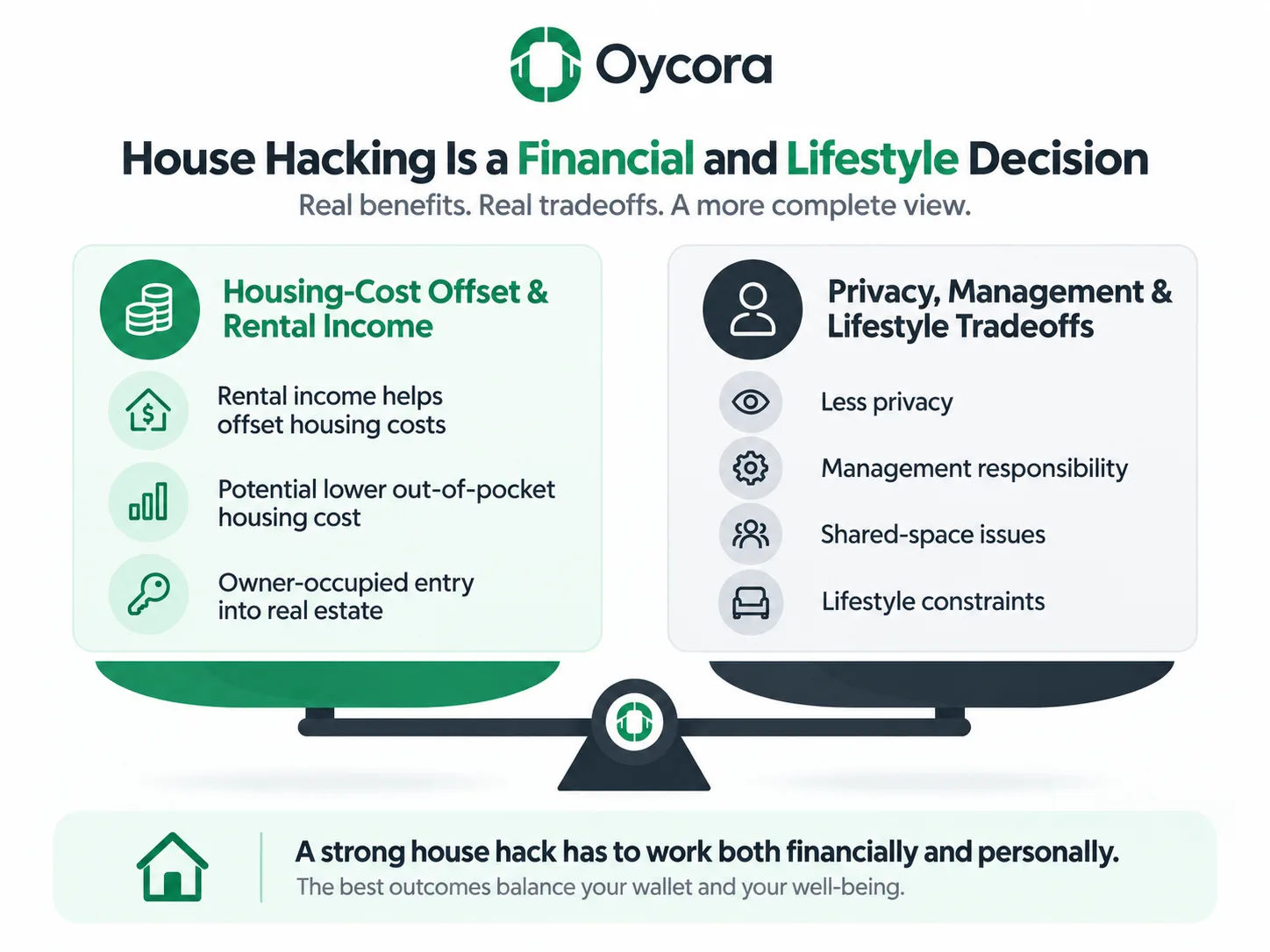
This is why the goal should not automatically be to eliminate your entire housing payment. “Live for free” can be useful marketing shorthand, but it is not a serious underwriting standard. A house hack can still be financially valuable if rental income reduces a $2,500 monthly housing burden to $1,200, especially if the owner is also building equity and gaining experience operating a property.
The more useful question is whether the remaining personal housing cost is attractive relative to the lifestyle and management responsibilities required to achieve it. A mathematically strong house hack can be a poor personal fit, just as a property with only partial housing-cost reduction can still be a very effective strategy for the right owner.
Once that tradeoff is understood, the next step is financing. Owner occupancy is one of the features that can make house hacking distinct from buying a conventional rental, and the way lenders treat the property’s rental income can materially affect both qualification and the amount of cash required to purchase it.
Back to Guide contentsFinance and Qualify for the Property
House hacking can create financing opportunities that do not exist for a traditional non-owner-occupied rental because the buyer intends to live in the property. That owner-occupancy can affect eligible loan programs, required cash, and the way rental income from the other units is treated during underwriting.
The financing should still be analyzed as part of the investment rather than simply as a way to reduce the down payment. A lower-cash owner-occupied structure can make the property easier to acquire, but the resulting loan still has to fit the building’s income, the buyer’s personal finances, and the amount of housing cost they are comfortable carrying.
Why Owner-Occupancy Changes the Financing
A duplex, triplex, or four-unit property can still be treated as a primary residence when the borrower genuinely occupies one of the units and satisfies the applicable loan requirements. Freddie Mac currently lists 2–4 unit owner-occupied primary residences as eligible property types for a range of mortgage products, while Fannie Mae also permits qualifying rental income from eligible 2–4 unit principal residences.
That can make house hacking materially different from buying the same building purely as an investment property. Owner-occupied financing may offer different LTV limits, pricing, reserve requirements, or product eligibility depending on the loan program. Freddie Mac’s HFA Advantage program, for example, currently permits up to 95% LTV on eligible 2–4 unit primary residences, subject to its specific borrower and program requirements.
The important point is not that every house hack qualifies for a low-down-payment loan. Eligibility varies by product, borrower, property, and underwriting system. The useful takeaway is that occupancy changes the financing category, which can change the acquisition economics substantially.
Owner occupancy also has to be legitimate. A borrower should not represent an investment property as a primary residence simply to obtain more favorable financing. The strategy only works within the applicable occupancy rules of the chosen loan program.
How Rental Income May Help Qualification
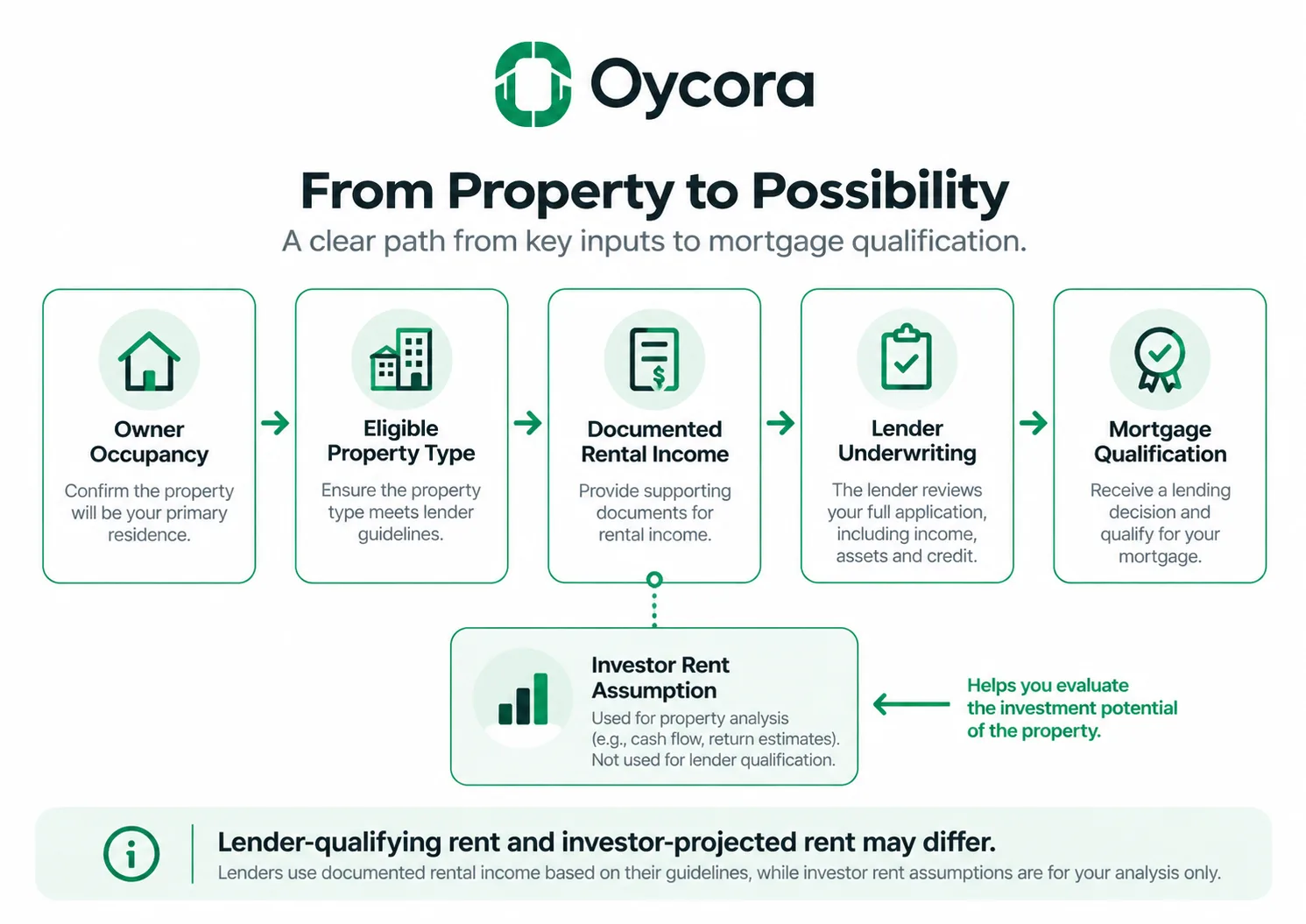
The rent from the other units can sometimes help the borrower qualify for the mortgage, but lenders do not simply take the investor’s projected rent and add the full amount to income.
Fannie Mae’s current subject-property rental-income guidance allows rental income from eligible 2–4 unit principal residences and from certain one-unit primary residences with an ADU. For purchases, the lender generally uses appraisal-supported rent documentation and, when applicable, executed lease agreements. Freddie Mac likewise states that rental income from the other units of an eligible 2–4 unit primary residence can be added to borrower income when calculating housing expense and debt-to-income ratios.
The qualifying amount may still differ from the rent used in the investor’s own property analysis. A buyer might reasonably expect one unit to rent for $1,600 based on local comparables, while lender underwriting may use an appraisal-derived figure or apply its own treatment before determining how much income is allowed for qualification.
This creates two separate numbers that should not be confused:
Investor rent assumption: what the owner reasonably expects the unit to produce economically.
Qualifying rental income: the amount the lender allows to support the mortgage application.
Both matter. The first helps determine whether the house hack works as an investment and housing strategy. The second determines whether the borrower qualifies for the proposed loan.
Buying a Duplex as a House Hack
Assume a buyer is considering a $300,000 duplex. They plan to occupy one unit and rent the other. For simplicity, assume the loan structure requires a 5% down payment and the following estimated acquisition costs.
| Purchase & Financing | Amount |
|---|---|
| Purchase price | $300,000 |
| Down payment | $15,000 |
| Loan amount | $285,000 |
| Closing costs / prepaid items | $9,000 |
| Initial repairs / setup | $6,000 |
| Initial cash needed before reserves | $30,000 |
Assume the rented unit is expected to produce $1,550 per month in actual market rent, while the lender ultimately uses $1,450 per month as qualifying rental income under its underwriting.
Now estimate the monthly housing cost:
| Monthly Housing Cost | Amount |
|---|---|
| Principal & interest | $1,900 |
| Property taxes | $400 |
| Insurance | $180 |
| Owner-paid utilities / common costs | $120 |
| Maintenance / reserve allowance | $200 |
| Total modeled housing cost | $2,800 |
| Less rent from second unit | −$1,550 |
| Owner’s effective housing cost | $1,250/month |
The buyer is not “living for free.” They are still contributing approximately $1,250 per month under the assumptions above, while also taking responsibility for maintenance, vacancy, repairs, and the mortgage.
The lender may evaluate the transaction differently. It may use the $1,450 qualifying rent rather than the investor’s $1,550 expectation, along with the borrower’s personal income, debts, credit, and reserves. That difference does not make either number wrong. They serve different purposes.
The example also shows why a house hack should be evaluated on more than the down payment. The relatively small equity contribution makes the purchase accessible, but the owner still needs closing cash, repairs, reserves, and enough income to comfortably carry the property if the rented unit becomes vacant.
Financing can make the strategy possible. It does not remove the need for the property to work economically. The next step is to analyze the house hack from both sides at once: as a place to live and as an income-producing rental property.
Back to Guide contentsAnalyze the House Hack as Both a Home and an Investment
Once financing is understood, the house hack needs to be analyzed from two angles at the same time. The property has to work as a place to live, but it also has to function as a rental. That means the owner should understand both the effective personal housing cost and the economics of the income-producing portion of the property.
This is where house hacking differs from a normal rental analysis. The owner is not simply asking, “How much cash flow does this property produce?” They are also asking, “How much does this arrangement reduce my own housing cost compared with my alternatives?” Those two questions are related, but they are not the same.
Calculate the Effective Housing Cost
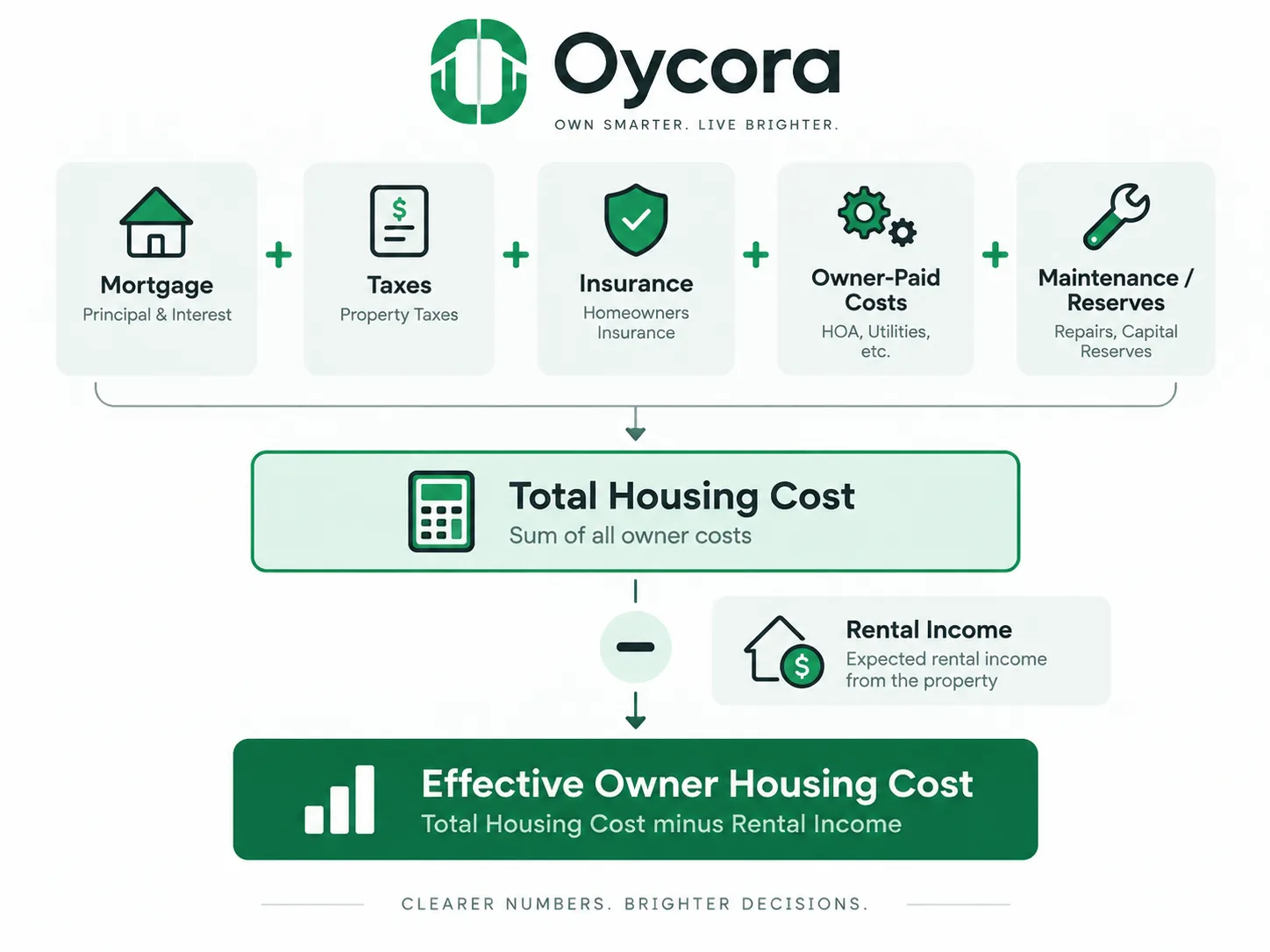
The most useful house-hack number for many buyers is the amount they personally expect to pay each month after rental income is applied against the total housing cost.
A simple framework is:
Effective Housing Cost = Total Monthly Housing Cost − Rental Income Received
Total housing cost should include more than principal and interest. Property taxes, insurance, owner-paid utilities, maintenance, and reserve planning all affect the actual burden of ownership. If the owner pays water, lawn care, common electricity, or internet for tenants, those costs belong in the model as well.
Assume a duplex has a total modeled monthly housing cost of $2,800 and the rented unit produces $1,550 per month. The owner’s effective housing cost would be approximately $1,250 per month before taxes or other personal considerations.
That number becomes more useful when compared with realistic alternatives. If renting a comparable apartment would cost $1,600 per month, the house hack may reduce the owner’s out-of-pocket housing cost while also building equity. If the same buyer could otherwise live somewhere for $700, the tradeoff looks different.
This is why “living for free” is usually too simplistic. A house hack can still be financially effective even when the owner pays a meaningful amount each month. The strategy is about reducing housing cost and building ownership economics, not meeting an arbitrary zero-dollar threshold.
Treat the Rental Side Like a Real Rental Property
The rental portion of a house hack should be underwritten with the same discipline as any other rental. Rent is not guaranteed, tenants may move out, repairs still occur, and the presence of the owner on-site does not eliminate vacancy or maintenance risk.
Start with supported rent rather than the highest possible listing price. Account for vacancy and collection loss, especially if the strategy depends heavily on one tenant. In a duplex, one vacant rental unit can eliminate 100% of the property’s rental income while the owner remains responsible for the entire mortgage.
Operating expenses also need to be allocated thoughtfully. Some costs belong to the entire property, while others may be tied more directly to one unit. Shared utilities, lawn care, snow removal, common-area electricity, and maintenance affect the property as a whole even when one side is owner-occupied.
Reserve planning matters for the same reason. The fact that the owner lives in the property does not make the roof, furnace, plumbing, or appliances last longer. If anything, house hacking can tempt buyers to blur personal-home expenses and rental expenses because both occur in the same building.
The cleaner approach is to maintain a property-level operating model, then separately calculate the owner’s effective housing cost. That preserves a clear view of how the real estate is performing while still showing how much the rental income is helping the owner personally.
Compare House Hacking With Renting or Buying Alone
House hacking makes the most sense when compared with the buyer’s realistic alternatives rather than evaluated in isolation.
One alternative is renting. Renting may require less upfront cash and provide more flexibility, but it does not build property equity and offers no rental income. Another is buying a primary residence without tenants, which provides more privacy but places the full housing cost on the owner. A third is buying a traditional investment property while continuing to live elsewhere, which separates home life from tenants but may require different financing and more total cash.
A useful comparison should look beyond the monthly payment. Consider cash required upfront, effective monthly housing cost, rental income, equity accumulation, maintenance responsibility, privacy, mobility, and management workload.
| Factor | House Hack | Rent | Buy Without Tenants |
|---|---|---|---|
| Upfront cash | Moderate to high | Usually lower | Moderate to high |
| Rental income | Yes | No | No |
| Housing-cost offset | Potentially significant | None | None |
| Equity building | Yes | No | Yes |
| Tenant management | Yes | No | No |
| Privacy | Lower to moderate | Usually higher | Higher |
| Flexibility to move | Lower | Higher | Lower |
The point of the comparison is not to rank the options. It is to reveal the tradeoffs. A house hack may produce the strongest financial outcome for one buyer and be a poor lifestyle fit for another.
The strategy works best when the owner values both sides of the arrangement: the financial benefit of rental income and the practical reality of living in or near the property being managed. If one side is ignored, the house hack can look much better on paper than it feels in real life.
Back to Guide contentsLive With It, Manage It, and Plan the Exit
House hacking does not stop being an investment strategy once the purchase closes. The property still has to function day to day, and the fact that the owner lives on-site can make management easier in some ways and more personal in others. Privacy, communication, shared utilities, maintenance, and tenant boundaries all matter more when the landlord is also a neighbor.
The strategy also changes over time. Many house hackers eventually move out, convert the property into a full rental, refinance, sell, or use the experience to buy another property. Planning for that transition early makes it easier to understand whether the property still works once the owner-occupancy benefit disappears.
Landlord and Tenant on the Same Property
Living near tenants can make management more convenient. Maintenance issues are easier to notice, the owner can keep a closer eye on the property, and response times may be faster. That proximity can be especially useful for a first-time landlord learning how repairs, turnover, and tenant communication actually work.
The downside is that professional boundaries can become harder to maintain. A tenant who sees the owner every day may be more likely to make informal maintenance requests in the driveway or knock on the door instead of using the agreed communication process. Shared parking, laundry, yard space, entrances, storage, or utilities can also create friction if expectations are not clear from the beginning.
The property layout can reduce many of these problems. Separate entrances, clearly assigned parking, good sound insulation, defined outdoor areas, and independently controlled utilities can make the arrangement feel much more like normal neighboring households rather than a landlord living inside the rental operation.
Written systems still matter even when everyone lives close together. Rent collection, maintenance requests, lease enforcement, notices, and documentation should remain professional. The owner may be physically nearby, but the rental relationship should not depend on casual verbal agreements.
Local landlord-tenant rules also continue to apply. Owner occupancy can affect the treatment of some properties under specific laws, but the exact rules vary by jurisdiction. Living in the building should never be assumed to remove normal legal responsibilities around leases, deposits, safety, access, or tenant rights.
What Happens When You Move Out
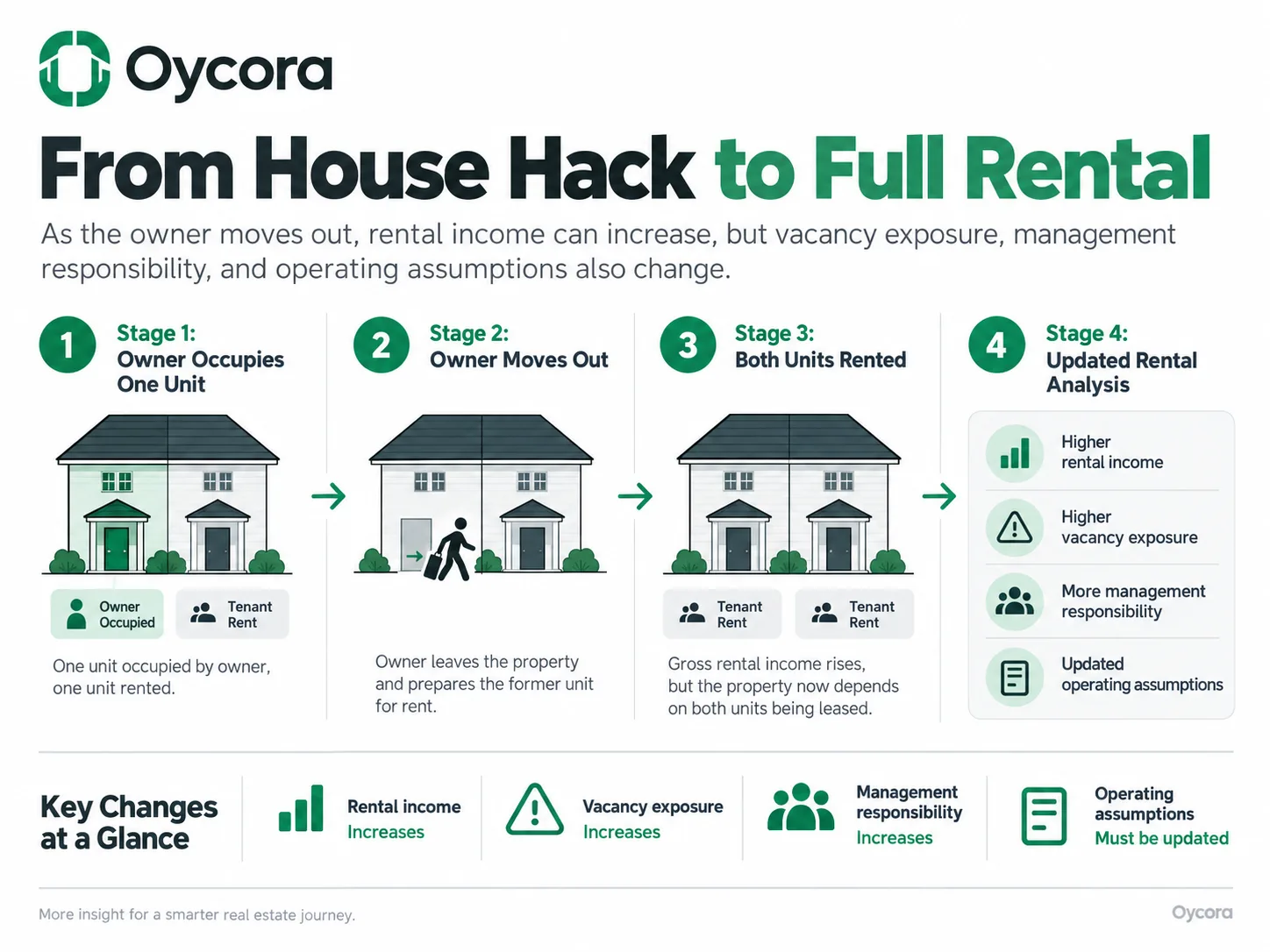
One of the most important long-term advantages of a house hack is that the property may eventually become a conventional rental. When the owner moves out of their unit, that space can potentially become another source of rental income, changing the property from a partially rented residence into a fully income-producing asset.
That transition should trigger a new analysis.
Suppose the owner previously occupied one half of a duplex while collecting $1,550 from the other unit. After moving out, the former owner unit may rent for $1,650. Gross potential rental income is now significantly higher, but so are vacancy exposure and management responsibilities because both units are rental units.
The owner should revisit rent assumptions, vacancy, utilities, management costs, maintenance, reserves, insurance, and cash flow. Costs previously treated partly as personal housing expenses may now belong entirely to the rental operation. The insurance structure may need to change as well once the property is no longer owner-occupied.
The existing mortgage does not automatically change simply because the owner later moves out after legitimately satisfying the original occupancy requirements. Future purchases or refinances, however, will be underwritten based on the circumstances at that time and the rules of the new loan being requested.
This makes house hacking useful as a potential bridge into rental ownership, but the next phase should not be evaluated using the original house-hack numbers. Once the owner leaves, the property has a different operating structure and deserves a fresh analysis.
When House Hacking Stops Making Sense
House hacking does not have to be permanent. A strategy that works well at one stage of life may become unattractive later.
Privacy needs can change. A buyer may be comfortable sharing a duplex at age 25 and much less interested after starting a family or working from home. A room-rental strategy may become tiring even if the numbers remain strong. Management demands can also become harder to justify as income, career, or personal responsibilities change.
The property itself may also stop fitting the strategy. Rental demand can weaken, major repairs can increase the cost of ownership, or the owner may discover that the layout creates more tenant conflict than expected. Conversely, appreciation or equity growth might create an opportunity to sell, refinance, or redirect capital elsewhere.
This does not mean the original house hack failed. Investment strategies should be allowed to evolve.
A useful decision framework is to compare the current arrangement with the alternatives available now, not with the circumstances that existed when the property was purchased. What is the effective housing cost today? What could the owner earn by renting their unit? What would another home cost? How much equity is tied up in the property? How much management burden is the owner carrying?
House hacking is most valuable when it continues to serve both sides of the strategy: the housing side and the investment side. Once one side no longer fits, changing the arrangement can be the logical next step.
Back to Guide contentsPractical Takeaways
House hacking works by combining owner occupancy with rental income, but that simple description hides several important decisions. The property type, layout, financing, tenant separation, and lifestyle all affect whether the strategy feels sustainable in practice.
Analyze the property as both a home and a rental. Calculate the full housing cost rather than comparing rent only with principal and interest, and account for vacancy, maintenance, reserves, insurance, utilities, and other owner-paid expenses. Rental income can meaningfully reduce the owner's housing burden without needing to reduce it all the way to zero.
Keep lender qualification separate from investment analysis. The rent used by the lender may differ from the rent the owner expects to collect, and owner-occupied financing still has to satisfy the requirements of the specific loan program.
Finally, think beyond the first year. A good house hack should have a reasonable path after the owner moves out. Understanding how the property could perform as a full rental makes the original purchase easier to evaluate and gives the owner more flexibility later.
Back to Guide contentsConclusion
House hacking can be a practical way to combine housing and rental-property ownership, but it works best when it is treated as more than a financing shortcut.
The strongest house hacks start with a property that fits the owner's lifestyle, produces supportable rental income, has financing the buyer can realistically carry, and leaves enough room for vacancy, repairs, and normal ownership costs. The strategy becomes more useful when the owner understands exactly how much the tenants are offsetting housing costs rather than relying on slogans about living for free.
It also provides something that is difficult to replicate through reading alone: direct experience. The owner learns what tenants need, how buildings behave, which expenses were underestimated, and how real cash flow differs from projections.
That experience can become the foundation for future rental ownership, whether the property eventually becomes a full rental, remains a long-term house hack, or is sold to fund another opportunity.
House hacking is ultimately a hybrid strategy. It has to make sense financially, operationally, and personally. When those three pieces align, it can be a strong first step into real estate ownership.
Back to Guide contentsHow Oycora calculates this
Calculation methodology
Related articles

Property Analysis
What Is Cap Rate in Real Estate and How Do You Calculate It?
Cap rate measures a property's net operating income relative to its value. Learn how to calculate capitalization rate, what changes it, how to compare properties, and why cap rate should never be used as a stand-alone buy-or-pass signal.

Property Analysis
How to Calculate Rental Property Cash Flow
Rental property cash flow is the money left after property income, operating expenses, and financing costs are accounted for. Learn how to calculate it, what affects it, and why realistic assumptions matter more than simply producing a positive number.
Property Analysis
How Much Should You Set Aside for Rental Property Maintenance and Repairs?
Rental property maintenance costs are uneven, but they should still be planned for. Learn how to build a realistic maintenance budget, separate routine repairs from CapEx, and choose between percentage-based and component-based reserve methods.
Related Guides

Oycora Guide · Property Analysis
The Complete Guide to Analyzing a Rental Property
A complete rental-property analysis starts long before the final return percentage. This Guide walks through how to build realistic assumptions, measure operating performance, account for financing, interpret the major metrics, and stress-test the result before relying on it.
Read Guide →
Oycora Guide · Getting Started
How to Buy Your First Rental Property: A Beginner’s Guide
Buying your first rental property involves more than finding a house that rents for more than the mortgage. This Guide walks through preparing financially, defining what you are looking for, evaluating your buying capacity, and understanding the responsibilities that come with becoming a landlord.
Read Guide →