The maximum price a lender is willing to finance and the amount of rental property you can comfortably afford are not necessarily the same number. Loan approval focuses on underwriting requirements. Investment affordability also has to account for how much cash you have available, how much must remain after closing, what the property needs immediately, and whether the resulting financing still produces acceptable cash flow.
That distinction matters because a buyer can have enough money to close and still leave the transaction financially stretched. A down payment is only one part of the acquisition. Closing costs, inspections, initial repairs, lender reserves, insurance, and post-closing liquidity can all compete for the same pool of cash.
A practical affordability analysis therefore starts with the investor's capital and works backward toward a purchase range. The goal is not to spend the maximum possible amount. It is to identify a range where the acquisition, financing, reserves, and property economics can all work together.
Lender Approval Is Not the Same as Investment Affordability
A lender asks whether the borrower and transaction meet its credit standards. Depending on the loan, that may involve income, debts, credit, reserves, property value, rental income, or the property's debt coverage. Passing those tests tells you the financing may be available; it does not tell you whether using all of that borrowing capacity makes sense for the investment.
An investor also needs to think about what happens immediately after closing. If buying at the top of the approved range consumes nearly all available savings, the first vacancy or repair can create a liquidity problem. A somewhat less expensive property may leave the owner with more reserves, lower debt service, and greater flexibility even though the lender would have allowed a larger purchase.
This is why affordability should be treated as a capital-allocation decision rather than simply a borrowing-limit question. The useful number is the price range that leaves enough money to complete the purchase and operate the property afterward.
Start With the Cash You Actually Have Available
Before calculating a target property price, separate the money available for the transaction from money that should remain untouched for other obligations. An investor with $100,000 in savings may not realistically have $100,000 available for one rental purchase if part of that money is needed for personal emergencies, taxes, other investments, or existing properties.
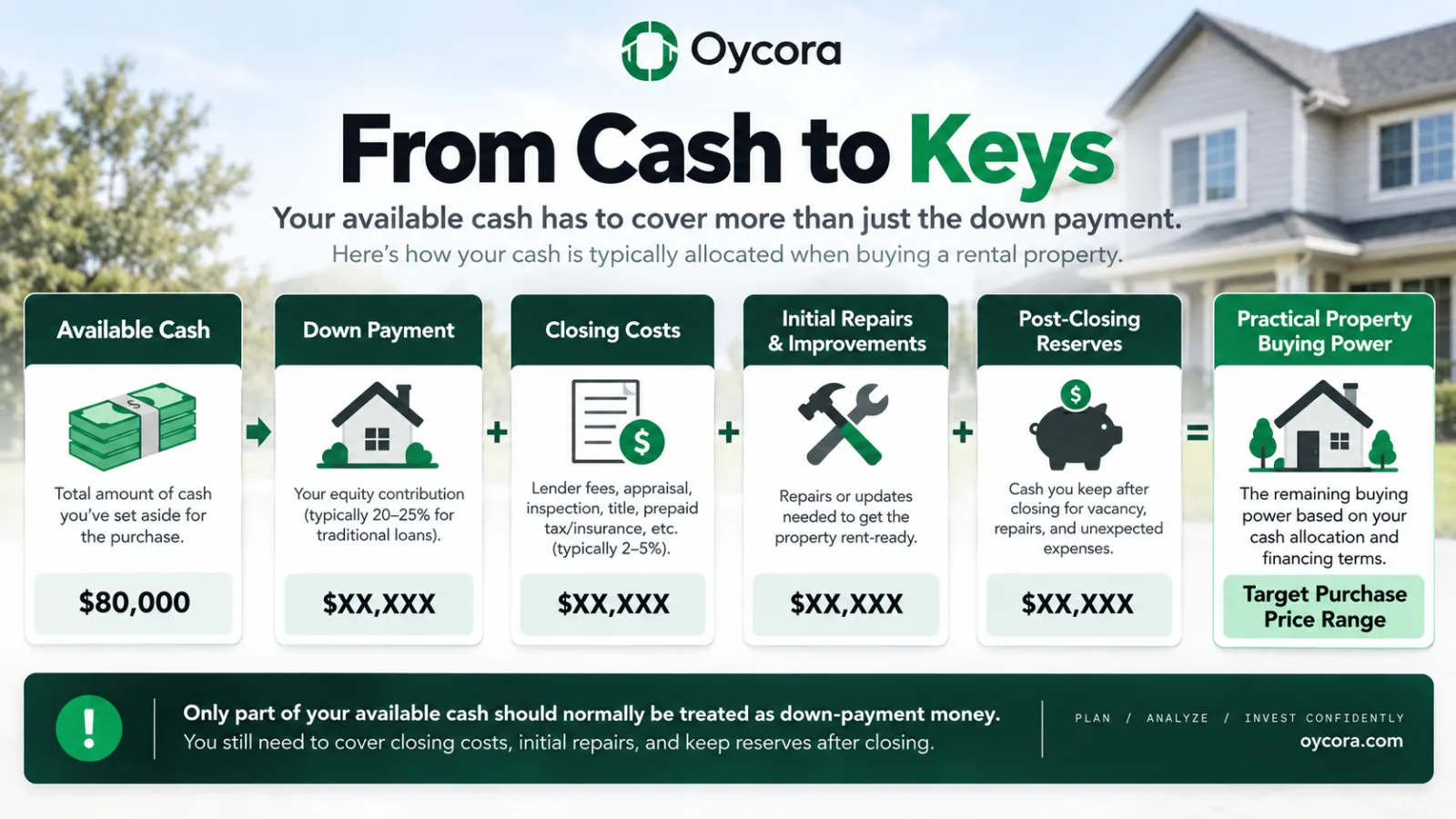
Once the acquisition pool is defined, it needs to cover more than the down payment. Common cash requirements can include closing costs, inspections, appraisal costs, prepaid insurance or taxes, immediate repairs, renovation work, and reserves. The exact amounts vary by transaction, but leaving them out will overstate how much property the investor can afford.
Initial repairs deserve particular attention. A $300,000 rental requiring $25,000 of immediate work may require more investor cash than a $320,000 property that is already rent-ready. Purchase price alone therefore does not determine affordability.
Down Payment and LTV Determine How Much Price Your Cash Can Support
The down payment is usually the largest single cash requirement, which makes the financing structure a major driver of buying power. If the loan requires 20% down, each $20,000 of down-payment capital supports roughly $100,000 of property value before closing costs and other cash needs are considered. At 25% down, the same $20,000 supports only about $80,000 of purchase price.
This relationship is expressed through loan-to-value ratio, or LTV. An 80% LTV loan means the lender finances 80% of the property value and the buyer contributes approximately 20% equity. A 75% LTV loan requires more equity upfront but creates a smaller loan balance.
Lower down payments can increase buying power because less cash is required for each dollar of property value. They also increase leverage, which can mean higher debt service and less cash flow. The financing structure that allows the highest purchase price is therefore not automatically the structure that produces the strongest investment.
Closing Costs and Initial Repairs Reduce Buying Power
It is easy to calculate affordability using only:
Available Cash ÷ Down Payment Percentage
That usually overstates the answer because the investor still has to fund the rest of the transaction. If $80,000 is available and the loan requires 20% down, dividing $80,000 by 20% suggests a $400,000 purchase. But if $12,000 is needed for closing costs, $8,000 for immediate repairs, and $20,000 is intentionally retained as reserves, only $40,000 remains for the down payment.
That changes the practical price dramatically.
Closing costs can also vary with property price and loan structure, which means affordability is iterative rather than perfectly linear. As the target price rises, some acquisition costs may rise with it. A calculator can make this easier by modeling the down payment, closing assumptions, financing, and available cash together.
Turning $80,000 Into a Practical Purchase Range
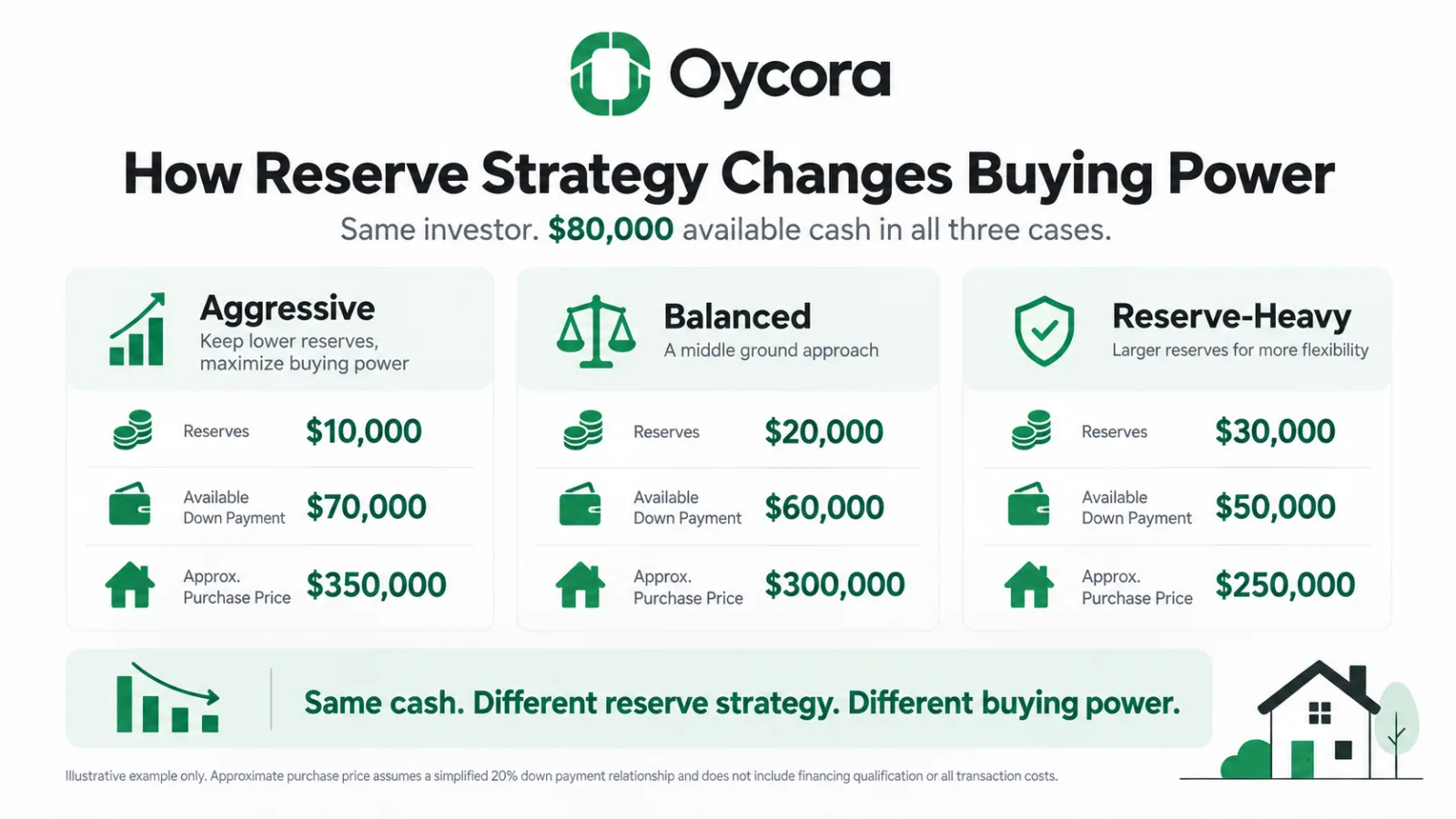
Assume an investor has $80,000 available specifically for a rental-property acquisition. Compare three different ways that cash could be allocated.
| Cash Allocation | Aggressive | Balanced | Reserve-Heavy |
|---|---|---|---|
| Total cash available | $80,000 | $80,000 | $80,000 |
| Post-closing reserves | $10,000 | $20,000 | $30,000 |
| Closing costs / prepaid items | $10,000 | $10,000 | $10,000 |
| Initial repairs / improvements | $5,000 | $5,000 | $5,000 |
| Cash available for down payment | $55,000 | $45,000 | $35,000 |
Now assume the investor uses financing requiring a 20% down payment:
| Strategy | Down-Payment Cash | Approx. Maximum Price Supported by Down Payment |
|---|---|---|
| Aggressive | $55,000 | $275,000 |
| Balanced | $45,000 | $225,000 |
| Reserve-heavy | $35,000 | $175,000 |
The investor has the same $80,000 in every scenario. The practical buying power changes because the amount of cash intentionally preserved after closing changes.
That does not mean the aggressive strategy is wrong. It means the investor is choosing between more property now and more liquidity afterward. The correct balance depends on the property, expected repairs, income stability, financing, and the investor's broader financial position.
Keeping More Reserves Lowers Buying Power, but Can Improve Resilience
Reserves reduce the amount of cash available for the down payment, so they naturally lower the maximum purchase price. That can feel inefficient when the investor is eager to buy, but reserves serve a different purpose from equity. They give the property room to absorb vacancy, repairs, insurance deductibles, turnover costs, or other expenses without immediately requiring new outside cash.
The amount needed depends on the property and investor. A newer rental with recently replaced systems may justify a different reserve level from an older property with an aging roof and HVAC system. An investor with several properties may also think about liquidity differently from someone buying a first rental.
The important point is to decide on a reserve target before calculating the maximum price. If reserves are treated only as whatever cash happens to remain after closing, the affordability analysis will naturally push the buyer toward spending almost everything.
A Property Can Be Affordable to Buy and Still Be a Poor Fit
Affordability and investment quality are separate questions. A buyer may have enough cash and borrowing capacity to purchase a $300,000 rental, but that property may produce weak cash flow because taxes, insurance, maintenance, vacancy, or debt service are too high.
The opposite can happen as well. A $200,000 property may appear easily affordable from a cash perspective but require extensive repairs or have weak rental demand. The affordability calculation only tells you whether the transaction fits the investor's available capital and financing structure.
Once a realistic purchase range is established, the properties inside that range still need to be underwritten normally. Rent, vacancy, operating expenses, NOI, debt service, cash flow, cash-on-cash return, DSCR, and reserves all remain relevant.
This is why the search process should move in two directions: Can I afford to acquire it? and Does it make sense to own it?
Financing Terms Can Change the Affordable Price
The same investor can have very different buying power under different financing structures. A lower down-payment requirement increases the property value that a fixed amount of cash can support, while a higher down payment does the opposite. Interest rate and amortization then determine whether the resulting loan payment is actually manageable.
Suppose a financing option allows a higher purchase price but produces substantially more debt service. The investor may technically be able to close on the property while the projected cash flow becomes too thin. In that case, cash-on-hand is not the limiting factor—the property's ability to support the loan is.
This is where affordability and underwriting converge. A practical maximum price should satisfy both the investor's cash constraint and the property's financing economics.
Common Rental Property Affordability Mistakes
The most common mistake is treating every available dollar as down-payment money. That produces the largest theoretical purchase price but leaves closing costs, repairs, and reserves unfunded. Another is using the lender's maximum approval as the investment budget without considering whether the resulting payment leaves enough property cash flow.
Buyers can also underestimate the effect of immediate repairs. A lower-priced property is not necessarily easier to afford if it requires significant cash shortly after closing. Similarly, failing to account for insurance or tax changes can make the ongoing ownership cost meaningfully higher than expected.
Another mistake is confusing affordability with attractiveness. A property does not become a good investment simply because the investor has enough money to buy it.
Set a Search Range Before You Start Shopping
A useful property search should begin with a range rather than a single maximum number. The lower end might represent properties that preserve substantial liquidity, while the upper end represents what remains feasible under more aggressive but still acceptable assumptions.
Start with the amount of cash available for the investment. Subtract the reserves you want to retain, estimated closing costs, and expected initial repairs. Apply the remaining cash to the down payment requirement, then test whether the resulting loan payment still works with the property's likely income and expenses.
That process produces a more meaningful buying range than simply asking a lender, “What's the most I can borrow?”
The purpose of rental-property affordability analysis is not to determine the largest deal you can force into your budget. It is to identify a purchase range where the acquisition can close, the property can operate, and enough liquidity remains for ownership after the keys are handed over.