
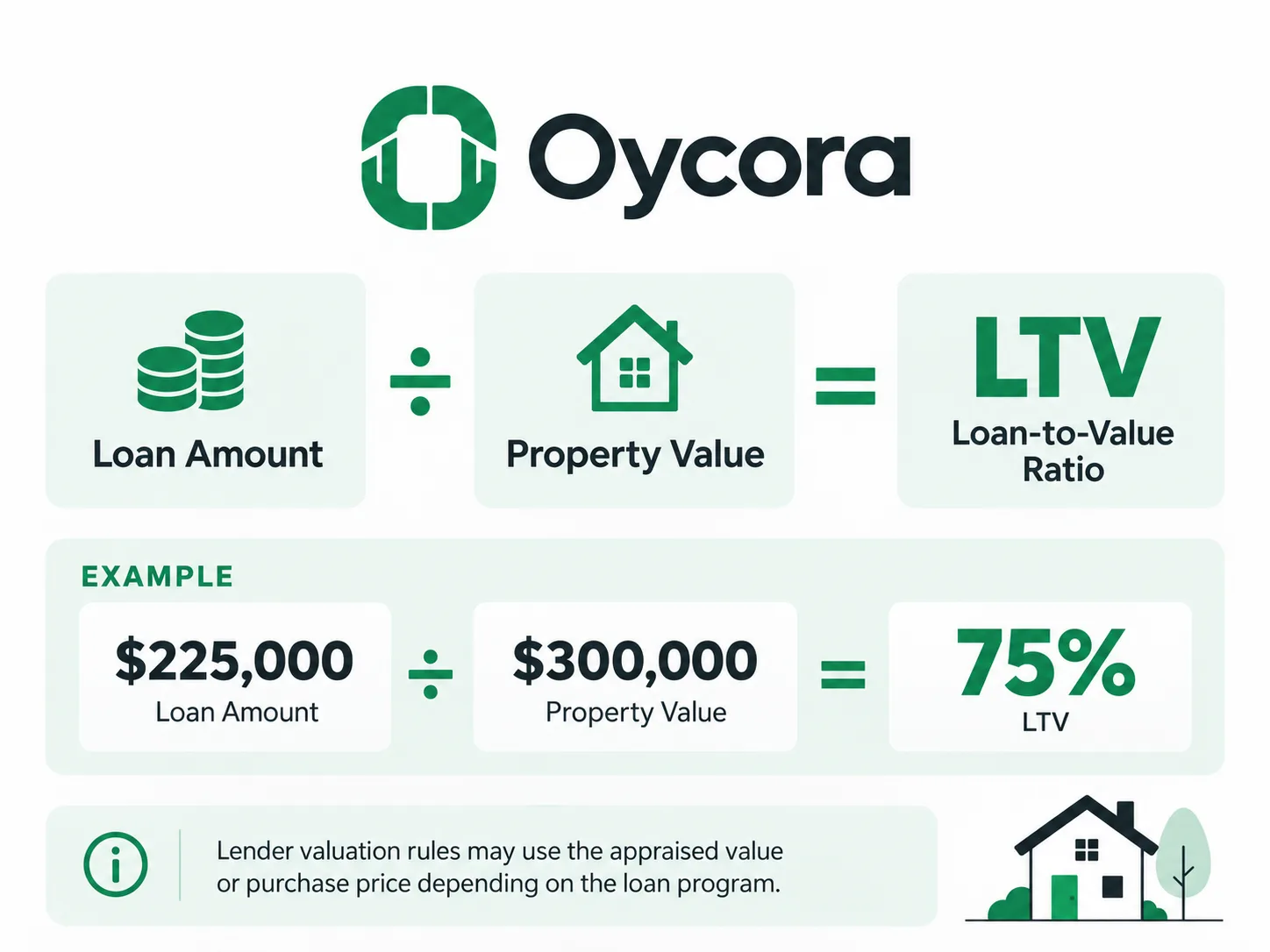
Loan-to-value ratio, usually shortened to LTV, tells you how much of a property's value is being financed with debt. If you buy a $300,000 rental property with a $225,000 mortgage, the starting LTV is 75%. The remaining 25% is equity contributed through the down payment, assuming the lender uses the purchase price as the relevant value.
LTV matters because it sits at the center of several financing decisions. It affects how much cash the buyer needs upfront, how much debt the property carries, and how much exposure the lender has relative to the collateral. The Consumer Financial Protection Bureau describes LTV as the amount being financed compared with the property's appraised value and notes that a larger down payment produces a lower LTV.
For rental-property investors, LTV is also a useful way to think about leverage. A higher LTV means more of the property is funded with debt and less with investor equity. A lower LTV means more investor cash is committed upfront and the loan represents a smaller share of the property's value.
How Is LTV Calculated?
The basic formula is:
LTV = Loan Amount ÷ Property Value × 100
Suppose a rental property is purchased for $400,000 with a $300,000 first mortgage. The LTV is:
$300,000 ÷ $400,000 = 75% LTV
The calculation itself is straightforward, but the value used by the lender deserves attention. Fannie Mae defines LTV as the relationship between the original first-mortgage amount and the property's appraised value, or the sales price when that price is lower. Selling Guide In other words, an investor cannot necessarily create a lower LTV simply by agreeing to pay substantially more than the lender believes the property is worth.
If a property is under contract for $320,000 but appraises for $300,000, the lender may base its LTV calculation on the lower $300,000 figure under applicable guidelines. That can affect both the maximum loan amount and the amount of cash the buyer needs to complete the purchase.
How Down Payment and LTV Work Together
For a simple purchase with one mortgage and no unusual financing structure, down payment and LTV are two ways of looking at the same capital stack. A 20% down payment generally corresponds to approximately 80% LTV, while 25% down corresponds to approximately 75% LTV.
That relationship can make LTV more intuitive:
| Down Payment | Approximate Starting LTV |
|---|---|
| 10% | 90% |
| 20% | 80% |
| 25% | 75% |
| 30% | 70% |
| 40% | 60% |
A larger down payment reduces the amount borrowed, which lowers LTV. The CFPB notes that a lower LTV can affect loan pricing and eligibility because lenders generally view higher-LTV lending as carrying greater collateral risk.
For investors, however, putting more money down is not automatically the optimal choice. A larger down payment can reduce debt service and strengthen cash flow, but it also ties up more investor capital. That tradeoff is why LTV should be evaluated alongside cash-on-cash return, DSCR, liquidity, and the investor's broader use of capital.
How LTV Changes the Same Rental Property
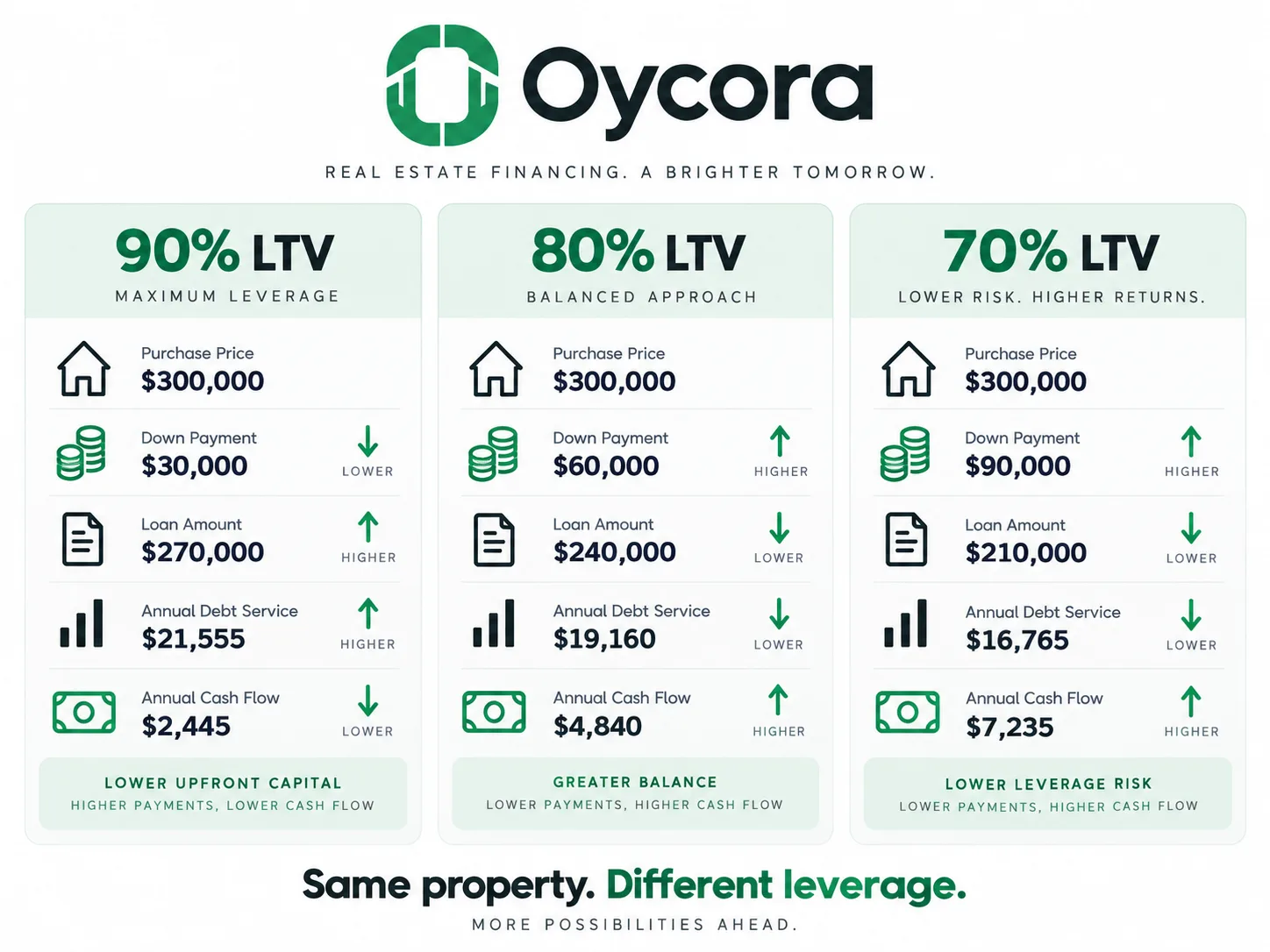
Assume three investors are considering the same $300,000 rental property. The property's rent, operating expenses, and NOI are identical in every scenario. Only the down payment and loan amount change.
| Scenario | Down Payment | Loan Amount | LTV | Approx. Annual Debt Service* |
|---|---|---|---|---|
| Higher leverage | $30,000 | $270,000 | 90% | $21,555 |
| Moderate leverage | $60,000 | $240,000 | 80% | $19,160 |
| Lower leverage | $90,000 | $210,000 | 70% | $16,765 |
*Illustrative debt service assumes the same hypothetical rate and amortization solely to show the financing relationship.
Now assume the property generates $24,000 of annual NOI:
| LTV | NOI | Annual Debt Service | Simplified Pre-Tax Cash Flow |
|---|---|---|---|
| 90% | $24,000 | $21,555 | $2,445 |
| 80% | $24,000 | $19,160 | $4,840 |
| 70% | $24,000 | $16,765 | $7,235 |
The lower-LTV structure produces more annual cash flow because the loan is smaller. But the investor also contributed substantially more cash upfront. That additional equity could affect cash-on-cash return differently, which is why the highest cash flow does not automatically mean the most efficient use of investor capital.
Why Lenders Care About LTV
From the lender's perspective, LTV helps show how much debt is secured by the property relative to its value. A higher LTV means the borrower has less equity between the outstanding loan and the property's value, leaving the lender with less collateral cushion if the property must be sold after a default.
That is why LTV can affect eligibility, pricing, mortgage-insurance requirements, and other loan terms. The CFPB notes that lenders use LTV when deciding how much they are willing to lend and that higher-LTV borrowers may receive different rates or loan requirements.
The exact maximum LTV depends on the loan program, occupancy, property type, borrower qualifications, and other underwriting rules. There is no universal maximum that applies to every rental-property loan, so an investor should use the requirements of the actual lender or program rather than treating one percentage as an industry-wide standard.
Higher LTV Means More Leverage
LTV is one of the clearest ways to describe leverage. A 90% LTV acquisition means only 10% of the property value is initially represented by the buyer's equity, while a 60% LTV structure means the investor has contributed much more equity relative to debt.
Leverage can amplify returns when property performance exceeds the cost of borrowing because the investor controls a larger asset with less personal capital. At the same time, it creates a larger fixed debt obligation relative to the same property income. If vacancy rises or expenses increase, that debt payment does not automatically fall.
This is why higher leverage often creates a thinner margin for error. The property may produce less cash flow and a lower DSCR even though the underlying rent and NOI are unchanged. Lower leverage generally improves coverage and reduces required debt service, but it does so by committing more equity to the deal.
Neither structure is universally better. LTV simply helps make the tradeoff visible.
LTV vs. DSCR
LTV and DSCR are both lending metrics, but they measure different types of risk.
LTV compares the loan with the property's value:
LTV = Loan Amount ÷ Property Value
DSCR compares qualifying property income with annual debt service:
DSCR = NOI ÷ Annual Debt Service
A property can have a low LTV but weak DSCR if the income is poor relative to the required payment. It can also have a relatively high LTV while maintaining stronger coverage if the property produces substantial NOI relative to debt service.
LTV therefore focuses primarily on collateral and leverage, while DSCR focuses on income and payment coverage. Looking at both provides a more complete picture than either metric alone.
What Happens to LTV as the Loan Is Paid Down?
The original LTV is established when the loan is made, but the relationship between debt and property value can change over time. As principal is repaid, the outstanding loan balance falls. If the property also appreciates, the investor's current equity may grow even faster.
Suppose a property is worth $300,000 and begins with a $240,000 loan, or 80% LTV. Several years later, the mortgage balance may have fallen to $220,000 while the property is worth $350,000. The current loan balance relative to current value would be about 62.9%.
That does not change the historical original LTV used when the loan was originated, but it can become important when refinancing or evaluating current leverage. The new lender will typically obtain a current valuation as part of the new credit decision. The CFPB notes that mortgage lenders obtain property valuations in purchase and refinance transactions because the estimated value is part of the lending decision.
LTV Matters When Refinancing
Refinancing effectively creates a new financing decision, so current property value and the proposed new loan amount become important again. If a property has appreciated and the mortgage balance has declined, the investor may have enough equity to refinance into a lower-LTV structure or potentially access some equity through a larger new loan.
A cash-out refinance raises the new loan balance relative to the property value, which increases leverage. That can release capital for another investment or other use, but it can also increase debt service and reduce future cash flow.
For example, an investor with a $200,000 loan on a $350,000 property has about 57% current LTV based on those figures. Refinancing into a $260,000 loan would move the ratio to roughly 74%. The investor receives additional proceeds, but the property now carries more debt.
This is why refinance decisions should be evaluated using more than the amount of cash that can be extracted. The resulting LTV, debt service, cash flow, DSCR, closing costs, and loan terms all matter.
Is a Lower LTV Always Better?
A lower LTV generally reduces lender exposure and the property's financing burden, but it does not automatically create the best investment structure for every investor.
Putting $150,000 into one property may create excellent coverage and low debt, but that same capital could potentially have been divided among multiple investments or retained as liquidity. An investor may therefore accept a higher LTV because preserving cash is strategically valuable, even though the property carries more debt.
The opposite can also be true. An investor who values stable cash flow and a wider margin for error may prefer a larger down payment and lower leverage even if that reduces cash-on-cash efficiency.
LTV should therefore be treated as a description of the capital structure, not a score. The useful question is not simply whether the ratio is high or low, but whether the amount of leverage fits the property's income, financing terms, reserve position, and investor strategy.
Use LTV to Understand the Financing Structure
Loan-to-value ratio gives investors a simple way to see how much of a property's value is financed with debt. It connects purchase price, appraisal, down payment, and loan amount into one percentage and makes different financing structures easier to compare.
But LTV does not tell you whether the property cash flows, whether its expenses are realistic, or whether the investment is attractive. A 60% LTV property can still perform poorly, while an 80% LTV property can still produce strong operating results.
Use LTV for the question it actually answers: how leveraged is the property relative to its value?
Then evaluate what that leverage does to the rest of the investment—debt service, cash flow, DSCR, cash-on-cash return, reserves, and the investor's available capital.