
Refinancing a rental property means replacing the existing mortgage with a new loan. The new financing might reduce the interest rate, lower the monthly payment, change the repayment term, or allow the investor to borrow against equity that has accumulated in the property. Those benefits can be meaningful, but a refinance is not automatically an improvement just because the new rate is lower.
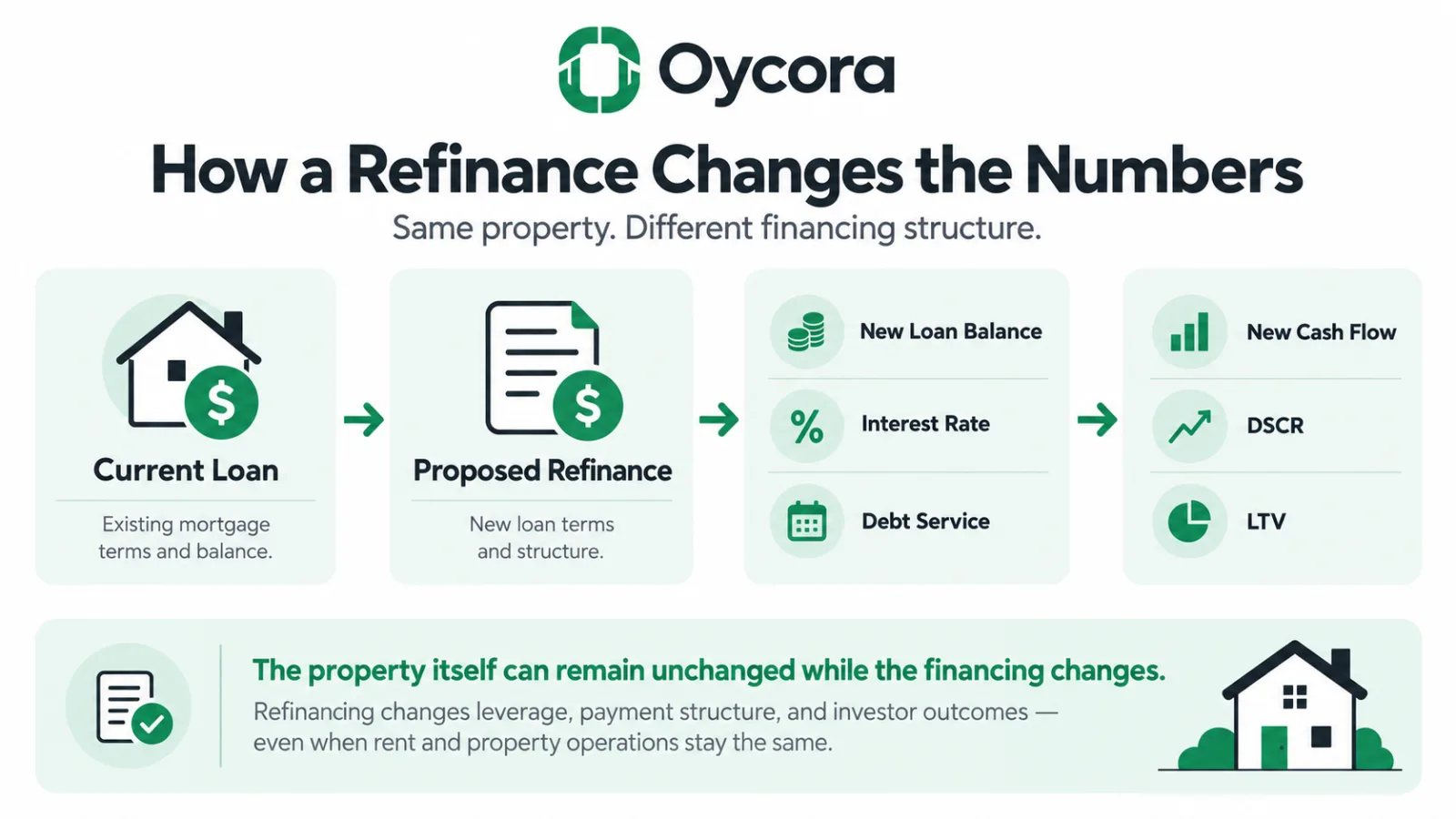
Every refinance changes the capital structure of the investment. The property may have the same tenants, rent, operating expenses, and NOI before and after the transaction, while debt service, cash flow, DSCR, loan balance, and LTV all change. The decision should therefore be evaluated as an investment decision rather than simply a mortgage-shopping decision.
The Consumer Financial Protection Bureau defines a mortgage refinance as taking out a new loan to pay off and replace the old one and lists lower rates, lower payments, and borrowing additional money among the common reasons borrowers refinance. It also cautions that a lower payment can sometimes come from extending the loan term rather than purely from receiving a better rate.
What Does Refinancing Actually Change?
A refinance normally pays off the existing mortgage and replaces it with a new one. That means the new loan can have a different balance, interest rate, amortization schedule, monthly payment, maturity date, and set of closing costs.
For a rental-property investor, the most immediate effect is usually debt service. If the new loan reduces annual principal and interest payments, more NOI remains available as pre-tax cash flow. If the new loan is larger because the investor is taking cash out, the opposite can happen even if the interest rate itself improves.
Refinancing can also reset the amortization clock. An investor who has already spent seven years paying down a 30-year mortgage might refinance into a new 30-year loan and reduce the monthly payment partly because the remaining balance is being spread across a longer period again. That may help current cash flow, but it can slow future principal reduction and increase the total time the property remains financed.
Rate-and-Term Refinance vs. Cash-Out Refinance
The two broad refinance situations an investor is likely to encounter are rate-and-term refinancing and cash-out refinancing.
A rate-and-term refinance primarily changes the financing terms without extracting substantial equity. The investor might refinance because market rates have fallen, because the existing loan has an unfavorable structure, or because a longer or shorter amortization better fits the strategy. Freddie Mac's no-cash-out refinance framework includes eligible one- to four-unit investment properties, although actual LTV and underwriting requirements depend on the loan program and borrower.
A cash-out refinance creates a new mortgage larger than the amount needed to pay off the old loan, allowing the investor to receive part of the property's equity in cash. Fannie Mae and Freddie Mac both permit qualifying cash-out refinance transactions on investment properties subject to their respective eligibility, seasoning, valuation, and LTV requirements. For example, Fannie Mae's current guidance generally requires an existing first mortgage being paid off in a cash-out refinance to be at least 12 months old, subject to specified exceptions.
The key difference is that cash-out refinancing intentionally increases debt relative to a simple payoff of the existing balance. That may create useful capital, but it can also increase leverage, debt service, and the property's dependence on continued rental income.
Why Investors Refinance Rental Properties
One of the clearest reasons to refinance is a meaningful reduction in borrowing cost. If a lower interest rate reduces the payment enough to outweigh the transaction costs, the property may generate more cash flow without any change in its operating performance.
Investors may also refinance to change the loan term or amortization structure. A shorter amortization can accelerate principal paydown but increase the required payment, while a longer one can improve current cash flow by spreading repayment over more time. The correct choice depends on whether the investor prioritizes liquidity, current income, faster equity growth, or some combination of those goals.
Another reason is equity access. A property that has appreciated or had its mortgage paid down may contain significant equity that could potentially be redeployed into renovations, reserves, another acquisition, or another investment. That equity is not free capital, however. A cash-out refinance converts part of it back into debt.
Current Loan vs. Two Refinance Options
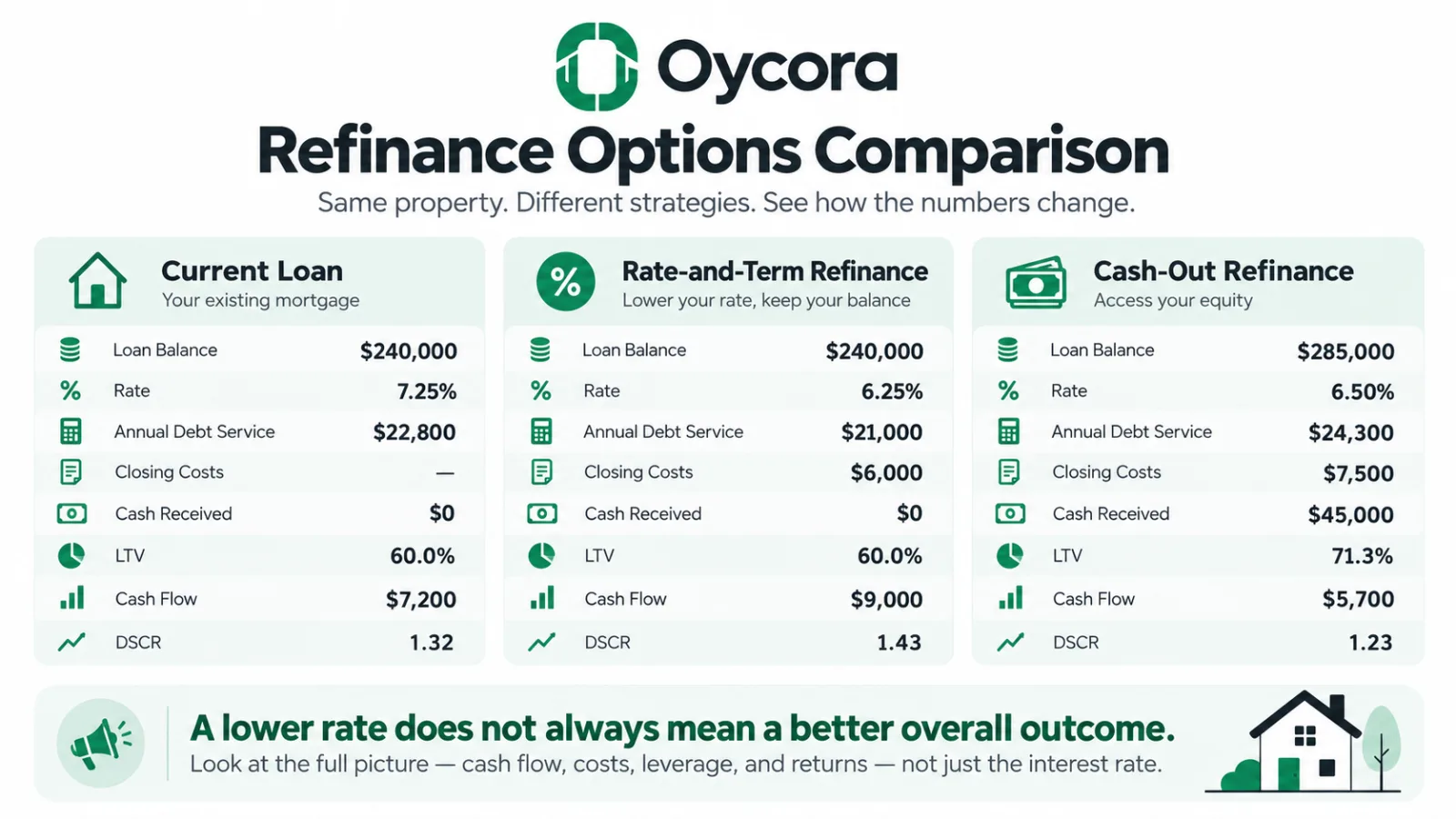
Assume a rental property produces $30,000 of annual NOI. Its current mortgage balance is $240,000, and annual principal and interest payments total $22,800.
| Financing Scenario | Current Loan | Rate-and-Term Refi | Cash-Out Refi |
|---|---|---|---|
| Loan balance | $240,000 | $240,000 | $285,000 |
| Interest rate | 7.25% | 6.25% | 6.50% |
| Annual debt service | $22,800 | $21,000 | $24,300 |
| Closing costs | — | $6,000 | $7,500 |
| Cash received | — | $0 | $45,000 |
| Property value | $400,000 | $400,000 | $400,000 |
| LTV | 60.0% | 60.0% | 71.3% |
| NOI | $30,000 | $30,000 | $30,000 |
| Pre-tax cash flow | $7,200 | $9,000 | $5,700 |
| DSCR | 1.32 | 1.43 | 1.23 |
The rate-and-term refinance improves annual cash flow by $1,800 and strengthens DSCR because the loan balance remains unchanged while debt service falls. The cash-out refinance gives the investor $45,000 of equity back, but annual cash flow falls below the current loan because the larger balance produces more debt service.
Neither refinance can be judged from the rate alone. The rate-and-term option has the strongest operating result in this example, while the cash-out option may still be attractive if the investor has a productive use for the $45,000 and is comfortable with the higher leverage.
Closing Costs Determine Whether the Savings Are Worth It
Refinancing creates a new mortgage transaction, so there are usually new costs. The CFPB lists mortgage closing costs such as origination charges, appraisal fees, title insurance, government fees, prepaid expenses, and other lender or third-party charges.
That means payment savings should be compared with the cost required to obtain them. A simple way to do this is the break-even period:
Break-Even Period = Refinance Closing Costs ÷ Monthly Payment Savings
Using the example above, suppose the rate-and-term refinance costs $6,000 and saves $150 per month. The simple break-even period would be approximately:
$6,000 ÷ $150 = 40 months
If the investor expects to sell the property in two years, paying $6,000 to save $150 per month is much less attractive. If the investor expects to hold it for another decade, the refinance has considerably more time to recover its cost.
A so-called no-closing-cost refinance should also be examined carefully. The CFPB explains that lenders may cover upfront costs by charging a higher interest rate or adding the costs to the loan balance. In either case, the cost still exists economically even if the borrower does not write a large check at closing.
How Refinancing Changes Cash Flow and DSCR
If NOI remains constant, lower debt service directly improves simplified pre-tax cash flow. It also improves DSCR because the same property income is being divided by a smaller annual debt obligation.
This makes rate-and-term refinancing potentially valuable for properties whose financing is consuming too much of their NOI. A property generating $30,000 of NOI with $25,000 of debt service has much less margin than one with the same NOI and $20,000 of debt service.
The reverse is true with a more aggressive cash-out refinance. Extracting equity may increase the loan balance enough to reduce cash flow and debt coverage. The new capital may still be strategically valuable, but the investor should be able to see exactly what was traded away to obtain it.
This is why cash flow and DSCR belong in the refinance comparison alongside the interest rate.
Cash-Out Refinancing Changes LTV and Risk
A cash-out refinance generally increases LTV because the investor is replacing the old balance with a larger mortgage. If the property is worth $400,000 and the loan increases from $240,000 to $285,000, LTV rises from 60% to about 71%.
That matters because more of the property is now financed with debt and less equity remains as a cushion. Higher leverage may also increase the required payment and reduce the property's ability to absorb weaker occupancy or rising expenses.
Loan programs themselves often impose different maximum LTV requirements depending on whether a transaction is cash-out or no-cash-out. Freddie Mac, for example, publishes different LTV limits by property type and transaction category, while Fannie Mae's valuation and cash-out guidance similarly distinguishes investment-property transactions.
The strategic question is therefore not simply, “How much equity can I pull out?” It is, “What will the property look like after I pull it out?”
When Refinancing May Make Less Sense
Refinancing often makes less sense when the expected savings are small relative to the transaction costs. A slight rate improvement may look attractive until the appraisal, lender fees, title costs, and other charges are included.
A short remaining holding period can create the same problem. If the property is likely to be sold before the refinance reaches its break-even point, the investor may never recover the upfront cost.
Resetting amortization can also be undesirable when the owner has already made substantial progress paying down the existing loan. The new payment may be lower, but the investor may be exchanging faster principal reduction for a longer repayment timeline.
Cash-out refinancing deserves additional caution when the property already has thin cash flow or weak coverage. Extracting equity from a property with little operating margin can leave the investment more exposed to vacancy, repairs, and other setbacks.
Finally, refinancing can be unnecessary when the existing debt is already unusually favorable. Replacing a low-rate fixed loan simply to access cash may create a much more expensive financing structure across the entire remaining balance.
A Practical Refinance Decision Framework
Before refinancing, compare the existing loan and proposed loan side by side. Look at the new balance, interest rate, monthly payment, annual debt service, amortization, term, closing costs, cash received, LTV, cash flow, and DSCR.
Then ask how long you expect to keep the property. Calculate how long it takes for payment savings to recover the transaction costs. If cash is being extracted, identify what the money will actually be used for and whether that use justifies the added debt.
Finally, stress-test the property after the refinance. If vacancy increases or expenses rise, does the new loan still leave enough coverage? A refinance that works only when every assumption goes right may be creating more risk than the initial headline benefit suggests.
Refinancing can be a powerful tool, but it should improve the investment for a clear reason. The objective is not simply to obtain a new mortgage. It is to create a financing structure that better fits the property's income, the investor's strategy, and the expected holding period.