

An empty rental has a cost even when the advertised rent looks right. If a qualified applicant would sign now with a rent credit, the useful question is how that offer compares with a realistic alternative: continuing to market the property, collecting no rent in the meantime, and hoping to lease it without a concession.
A concession can leave you with more rental income over the coming year, but it does not automatically make a weak applicant, an unsuitable lease, or an unrealistic asking rent a good decision. Start with a consistent measurement period, separate the rent credit from other costs, and test how long you would actually wait. That gives you a defensible negotiating range rather than a rule that every empty property should offer free rent.
Compare the Same Months, Not Just Two Lease Totals
Choose a start date and an end date before comparing offers. For a property available now, a useful first view is the next 12 months from today. If one tenant begins immediately and another begins a month later, the later lease contributes only 11 months of rent inside that window, even if both leases have a 12-month term.
Comparing the immediate lease’s discounted 12-month total with all 12 payments on the later lease hides the empty month. The later lease extends beyond the common end date. That final payment belongs in a longer analysis, along with whatever happens to the first lease after its initial term. It should not be pulled into only one side of a one-year comparison.
Use the same property condition, rental services, collection assumptions, and expense definitions on both sides. If a different tenant would pay more, occupy the property for longer, or require extra work, make that a separate assumption. A simple comparison is valuable because it shows which change is doing the work.
Translate the Offer Into Actual Rental Receipts
A rent concession is an incentive that reduces what the owner receives, such as a credit against one month’s rent. The lease may still state a monthly rent of $2,000, but a $1,000 credit reduces the total collected over 12 paid months from $24,000 to $23,000. Averaged across those months, that is approximately $1,916.67 per month. The average describes this example’s receipts; it does not rewrite the lease’s payment schedule.
The distinction also appears in professional underwriting. Fannie Mae’s multifamily income guidance treats concessions, physical vacancy, and bad debt as separate reductions in income. That guidance has its own lending context, but the analytical lesson is useful here: show each reduction explicitly instead of treating advertised rent as collected rent.
Record the credit’s amount, when it applies, and any conditions in the proposed lease documents. A credit in month one reduces early cash receipts differently from a credit in month twelve, even if the undiscounted yearly total is identical. The timing can matter when the property needs immediate cash for its bills.
Compare a Credit With One Empty Month
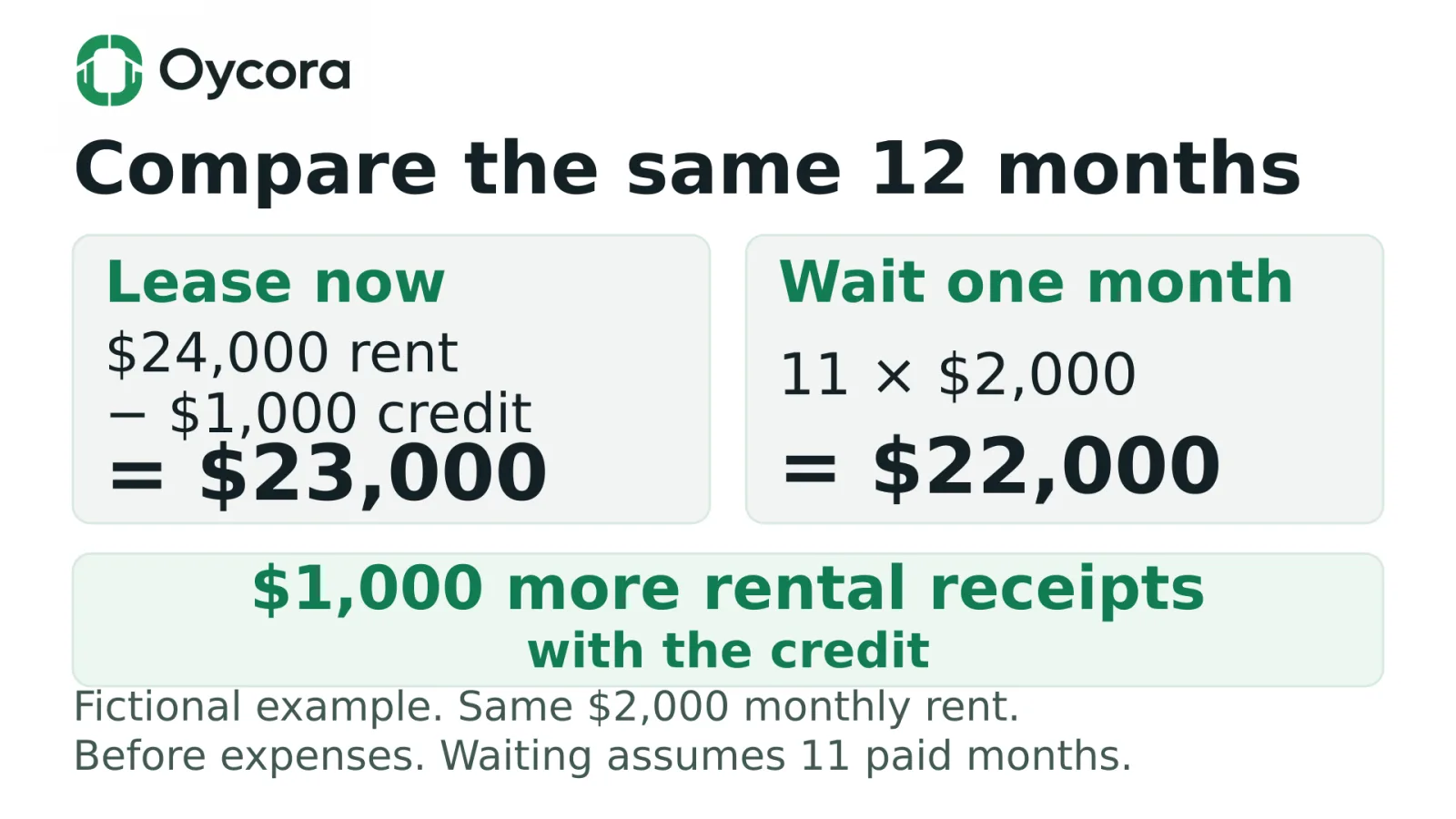
Consider a fictional ready-to-rent property advertised at $2,000 per month. Under the first scenario, a qualified tenant starts immediately, owes 12 monthly payments during the next 12 months, and receives a one-time $1,000 credit against the first month’s rent. Under the second scenario, the property remains empty for one month and then collects 11 full monthly payments at the same $2,000 rent before the comparison ends.
Assume all amounts due after the credit are collected, no other concessions apply, and neither scenario has another vacancy during the measurement period. Leasing costs and all other property costs are held equal for this first comparison. These are hypothetical scenarios, not a prediction that the credit guarantees a signed lease or that waiting will produce a tenant after exactly one month.
Real World Example
Fictional next-12-month comparison. Same $2,000 monthly rent; all amounts due are collected. One $1,000 first-month credit for immediate occupancy versus one month vacant and 11 paid months. All other costs held equal; receipts are before expenses.
| Measure | Lease now with credit | Wait one month |
|---|---|---|
| Paid months in the window | 12 | 11 |
| Rent before credit | $24,000 | $22,000 |
| One-time rent credit | −$1,000 | $0 |
| Rental receipts before expenses | $23,000 | $22,000 |
Additional rental receipts with the credit
$1,000
$23,000 − $22,000 = $1,000
The credit scenario collects more only because it avoids the assumed month of vacancy. This is rental income before expenses, not profit or final cash flow.
Find the Rent-Only Break-Even Point
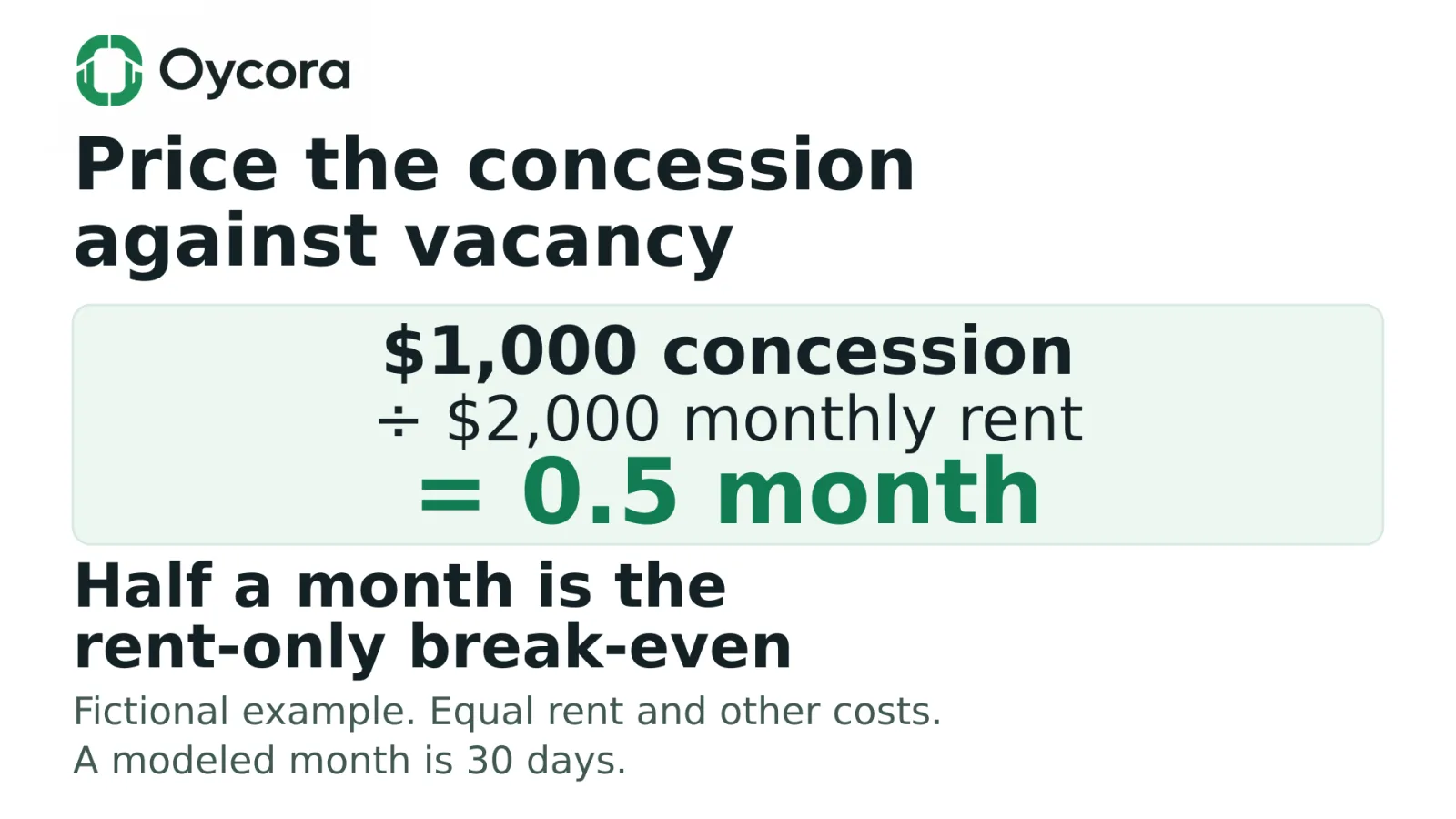
With the same monthly rent and all other costs equal, the rent-only break-even vacancy duration is the concession divided by monthly rent. Here, $1,000 divided by $2,000 equals 0.5 month. If the credit really avoids more than half a month of vacancy, immediate leasing produces more rental receipts over the same horizon. If it avoids less, waiting produces more under this simplified model.
You can also read the comparison as a maximum rent-only concession. Avoiding one otherwise empty month at $2,000 would justify up to $2,000 of credit before the rental receipts are equal. That equality is a modeled ceiling, not a suggested offer. A smaller credit may achieve the same outcome, and the avoided vacancy has not happened yet.
Be careful when converting a month into days. Actual lease dates and proration rules control the real payment schedule. A 30-day modeled month makes half a month 15 modeled days, but calendar months vary. For an actual offer, compare the rent due between the same two dates rather than assuming every month contains 30 days.
Add Only the Costs That Change Between the Choices
Next, bring in expenses that differ. Extra vacancy-only utilities, an additional advertising bill, or a different placement fee can change the result. A property manager may charge a percentage of collected rent, a fixed leasing fee, a minimum monthly fee, or a combination. Use the actual agreement to determine whether the concession and the empty period change those charges.
Keep common costs in the full property budget, but do not make them appear twice in this incremental decision. Property taxes, insurance, and scheduled debt service do not become additional costs of waiting merely because they remain payable while the property is empty. When the same amounts are paid in both scenarios over the same dates, they cancel out of the comparison. Your cash reserve still has to cover them.
Similarly, a repair needed before either tenant can move in is not automatically a cost caused by the waiting option. Count only the difference in required work or timing. The example’s $23,000 and $22,000 figures are rental receipts before expenses, not NOI, profit, or cash available to spend. After choosing a plausible leasing scenario, carry its income into the complete property cash-flow model.
Stress-Test the Wait Instead of Predicting It Precisely
For the fictional property, leasing immediately without any credit would collect $24,000 over the period and beat the concession scenario by $1,000. Waiting one month produces $22,000 and falls behind it by $1,000. Waiting two months leaves ten paid months, or $20,000, which is $3,000 less than the $23,000 concession scenario. The decision changes with the leasing forecast.
Build that forecast from comparable properties, recent inquiries, showing activity, application quality, and the unit’s condition and availability. An advertised comparable tells you what another owner is asking, not necessarily what a tenant ultimately paid. Incentives can also make two identical asking rents economically different.
If there is weak demand at the current price, a credit may not solve the underlying problem. Consider whether the listing, repairs, showing access, or asking rent needs attention. If a credible applicant is ready to sign at full rent, the credit may be unnecessary. Keep the distinction between a scenario and a commitment clear until a lease is actually executed.
Check the Lease and Keep the Offer Clear
A financial comparison does not establish which rental terms are permitted. Before advertising or documenting a credit, check the lease, applicable state and local requirements, and any rules attached to the property’s housing program. USAGov’s tenant-rights directory links to state resources and explains the importance of reading the lease. Obtain qualified local advice when the terms or required disclosures are unclear.
Use consistent, lawful application standards and document what the offer includes. HUD’s fair-housing overview is a useful starting point for understanding federal protections; local protections may also apply. A spreadsheet does not justify discriminatory treatment or replace fair-housing compliance.
Make the stated rent, credit amount, credit timing, lease term, and any valid conditions understandable together. Do not imply that a discounted effective rent is the actual payment due every month if the credit is applied once. Do not assume that the advertised rent can automatically become the basis for a future increase regardless of the agreement or local rules.
Use the Calculation as a Negotiating Tool
The practical sequence is straightforward: define the common dates, write down realistic move-in dates, calculate rent actually due inside the window, subtract the proposed concession once, and add only costs that differ. Then test a shorter and a longer wait. Keep a separate record of assumptions so that a new application, quote, or showing result can change the decision without rebuilding the model.
For this example, the $1,000 credit wins against a full month of vacancy by $1,000 in rental receipts. The conclusion depends on avoiding that vacant month; it is not a general endorsement of concessions. A clear model helps you identify what you need to learn before accepting an offer, and prevents a higher advertised rent from obscuring a lower amount actually collected.