

A property manager can be worth paying for even when hiring one reduces the cash you keep. The question is whether the complete price is reasonable for the work transferred, the time recovered, and any operating improvement you can realistically expect. A headline percentage answers only part of that question.
Start with a specific period and a written quote. Compare what you would pay over the next 12 months with the cash you would spend managing the same property yourself. Then estimate how much owner time remains under each option. Keeping those two comparisons separate helps you see both the effect on the property’s bank account and the trade-off in your own schedule.
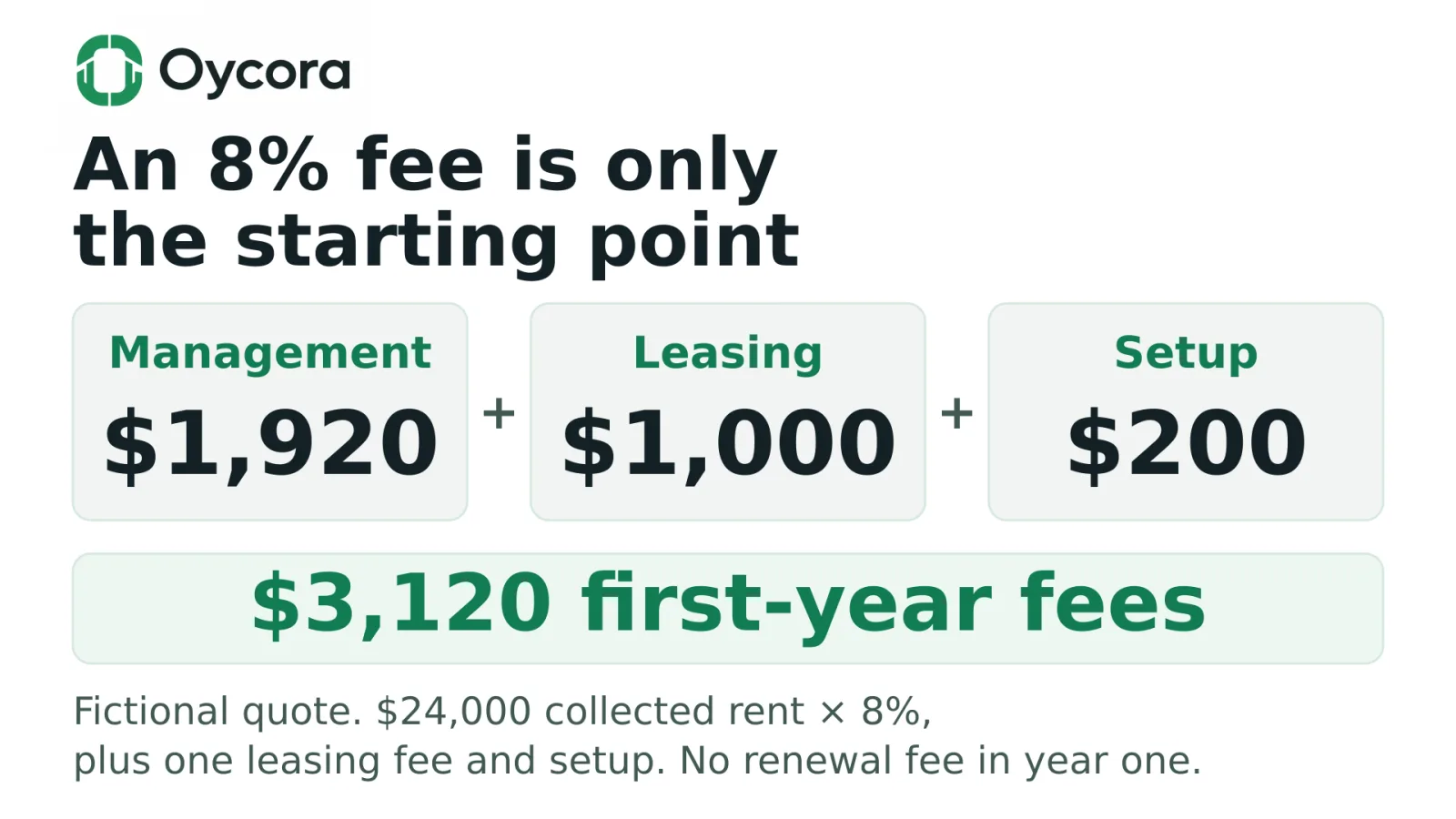
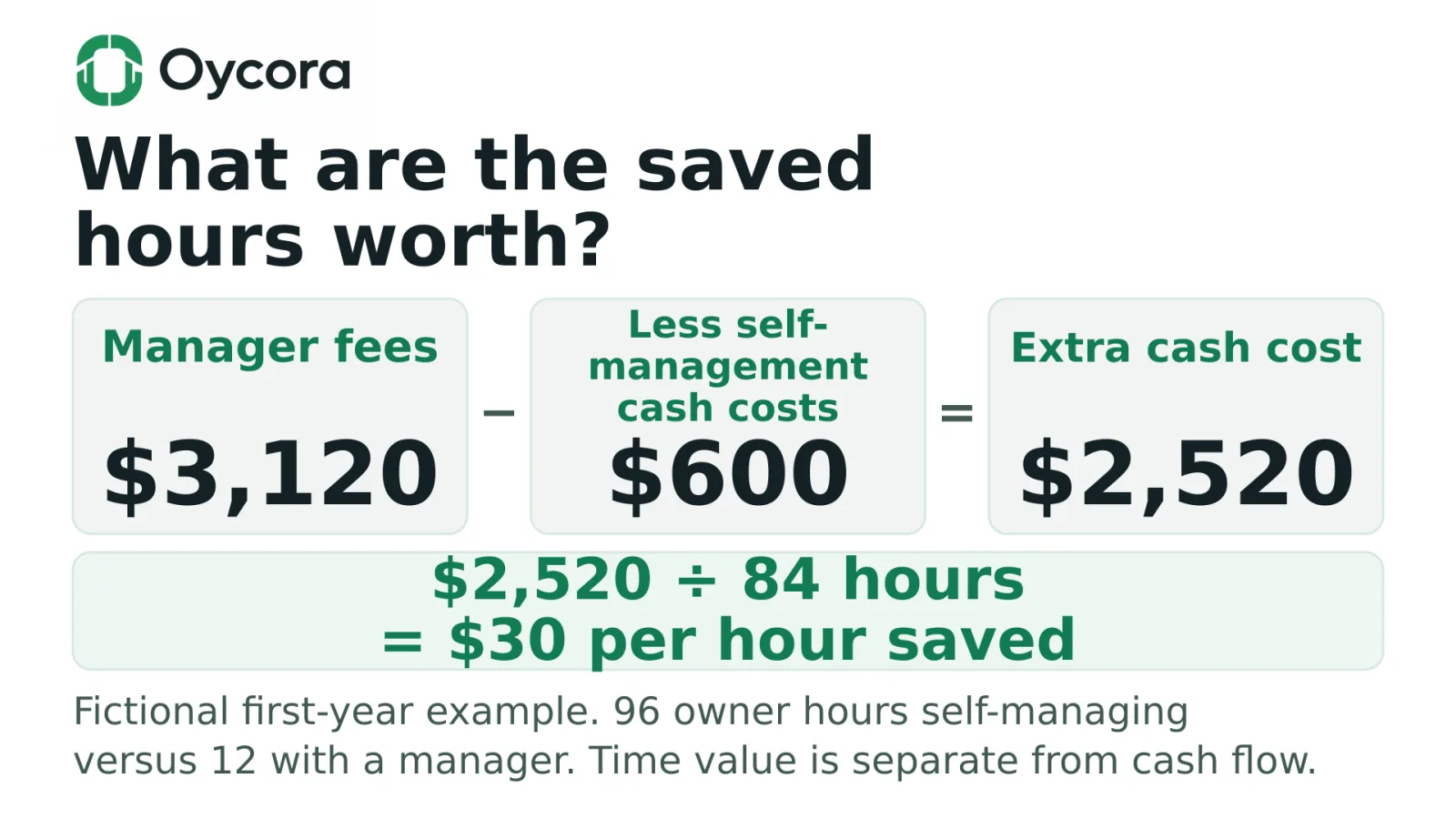
In the fictional example below, an 8% management fee becomes a 13% first-year service cost after leasing and setup charges. Hiring the manager costs an additional $2,520 and saves an estimated 84 owner hours. That makes the central question concrete: would you pay $30 for each of those hours back?
Turn the percentage into a complete quote
Ask what the percentage applies to. A fee based on rent actually collected behaves differently from a charge based on scheduled rent, and a monthly minimum can change the calculation again. Confirm whether fees continue during vacancy and whether other receipts are included in the calculation.
Next, identify every separate charge that your coming year could trigger. That may include onboarding, tenant placement, renewal, inspections, accounting, maintenance coordination, or ending the agreement. Record what each fee includes so that you do not add the same service twice. The NARPM Financial Performance Guide separates leasing, renewal, owner administrative, inspection, and maintenance-coordination charges from base management fees. Its older survey is useful for identifying questions to ask, rather than establishing today’s prices.
Request a sample owner statement alongside the fee schedule. It helps reveal how charges appear in practice and which bills are simply passed through to you. A lower advertised percentage can still produce a higher annual bill if the separate charges are larger or more frequent.
Ask the manager to price two concrete situations: a year with one new placement and a year in which the same tenant renews. Request the full dollar total for each, using the same rent assumptions. This reveals which charges recur and which depend on a specific event, without treating a placement-heavy first year as the permanent annual cost.
Compare One Rental Over the Same First Year
Our example uses one rental collecting $24,000 over the next 12 months: $2,000 for each of 12 paid months. Both options begin with one new lease and produce the same collected rent. This deliberately assumes no improvement in vacancy, rent, or tenant payment performance from hiring a manager. Those possibilities can be tested later.
The fictional manager charges 8% of collected rent, a $1,000 leasing fee, and a $200 setup fee. The leasing charge includes the advertising and placement work assumed in this example. There is no renewal within the period and no renewal charge, inspection fee, repair markup, or other management charge. These inputs illustrate a calculation; they are not market averages or a recommendation for what a manager should charge.
Self-management requires $600 of out-of-pocket advertising and administration costs. The owner performs the leasing and oversight work personally. Taxes, insurance, debt payments, repairs, and other property costs are assumed identical under both options. They remain in the full property budget but cancel out of this particular decision comparison.
Real World Example
Fictional figures for one rental and one new lease over the same next 12 months. Collected rent and common property costs are identical under both options.
| Item | With a manager | Self-managed |
|---|---|---|
| Annual rent actually collected | $24,000 | $24,000 |
| Management fee: 8% of collected rent | $1,920 | $0 |
| One new-lease placement fee | $1,000 | $0 |
| One-time setup fee | $200 | $0 |
| Self-managed ads and admin | $0 | $600 |
| Total decision-specific cash costs | $3,120 | $600 |
| Estimated owner hours | 12 hours | 96 hours |
Extra cash cost per estimated owner hour saved
$30 per hour
($3,120 − $600) ÷ (96 − 12) = $2,520 ÷ 84 = $30
The management service cost is $3,120, or 13% of $24,000 collected rent. It costs $2,520 more than self-management and saves an estimated 84 owner hours. The hourly figure is a personal time trade-off, not an extra cash expense. No renewal fee, repair markup, inspection fee, or other management charge is assumed; common property costs are excluded from this comparison.
Find the additional cash cost
The percentage fee is $24,000 × 8% = $1,920. Adding the $1,000 leasing fee and $200 setup charge brings the first-year management service cost to $3,120. Dividing that by $24,000 gives 13% of collected rent.
The extra cash cost of hiring the manager is $3,120 minus the $600 you would otherwise spend: $2,520 for the year. You would have that much less cash available under the management option if all other results stayed equal. Calling the difference $3,120 would overlook the self-management costs you avoid.
That annual difference averages $210 per month, although the actual bills will be uneven. The setup and leasing fees may fall early in the relationship. Check their payment dates before committing, especially if the property’s cash buffer is thin.
Keep the comparison limited to costs that change. If the same plumber would charge $400 under either arrangement, that invoice belongs in both budgets. Add a coordination charge only when the manager’s agreement actually imposes one. Our example assumes none.
Put a realistic value on the hours you recover
Suppose you expect to spend 96 hours during the year self-managing, including advertising, showings, lease administration, communication, and coordinating repairs. With a manager, you estimate 12 hours reviewing statements, approving decisions, and checking performance. The estimated time saving is 96 − 12 = 84 hours.
Divide the additional cash cost by those saved hours: $2,520 ÷ 84 = $30 per hour. You are deciding whether recovering that time is worth the price. The result is sensitive to your estimates. If the manager saves only 42 hours, the same cash difference costs $60 per hour saved.
Use a recent time log where possible. Include travel, interrupted evenings, bookkeeping, and the work of finding and supervising contractors. Also count the time you will still spend overseeing a manager. Delegating daily work does not make reviewing statements or making substantial spending decisions disappear.
Your personal value for an hour can reflect family time, rest, other work, or the inconvenience of being on call. It need not equal your salary. An hour recovered on Saturday does not automatically create another paid hour at work, and assigning it a value does not create another expense leaving your bank account.
If you value the 84 hours at $25 each, their subjective value is $2,100, below the $2,520 cash premium. At $40 each, it is $3,360, above that premium. Neither choice changes the actual management bill.
Test performance claims separately
A prospective manager may expect to lease faster, reduce missed payments, or negotiate better contractor prices. Ask for evidence relevant to your property type and location. Useful questions include how recent comparable homes performed, how the manager measures days to lease, and which services produced any reported savings.
Keep your first comparison at equal operating performance. Then build a second scenario using improvements you can defend. Change the expected rent collected and any affected expenses on both sides. Recalculate percentage fees when collections change. Crediting a manager with higher gross rent while leaving the fee unchanged can overstate the benefit.
A stronger service can also matter because you live far away or cannot respond reliably during your working day. Describe that benefit plainly rather than inventing a dollar estimate for avoided disasters. If the numbers work only after assuming several unproven improvements, you have identified what must be verified before signing.
Make the agreement match the service you expect
A useful quote says who handles each task, when they respond, and what requires your approval. Discuss routine repair spending limits, emergency decisions, inspection arrangements, owner reporting, and responsibility for leasing. Ask who keeps any tenant-paid fees and whether affiliated vendors or referral payments are involved.
These questions have a professional basis. The NARPM Code of Ethics calls for member agreements to outline responsibilities and fees, and for relevant benefits to be disclosed to and approved by the client. It also addresses accurate and timely financial reporting. Membership standards are useful checks, but you still need to read the particular contract.
The IREM property management FAQ describes the agreement as defining the manager’s authority, compensation, limits, and the owner’s obligations. Before signing, understand the contract term, termination process, and any charges or continuing obligations when you leave. For unclear legal provisions or local requirements, get advice from a qualified local professional.
Choose the arrangement your property and schedule can support
Self-management may fit when you have reliable availability, the necessary skills, and a property you can supervise without substantial travel. Professional management becomes easier to justify when the complete fee is affordable and the work removed is genuinely valuable to you. Either choice needs enough money left for the property’s other obligations.
Before deciding, write down three numbers: the complete annual management quote, the self-management cash costs it replaces, and the owner hours you reasonably expect to save. Use those to calculate the cash premium and the price per hour recovered. Then review the service commitments and any performance assumptions supporting your decision.
Keep the first year distinct from later years. A setup fee may disappear, while renewal or another placement could add a different charge. Rebuild the comparison around the events you actually expect. A manager is worth the cost when the agreed service and realistic benefits justify the full price for your circumstances.
If you hire a manager, revisit the comparison using the first few statements and your own time log. Check whether charges match the agreement and whether the tasks you expected to hand over have actually moved. A useful review asks what changed in cash costs, owner workload, and service quality; a low fee alone cannot answer those questions.