
One landlord insurance quote costs $1,500 a year and another costs $1,860. The first leaves another $30 a month in your operating budget. If it also requires you to cover $2,500 more of the same loss, however, the premium alone is an incomplete comparison. Coverage differences can matter even more than the deductible.
Begin by comparing the coverage you would actually receive. Once the terms are comparable, translate the annual premium into cash flow and test whether you have enough available cash for the deductible and costs the policy may not cover. That gives you two separate numbers: what you expect to pay in an ordinary year and what you need to be able to handle if something goes wrong.
Give Each Insurer the Same Facts
Request quotes for the same address and rental arrangement, with the same effective date. Provide the construction, occupancy, number of units, expected periods without tenants and relevant property details the agent requests. Clarify whether the rental is occupied now and what you intend to do before renting it. An owner-occupied unit in a duplex, a fully tenant-occupied house, and a property under substantial renovation may not be quoted on the same basis.
Start with the actual property and planned use rather than assuming the seller’s policy is a workable substitute. Ask how the quote responds to a vacancy during repairs or an extended gap between tenants. A gap that is normal in your business plan may matter to coverage. Get unclear answers in writing and check them against the actual policy forms and endorsements before relying on them.
This is a local quote exercise. The Minneapolis Fed’s property-insurance research describes rising costs reported by multifamily housing providers, and federal analysis has documented meaningful geographic differences in homeowners premiums. Neither evidence base tells you what a particular small rental will cost to insure. Use current written quotes for the address.
Minneapolis Fed: Property Insurance Costs in Multifamily Housing
Compare Coverage Before Ranking the Premiums
Start with the dwelling limit and the way covered losses are valued. Replacement-cost and actual-cash-value terms can produce different settlements. A quote can also handle the roof or other parts of the property differently from the rest of the building. Ask which limits, loss-settlement terms and sublimits apply to the specific property, and what must happen before the insurer pays any additional amount. The California Department of Insurance explains the general distinction between replacement cost and actual cash value; the form and state rules still govern the actual quote.
Compare liability limits separately from property coverage. Review any exclusions, endorsements, separate deductibles and requirements your lender imposes. If the quote is contingent on inspection or repairs, make sure you know the deadline and whether the quoted coverage can be in force at closing. A lower premium is not comparable if it depends on a narrower policy or a repair you have not budgeted.
Ask how loss-of-rent or fair-rental-value coverage works, if offered. Is it triggered by covered physical damage, what limit and duration apply, and does a waiting period apply? Do not assume it covers ordinary vacancy, an eviction delay or delinquent rent. The NAIC’s discussion of dwelling and landlord policies distinguishes covered rental-income loss tied to property damage from broader assumptions you might otherwise make about the policy.
NAIC: Dwelling and Landlord Policy Context (PDF)
Check the Terms That Are Easy to Miss
A declarations page is useful for checking limits, premium and deductibles, but it may not explain why a claim could be excluded or limited. Ask for the policy form and applicable endorsements and look for different terms on roofs, water damage and properties that are vacant for a period. The right question is not just whether a hazard is mentioned, but which conditions have to be satisfied and which limit applies when it is covered.
Ask the agent to explain a realistic scenario that concerns you, using the exact property and proposed occupancy. For instance, what would happen if a covered loss made one unit temporarily uninhabitable while the other unit stayed occupied? Walk through the applicable deductible, the documentation you would need, the effect of a rental-income limit, and the costs you might pay before a reimbursement. A verbal explanation helps frame the question; it does not replace the policy terms.
Keep a simple written note beside the quote with three things: the regular premium, the largest immediate cash demand you can identify, and the exclusions you still have to resolve. When one quote appears much cheaper, see which of those three lines actually changed.
California Department of Insurance: Residential Coverage Terms
Translate the Quote Into Your Rental Budget
Use the total annual premium for the coverage you expect to maintain, including separately billed policies required for your plan. Check whether installment fees or other charges are already included. Divide the annual total by twelve when comparing average monthly cash flow, then record actual payment dates separately in the cash calendar. Paying a premium annually does not make it a one-time acquisition cost.
If you enter insurance under operating expenses, do not subtract it a second time through an escrow-inclusive mortgage payment. Use principal and interest for the loan line and record the other expenses where they belong. An escrow payment change can include a temporary shortage collection as well as a higher ongoing premium. Separate those before deciding what changed in future years.
Do not book a deductible as a charge you are certain to pay every year. It is one possible cash exposure. Keep it visible in a separate reserve or claims scenario, alongside uncovered work, potential gaps in rent and the timing of any insurer payment. A deductible is also not a cap on your out-of-pocket cost for a loss.
Real World Example
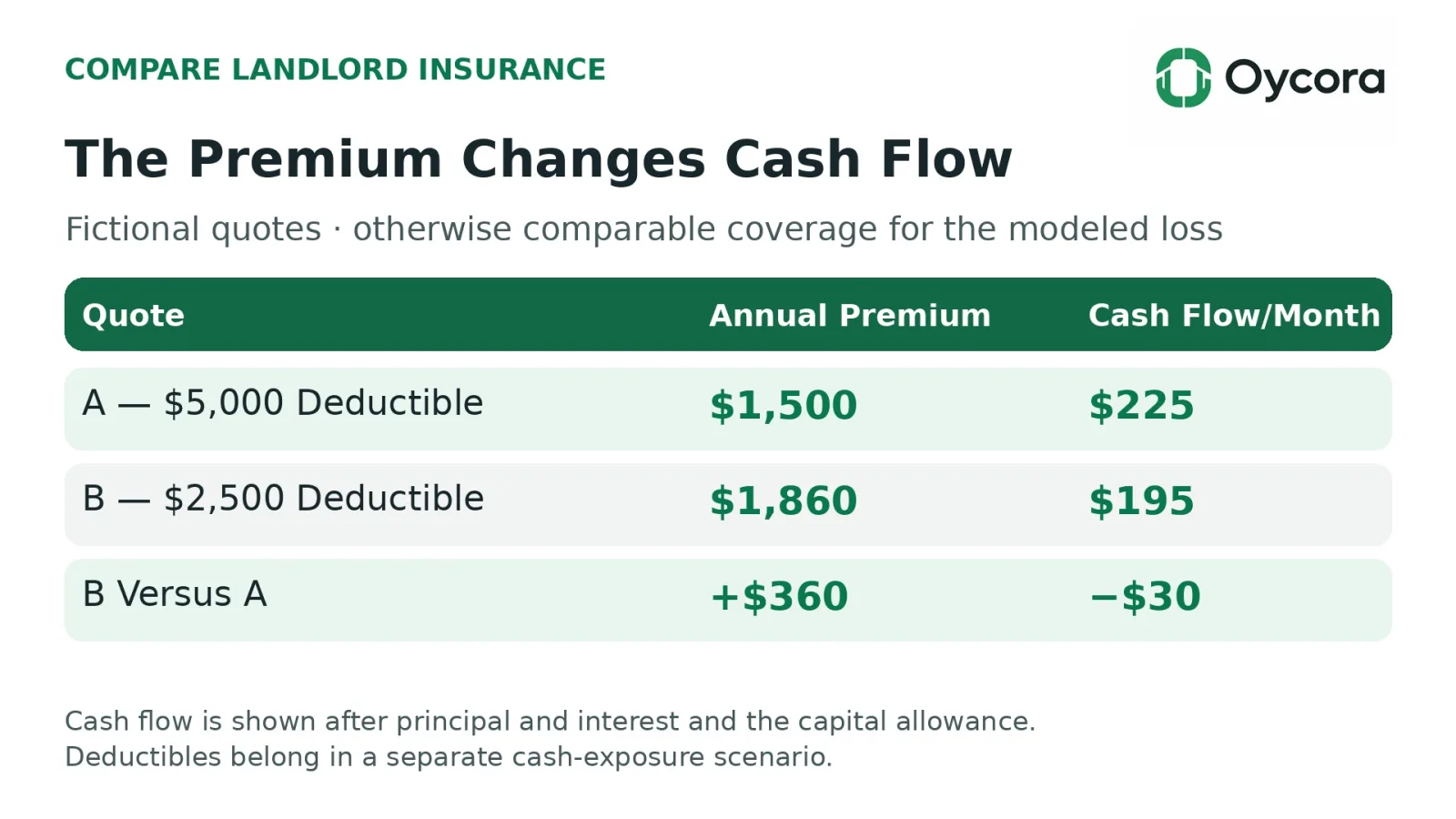
Assume a fictional rental with $24,600 in effective annual income, $7,200 of operating expenses before insurance, $12,000 of principal and interest, and a $1,200 annual capital allowance. Both quotes in this illustration have otherwise equivalent coverage for a qualifying loss. Quote A charges $1,500 annually with a $5,000 deductible. Quote B charges $1,860 annually with a $2,500 deductible. These are example quotes, not current prices, available terms or coverage recommendations.
With Quote A, operating expenses total $8,700 and NOI is $15,900. After debt service and the capital allowance, the projected cash flow is $2,700 a year, or $225 a month. With Quote B, operating expenses are $9,060 and NOI is $15,540. Cash flow is $2,340 a year, or $195 a month. The annual premium difference is $360, equal to $30 a month.
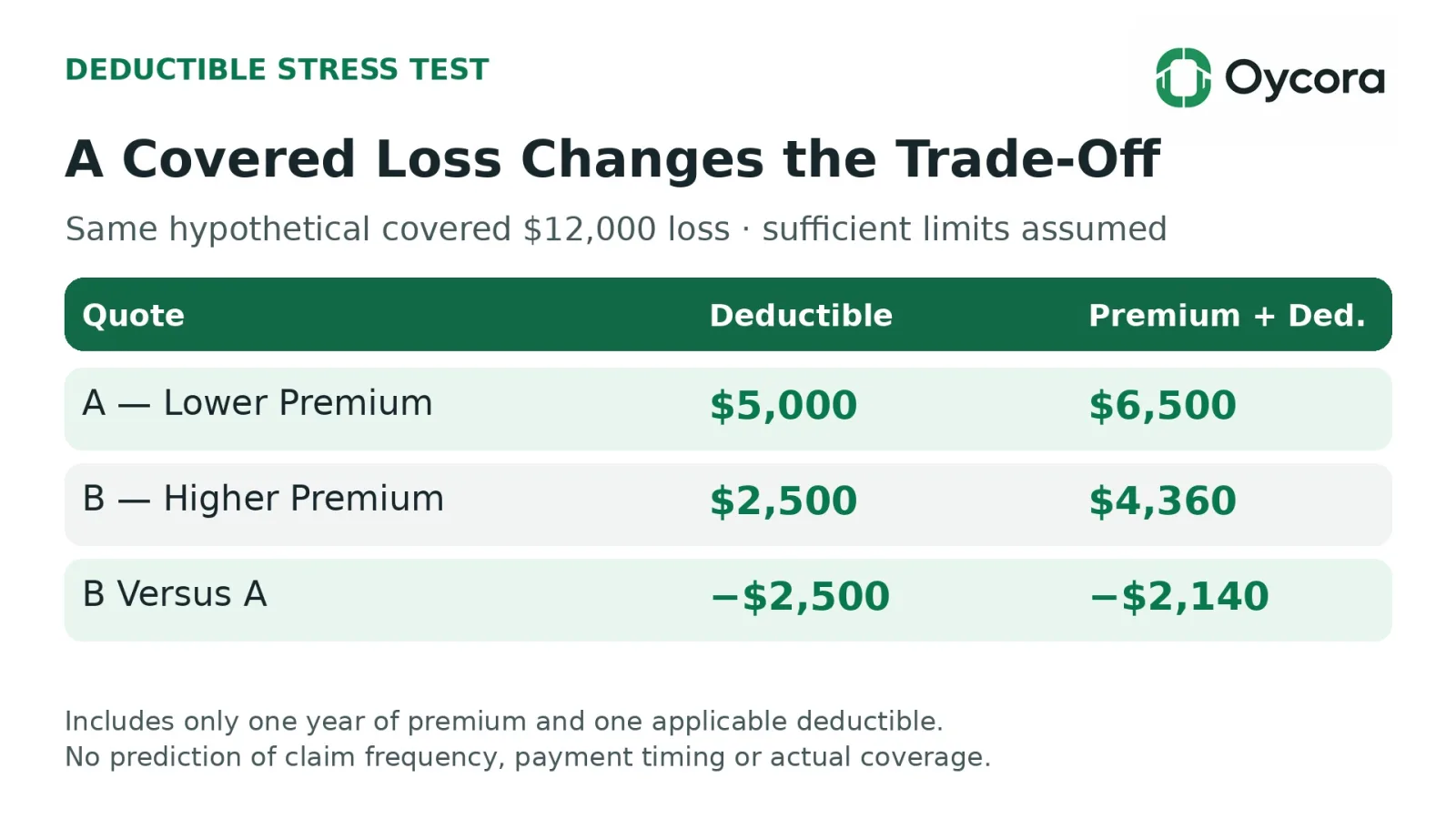
Now assume one covered $12,000 loss in the same year, with no other claim differences and sufficient limits. Under this simplified example, Quote A leaves a $5,000 deductible and Quote B leaves $2,500. Comparing only that year’s premium plus deductible, A costs $6,500 and B costs $4,360. B costs $2,140 less in this specific loss year, even though it costs $360 more in a claim-free year. The example does not estimate how often a claim will happen, when reimbursement arrives, or what either insurer would pay on a real claim.
Match the Deductible to Cash You Can Actually Use
If the lower-premium quote saves $360 a year, it takes about 6.9 claim-free years for those savings to equal the $2,500 difference in deductibles, assuming premiums and deductibles stay unchanged and ignoring the time value of money. This puts the numbers on the same scale. It does not predict a claim frequency or turn either quote into an automatic winner.
Compare the higher deductible to the amount of liquid money you have available after closing. A $5,000 reserve that also needs to cover vacancy, an appliance replacement and next month’s mortgage does not give you $5,000 for each event. Test how the property would operate if the deductible and an ordinary disruption landed close together. Check for additional deductibles or uncovered costs before treating the example as your full exposure.
A percentage deductible deserves special attention. Find out the base to which the percentage applies and request the dollar amount for the quoted property. Do not assume a displayed percentage is applied to the amount of the claim. Ask whether different perils use different deductibles and whether multiple properties, structures or incidents would be treated together or separately.
Oycora: How Much Cash Should You Keep in Reserve?
Review the Quote Again Before It Becomes a Budget Assumption
Before closing or renewal, ask the agent to identify in writing what changed from the prior quote: premium, limit, deductible, valuation terms, excluded causes of loss or eligibility conditions. Keep a copy of the quote and issued documents so you can see whether the final policy matches the comparison you made. If it changed, rerun the cash flow and reserve checks rather than just updating the price.
Consider the simple review order: confirm the rental use, compare the coverage you need, check the biggest plausible immediate cash demand, and then compare annual premiums. This article explains how to test quotes in a cash flow model; it does not interpret a specific insurance contract or recommend a policy. Ask an appropriately licensed insurance professional to resolve policy and coverage questions.
Enter both annual premiums into the rental cash flow model with the rest of the property held constant. Keep the claim scenario beside those results in your reserve worksheet. That way the numbers show both what you pay to carry the policy and what you need to be ready to cover.