

A tenant moves out, the cleaner sends a bill, and the property is advertised again. It is tempting to call the cleaner’s invoice the turnover cost. But the larger expense may be rent the property does not collect while work and leasing are underway. Placement fees, small repairs, utility transfers, and your own time can make the total substantially different from the first quote.
The useful number depends on the decision. To improve the next turnover, estimate the income and spending that change because the tenant leaves. To avoid a cash shortage, map actual receipts and bills by date. Those calculations answer different questions. Keeping them separate helps you budget accurately and identify which delays or expenses are worth addressing.
Define the Turnover Before Adding the Bills
Start with a clear baseline: the same property remaining occupied, in the same rentable condition, over the same dates. Then compare what happens when the old tenancy ends and the replacement tenancy begins. Record the last date rent is owed, the possession handover, the ready-to-rent date, and the new rent commencement date. They are not necessarily the same dates as moving trucks arriving or departing.
For planning, turnover cost is lost collectible rent plus additional turnover spending, less verified recoveries or expenses actually avoided. Keep owner time as a separate economic estimate. This is a management comparison, not a tax-return calculation. It also does not establish whether unpaid rent is legally recoverable from the departing tenant.
Separate routine preparation from optional improvements. A kitchen upgrade chosen between tenants may require cash during the turnover, but that does not make the entire project a cost caused by this departure. Record it as its own decision, including any extra downtime it creates.
Build the Rent Gap From Dates
Use rent that would realistically have been collected under the baseline, not an aspirational new asking rent. If the rent changes with the new lease, show the rate change separately from the gap. Include periods when the property is being repaired and periods when it is ready but waiting for a tenant; neither produces rent simply because marketing has started.
Avoid stacking overlapping intervals. Ten days of repairs followed by fourteen additional days before rent begins is a twenty-four-day gap. Ten days of repairs occurring inside a twenty-four-day leasing period is also twenty-four days, not thirty-four. A simple calendar can prevent a large overstatement.
Actual lease dates and lawful proration terms govern real receipts. A modeled thirty-day month is convenient for an illustration, but should not silently replace those terms. Existing arrears, a new-lease concession, and future collection risk should each have their own line rather than being hidden inside the vacancy days.
Collect the Invoices That Belong to This Turn
Ask for a written scope covering cleaning, touch-up painting, small repairs, lock work, advertising, and any leasing or placement charge. Check the management agreement before adding separate fees: advertising or inspections may already be included. Conversely, a regular management percentage may not include placement. Use the actual charge and its payment trigger, rather than assuming every manager bills the same way.
Include utilities or service charges the owner takes over only because the home is empty. A utility bill already paid by the owner during occupied months is not automatically an additional turnover expense. Count the change, including any genuine savings, and keep the entire bill in the full property budget.
Do not label every invoice an immediately deductible repair. IRS Publication 527 distinguishes repairs and maintenance from improvements that must be capitalized, subject to applicable rules. The operational budget can show cash spent today while the tax records classify it differently. Oycora’s rental property expenses, reserves, and cash flow resource explains the broader budgeting categories.
Compare the Complete Turnover Cost
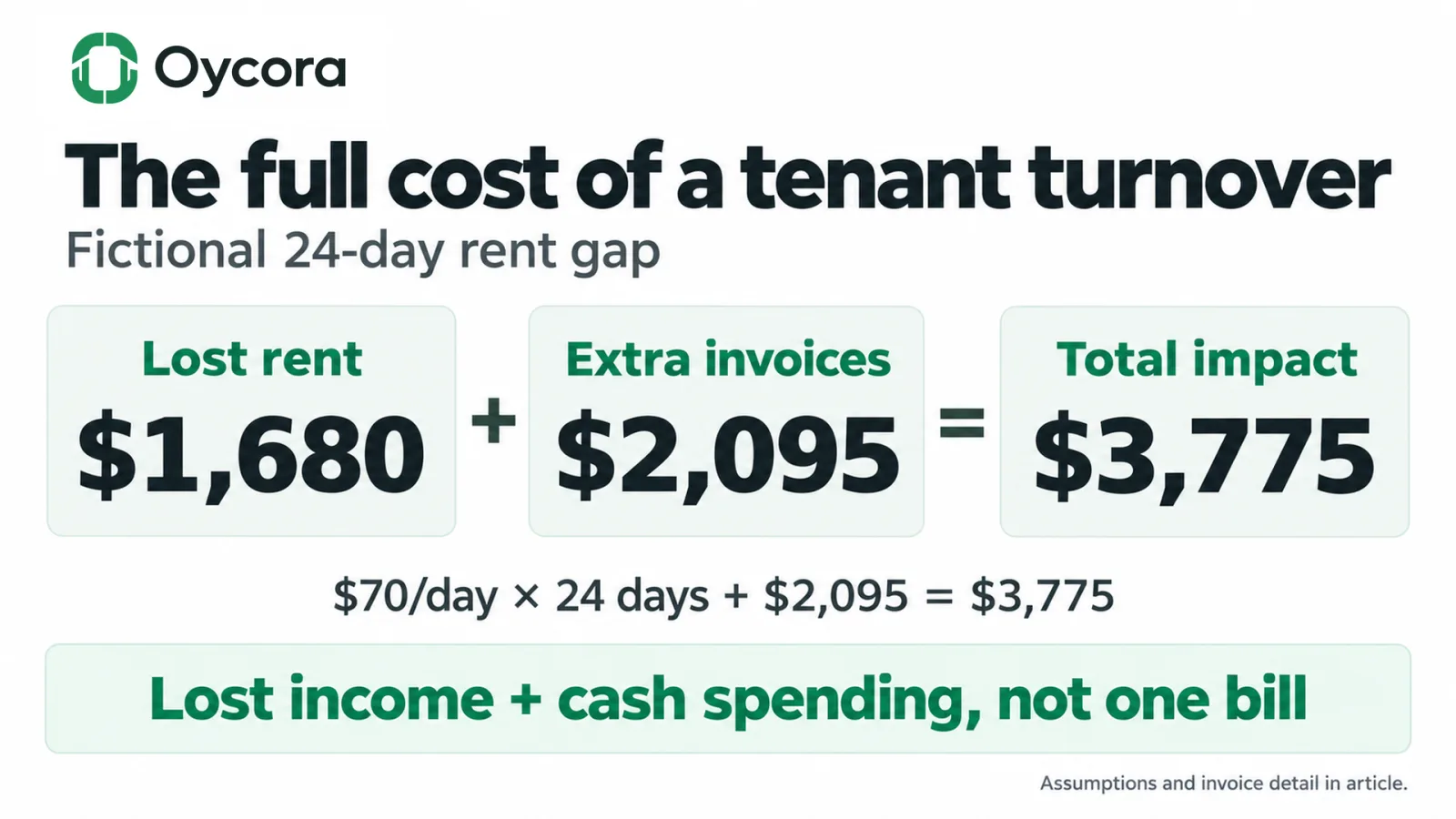
Consider a fictional rental with $2,100 monthly rent and no rent increase between tenants. Use a thirty-day modeled month, making rent $70 per day. Rent stops for twenty-four days; the remaining six days produce $420, collected within the month. All turnover invoices are paid during that month, and there are no concessions, deposit recoveries, or other expense changes.
Cleaning costs $300, painting $550, minor repairs $250, lock work $125, leasing $750, and vacancy-only utilities $120. These are illustrative quotes, not typical market prices. The table separates the $1,680 income loss from $2,095 of additional spending. Together, they reduce the owner’s cash outcome by $3,775 compared with uninterrupted occupancy.
Real World Example
Fictional single-unit turnover. Rent is $2,100 per modeled 30-day month; the rent gap is 24 days. All quoted costs are incremental, paid within the month, and shown before tax. No concessions, recoveries, upgrades, or other cost changes.
| Component | Calculation or assumption | Turnover impact |
|---|---|---|
| Lost rent | $2,100 ÷ 30 × 24 days | $1,680 |
| Cleaning | Illustrative invoice | $300 |
| Painting | Illustrative invoice | $550 |
| Minor repairs | Illustrative invoice | $250 |
| Lock work | Illustrative invoice | $125 |
| Leasing | Illustrative contract fee | $750 |
| Vacancy-only utilities | $5 × 24 days | $120 |
| Additional cash invoices | $300 + $550 + $250 + $125 + $750 + $120 | $2,095 |
| Total turnover impact | $1,680 lost rent + $2,095 invoices | $3,775 |
Reduction versus uninterrupted occupancy
$3,775
($2,100 ÷ 30 × 24) + $300 + $550 + $250 + $125 + $750 + $120 = $3,775
This is lost rent plus incremental cash spending, not a standalone cash payment or tax deduction. Common ongoing bills and optional owner time are excluded from this total.
Keep the Cash Requirement Separate
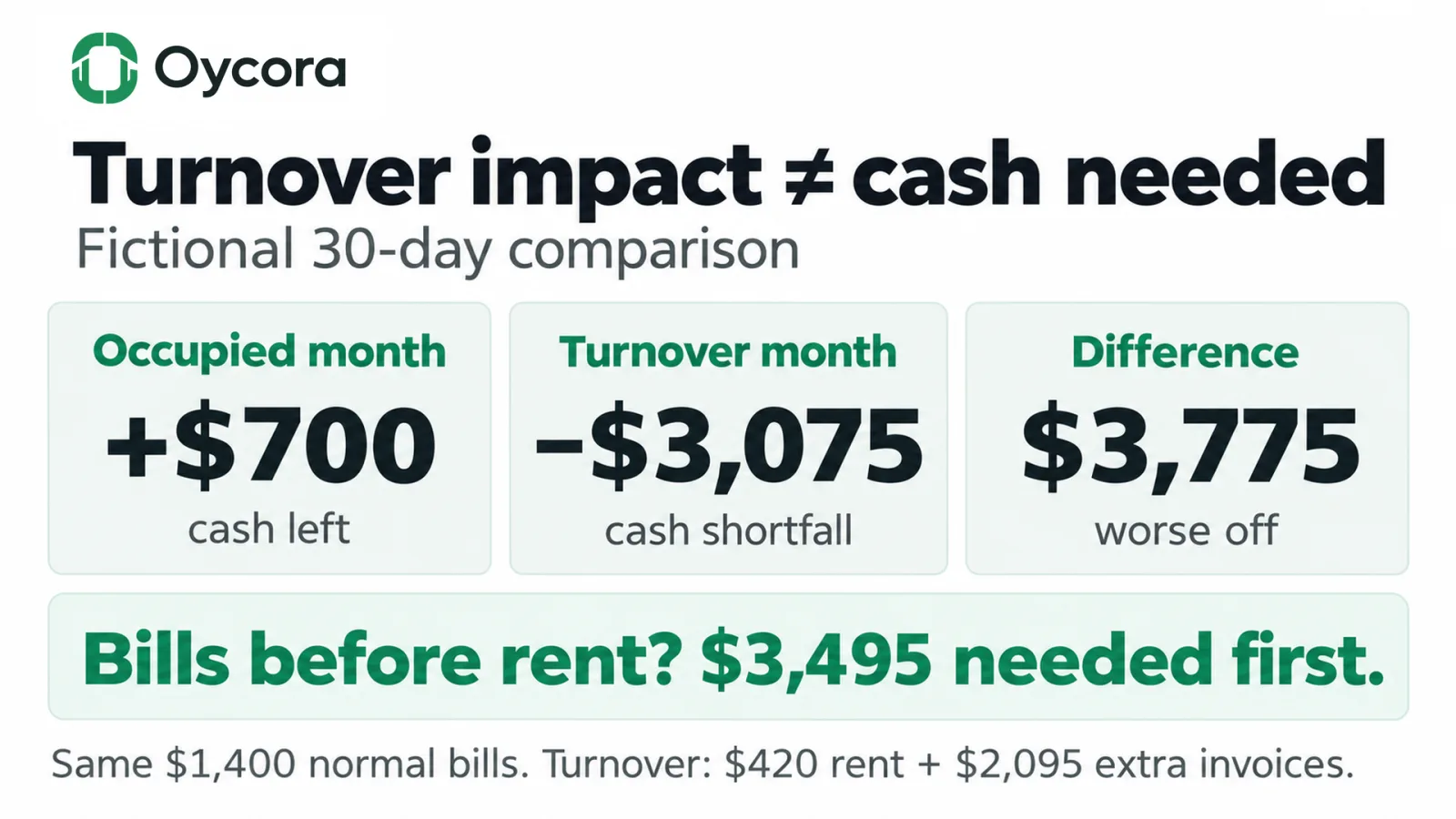
Suppose the same property also pays $1,400 in normal monthly bills, including financing and operating obligations. These bills are identical in the occupied and turnover scenarios; the $120 vacancy-only utilities are additional. Without turnover, $2,100 collected minus $1,400 paid leaves $700. During turnover, $420 collected minus $1,400 of normal bills and $2,095 of extra invoices leaves a $3,075 cash shortfall.
The difference between positive $700 and negative $3,075 is the same $3,775 turnover cost. Adding the $1,400 normal bills again to that cost would count common obligations as though turnover created them. But omitting those bills from the cash calendar would understate what must be funded.
The month-end shortfall is not necessarily the largest funding need. If every bill is paid before the $420 arrives, the property needs $3,495 available first. Deposits held for others are not unrestricted reserves. For a broader liquidity plan, see How Much Cash Should You Keep in Reserve for a Rental Property?
Treat Deposits and Your Time Carefully
Do not reduce the estimate by the entire security deposit just because the money is in an account. Determine which deductions are permitted, document the condition and charges, and follow applicable accounting and return requirements. Until a recovery is properly established, a gross-cost estimate is more useful for funding the work. An expected reimbursement can also arrive after the contractor needs payment.
Deposit rules, entry requirements, and notice deadlines depend on the jurisdiction and tenancy. USAGov’s tenant-rights page directs readers to state resources. Use those resources and qualified local advice for the applicable requirements; a turnover worksheet does not authorize withholding a deposit or ending a tenancy.
Track owner hours separately from cash invoices. Eight hours valued at an illustrative $35 per hour adds $280 of time cost to the example, giving a $4,055 economic estimate. That figure is useful when comparing workflows, but it is not another payment from the bank account. Do not count both your hours and a contractor’s charge for the same work unless both are genuinely required.
Spend on Speed Only When It Changes the Outcome
The calendar shows where an improvement might pay. In this example, each additional empty day costs $70 of rent. Assume vacancy-only utilities also continue at $5 per day. A seven-day delay would therefore add $525, raising turnover cost from $3,775 to $4,300, with every other assumption unchanged.
Now suppose a vendor offers a $200 premium that genuinely brings rent commencement forward four days. Avoided rent loss is $280 and avoided utilities are $20, so the $300 benefit exceeds the premium by $100. The premium is worthwhile under those assumptions. If the tenant cannot start earlier, finishing work faster does not create those rental receipts.
Scheduling vendors promptly, ordering necessary parts, and making showing access practical can reduce avoidable gaps. Do not shorten the timeline by leaving required repairs unfinished or weakening lawful screening standards. HUD’s fair-housing overview describes federal protections in rental housing; applicable state and local protections also need attention.
Turn the History Into a Budget
After move-in, replace estimates with actual invoices and dates. Record how much time was spent on work, how much passed after the property was ready, and what delayed rent commencement. Review comparable units separately when their condition or leasing arrangements differ. A single expensive turn should not become a universal benchmark, but neither should an unusually easy one.
For illustration, spreading one $3,775 turnover across twenty-four months gives $157.29 per month: $70 for rent loss and $87.29 for direct spending. The interval is a planning assumption, not a claim that tenants leave on schedule. Test a shorter interval and a more expensive turn before deciding how much cash to retain.
Keep each component in its proper place. If the annual model’s vacancy allowance already covers turnover rent loss, adding the full $157.29 as an operating expense counts the $70 again. Likewise, painting already included in a maintenance budget should not reappear in a separate turnover allowance. Reserving money and later paying the same bill are not two expenses.
Frequently Asked Questions
Is lost rent the same as a turnover expense?
It reduces the owner’s result, but it is an income loss rather than an invoice. Keep it separate from cleaning, repairs, and leasing costs so the full property model does not subtract it twice.
Should I include the mortgage payment?
Include it in the cash calendar. When the same payment is due with or without turnover, it is not an additional cost caused by the departure. Any genuinely different financing cost belongs in the comparison.
What is a normal turnover cost?
There is no universal figure suitable for every property. Use actual rent, a realistic rent-gap calendar, written scopes, and the relevant contracts. Compare the result with your own prior turns rather than treating this fictional example as a market average.
Know Which Number You Are Using
A useful turnover budget explains both the loss relative to staying occupied and the cash needed before new rent arrives. Price the work, map the dates, keep recoveries and owner time distinct, and reconcile the result with the annual model. The next decision becomes clearer when you can see whether the problem is an expensive invoice, an avoidable delay, or insufficient available cash.