
Oycora Guide · Property Analysis
The Complete Guide to Rental Property Expenses, Reserves, and Cash Flow
Rental income does not become cash flow until the property’s real costs are accounted for. This Guide explains operating expenses, maintenance, capital expenditures, reserves, debt service, and how those categories work together to determine what a rental actually produces.

A rental property can collect plenty of rent and still produce disappointing cash flow. The gap between those two numbers is filled by vacancy, taxes, insurance, management, maintenance, utilities, future capital needs, financing, and other costs that are easy to underestimate when the analysis focuses too heavily on rent and the mortgage payment.
The challenge is not simply identifying expenses. It is classifying them correctly and planning for costs that do not arrive on a predictable schedule. Property taxes may be billed consistently, while a roof replacement might happen once in decades. Routine maintenance belongs to the ongoing operation of the property, while mortgage debt service belongs to the financing structure. Mixing those categories together makes NOI, reserves, and cash flow harder to interpret.
This Guide builds a practical framework for separating those costs, estimating them realistically, planning reserves, and understanding how the entire expense structure flows into NOI and investor cash flow. The objective is not to predict every dollar perfectly. It is to make sure the analysis reflects the fact that owning a rental property costs more than the bills that happen to arrive this month.
Understand Where Rental Income Goes
Before creating a budget, it helps to understand that not every dollar leaving the property belongs in the same category. Recurring operating expenses, major capital expenditures, reserves, and financing costs all affect the investment, but they answer different questions inside the analysis.
Keeping those categories separate makes the model easier to interpret. You can see how the property performs before financing, how much capital needs to be planned for future components, and how much cash is ultimately left for the investor.
Operating Expenses vs. Financing vs. Capital Costs
Operating expenses are the recurring costs required to keep the rental functioning and producing income. Typical examples include property taxes, insurance, property management, routine maintenance, owner-paid utilities, HOA dues, landscaping, pest control, and similar recurring services. These costs generally reduce property income when calculating NOI.
Financing costs belong to a different part of the analysis. Mortgage principal and interest depend on the buyer’s loan structure rather than the property’s underlying operations. Two investors can buy the same rental with the same rent and operating expenses but have very different debt service because one used a larger down payment or obtained a different interest rate.
Capital expenditures and reserves sit in another category. A roof replacement, complete HVAC replacement, major plumbing work, or substantial electrical upgrade does not behave like a recurring monthly operating bill. These costs are often large, irregular, and tied to components with multi-year useful lives. Depending on the methodology, the actual expenditure or the reserve planned for it may be tracked separately from conventional NOI.
That separation matters because each category answers a different analytical question. Operating expenses help determine how efficiently the property itself operates. Financing determines how much operating income remains after debt service. Capital planning helps determine whether the property can absorb major future needs without turning a seemingly profitable investment into an unexpected cash drain.
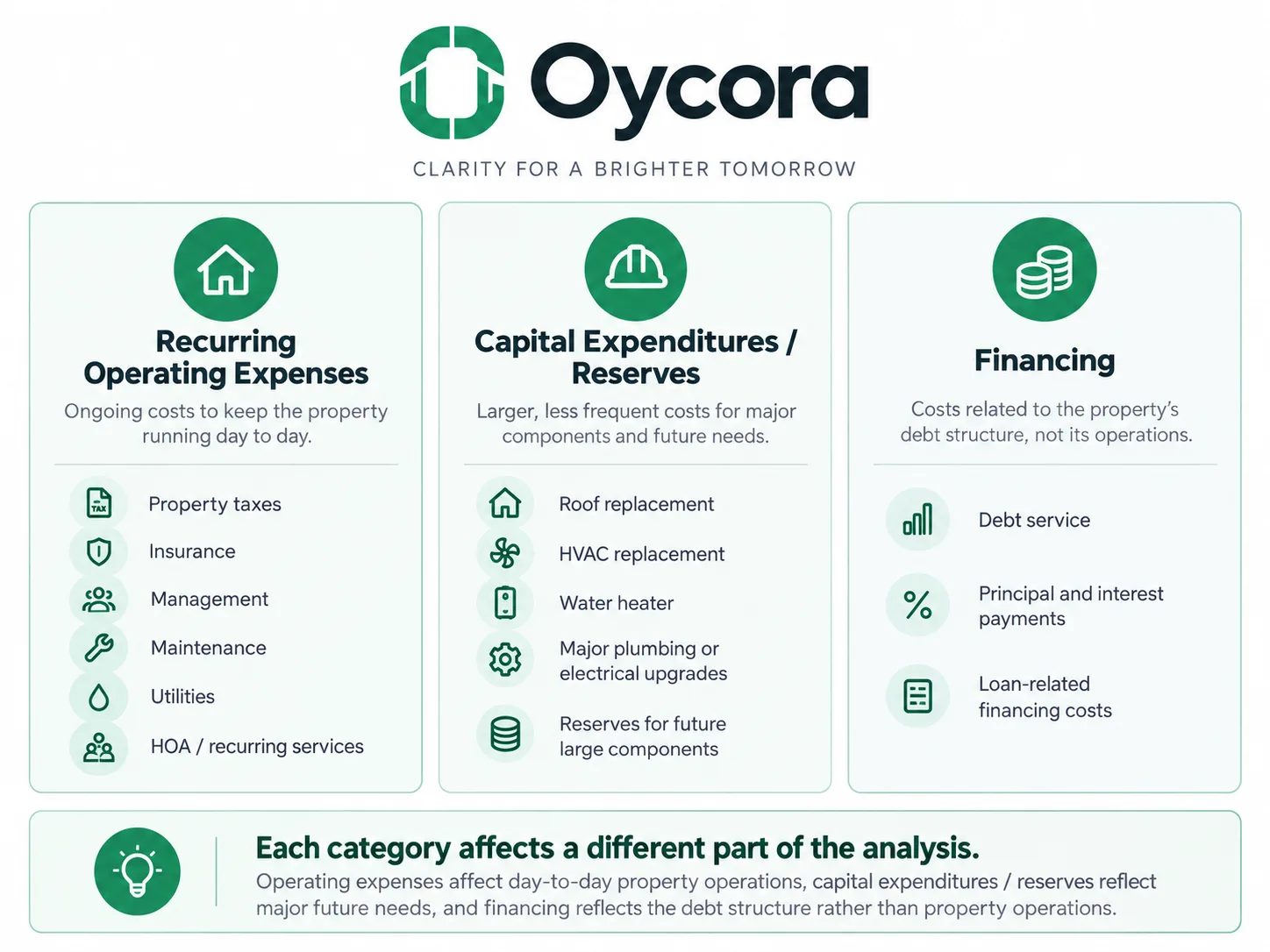
A common mistake is to treat every expense as though it should be deducted in the same place. Doing so can make NOI difficult to compare between properties and blur the difference between property performance and investor financing. A cleaner model keeps the categories visible even though all of them eventually matter to the owner.
Repairs, Maintenance, and Improvements Are Not the Same Thing
Maintenance and repairs are closely related, but they are not identical to major improvements or component replacements. Routine maintenance is recurring upkeep intended to keep the property operating in its existing condition. HVAC servicing, gutter cleaning, minor landscaping work, and other preventive tasks fit naturally into this category.
Repairs address something that has failed, worn out, or been damaged. Fixing a leaking faucet, replacing a broken appliance component, repairing drywall, or correcting a minor electrical issue are common examples. These expenses can be irregular, but they are still part of ordinary property ownership.
Capital expenditures, or CapEx, generally involve larger replacements or improvements with a longer useful life. A new roof, full HVAC replacement, major plumbing system, electrical upgrade, or substantial renovation belongs in a different category from fixing a small leak. The IRS similarly distinguishes ordinary repairs and maintenance from improvements that better, restore, or adapt property, although tax treatment should not be confused directly with investment-analysis classification.
The distinction matters because a property can have low routine maintenance while still carrying significant future capital risk. A recently serviced furnace does not eliminate the possibility that the entire system may need replacement in a few years. Likewise, a quiet repair history does not make an aging roof disappear from the long-term budget.
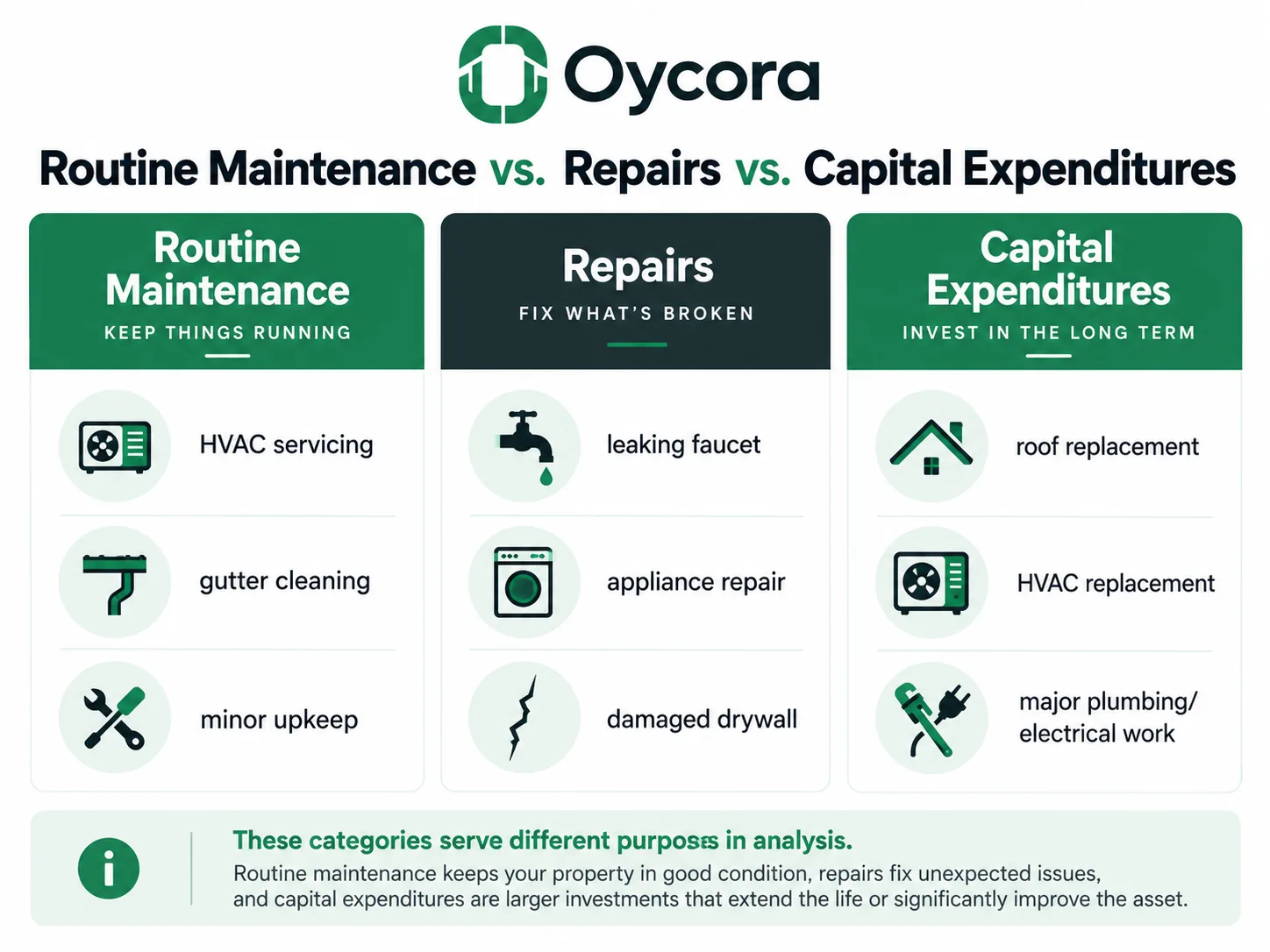
Good underwriting therefore separates the ongoing cost of keeping the property functional from the future cost of replacing major systems. Both matter, but treating them as one vague “maintenance” number makes it difficult to understand what the property actually requires.
Why Irregular Expenses Still Belong in the Plan
The hardest expenses to budget are often the ones that do not happen every year. A property might go two years without a major repair and then need a water heater, appliance replacement, plumbing work, and turnover repairs within a few months. Looking only at the quiet years can create the impression that the property is cheaper to operate than it really is over time.
That is why reserves are useful. They spread the economic impact of irregular costs across multiple periods rather than pretending the expense does not exist until the bill arrives. The reserve itself may not be an expense in the same accounting sense as a repair that was actually completed, but from an investment-planning perspective it acknowledges that components wear out and capital needs eventually occur.
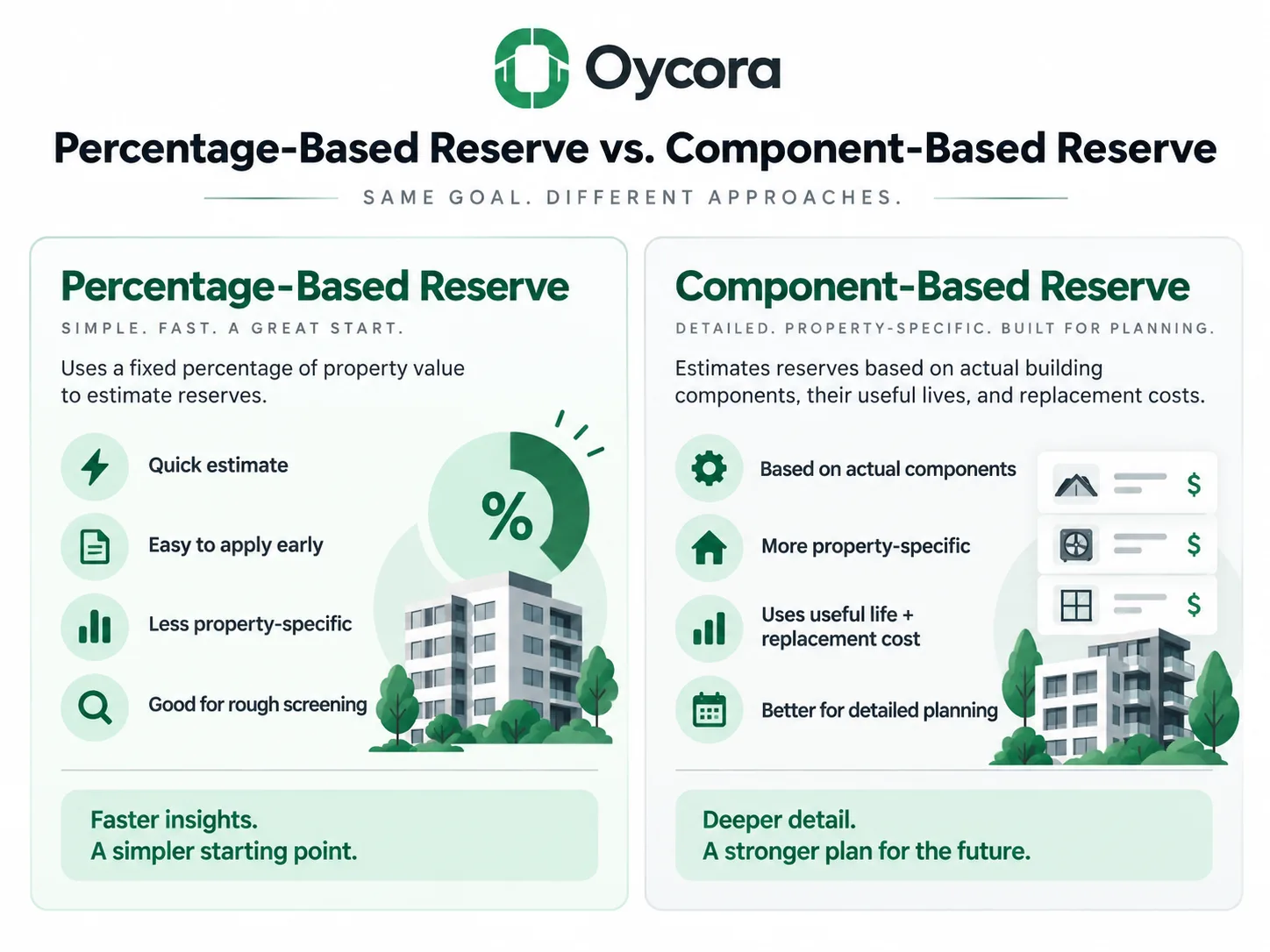
Percentage-based reserve assumptions can provide a rough starting point when little is known about the property. A more detailed approach identifies major components individually, estimates their remaining useful life and replacement cost, and sets aside money accordingly. Neither method predicts the exact timing of future expenses, but both are more realistic than assuming major replacements will never occur.
The same principle applies to vacancy and turnover. A unit may stay occupied for several years, yet the eventual move-out can still create lost rent, cleaning, paint, repairs, and leasing costs. Irregular does not mean optional.
The strongest expense model therefore combines recurring costs you can see today with future costs you know the property will eventually face. Once those categories are understood, the next step is building an annual budget that turns them into usable operating and reserve assumptions rather than leaving them as vague possibilities.
Back to Guide contentsBuild a Realistic Expense and Reserve Model
Once the expense categories are separated correctly, the next step is turning them into a working annual budget. The goal is not to predict every future bill with perfect accuracy. It is to create assumptions that are specific enough to the property that NOI, reserves, and cash flow are not being built on generic percentages alone.
This is where the model becomes much more practical. Some expenses can be pulled from current records or quotes, while others need to be estimated from property condition, historical costs, lease responsibilities, and future component needs. The best budget uses exact figures where they are available and reasonable assumptions where they are not.
Estimate the Recurring Operating Expenses
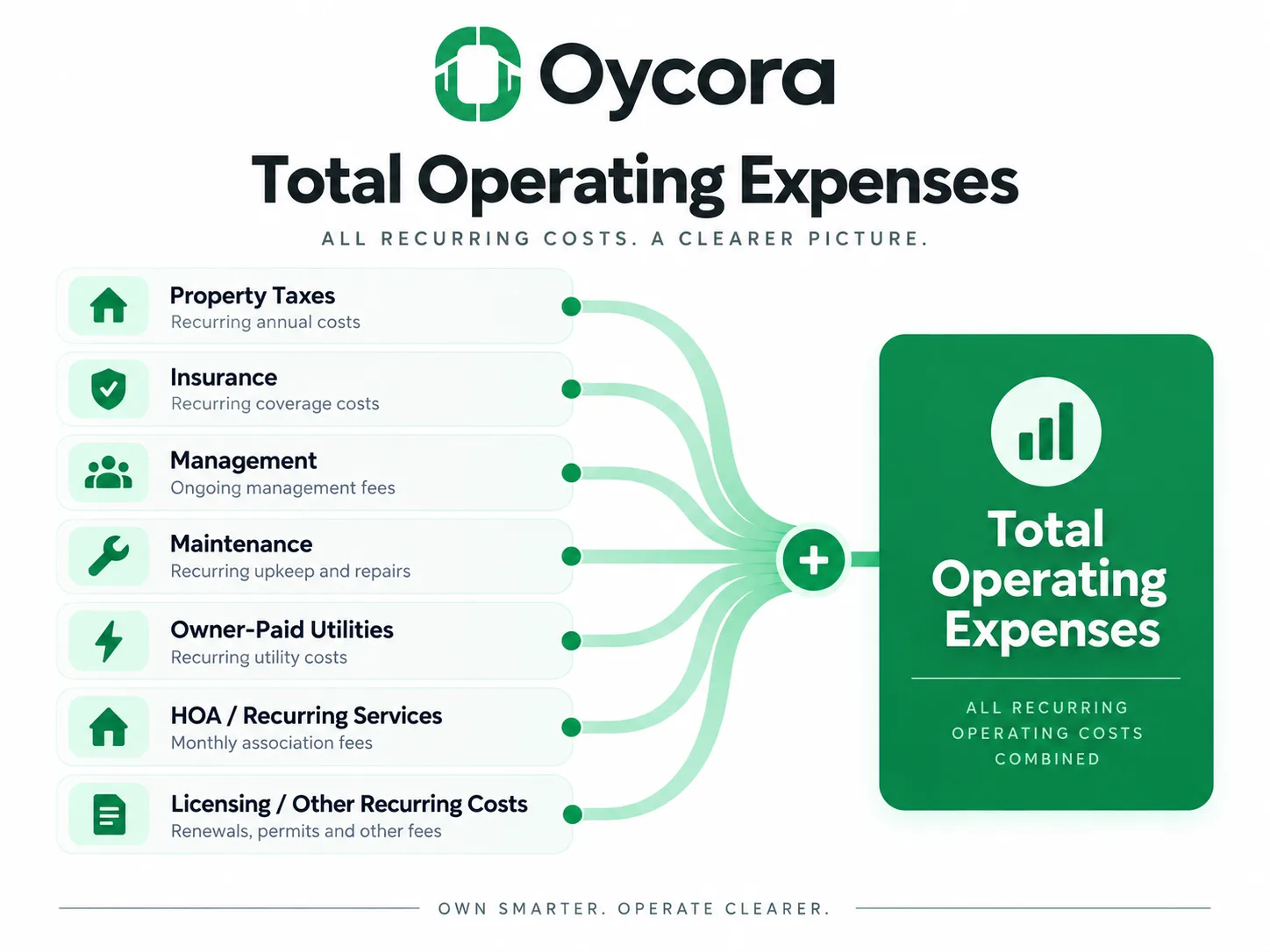
Recurring operating expenses should begin with the costs that already exist or can be verified directly. Property taxes, insurance, management, utilities, HOA dues, landscaping, pest control, licensing, and similar items are often easier to estimate because they are tied to current bills, contracts, or published rates.
Property taxes deserve care because the seller’s current tax bill may not always represent the buyer’s future cost. Reassessment rules vary by jurisdiction, and a change in ownership can sometimes affect taxable value. Insurance should also be based on an actual quote whenever possible rather than a percentage of property value, especially in markets where premiums have moved sharply.
Management is another place where assumptions can become inconsistent. If the investor intends to self-manage, there may be no immediate management fee, but the property still requires management work. For comparison purposes, some investors choose to model a market management fee anyway so the property can be evaluated on a more transferable basis. Others may keep self-management outside the expense model but track the time burden separately. The important thing is to make the choice explicit.
Maintenance should be treated as a recurring operating assumption even when the exact timing is unknown. A property with newer systems and strong maintenance history may justify a lower estimate than an older property with recurring issues, but a recent quiet year should not automatically become the long-term expectation. Property-specific history is more useful than a universal percentage when it is available.
Plan for Major Components and CapEx
Large replacements need a different planning method because they may not occur during the year being analyzed. A roof, HVAC system, water heater, major plumbing line, exterior siding, or electrical system can remain functional for years and then require a large amount of cash in one period.
One approach is a percentage reserve, where the investor sets aside a fixed percentage of rent, property value, or another base each year. This method is simple and can be useful during an early screening stage, but it does not know whether the roof is two years old or twenty-five years old.
A component-based reserve starts with the property itself. List the major items, estimate each component’s remaining useful life and replacement cost, then calculate an annual reserve contribution. If an HVAC system is expected to cost $9,000 to replace in nine years, a simple planning estimate would set aside about $1,000 per year toward that future need.
Neither method predicts the exact replacement date. The purpose is to avoid treating future capital costs as zero simply because they have not happened yet.
Component planning becomes especially valuable when several expensive systems are aging at the same time. A property with a newer roof but an old furnace, water heater, and electrical panel may need a very different reserve plan from another property of the same age. The closer the analysis gets to an actual acquisition, the more useful it becomes to replace broad percentages with specific component estimates.
Build the Annual Property Budget
Assume a fictional rental property produces $36,000 in gross potential annual rent. After applying a vacancy and collection-loss assumption, the property is expected to collect $34,200 in effective rental income.
Now build the annual operating budget:
| Operating Expense | Annual Amount |
|---|---|
| Property taxes | $4,200 |
| Insurance | $1,800 |
| Property management | $2,736 |
| Routine maintenance & repairs | $2,400 |
| Owner-paid utilities | $900 |
| HOA / recurring services | $600 |
| Total operating expenses | $12,636 |
That produces:
| Operating Result | Annual Amount |
|---|---|
| Effective rental income | $34,200 |
| Less operating expenses | −$12,636 |
| Net Operating Income | $21,564 |
Now add a separate reserve plan for major future components:
| Reserve Component | Annual Reserve |
|---|---|
| Roof | $900 |
| HVAC | $800 |
| Water heater / appliances | $400 |
| Other major components | $500 |
| Total annual capital reserve | $2,600 |
The reserve does not change the property’s conventional NOI in this example because it is being tracked separately from operating expenses. It does, however, matter when deciding how much cash the investor should treat as truly available for spending.
That distinction is exactly why the categories were separated earlier. The property produces $21,564 of NOI, but an investor who also plans to set aside $2,600 annually for future capital needs has less free cash available than NOI alone suggests.
A useful annual budget therefore has at least two layers: the operating budget that produces NOI and the reserve plan that prepares for irregular future costs. Once financing is added, those layers can be carried forward into a more realistic cash-flow model.
Back to Guide contentsTurn the Budget Into Cash Flow
Once the operating budget and reserve plan are built, the next step is seeing how those costs flow through the property. This is where gross rent turns into effective income, effective income turns into NOI, and NOI is eventually reduced by financing to determine what may actually remain for the investor.
The key is keeping the layers separate long enough to understand what each one means. If vacancy, operating expenses, reserves, and debt service are all blended together too early, the final cash-flow number becomes harder to interpret. A cleaner model lets you see whether weak performance comes from the property itself, from future capital needs, or from the financing structure.
Move From Effective Income to NOI to Cash Flow
The income side begins with what the property can reasonably collect, not simply the rent shown on a listing. Gross potential income should first be adjusted for vacancy and collection loss to arrive at effective income. From there, recurring operating expenses are deducted to produce NOI.
The basic sequence is:
Gross Potential Income → Effective Income → NOI → Cash Flow
NOI is useful because it stops before financing. It shows the property’s operating performance after recurring expenses but before the mortgage structure is applied. That makes it easier to compare properties without allowing one buyer’s loan terms to distort the underlying economics.
Cash flow comes later. Once debt service is deducted from NOI, the result begins to reflect the investor’s financing structure. Depending on the methodology, separately tracked reserve contributions or other investor-level costs may also reduce the amount of cash treated as available.
This is why rent minus mortgage payment is not cash flow. It skips vacancy, taxes, insurance, management, maintenance, owner-paid utilities, and the other costs that sit between rent and NOI. A property can easily rent for much more than its mortgage payment and still produce weak cash flow once the full expense structure is included.
Add Debt Service and Understand the Margin
Debt service is one of the largest recurring claims on NOI for a financed property. If annual NOI is $21,564 and annual debt service is $16,800, the simplified pre-tax cash flow is $4,764 before considering any separately modeled reserve contributions.
That $4,764 is more useful when viewed as a margin rather than a promise. It represents the amount left under the assumptions being modeled. If insurance increases, vacancy runs higher, or maintenance exceeds the budget, part of that margin disappears.
The relationship also shows why two investors can experience the same property differently. One buyer may use a larger down payment and carry lower annual debt service. Another may use more leverage and preserve more cash upfront, but the higher mortgage payment consumes more NOI each year.
A property with thin cash flow is not automatically a bad investment, but it has less room for ordinary variance. When the expected margin is only a few hundred dollars per year, one moderate repair can consume most of it. That is why cash flow should be tested under more than one expense scenario.
Base Case vs. Higher-Cost Year
Continue with the fictional property from the previous section. Under the base assumptions, it produces $34,200 of effective income, $12,636 of operating expenses, and $21,564 of NOI. Assume annual debt service of $16,800 and a separately tracked annual capital reserve of $2,600.
| Base Case | Annual Amount |
|---|---|
| Effective income | $34,200 |
| Operating expenses | −$12,636 |
| NOI | $21,564 |
| Debt service | −$16,800 |
| Pre-tax cash flow before reserves | $4,764 |
| Planned capital reserve | −$2,600 |
| Cash remaining after reserve planning | $2,164 |
Now assume a more expensive year. Vacancy is slightly higher, insurance increases by $400, and maintenance runs $1,500 above the base assumption.
| Higher-Cost Year | Annual Amount |
|---|---|
| Effective income | $33,300 |
| Operating expenses | −$14,536 |
| NOI | $18,764 |
| Debt service | −$16,800 |
| Pre-tax cash flow before reserves | $1,964 |
| Planned capital reserve | −$2,600 |
| Cash remaining after reserve planning | −$636 |
The property itself did not suddenly become fundamentally different. A few ordinary assumptions moved against the investor, and the available cash narrowed quickly. That is the point of building the expense structure carefully: the cash-flow result should reflect how much room exists when costs do not land exactly on the base case.
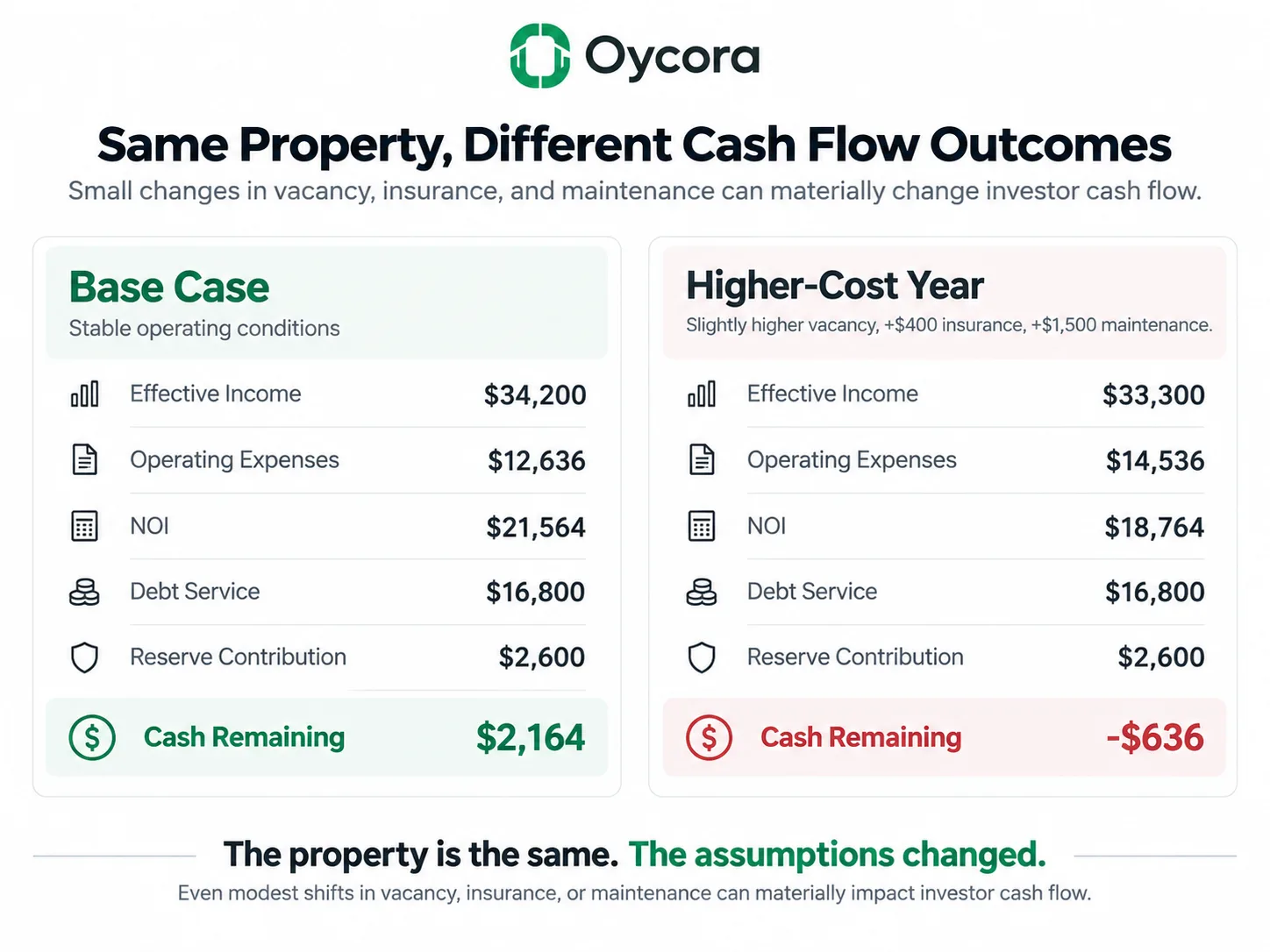
A strong cash-flow model therefore does more than calculate one number. It shows where that number came from and how sensitive it is to the property’s real operating costs.
Back to Guide contentsManage Reserves and Actual Performance Over Time
A reserve plan is only useful if it stays connected to the property’s real condition and operating history. The assumptions made at acquisition should become more specific as the owner learns how the property actually performs, which components age faster than expected, and which costs were initially over- or underestimated.
The goal is not to maintain one fixed reserve percentage forever. It is to keep enough liquidity available for short-term operating problems while also preparing for larger capital needs that become increasingly predictable as the property ages.
Operating Reserves vs. Capital Reserves
Operating reserves and capital reserves solve different problems.
Operating reserves are intended to provide liquidity when normal operations do not go according to plan. Vacancy lasts longer than expected, a tenant stops paying, insurance deductibles become necessary, or several smaller repairs occur close together. These reserves help the property continue functioning without requiring the owner to immediately contribute new cash from outside the investment.
Capital reserves are more directly tied to future major components. Roofs, HVAC systems, water heaters, appliances, exterior surfaces, plumbing, and electrical systems eventually require significant work or replacement. Saving for those items gradually can prevent a predictable long-term need from becoming an unexpected financial emergency.
There is some overlap in practice because cash is fungible. An owner may maintain one property reserve account rather than physically separating every category. The analytical distinction is still useful because it shows whether the available cash is meant to protect against short-term volatility or fund known long-term obligations.
A property with six months of operating reserves but several aging systems may still have weak capital planning. Conversely, a detailed component reserve does not eliminate the need for accessible cash when rent is interrupted unexpectedly. Healthy reserve planning accounts for both.
When to Use Percentage-Based vs. Component-Based Reserves
Percentage-based reserves work best when the analysis is still broad. During an early property screen, there may not be enough information to estimate the remaining life of every system. Applying a reasonable reserve assumption can prevent major future costs from being ignored while keeping the analysis manageable.
As better information becomes available, a component-based method becomes more useful. An inspection may reveal that the roof is relatively new, the HVAC system is approaching the end of its expected service life, and the water heater is already older than average. Those details allow the reserve plan to reflect the actual property instead of treating every building of similar value the same way.
The methods do not have to compete. A percentage estimate can provide the first layer, while component planning can refine it. If the detailed component estimate comes out much higher than the original percentage reserve, that discrepancy is useful information rather than a problem to be hidden.
Reserve planning should also be revisited after major replacements. Once an HVAC system is replaced, the component reserve should no longer treat it as though replacement is imminent. Similarly, if inspection reveals that a roof needs replacement much sooner than expected, the reserve assumption should be adjusted immediately rather than waiting for the expense to occur.
The closer the analysis gets to actual ownership, the more valuable property-specific information becomes.
Update the Model With Real Expenses
The first year of ownership turns assumptions into actual operating data. Taxes, insurance, maintenance, utilities, management, vacancy, and repairs can now be compared directly with what was modeled before the property was purchased.
That comparison should not be treated simply as a scorecard. If maintenance was $1,000 above budget, the useful question is why. Was there one unusual repair, or was the maintenance assumption systematically too low? If insurance increased substantially, is that likely to repeat? If vacancy was lower than projected, was the year unusually strong or was the original assumption too conservative?
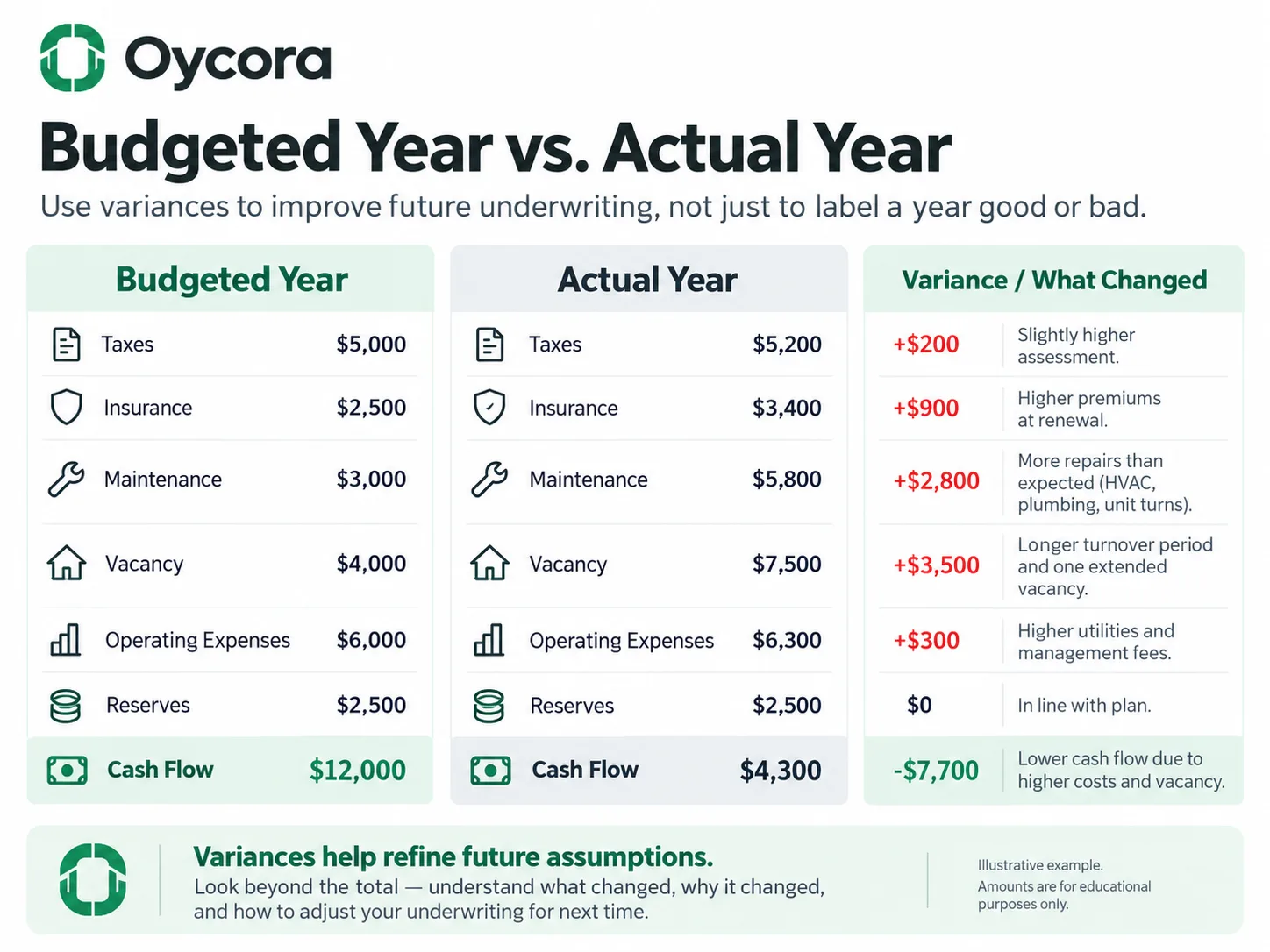
Several years of actual operating history become increasingly valuable. Patterns begin to emerge, and future underwriting can be based more heavily on observed costs rather than generic assumptions. That information also improves the investor’s ability to evaluate future acquisitions because firsthand experience reveals which expenses were easiest to underestimate.
The model should therefore evolve with the property. Reserve targets can change as components age or are replaced, operating expenses should be updated when recurring bills change, and cash-flow expectations should respond to what the property is actually producing.
The purpose of tracking is not to force reality to match the original spreadsheet. It is to let reality make the next spreadsheet better.
Back to Guide contentsPractical Takeaways
A rental property’s expense structure becomes easier to understand once the costs are separated by purpose. Recurring operating expenses determine NOI. Financing determines how much of that NOI remains after debt service. Capital expenditures and reserve planning account for larger future needs that may not appear in an ordinary month.
Use exact property information wherever it is available. Actual taxes, insurance quotes, lease responsibilities, utility bills, and maintenance history are more valuable than generic assumptions. When information is limited, percentage-based estimates can provide a useful starting point, but they should become more property-specific as inspection and ownership reveal additional details.
Do not assume a quiet year represents the property’s permanent cost structure. Maintenance, vacancy, turnover, and major replacements are uneven by nature. The budget should recognize those costs before they occur rather than treating them as surprises every time.
Most importantly, distinguish NOI from spendable cash. A property can produce healthy NOI while debt service and reserve planning leave the investor with relatively little cash available. Understanding that progression makes it much easier to see where the money is actually going.
Back to Guide contentsConclusion
Rental-property cash flow is the end of a sequence, not the starting point. Rent first has to survive vacancy and collection loss. Effective income then has to cover the recurring expenses required to operate the property. NOI must support the financing, and the investor still needs a plan for major components that will eventually require capital.
The formulas are relatively simple. The difficult part is deciding what belongs in each category and estimating those costs realistically enough for the result to mean something.
A strong property budget therefore combines day-to-day operating costs with long-term planning. It keeps financing separate from operations, distinguishes routine repairs from major replacements, and updates assumptions as real performance data becomes available.
The goal is not to eliminate uncertainty. It is to make sure the property has been analyzed with enough discipline that ordinary repairs, vacancy, and future component replacements were part of the plan before they became bills.
Back to Guide contentsHow Oycora calculates this
Calculation methodology
Related articles

Property Analysis
How to Analyze a Rental Property: A Step-by-Step Guide to the Numbers
A rental property's purchase price and monthly rent tell only part of the story. Learn how income, expenses, financing, cash flow, and return metrics fit together in a complete rental-property analysis.

Property Analysis
What Is Cap Rate in Real Estate and How Do You Calculate It?
Cap rate measures a property's net operating income relative to its value. Learn how to calculate capitalization rate, what changes it, how to compare properties, and why cap rate should never be used as a stand-alone buy-or-pass signal.

Property Analysis
What Is Net Operating Income (NOI) in Real Estate?
Net operating income measures how much income a property produces after operating expenses but before financing. Learn the NOI formula, what belongs in the calculation, what does not, and how to use it when analyzing a rental property.
Related Guides

Oycora Guide · Property Analysis
The Complete Guide to Analyzing a Rental Property
A complete rental-property analysis starts long before the final return percentage. This Guide walks through how to build realistic assumptions, measure operating performance, account for financing, interpret the major metrics, and stress-test the result before relying on it.
Read Guide →
Oycora Guide · Getting Started
How to Buy Your First Rental Property: A Beginner’s Guide
Buying your first rental property involves more than finding a house that rents for more than the mortgage. This Guide walks through preparing financially, defining what you are looking for, evaluating your buying capacity, and understanding the responsibilities that come with becoming a landlord.
Read Guide →