A rental property can show positive annual cash flow and still leave its owner short of money when a tenant moves out or a major repair arrives. The operating statement describes income and expenses over a period. A cash reserve answers a different question: what can the property pay for before the next rent payment comes in?
There is no single dollar amount that makes every rental adequately funded. A useful target starts with the costs that continue during an income interruption, then accounts for known replacements and unexpected bills without counting the same money twice. The goal is a defensible liquidity plan, rather than a reassuring percentage with no connection to the property.
What Counts as a Rental Property Cash Reserve?
A reserve is money deliberately kept available for the property instead of being spent at closing, distributed to the owner, or committed to another investment. It provides a buffer between an uneven stream of rental income and bills that may not wait. That buffer can support operations during vacancy, an unexpected repair, or a period when collected rent is below the budget.
For day-to-day planning, distinguish immediately accessible cash from assets that would first need to be sold, borrowed against, or withdrawn under restrictions. A property may have substantial equity but little money available to pay a contractor this week. A possible future refinance is therefore a financing option, not the same thing as an existing cash balance.
Also distinguish available reserves from cash already earmarked for another purpose. Money needed for a tax bill, a scheduled roof replacement, or personal living expenses cannot simultaneously provide its full value as an unrestricted emergency cushion. The account balance is only the starting point; the commitments against it matter just as much.
Start With the Bills That Continue When Rent Stops
Begin with the property’s essential monthly carrying costs under a specific stress scenario. For a fully vacant single-family rental, that may include mortgage principal and interest, property taxes, insurance, association charges, minimum utilities, and essential upkeep. Review management and service agreements rather than assuming every fee disappears when rent does.
Use actual bills and contract terms wherever possible. If the mortgage payment already includes tax and insurance escrow, do not add those amounts a second time. Conversely, a principal-and-interest payment alone does not represent the entire carrying cost. Annual bills can be converted to monthly equivalents for comparison, but the cash plan should still recognize when the full payment is due.
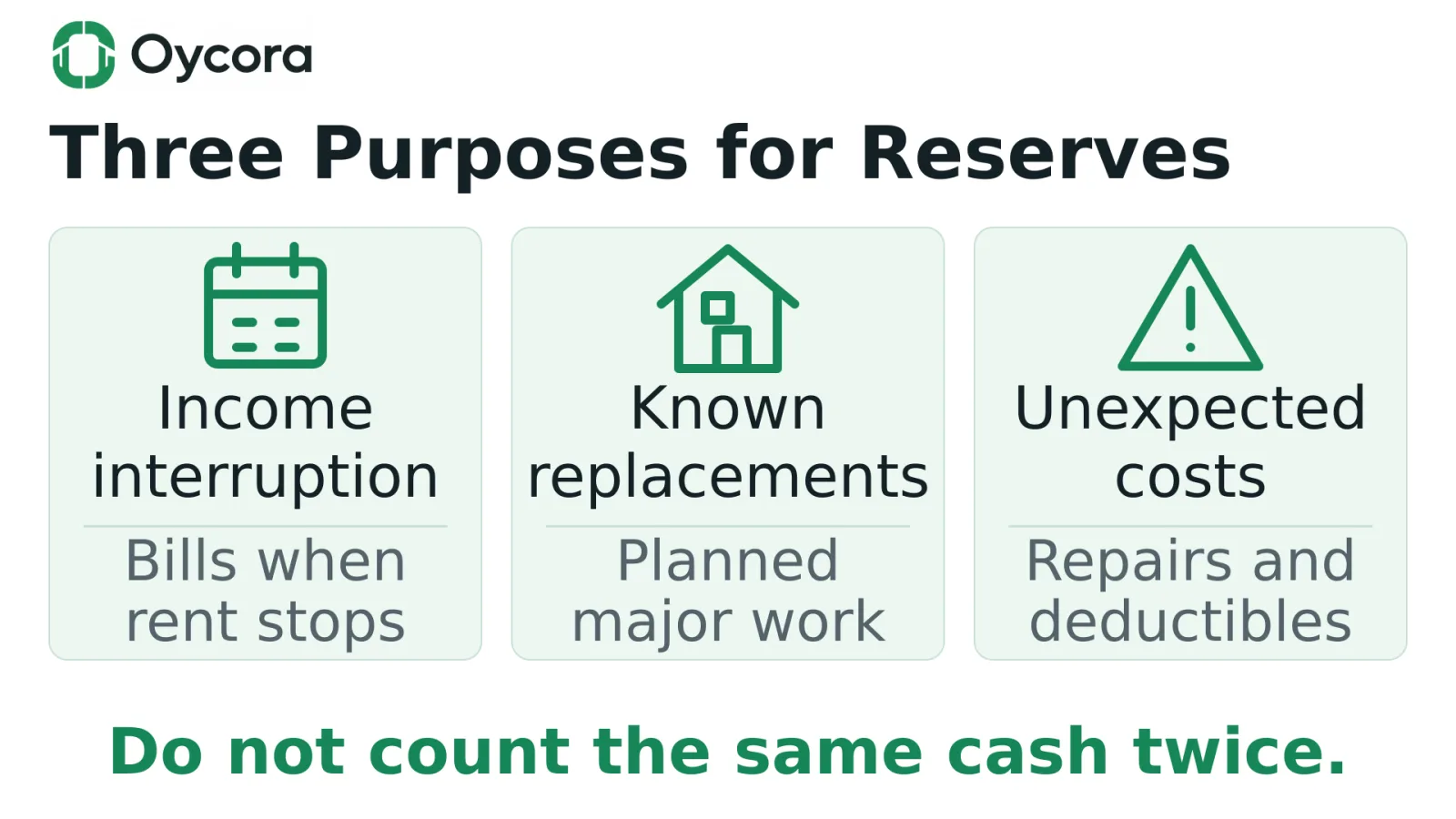
For a complete loss of rental income, a simple starting calculation is: Income-interruption cushion = essential monthly carrying costs × months to cover. This is a planning scenario, not a prediction of vacancy duration. For a multi-unit property, a partial income interruption may be more relevant. In that case, calculate the month-by-month shortfall after the rent and other cash income expected to remain. Do not add forgone rent again as a separate cash bill. State which scenario is being tested before interpreting the number.
Separate Income Protection From Known Replacement Costs
A maintenance budget, a CapEx allowance, and a funded cash reserve are related but different. Routine upkeep is spending expected in the operating budget; a CapEx allowance is a planning amount for larger replacements; a funded reserve is cash actually retained and available. Deducting $200 a month for future replacements in a forecast does not itself transfer $200 into savings. If the owner distributes that money, the model shows an allowance but the bank balance does not.
List near-term work separately using inspections, component condition, contractor estimates, and expected timing. A roof likely to need replacement next year creates a different funding problem from an unexpected appliance repair. The Maintenance & CapEx Reserve Calculator can help organize the replacement allowance, while the cash reserve plan determines how much funding must already be available.
It is reasonable to track separate purposes within the property’s cash balance. What matters is avoiding double counting. If $8,000 of a $12,000 balance is committed to a known project, only $4,000 remains for other needs unless that project can genuinely be deferred. An internal transfer between operating and reserve accounts is not a second property expense. When reviewing actual cash, count the bill once and reconcile the reserve withdrawal; do not treat a planning allowance and the same reserve-funded bill as two separate payments. Tax treatment and bookkeeping classification are separate questions from whether the cash is available.
Compare Three Reserve Balances on the Same Property
Consider a fictional rental with $1,500 in essential monthly costs during a complete loss of rent. That amount consists of $1,000 in mortgage principal and interest, $250 in property taxes, $150 in insurance, and $100 in minimum utilities and essential upkeep. Taxes and insurance are not already included in the mortgage figure.
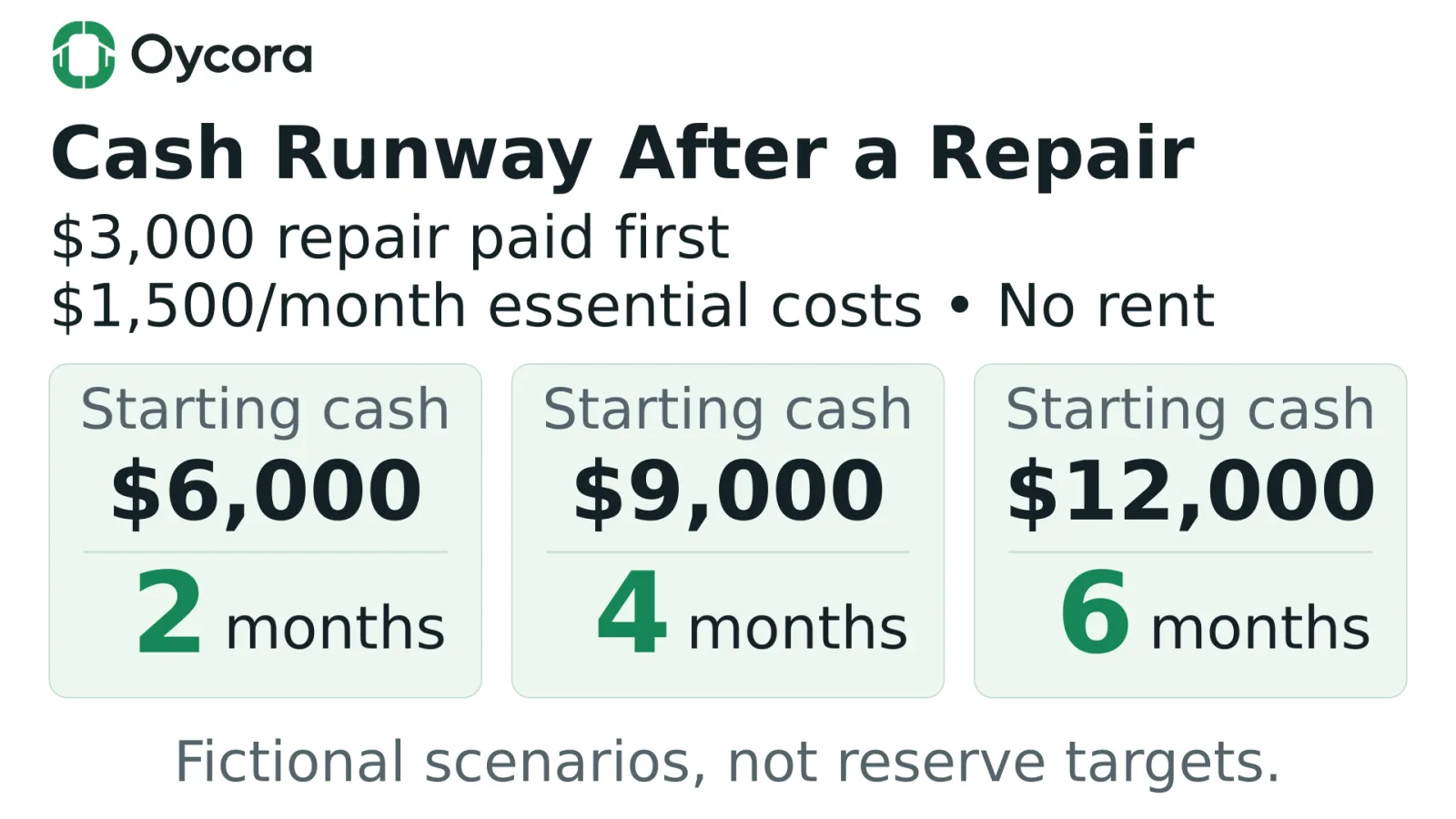
Assume a $3,000 unexpected repair is paid immediately, after which the property receives no rent. Compare starting reserves of $6,000, $9,000, and $12,000. All other assumptions remain unchanged. There are no additional repairs, financing proceeds, owner contributions, or interest earnings in this simplified comparison.
Cash Remaining After a Repair and Loss of Rent
Fictional illustration. Essential carrying costs are $1,500 per month. The $3,000 repair is paid before the zero-rent period begins. These are scenarios, not recommended reserve minimums.
| Measure | Smaller cushion | Middle cushion | Larger cushion |
|---|---|---|---|
| Starting cash reserve | $6,000 | $9,000 | $12,000 |
| Immediate repair payment | $3,000 | $3,000 | $3,000 |
| Cash remaining after repair | $3,000 | $6,000 | $9,000 |
| Essential monthly carrying costs | $1,500 | $1,500 | $1,500 |
| Months covered with no rent | 2 months | 4 months | 6 months |
Middle scenario: four months of carrying costs
4 months
($9,000 − $3,000) ÷ $1,500 = 4 months
The reserve is exhausted at the end of month four under these assumptions. This leaves no further buffer for another bill. The repair is counted once, and no separate replacement fund is assumed.
Before the repair, the middle balance appears to represent six months of carrying costs. After paying for the repair, it supports only four. This is why describing an account as “six months of reserves” can be misleading unless the costs and competing uses are defined.
The larger balance buys more time under the same assumptions; it does not improve rent, reduce operating expenses, or make an otherwise weak property profitable. Nor does the table establish that six months is enough. A longer interruption or a second repair would require additional funding.
Use Risk Factors to Choose the Scenario
The appropriate cushion depends partly on how much uncertainty the owner is carrying. A property with aging systems, limited operating history, or several replacements approaching together deserves a different stress test from a recently inspected property with documented costs. Less debt can reduce carrying costs, depending on the loan’s rate, term, and payment structure, but it does not remove taxes, insurance, upkeep, or replacement needs.
Income concentration matters as well. A vacant single-family home may collect no rent until it is relet. A small building may retain some rent when one unit turns over, but units can also share risks such as the same roof or heating system. Multiple rentals do not automatically eliminate the possibility of several cash demands arriving together.
The owner’s ability to replenish the account also matters. Reliable outside income may provide flexibility, but money needed for household emergencies should not be assumed available without limit. Test a longer interruption, a higher repair cost, or both. The purpose is to see where the plan fails before a real bill exposes the weakness.
Lender Reserve Requirements Answer a Different Question
Mortgage underwriting can impose its own reserve requirement. Fannie Mae’s Selling Guide, checked on October 16, 2026, measures reserves using months of the qualifying housing payment and eligible assets remaining after closing. It identifies six months for investment-property loan casefiles underwritten through Desktop Underwriter, with additional requirements possible. Other transactions, programs, and lender requirements can differ.
That is an eligibility framework, not a universal operating recommendation. Underwriting may recognize eligible assets beyond a dedicated cash account, and its payment definition may differ from the essential costs in a landlord’s stress test. Ask the lender what must remain after closing and which assets qualify, then build the property’s practical cash plan separately.
Passing a lender’s test does not demonstrate that a particular roof, deductible, or income interruption is fully funded. Equally, the illustration in this article is not a substitute for the lender’s calculation. Keep the two purposes visible rather than assuming that one number settles both questions.
Fund and Rebuild the Reserve Deliberately
Before buying, calculate what will remain after the down payment, closing costs, immediate work, and other commitments. A reserve target that exists only before those payments are made gives an overstated picture of post-closing flexibility. This is also why a lower purchase budget can sometimes produce a more durable ownership plan than using every available dollar to close.
After purchase, set a contribution amount that fits the property’s actual cash generation. Rebuilding a $3,000 withdrawal with $250 monthly contributions takes 12 months if there are no further withdrawals or earnings. If normal cash flow cannot support that contribution, the plan needs another realistic funding source, a longer rebuilding period, or a reassessment of distributions.
Keep the balance accessible on a timescale that matches likely bills and review it regularly. The Consumer Financial Protection Bureau’s emergency-fund guidance emphasizes tailoring savings to the situation and keeping funds safe and accessible. For a rental, translate that principle into a written target, permitted uses, and a rebuilding process rather than treating any positive bank balance as sufficient.
Review Liquidity Alongside Cash Flow and Return
Reserves and cash flow solve related but different problems. Cash flow helps assess whether the property can sustain itself over time; reserves help it absorb timing differences and shocks. Repeatedly drawing down savings to cover ordinary operations may indicate a structural shortfall rather than a temporary emergency. A larger account delays that problem without necessarily correcting it.
Review the plan after a major repair, insurance renewal, tax change, refinancing, or change in expected rent. Reconcile the cash balance with earmarked replacement funds and near-term bills, then rerun the interruption scenario. Use the Vacancy Cost Calculator to explore lost rent and the Rental Property Cash Flow Calculator to check the ongoing budget, keeping their assumptions consistent.
A useful reserve target is one the owner can explain: which costs it covers, how long it lasts, what else could draw on it, and how it will be replenished. That explanation is more valuable than selecting a round number and assuming the property is protected. The examples here are educational planning tools, not individualized lending, tax, or investment advice.