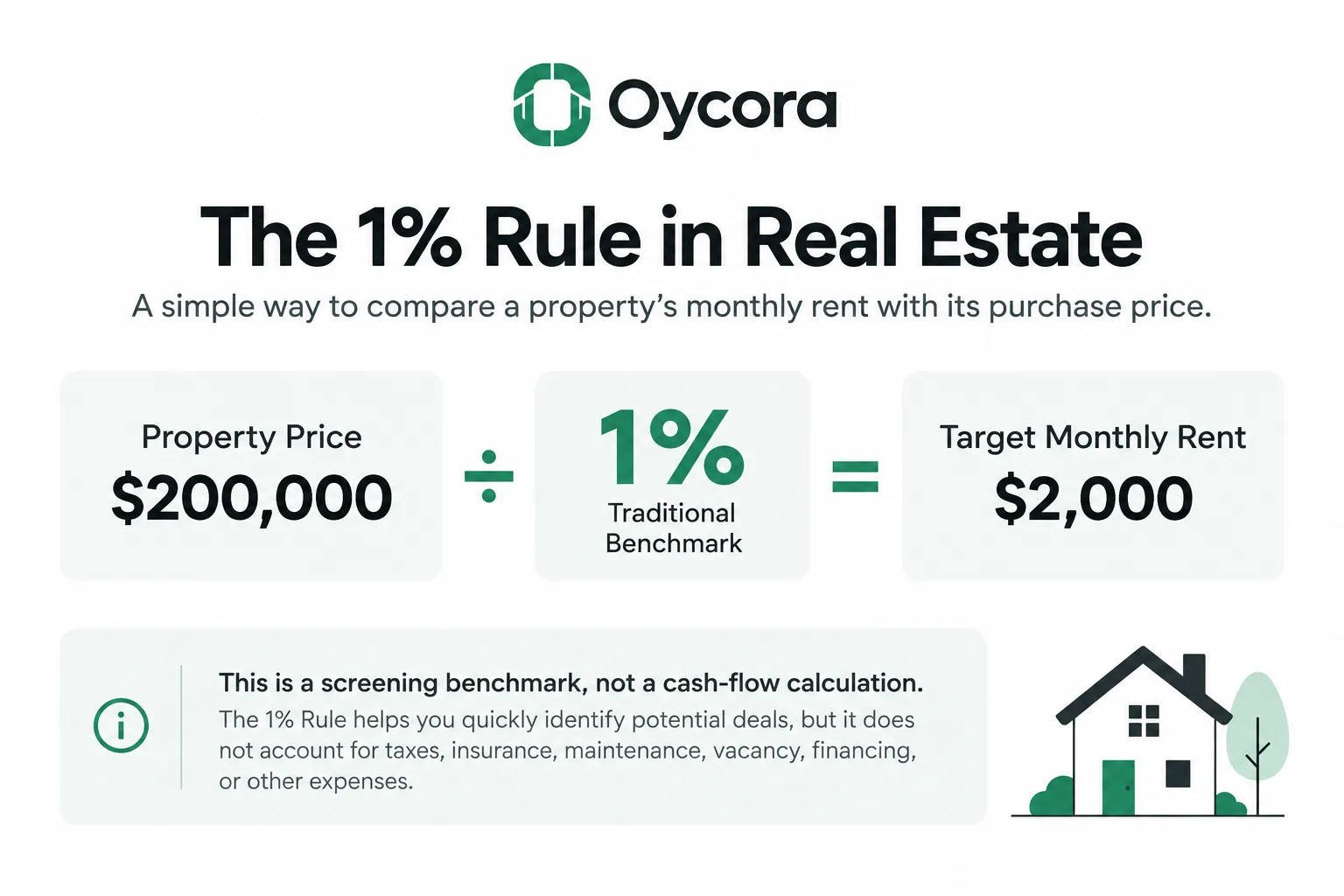
The 1% Rule is one of the most recognizable shortcuts in rental-property investing. The idea is simple: a property's monthly rent should equal at least 1% of its purchase price. A $200,000 property would therefore need to rent for about $2,000 per month to meet the rule.
That simplicity is exactly why the rule became popular. Investors looking through dozens of listings could compare rent with price in a few seconds and decide which properties deserved a closer look. The problem is that a rent-to-price ratio does not tell you what the property actually costs to operate or finance.
That distinction matters even more today. Recent BiggerPockets commentary argues that the traditional 1% Rule has become less reliable as a cash-flow shortcut because interest rates, taxes, and insurance can materially change the outcome even when a property's rent-to-price ratio looks strong.
The 1% Rule is therefore best understood as a screening heuristic, not a buy/no-buy rule.
What Does the 1% Rule Actually Say?
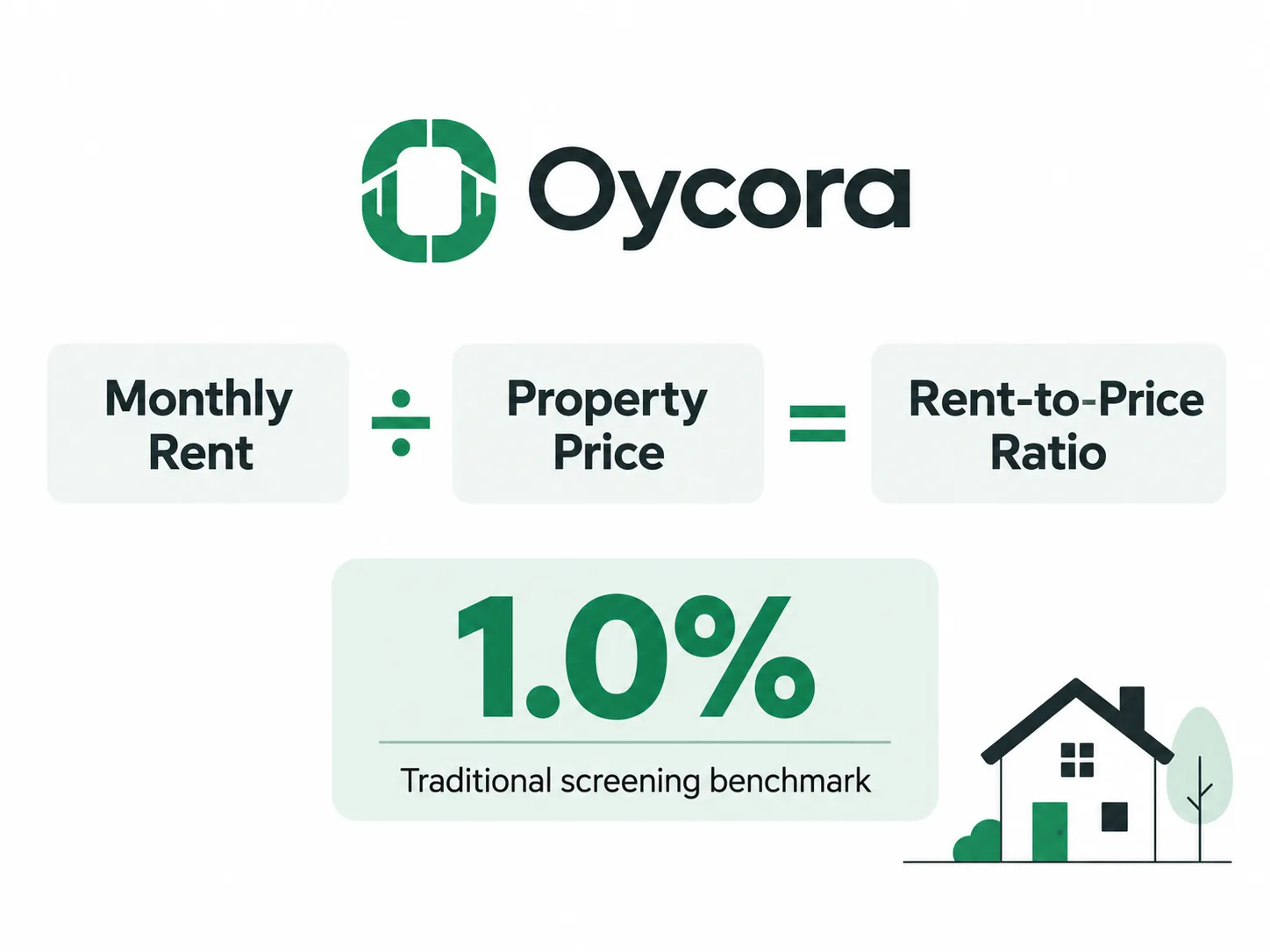
The standard formula is:
Monthly Rent ÷ Property Price = Rent-to-Price Ratio
A property meets the traditional 1% Rule when that ratio equals or exceeds 1%. For example:
$2,000 monthly rent ÷ $200,000 purchase price = 1.0%
In that case, the property meets the rule exactly. A property renting for $1,600 at the same $200,000 price would have a 0.8% rent-to-price ratio, while one renting for $2,400 would have a 1.2% ratio.
Some versions of the rule also include the cost of immediate repairs or improvements in the price basis. BiggerPockets, for example, has described the rule using purchase price plus necessary repairs when evaluating the threshold.
The important thing is consistency. If one property is calculated using only the purchase price and another includes a large renovation budget, the comparison becomes less useful. For screening purposes, use the same definition across the properties being compared.
Why Investors Used the 1% Rule
The 1% Rule was useful because it acted as a rough proxy for cash-flow potential without requiring a complete underwriting model. A property with relatively high rent compared with its price often had more room to absorb operating expenses and financing than a property with very low rent relative to price.
That relationship is real. BiggerPockets has historically described rent-to-price ratio as a useful screening measure because it can correlate with cash-flow potential, even while cautioning against treating the 1% threshold itself as a law.
The rule also solved a practical problem: investors cannot spend an hour underwriting every listing they encounter. If you are reviewing 50 potential properties, a fast rent-to-price screen can help narrow the list before you research taxes, insurance, maintenance, financing, and comparable rents in detail.
That is still the rule's strongest use today. The mistake is assuming that because a property passes the 1% screen, it must cash flow. The rule never actually calculates cash flow.
0.6% vs. 0.8% vs. 1.0%
Assume three fictional properties each rent for different amounts relative to their purchase price.
| Property | Purchase Price | Monthly Rent | Rent-to-Price Ratio |
|---|---|---|---|
| Property A | $300,000 | $1,800 | 0.60% |
| Property B | $250,000 | $2,000 | 0.80% |
| Property C | $220,000 | $2,200 | 1.00% |
Using only the 1% Rule, Property C looks strongest because it produces the most monthly rent relative to its price. Property A would likely be rejected immediately by an investor who uses 1% as a strict minimum.
But now add a small amount of context:
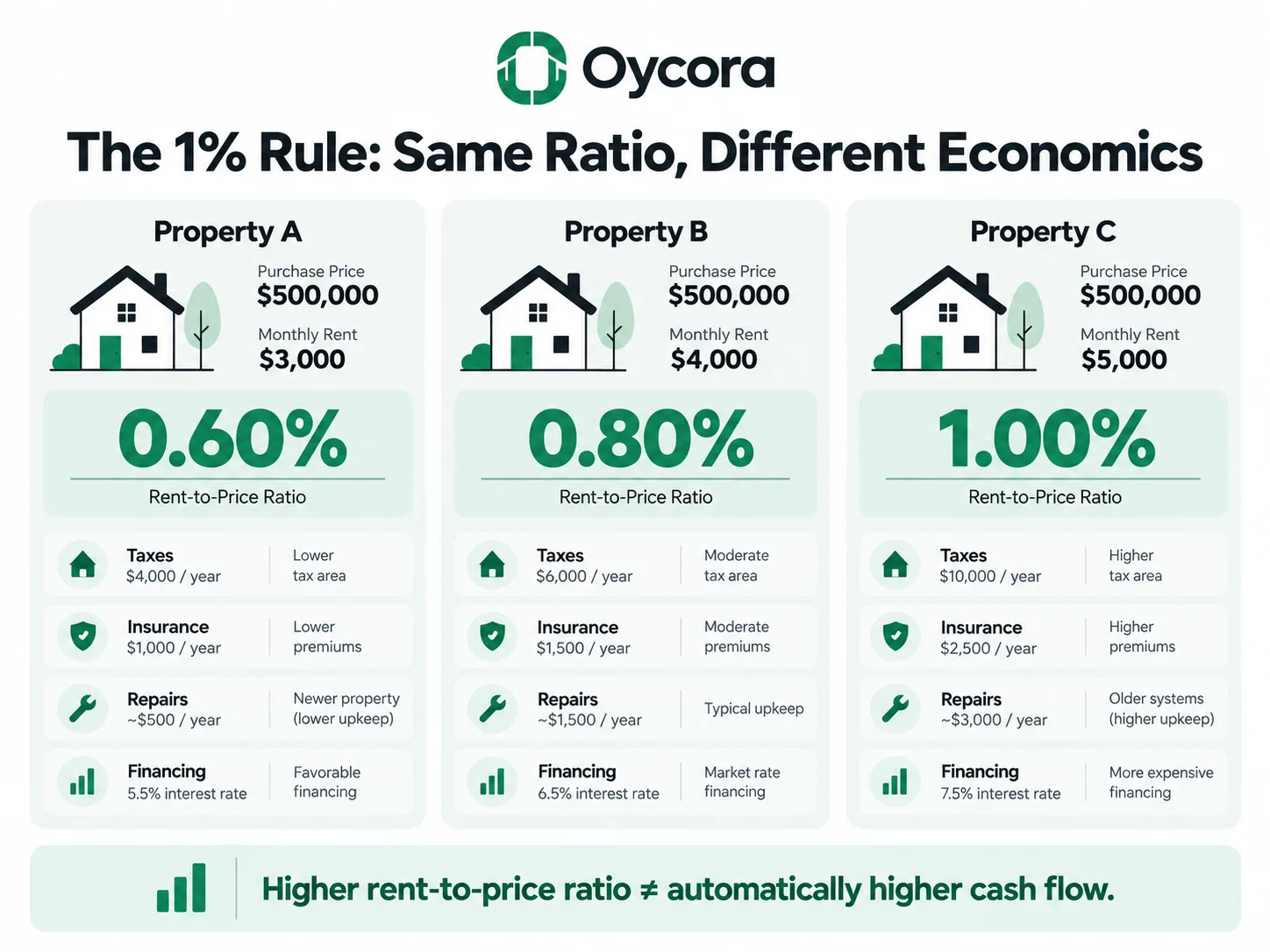
| Property | Ratio | Annual Taxes & Insurance | Expected Repairs | Financing |
|---|---|---|---|---|
| Property A | 0.60% | Lower | Newer property | Favorable |
| Property B | 0.80% | Moderate | Average | Moderate |
| Property C | 1.00% | Higher | Older systems | Expensive |
The 1% ratio still tells you something useful: Property C has a stronger rent-to-price relationship. It does not tell you whether Property C will produce more cash flow after expenses and debt service.
That requires a complete analysis.
What the 1% Rule Ignores
The biggest limitation is that the formula contains only two variables: rent and price.
It does not include property taxes. Two $200,000 properties renting for $2,000 per month both satisfy the 1% Rule even if one has a $2,000 annual tax bill and the other has an $8,000 bill.
It does not include insurance either. That omission has become increasingly important in markets where premiums vary widely by location and property characteristics. Recent BiggerPockets coverage specifically points to higher taxes and insurance as reasons why the traditional rent-to-price shortcut may produce false positives in the current market.
The rule also ignores vacancy, maintenance, property management, owner-paid utilities, HOA fees, capital expenditures, and financing. A 1% property with an aging roof, high insurance, and expensive debt can easily perform worse than a 0.7% property with lower costs and stronger financing.
This is why the rule should never be interpreted as:
1% = profitable
What it actually means is:
1% = relatively high monthly rent compared with purchase price
Those are not the same conclusion.
Why the 1% Rule Is Harder to Use Today
The traditional 1% threshold came from a different housing and financing environment. In many current markets, home prices have risen much faster than rents, making 1% properties difficult to find without moving into lower-priced areas, accepting heavier renovation needs, or targeting unusual property types.
At the same time, borrowing costs and several major expense categories have become more important in determining whether a rental cash flows. BiggerPockets' September 2026 discussion of a proposed “rent-to-payment ratio” specifically argues that comparing rent with the property's actual mortgage-related payment may be more informative than comparing rent only with price in today's environment.
That does not mean the 1% Rule has become mathematically wrong. The calculation still measures exactly what it always measured. What changed is how much investors can infer from that number.
A 1% ratio once may have been a stronger shortcut for likely cash flow in certain markets and financing environments. Today, the spread between a property's purchase price and its actual monthly carrying cost can vary much more depending on rate, insurance, taxes, and loan structure.
The rule still measures rent relative to price. It simply cannot carry the analytical weight some investors once gave it.
A Property Below 1% Can Still Work
Rejecting every property below 1% can eliminate perfectly viable rentals.
Suppose a high-quality property in a strong rental market produces a 0.7% ratio but has low maintenance needs, predictable vacancy, moderate taxes, and attractive financing. Its full cash-flow analysis may still be acceptable for the investor's goals.
A lower ratio might also be common for the property type or location. Higher-priced markets frequently produce lower rent-to-price ratios, while lower-cost markets may show much higher ones. Comparing the ratio across similar properties in the same market is usually more informative than forcing every property nationwide to meet the same 1% threshold.
BiggerPockets has made essentially this argument for years: rent-to-price can remain useful while the requirement that every good deal exceed exactly 1% is too rigid.
The ratio should raise questions, not answer them.
If a property sits at 0.5%, you may reasonably ask whether enough income exists to support the price. If another sits at 1.2%, you should ask why the rent is so high relative to value and whether the property's expenses, condition, or location explain it.
A Property Above 1% Can Still Fail
The opposite mistake is assuming that meeting the rule automatically creates a good rental.
A low-cost property might rent for more than 1% of its price because buyers perceive meaningful risk. Deferred maintenance, weak tenant demand, high turnover, high property taxes, unusual insurance costs, or poor condition may all contribute to a relatively low purchase price.
Financing can also eliminate the apparent advantage. If the investor uses expensive debt with a large monthly payment, strong gross rent may still leave very little cash after debt service.
This is especially important because the 1% Rule is a gross-income test. It knows nothing about the amount of money that actually remains after ownership costs. A ratio can tell you a property deserves further investigation. It cannot tell you that the investigation is finished.
When the 1% Rule Is Still Useful
The rule works best at the very beginning of the search process.
Imagine reviewing 100 rental listings. You may not have reliable insurance quotes, tax projections, repair estimates, financing terms, or operating histories for every property. Calculating a quick rent-to-price ratio can help identify which listings appear to offer stronger or weaker gross-income relationships.
That makes it useful for:
- Comparing similar listings quickly.
- Screening a large market or neighborhood.
- Identifying properties that deserve full underwriting.
- Spotting unusually low or high rent relative to price.
It becomes less useful once better information is available. If you already know the taxes, insurance, vacancy, maintenance, loan terms, and expected repairs, there is little reason to let a crude two-variable rule override a complete cash-flow model.
A shortcut should save time before detailed analysis, not replace detailed analysis after the information exists.
What Should You Analyze After the 1% Screen?
Once a property passes whatever initial screen you choose to use, move to the actual economics.
Start with supported rental income and account for vacancy and collection loss. Estimate the recurring operating expenses, including taxes, insurance, management, maintenance, owner-paid utilities, and other applicable costs. That produces NOI.
Then apply the actual financing structure and calculate debt service, pre-tax cash flow, cash-on-cash return, and DSCR. Major future capital needs and reserve assumptions should also be visible rather than ignored because they do not occur monthly.
That process may confirm the initial 1% screen—or completely reverse it.
A 0.75% property may ultimately show stronger cash flow than a 1.05% property once everything is included. The rule cannot know that because it was never designed to.
Use the 1% Rule for the Job It Was Built to Do
The 1% Rule remains useful because it is fast. In a few seconds, it tells you how much monthly rent a property produces relative to its price and gives you a simple basis for comparing potential deals.
What it does not do is calculate cash flow, profitability, risk, or investment quality.
The most useful way to apply it today is as an early screening heuristic. Use it to narrow the search, identify unusual rent-to-price relationships, and decide which properties deserve more work. Do not turn the 1% threshold into a requirement that automatically rejects every property below it or approves every property above it.
The rule becomes more useful once you stop asking it to answer questions it was never designed to answer.