
A BRRRR refinance can close successfully and still miss the investment plan. The new loan might repay the acquisition financing but return much less of your cash than expected. That difference matters when the money was supposed to fund the next purchase, replenish reserves, or repay another source of capital.
Start with the dollars that reach you after the old debt and refinance charges are paid, not the headline loan amount. Then compare those proceeds with your actual cash invested. A lower appraisal, tighter loan-to-value limit, or larger payoff can leave substantial cash unrecovered even when the property has equity. The calculation below separates that outcome from a more urgent problem: needing additional money just to close.
Separate Cash Left in the Deal From Cash Needed to Close
Use three amounts: owner cash invested before refinancing, the gross new loan, and the deductions required at closing. In a simple transaction, net refinance proceeds equal the new loan minus the existing payoff and refinance costs paid from those proceeds. Include other closing adjustments when they apply.
If net proceeds are positive but smaller than your invested cash, the difference is cash left in the deal. If proceeds are negative, their absolute value is additional cash required at closing; that contribution increases your unrecovered investment. Money received above your original cash investment is additional borrowing, not operating profit.
For this article, cash left means unrecovered owner contributions, excluding separately held reserves. It is not the same as property equity, accounting basis, or total economic profit. Those measures answer different questions. Keep the definition visible when comparing projects, particularly if one calculation includes reserve funding and another excludes it.
Build the Cash Ledger Before Estimating the Refinance
List the down payment, acquisition charges, cash-funded rehabilitation, and holding costs you actually paid. Reconcile loan-funded work separately: borrowed rehab funds are not owner cash, but the outstanding balance may need repayment. Include owner-funded principal payments in the cash ledger and use the resulting lower payoff. Principal paid from rental receipts is not automatically another owner contribution; reconcile those operating cash flows separately.
Replace a rough loan balance with a dated payoff quote as closing approaches. The CFPB explains that a payoff amount can include interest through the payoff date and unpaid fees, and may differ from the balance on a statement. Check your loan documents for any applicable prepayment or exit charge.
Keep refinance fees outside the pre-refinance cash figure when they will be deducted from the new loan. Fees already paid out of pocket belong in the cash ledger instead. Escrow deposits and prepaid items also affect immediate liquidity, although they are not all permanent transaction expenses. Record any later refunds separately rather than spending money before it arrives.
A Smaller Loan Can Leave Much More Cash Unrecovered
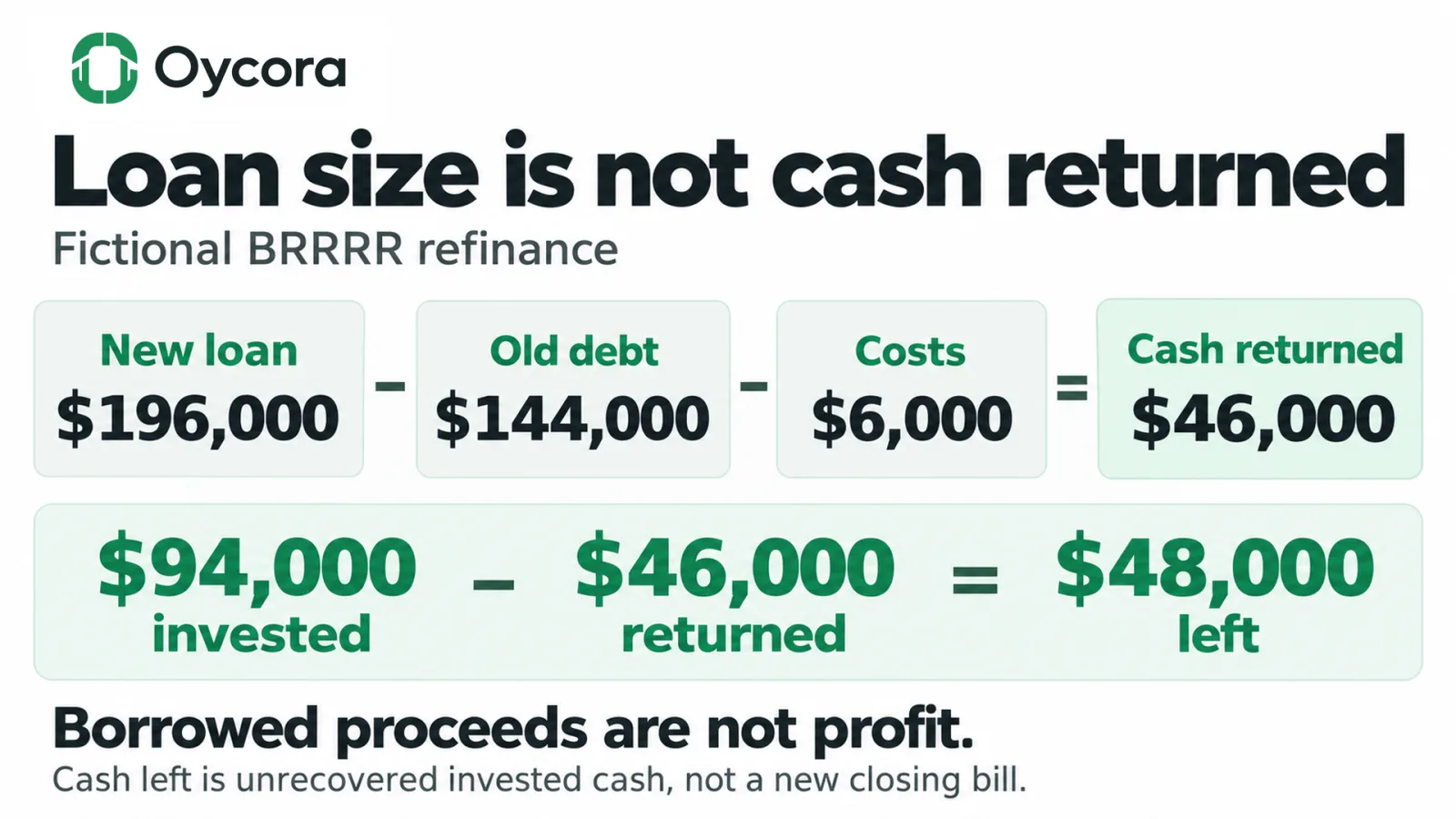
Consider a fictional purchase for $180,000, financed with a $144,000 interest-only acquisition loan and $36,000 of owner cash. The owner also pays $6,000 in acquisition costs, $40,000 for rehabilitation, and $12,000 in holding costs, including paid interest. There are no further loan draws, principal repayments, or pre-refinance rental cash flows. Owner cash invested is $94,000; total project spending is $238,000.
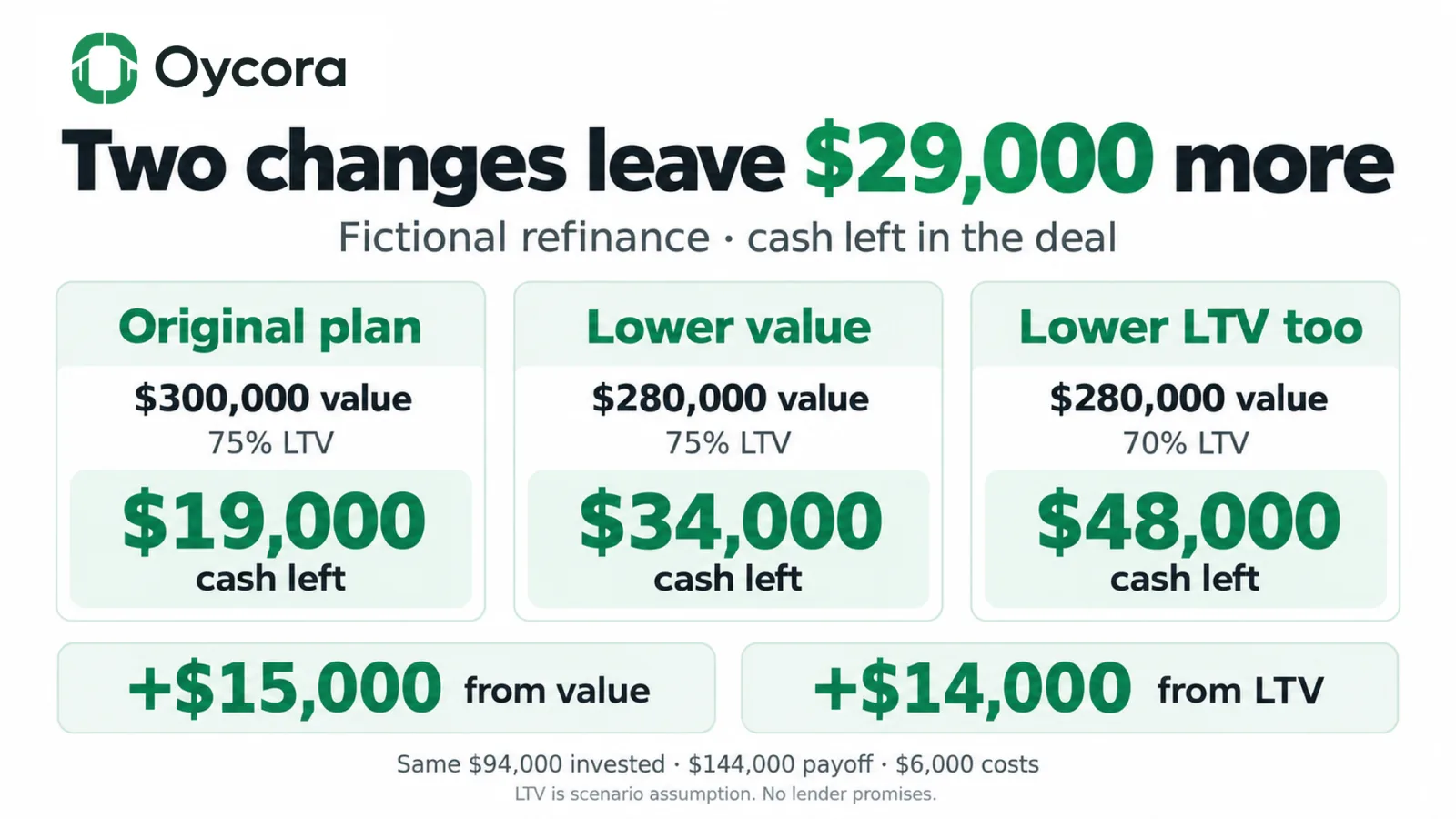
Assume the payoff remains $144,000 and refinance costs are $6,000, deducted at closing. The original plan uses a $300,000 refinance value and 75% LTV. The downside uses $280,000 and 70%. These are hypothetical assumptions, not available loan offers or universal lending limits. Both scenarios assume the borrower and property otherwise qualify.
Real World Example
Fictional BRRRR refinance comparison. Owner cash invested is $94,000. The $144,000 acquisition payoff and $6,000 refinance deductions are identical in both scenarios. No reserve deposit, escrow adjustment, additional lien, or cash paid outside closing is included.
| Measure | Original plan | Downside case |
|---|---|---|
| Refinance property value | $300,000 | $280,000 |
| Assumed refinance LTV | 75% | 70% |
| Gross refinance loan | $225,000 | $196,000 |
| Existing loan payoff | −$144,000 | −$144,000 |
| Refinance costs from proceeds | −$6,000 | −$6,000 |
| Net borrowed proceeds to owner | $75,000 | $46,000 |
| Owner cash left in the deal | $19,000 | $48,000 |
| Additional cash required to close | $0 | $0 |
Additional owner cash left versus the original plan
$29,000
$48,000 − $19,000 = $29,000
Downside loan: $280,000 × 70% = $196,000. Net proceeds: $196,000 − $144,000 − $6,000 = $46,000. Cash left: $94,000 − $46,000 = $48,000. The proceeds are borrowed money, not profit.
Find the Appraisal Needed to Recover Your Cash
The downside leaves $48,000 unrecovered rather than $19,000, a $29,000 increase. That is not a $29,000 check due at closing: the transaction still returns $46,000. It is a $29,000 reduction in capital released compared with the plan. Separately, the modeled equity is $84,000: the $280,000 value minus the $196,000 new debt. Equity does not make that amount available in your bank account.
To recover all $94,000, the new loan must cover $94,000 of returned cash, the $144,000 payoff, and $6,000 of refinance costs: $244,000 altogether. At 75% LTV, that requires approximately $325,333.33 of value, or $325,334 rounded upward to a whole-dollar threshold. This assumes LTV is the binding limit and costs stay fixed.
The arithmetic is a planning hurdle, not a valuation target for an appraiser. Fannie Mae’s LTV guidance generally uses current appraised value for refinance transactions, with specified exceptions. Your lender must confirm the applicable valuation basis and loan cap. Spending another dollar on improvements does not establish an extra dollar of appraised value.
Check Timing and Eligibility Before Relying on Proceeds
A favorable appraisal does not establish that a refinance can close on your preferred date. Ask the proposed lender to confirm ownership seasoning, existing-loan seasoning, title requirements, property condition, income documentation, and any restrictions on cash-out. Explain the acquisition financing and renovation history accurately instead of requesting a generic rate quote.
For example, Fannie Mae’s cash-out policy generally requires an existing first mortgage being paid off to be at least 12 months old and at least one borrower to have held title for six months, subject to stated exceptions. These are separate tests. Its delayed-financing exception has specific documentation and amount restrictions; it is not blanket permission to withdraw the entire renovated value immediately.
Other programs can have different requirements. Confirm the actual route before assuming a six-month refinance in your budget. Oycora’s rental property financing resource provides context for matching qualification and debt structure to the investment. A delay can add interest, utilities, insurance, and extension charges, so update both invested cash and the payoff.
Stress-Test the Gap and Keep Reserves Separate
Change one assumption at a time before combining setbacks. At the original 75% LTV, a $20,000 appraisal reduction cuts the loan by $15,000. At the lower $280,000 value, reducing LTV from 75% to 70% removes another $14,000. Together those changes explain the example’s $29,000 reduction in proceeds. Another $4,000 of cash-paid rehab overruns would independently increase cash left by $4,000 if nothing else changed.
Also model the point at which proceeds turn negative. With a $144,000 payoff and $6,000 of closing deductions, a $140,000 loan requires $10,000 from the owner to close. Starting from $94,000 already invested, unrecovered owner cash becomes $104,000. Confirm you could fund that obligation without relying on another unapproved refinance.
Preserve a separate reserve budget for the property and any lender requirement. Do not assume subject-property cash-out can satisfy the lender’s reserve test: Fannie Mae explicitly excludes those proceeds from acceptable reserves. Your operating cushion and the lender’s qualifying reserves also need not be the same amount. Neither should disappear from the plan merely because the refinance releases cash.
Judge the Rental After the Shortfall
Leaving cash invested does not by itself make the rental a poor investment. Recalculate stabilized cash flow using the actual proposed loan, realistic vacancy, operating expenses, and capital-replacement reserves. If the property works only when every dollar is recovered, the original plan may have depended too heavily on capital recycling.
Compare alternatives on both liquidity and ongoing cost. A smaller loan can leave more money invested while reducing debt service, depending on rate and term. A larger loan can return more cash but weaken the monthly cushion. Oycora’s discussion of when to refinance a rental property helps frame that broader comparison.
Do not repair the cash-recovery figure by hiding fees in a supposedly free refinance. The CFPB describes how no-closing-cost offers can use a higher rate or a larger loan balance. Those structures change where and when you pay. Compare actual proposed proceeds, payments, and costs rather than the marketing label.
Frequently Asked Questions
Does a refinance shortfall mean I need to bring cash?
Not necessarily. Receiving less than expected can leave more of your original contribution unrecovered without requiring another payment. Additional cash is needed when the approved loan and other closing credits do not cover the payoff and closing deductions.
Can I avoid the shortfall by waiting for a higher appraisal?
Possibly, but neither appreciation nor a higher future loan limit is assured. Compare the potential extra proceeds with additional holding costs, loan-extension terms, and the risk that the refinance remains unavailable. Waiting needs its own funded budget.
Should I use cash left as my cash-on-cash denominator?
A post-refinance analysis can use remaining owner cash, provided the convention and reserve treatment are explicit. Do not compare it casually with a return based on all original contributions. A tiny denominator can create a large percentage without much annual cash flow.
Plan Around the Cash You Can Actually Recover
A useful BRRRR plan can survive a refinance that returns less than hoped. Reconcile owner contributions, obtain realistic loan and payoff figures, and distinguish unrecovered cash from a closing deficit. Then decide whether the property’s ongoing cash flow and your remaining liquidity justify the capital that stays invested. The next acquisition should depend on confirmed available funds, not projected equity.