
Oycora Guide · Market And Economics
The Complete Guide to Rental Property Market Research
Learn how to compare rental markets, evaluate local demand and competing supply, verify operating constraints, and turn evidence into assumptions before underwriting a property.

A rental market deserves your attention when the evidence supports the kind of property you can buy and the operation you can sustain. A growing population, a low purchase price, or an attractive advertised rent can start the investigation. None answers the full question.
Useful market research connects demand, competing supply, local costs, and operating conditions before you commit to detailed property analysis. It helps you decide where to search, what assumptions need testing, and which uncertainties could make a location unsuitable for your strategy. The result should be a short, defensible shortlist rather than a ranking of supposedly perfect cities.
This Guide focuses on U.S. long-term residential rentals, particularly single-family homes and small multifamily properties. You will learn how to compare markets consistently, distinguish broad statistics from local evidence, and turn findings into a practical acquisition brief. Once you have a specific property, the complete rental property analysis Guide explains how to evaluate its income, expenses, financing, and returns.
Define the Market You Need Before Collecting Data
Write a Search Brief That Reflects Your Constraints
Start with the investment you are actually able to operate. A market that suits an experienced local owner renovating vacant four-unit buildings may be a poor fit for someone buying a rent-ready house from another state. Broad market attractiveness does not remove differences in capital, time, expertise, or access to reliable help.
Write a short search brief covering the property type, approximate purchase range, cash available after closing, intended rental use, and management arrangement. Add the geographic distance you can realistically cover and the condition of property you are prepared to take on. These constraints give the research a purpose. They also prevent an appealing listing from quietly changing the strategy.
For example, a buyer might seek a long-term duplex within a manageable drive, with ordinary maintenance rather than major rehabilitation, and enough remaining cash to absorb a vacancy or significant repair. Another buyer may need professional management from the first day. Those buyers should ask different questions about local contractor availability, management minimums, and travel costs, even if they consider the same city.
Separate firm limits from preferences. If you cannot finance extensive repairs, a market dominated by low-priced distressed inventory may fail your practical requirements before you compare growth rates. If you simply prefer a shorter drive, distance can remain a tradeoff. Establishing that distinction early saves research time and makes the eventual choice easier to explain.
Move From Regional Context to the Actual Rental Area
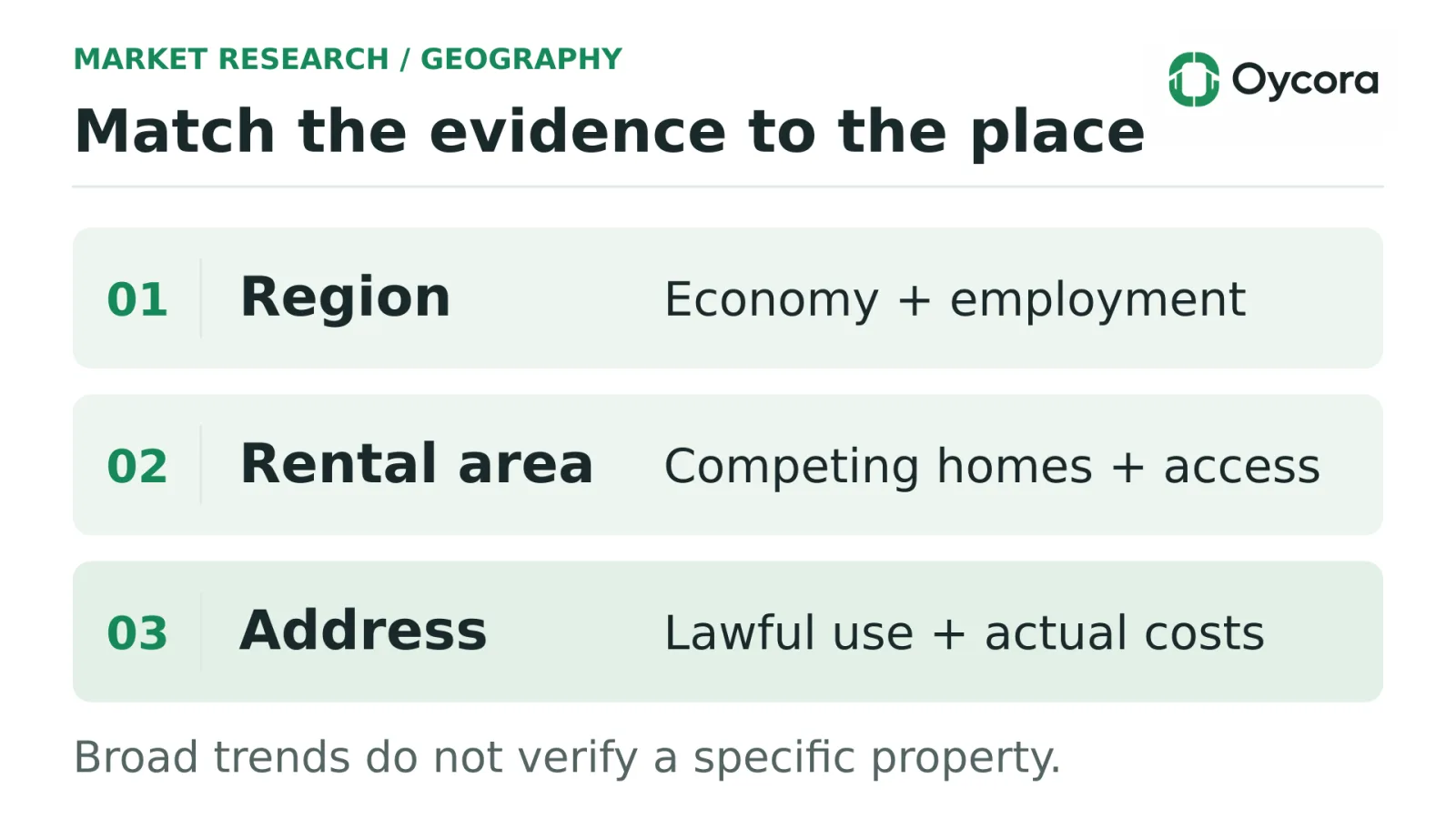
Use a metropolitan area or county to understand the broader economy, then narrow the investigation to the areas where the target properties compete. A city boundary, ZIP code, school district, census tract, and postal address can describe different geographies. Figures labeled with the same place name may therefore refer to different populations or housing stock.
Define a rental area by plausible substitutes for the property, including access to employment, transport, services, and competing housing. Record its boundary rather than relying on an informal neighborhood name. A highway, river crossing, transit connection, or long commute can make nearby properties serve different rental needs.
Finally, examine the address. Regional job growth cannot establish whether a particular building has a permitted rental use, an affordable insurance option, or a manageable maintenance burden. Keep these levels connected without allowing evidence from the broadest level to answer the most specific question. A useful market file identifies the geography beside every important figure.
Build an Evidence Base You Can Compare
Match Each Question to the Right Source
Begin with official statistical sources for the broad picture, local public records for jurisdiction-specific facts, and direct operating evidence for current conditions. These sources serve different purposes. A census estimate can describe the housing stock, while a property manager can discuss the recent leasing experience of a particular unit type. Neither should be asked to prove what the other measures.
For household and housing characteristics, the Census Bureau's American Community Survey can provide context. For employment by county and industry, the Bureau of Labor Statistics Quarterly Census of Employment and Wages, or QCEW, is a useful starting point. Local planning departments and the Census Building Permits Survey help identify development activity. Assessors, licensing offices, utility providers, and insurers address different parts of the operating picture.
Commercial reports, listing portals, and local commentary can reveal questions worth investigating. Before relying on a chart, check its coverage. An apartment report may describe large professionally managed buildings and exclude the small rentals you intend to buy. A listing portal describes the properties it captures, not necessarily the entire market. A broker's forecast may also reflect a particular transaction or business interest.
Create a simple source ledger as you work. For each important finding, record the source, release or contact date, period covered, geography, property segment, definition, and limitation. Preserve the underlying report or link and a brief explanation of how the finding affects your decision. This makes it possible to revisit an assumption without repeating the whole search.
Check Dates and Definitions Before Comparing Trends
A recent publication can describe an older period. Official estimates, newly released surveys, and current listings may all be useful, but they do not represent the same moment. Label both the observation period and the date you accessed the information. Compare like periods where seasonality matters, and note whether the series has been revised.
American Community Survey estimates require particular care. A five-year estimate combines information across a period; it is not a snapshot of the final year. The Census Bureau's guidance on comparing ACS data cautions against mismatched estimate types and overlapping five-year comparisons. Use appropriate nonoverlapping periods when examining change, and check whether definitions or boundaries changed.
Also read the uncertainty. A small difference between two estimates may not support a confident conclusion, particularly for a small area. The Bureau explains why margins of error matter when comparing estimates. If the evidence cannot distinguish a meaningful change, describe the trend as uncertain instead of turning the displayed digits into a growth story.
Consistency is more valuable than a large spreadsheet. Comparing one market's county employment with another's metro employment, or one area's asking rents with another's signed leases, can produce a precise-looking answer to the wrong question. Resolve the mismatch, show the limitation, or leave the comparison open.
Distinguish a Fact From the Assumption It Supports
A finding and its interpretation should occupy separate lines in your notes. “A 100-unit project has received a permit” is a potentially verifiable fact. “Those units will compete with my duplex next spring” adds assumptions about construction, timing, location, and price. Recording the second statement as if it were part of the first hides the most important uncertainty.
Use a short chain: observation, possible implication, next verification step. For a permitted project, the next step might be checking construction status and the proposed unit mix with the planning department or developer. For a manager reporting slower leasing, it might be reviewing the relevant properties and the period involved. This structure keeps a plausible story from acquiring more certainty each time it is repeated.
Missing information needs its own label. An empty field does not mean zero new supply, no insurance concern, or no rental restriction. Decide whether the missing item can wait until a property is identified or whether it prevents you from assessing the market at all.
Back to Guide contentsRead Rental Demand and Competing Supply Together
Look Beyond Population Growth
Population helps describe the scale of an area, but rentals are occupied by households. More people do not necessarily translate into the same percentage increase in households or rented homes. Household formation, tenure choices, and changes in household size can affect the relationship. Examine the number of households, the renter-occupied stock, and the kinds of housing available alongside population trends.
Income information adds context, provided the population measured fits the question. Income for all households is not the same as income for renter households, and a regional median does not establish what a particular household can pay. Use income distributions and housing-cost information to question whether the proposed rental offering fits the local housing market. Do not treat one median as a rent-setting formula or an applicant-screening rule.
Focus on housing and operational needs rather than stereotypes about who lives in an area. Useful questions concern the available unit sizes, accessibility features, commute options, condition, and total cost of occupancy. These are more informative for a property search than labeling neighborhoods by the perceived “quality” of their residents. Keep housing decisions consistent with applicable fair housing requirements; HUD explains federal rights and obligations, and additional state or local protections may apply.
Look for a plausible connection between the proposed rental and the evidence. If a broad population increase is concentrated far from your search area, the connection may be weak. If the available housing stock differs substantially from your intended property type, investigate whether that reflects unmet demand, development constraints, or simply a different market. An apparent gap is a research question, not proof of an opportunity.
Understand Employment Without Confusing Jobs and Residents
Employment research should explain where income comes from and how concentrated those sources are. Examine several years of county employment by industry, checking for reporting or classification changes that could affect comparisons, then investigate the major employers and employment centers relevant to the search area. Pay attention to losses as well as additions. A headline expansion can coexist with contraction elsewhere.
QCEW counts jobs associated with establishments; it does not count unique workers. The BLS QCEW questions and answers explains that someone with more than one covered job can be counted more than once. Jobs located in a county also differ from employed people who live there. Commuting can connect your rental area to employers outside its boundaries, while locally counted jobs may be filled by people living elsewhere.
Assess concentration rather than simply counting employer names. Several employers in the same cyclical industry can share an economic exposure. A major hospital, university, factory, or military installation may support housing demand, but the investment should still be tested against changes in that institution's operations. Employer-level information may require public filings, official announcements, or direct verification because detailed statistical records can be confidential.
Separate an announcement from an operating business. A proposed facility, projected hiring number, approved incentive package, and completed expansion describe different stages. Record what has happened and what remains contingent. Do not fund today's purchase price with rental growth that requires an unbuilt project to open on schedule.
Track the Housing Pipeline by Stage and Segment
Demand can grow while leasing becomes more competitive if new housing arrives faster or in a more relevant segment. Research competing supply with the same care you give employment. Identify the type of units, location, likely delivery period, asking-rent positioning, and whether the project is already leasing.
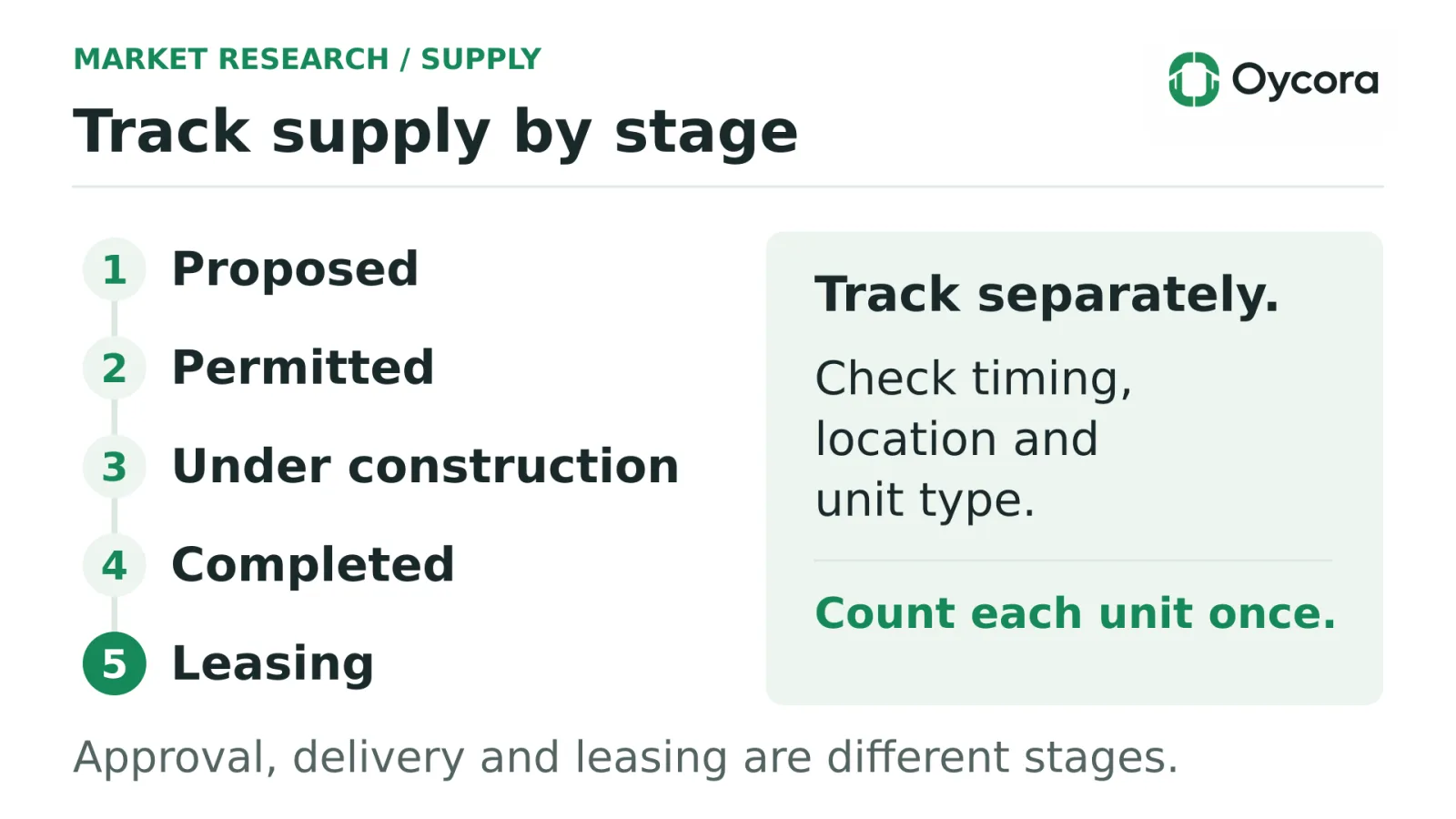
Permits are an early signal, not completed homes. A project may receive approval without starting, and a start does not establish when units become available. The Census Bureau's explanation of the relationship between permits, starts, and completions describes why these categories differ. Keep proposed, permitted, under-construction, completed, and leasing projects in separate fields. Avoid counting the same units each time they move through the process.
Scale matters. In a fictional rental area with 12,000 relevant existing units, 240 competitive units delivered over a year equal 2% of that stock: 240 divided by 12,000. That ratio describes the size of the delivery relative to a defined base. It is not a forecast of vacancy or rent growth. If another 600 units have permits but remain unbuilt, keep them in a separate pipeline category rather than adding them to available rental supply.
Relevance matters too. Expensive new apartments may compete directly with some small rentals and indirectly with others through concessions or moves between price segments. They may have little immediate connection to a distant single-family submarket. Investigate the likely overlap instead of assuming either that all construction competes equally or that a different building type cannot affect your market.
Ask when the units are expected to lease, not only when construction should finish. A concentration of deliveries during the same season may matter more for an upcoming purchase than an equivalent total spread across several years. Treat schedules as estimates and monitor delays, phased openings, and changes in marketing.
Keep stock and flow measures distinct. The existing rental stock is a count at a point or period; annual completions, new permits, and households added describe changes over time. Compare a flow with a relevant stock only when the geography and segment align, and explain the resulting ratio. Adding a year's permit count to an estimate of occupied rentals does not tell you how many homes are available today.
Use Leasing Evidence to Test the Broad Story
Current leasing conditions help test whether the regional narrative reaches the properties you intend to own. Observe relevant listings over time, speak with independent local operators, and look for changes in availability, concessions, and the time needed to secure a tenant. A single screenshot cannot show the direction of the market.
Keep asking rent separate from an agreed lease amount. An advertised reduction, a free-rent offer, included utilities, or a change in lease length can alter the economics without appearing in a simple headline-rent comparison. Oycora's article on rent concessions versus waiting for full rent shows why lease economics deserve attention. A listing that disappears might have leased, been withdrawn, or moved to another platform. Treat the outcome as unconfirmed until you can verify it.
Vacancy also has several meanings. A survey's share of vacant rental units, a manager's current available inventory, and your property's annual income lost to vacancy are not interchangeable. A broad vacancy statistic can identify a question to investigate, but it should not be pasted directly into a property cash-flow model. Oycora's article on budgeting for vacancy explains the property-level planning issue in more detail.
At this stage, establish a plausible rent range and leasing-risk range for the target property type. Detailed adjustments between individual rental comparables belong later, when the property's size, condition, amenities, and lease terms are known. Market selection should narrow those assumptions, not pretend to finish property underwriting before a property exists.
Research Framework
| Research area | Evidence to review |
|---|---|
| Demand | Households, jobs, and leasing |
| Supply | Permits, delivery, and competition |
| Costs and constraints | Insurance, rules, and services |
Use the evidence to set base and downside assumptions. Record the source, date, geography, and uncertainty for each input.
Back to Guide contentsCheck Whether You Can Operate in the Market
Investigate Costs and Rules at the Right Level
Purchase prices are easy to compare. The cost of owning a rental can be harder to see. Before committing substantial research time to a finalist, investigate property taxes, insurance availability, owner-paid utilities, rental registration or inspection requirements, and the services needed to keep the property operating. A cheap purchase can still create an expensive or impractical business.
Use the relevant taxing authority to understand how a proposed purchase could affect the assessment or bill. A seller's current payment is useful history, but it may reflect circumstances that do not carry over to a buyer. Obtain property-specific guidance rather than assuming a regional effective tax rate determines the next bill.
Seek insurance indications early enough to influence the search, then obtain appropriate property-specific quotes. Describe the intended rental use accurately and ask about limits, deductibles, exclusions, and material conditions. A broad estimate does not establish that a particular property is insurable on terms you can accept. Avoid treating an unconfirmed premium as a fixed acquisition input.
Check the official authorities responsible for zoning, lawful unit count, rental licensing, inspections, and applicable tenancy rules. Ask qualified local professionals where interpretation is required. Verify the proposed use at the address; a neighboring property or an existing advertisement is not proof that your intended use is permitted. This Guide cannot resolve jurisdiction-specific legal requirements.
Separate recurring costs from upfront work and potential capital needs. At market level, you are identifying likely pressure points and evidence to obtain. The property budget comes later. The Guide to rental property expenses and reserves explains how to keep those categories consistent.
Test Physical Exposure and Management Capacity
Research physical hazards and the practical response to them. Review relevant official maps and local information, then ask how the exposure affects the specific building, insurance, access, and maintenance needs. A regional hazard label is too broad to settle a property decision, while the absence of an obvious map warning is not a guarantee of safety.
The National Flood Insurance Program explains why flood risk extends beyond high-risk areas. Consult official maps and local officials, then investigate drainage, elevation, past water issues, and insurance at the property where relevant. Other hazards and building conditions need their own appropriate sources and inspections.
Confirm that the local operating support matches the property. Ask managers whether they handle the relevant unit type and area, how they charge for leasing and maintenance coordination, and what owner responsibilities remain. Ask contractors about availability and realistic scheduling. A long-distance investor needs a workable response when a tenant reports a problem, not merely a name on a contact list.
Consider the eventual sale as well. Review the kinds of buyers and properties that transact in the target segment, and whether your intended use or financing narrows the likely buyer pool. Thin or inconsistent sales evidence deserves caution. You do not need an appreciation forecast to recognize that a difficult exit could limit your flexibility.
Back to Guide contentsTriangulate the Findings Before Choosing a Shortlist
Ask Independent Local Sources Comparable Questions
Use local conversations to challenge the desk research. Speak with people who see different parts of the operation, such as a property manager, a leasing professional, an insurer, or a contractor. Independence matters: three contacts repeating the same sales report do not provide three separate confirmations.
Ask about recent experience with the property type and location you are considering. “How is the rental market?” invites a general opinion. More useful questions ask which units have been harder to lease, what concessions have been necessary, how maintenance scheduling has changed, and what evidence the person can share without disclosing private tenant information.
Record the scope of each answer. A manager's experience may be reliable for the buildings they manage while remaining unrepresentative of the whole area. Note the number or type of properties discussed, the period covered, and whether the answer comes from records or memory. Distinguish a quoted fee from a loose estimate and a completed lease from an expectation.
If practical, visit shortlisted areas and inspect the surroundings at relevant times. Test actual access and travel conditions, observe competing properties, and look for physical issues that online information may omit. A visit complements the evidence; one quiet afternoon or a polished leasing office should not outweigh the broader record.
Use Decision Categories Instead of a False Precision Score
Organize each finalist around the same questions: Does the target rental have plausible demand? What supply will compete with it? Can you operate it legally and practically? What costs or uncertainties could invalidate the purchase assumptions? What would make you stop?
A numerical score can summarize preferences, but its weights are judgments. A high average can also conceal a decisive problem. Keep nonnegotiable requirements outside any ranking. An unresolved lawful-use issue, unavailable management arrangement, or unworkable insurance quote should not be offset by several points for job growth.
Use plain decision categories such as investigate further, suitable for a property search, pause pending evidence, or outside the current strategy. Beside each conclusion, label the evidence as verified, provisional, or unresolved. These labels do not predict returns. They show how much confidence the current work deserves and which action comes next.
Conflicting evidence is useful when you investigate it. Strong employment growth alongside longer leasing times may reflect new supply, different geographic coverage, or a mismatch between the jobs being added and the housing being offered. Write down the competing explanations and the evidence that could distinguish them. Do not select whichever source makes the purchase look better.
Try to Disprove the Leading Explanation
Before selecting a market, write the strongest reason your current view could be wrong. If the thesis depends on a nearby employment center, ask what happens if hiring slows or workers choose a different commute. If it depends on limited competition, check whether proposed housing is absent from the current listing inventory only because it has not opened yet.
Then choose a small number of checks that could change the decision. Repeating searches that confirm the same headline adds less value than resolving one material contradiction. For example, a promising rent-to-price relationship deserves investigation of condition and operating costs. A consistently high asking rent deserves verification of concessions and completed leases.
This is also a way to stop research productively. You do not need every statistic about a place before searching for properties. You need enough evidence to explain the proposed rental's fit, understand the major uncertainties, and know what must be checked before committing capital. If an unresolved issue could invalidate the strategy, pause rather than filling the gap with a favorable assumption.
Back to Guide contentsTurn Market Research Into Property Assumptions
Real World Example
Consider a fictional buyer researching long-term duplexes in a fictional rental area. All figures below are illustrative planning assumptions, not observations about an actual market, recommended allowances, or a forecast. The buyer has found a candidate property but has not completed its due diligence.
The regional employment picture appears reasonably steady, while the local pipeline includes the 240 delivered units described earlier. Relevant leasing conversations suggest that some landlords are accepting lower effective rents and taking longer to fill vacancies. The buyer also has preliminary evidence of pressure on insurance and service costs. None of those findings proves what the duplex will earn. Together, they identify assumptions that deserve conservative testing.
Research Findings and Assumptions to Test
| Research finding | Assumption to test | Evidence still required |
|---|---|---|
| New competing units are leasing | Lower rent and greater income loss | Property-specific rent evidence and recent leasing outcomes |
| Insurance and service costs may rise | Higher recurring operating costs | Written quotes and confirmation of owner-paid obligations |
| Regional employment is relatively steady | No assumed rent growth in the initial budget | Continued review of relevant employers and local demand |
The buyer models the same duplex under a base case and a downside case. Both assume no other income, annual principal and interest of $14,400, and a planned annual capital expenditure reserve of $1,800. Income taxes are excluded. The recurring operating-cost amounts are fixed annual dollar assumptions within each case, rather than percentages that automatically fall with rent. They are assumed to include property taxes, insurance, routine repairs, management, and owner-paid services. Actual categories and amounts would need to match the property. Taxes and insurance are therefore not added again as part of debt service.
Base and Downside Budget
| Budget item | Base case | Downside case |
|---|---|---|
| Total monthly rent for both units | $2,400 | $2,250 |
| Scheduled annual rent | $28,800 | $27,000 |
| Vacancy and collection loss allowance | 5% or $1,440 | 8% or $2,160 |
| Effective gross income | $27,360 | $24,840 |
| Recurring operating expenses | $10,500 | $11,700 |
| Net operating income | $16,860 | $13,140 |
| Principal and interest | $14,400 | $14,400 |
| Planned capital expenditure reserve | $1,800 | $1,800 |
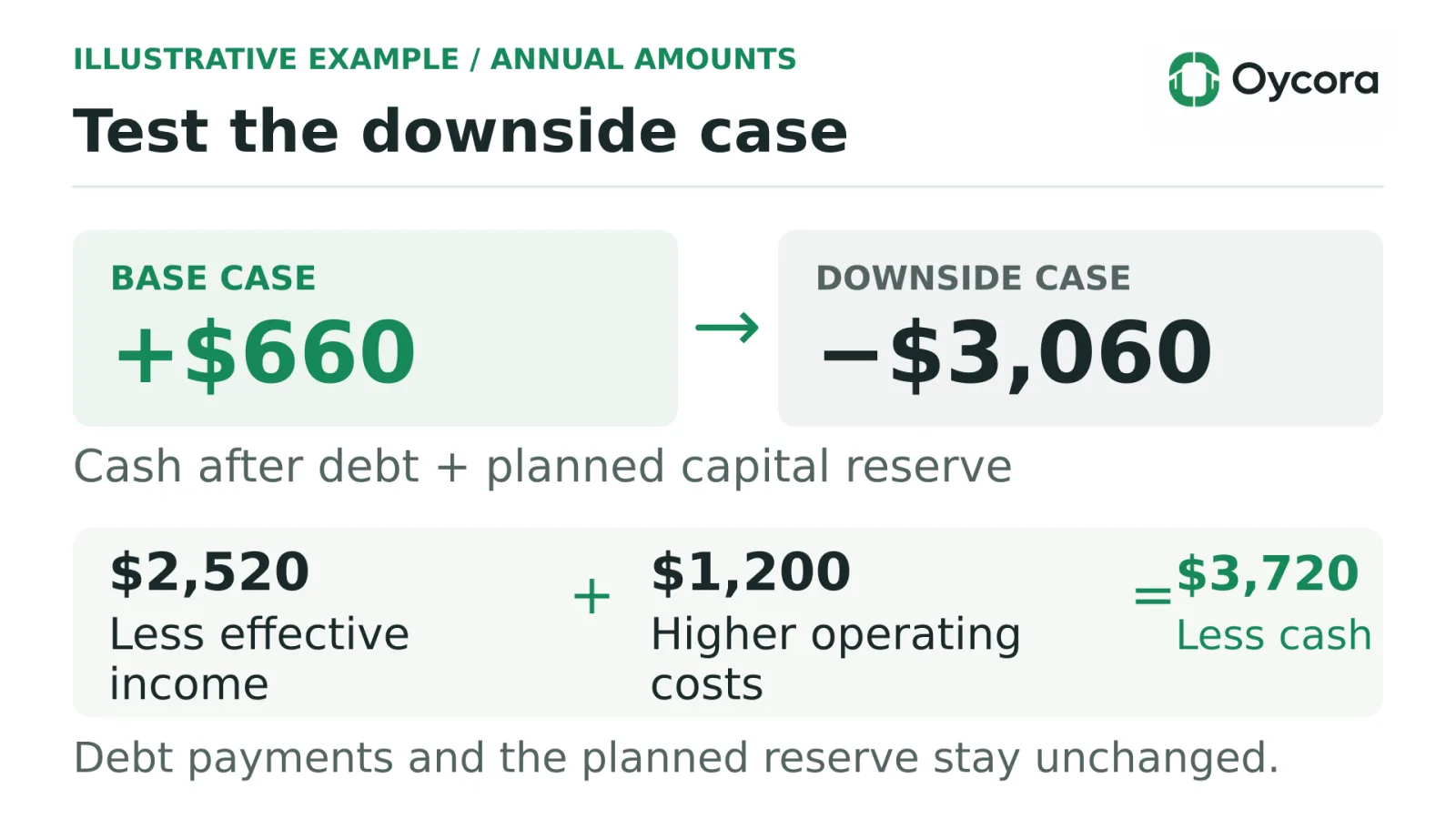
| Annual cash after debt and planned reserve | $660 | −$3,060 |
The base case starts with $28,800 of scheduled rent and deducts $1,440 of income loss to reach $27,360 of effective income. Subtracting $10,500 of operating expenses produces $16,860 of net operating income, or NOI. Debt service and the planned reserve leave only $660 for the year, equivalent to $55 per month.
In the downside case, $27,000 of scheduled rent less $2,160 of income loss produces $24,840 of effective income. After $11,700 of operating expenses, NOI is $13,140. The same debt service and planned reserve leave a $3,060 annual shortfall, equivalent to $255 per month. The combined change is $3,720 a year. Of that difference, $2,520 comes from lower effective income and $1,200 from higher operating costs. Neither the debt payment nor the planned reserve changes. This isolates how the market and operating assumptions affect the same financing structure, rather than mixing their effect with a different loan.
The loss allowances are hypothetical reductions in annual scheduled income. They are not Census vacancy rates or promises about leasing performance. The reserve is a planning allowance outside NOI, not a prediction of actual capital spending. If actual replacement spending is modeled separately, reconcile it with the reserve treatment so the same cost is not deducted twice.
This result does not establish that the entire market is unsuitable. It shows that this candidate's preliminary budget has little room for the research uncertainties. The buyer needs stronger evidence, different purchase or financing terms, or a different property before treating the opportunity as workable. A positive base case is not an unconditional pass, and market enthusiasm does not repair a weak property budget.
Document the Decision and the Conditions That Could Change It
Finish the research with a short market brief. State the search area, target property type, strategy constraints, main demand and supply findings, and the dates of the evidence. List the base and downside assumptions you would carry into property analysis, along with the sources that support them. Keep unresolved questions visible.
Add specific stop conditions. These might include inability to confirm the intended rental use, an insurance or tax estimate that makes the budget unworkable, or a lack of operating support within your available time and capital. The threshold should come from your constraints and the property analysis, not from a universal market score.
Set update triggers tied to the evidence. Refresh current leasing observations before relying on them for an offer. Recheck a major development when its delivery schedule changes. Revisit the thesis after a significant employer announcement, a material local rule change, or a quote that differs substantially from the research estimate. Keep the previous version so you can see what changed and why.
Then use the Rental Property Calculator to test a specific property's supported income, operating costs, financing, and reserves. Compare the base and downside cases, and replace provisional assumptions with verified property information as it becomes available. A calculator can expose sensitivity; it cannot verify the market evidence supplied to it.
Back to Guide contentsPractical Takeaways
• Define the target rental and your operating limits before choosing markets. Attractive statistics do not solve a mismatch with your budget or capabilities.
• Record geography, period, definition, and source beside each material finding. Comparable data is more useful than a larger collection of mismatched numbers.
• Read employment, households, competing supply, and current leasing evidence together. Investigate contradictions rather than averaging them away.
• Check costs, lawful use, insurance, hazards, and local support early. Keep address-level questions open until you have address-level evidence.
• Translate findings into explicit assumptions and downside tests. Advance a market because the evidence supports further work, not because a score implies certainty.
Back to Guide contentsConclusion
Good rental property market research produces a clearer decision about where to spend time and what to verify next. It explains why the target property could attract demand, which alternatives will compete with it, and whether the local operation fits the owner's resources.
The strongest outcome may be a smaller shortlist, a more cautious rent assumption, or a decision to pause. Keep the evidence traceable and the remaining uncertainty visible. That gives the next stage of property analysis a sounder starting point without claiming to predict the future of a market.
Back to Guide contentsFrequently Asked Questions
How Many Markets Should I Research
Start with a manageable shortlist that fits your strategy and access to information. There is no required number. Apply the same initial questions to each, eliminate clear mismatches, and deepen the work on the finalists. Research becomes less useful when collecting more locations prevents you from verifying the ones you might actually buy in.
Is a Growing Market Always Better for a Rental
No. Growth may coincide with high purchase prices, substantial new supply, rising ownership costs, or a property type that does not fit local demand. A slower-growing area may still deserve investigation. Compare the evidence and the property economics rather than using one growth rate as the decision.
Can I Research a Rental Market Remotely
You can do much of the initial work remotely using public data, local records, current listings, and independent conversations. You still need reliable verification of property condition, operating costs, lawful use, and relevant local circumstances. If you cannot visit, identify qualified people who can perform those checks and understand the limits of what they report.
Back to Guide contentsRelated Calculation Methodologies
For the definitions used when translating market evidence into a property budget, see Oycora's Vacancy methodology and Net Operating Income methodology. These explain the calculation treatment; they do not determine which local assumptions are appropriate.
Back to Guide contentsHow Oycora calculates this
Calculation methodology
Related articles

Market And Economics
How to Estimate Market Rent Using Comparable Rentals
Build a rent estimate from verified comparable leases, normalize incentives and utilities, and use supported adjustments to choose a realistic range rather than a precise-looking guess.
Property Analysis
What Is Gross Rent Multiplier (GRM) in Real Estate?
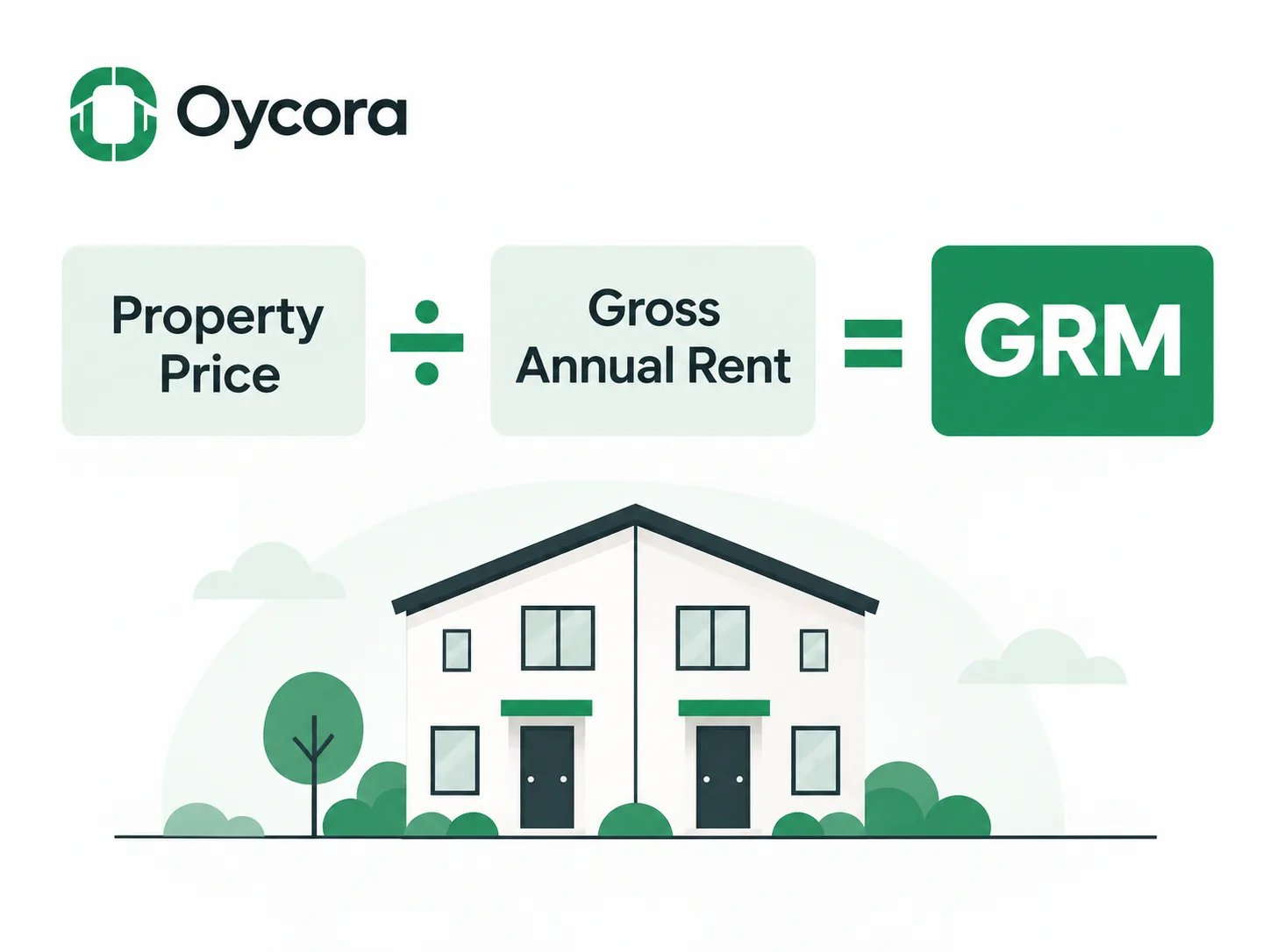
Gross rent multiplier is a quick way to compare a property's price with its gross annual rent. Learn how to calculate GRM, what a lower or higher result can suggest, and why it should only be used as an initial screening metric.
Property Analysis
How Much Cash Should You Keep in Reserve for a Rental Property?
A rental property reserve should reflect the bills that continue when rent stops, upcoming replacements, and unexpected costs. Learn how to build a property-specific cash cushion and test how long it could last.
Related Guides

Oycora Guide · Financing
The Complete Guide to Rental Property Financing
Rental property financing affects much more than the monthly mortgage payment. This Guide explains how occupancy, down payment, leverage, interest rate, amortization, qualifying rental income, DSCR, refinancing, and reserves shape both the purchase and the property’s long-term performance.
Read Guide →
Oycora Guide · Property Analysis
The Complete Guide to Rental Property Expenses, Reserves, and Cash Flow
Rental income does not become cash flow until the property’s real costs are accounted for. This Guide explains operating expenses, maintenance, capital expenditures, reserves, debt service, and how those categories work together to determine what a rental actually produces.
Read Guide →