
A rental listing tells you what the seller wants. Your underwriting should tell you what the property can support. Those are different questions, and starting with the asking price can make it surprisingly easy to stretch the assumptions until a deal appears to work.
Reverse underwriting changes the order. Start with defensible income, realistic expenses and the cash flow you want to retain. Calculate how much mortgage payment remains affordable. Then translate that payment into a loan amount and purchase price. The result is a price ceiling under your assumptions, not an appraisal, a promise of profit or proof that the seller should accept your offer.
This method is particularly useful when two investors like the same property but have different financing terms, cash reserves or income goals. They can reach different offer limits without either calculation being wrong. The important part is making those differences visible before negotiating.
Define the Cash Flow You Actually Want
“Three hundred dollars a month” sounds precise until you ask what has already been deducted. Does it mean rent minus the mortgage? Or does it mean money left after vacancy, taxes, insurance, management, routine maintenance, a capital replacement allowance and debt service?
For an offer decision, use the second approach. In this article, target cash flow means a projected average amount available after those deductions, before personal income taxes. It is not a guaranteed monthly distribution. A repair can consume several months of that average at once, and a vacancy can leave you funding bills from reserves.
Keep principal repayment and appreciation out of this target. Both can affect overall investment performance, but neither pays the current month's operating bills. Principal is included in the mortgage payment because it is cash leaving the account, even though it also reduces the loan balance.
If you need a refresher on the forward calculation, start with the cash-flow explanation below. Here, we will take that same relationship and solve it in the opposite direction.
Read how to calculate rental property cash flow.
Build the Property Budget Before Solving for Price
Use rent supported by comparable rentals, not the highest asking rent you can find. Identify whether the lease or market evidence supports the income immediately, or whether a renovation and a future lease-up would be necessary. A future rent increase should not silently become today's available income.
Subtract an allowance for vacancy and collection loss, then the operating costs the owner will pay. Get current insurance quotes, check the likely tax treatment after purchase with the appropriate local office, and review association dues, utilities and service contracts. A seller's historical bill is useful evidence, not a guarantee of your future cost.
Include maintenance and capital replacements without counting the same work twice. Routine repairs and a future roof are different planning needs. A monthly reserve allowance is not necessarily an expense incurred that month, but it reduces the amount you can responsibly treat as spendable. Do not describe a reserve contribution as a tax deduction or automatically equate it with accounting net operating income.
Finally, separate principal and interest from escrow. The CFPB explains that the total mortgage payment can also include taxes, insurance and mortgage insurance. If taxes and property insurance are already in your operating budget, subtract only principal and interest at the debt-service step, plus any financing-specific charge not counted elsewhere. Otherwise, you may deduct the same bills twice.
CFPB: Principal and interest versus the total monthly mortgage payment.
Real World Example
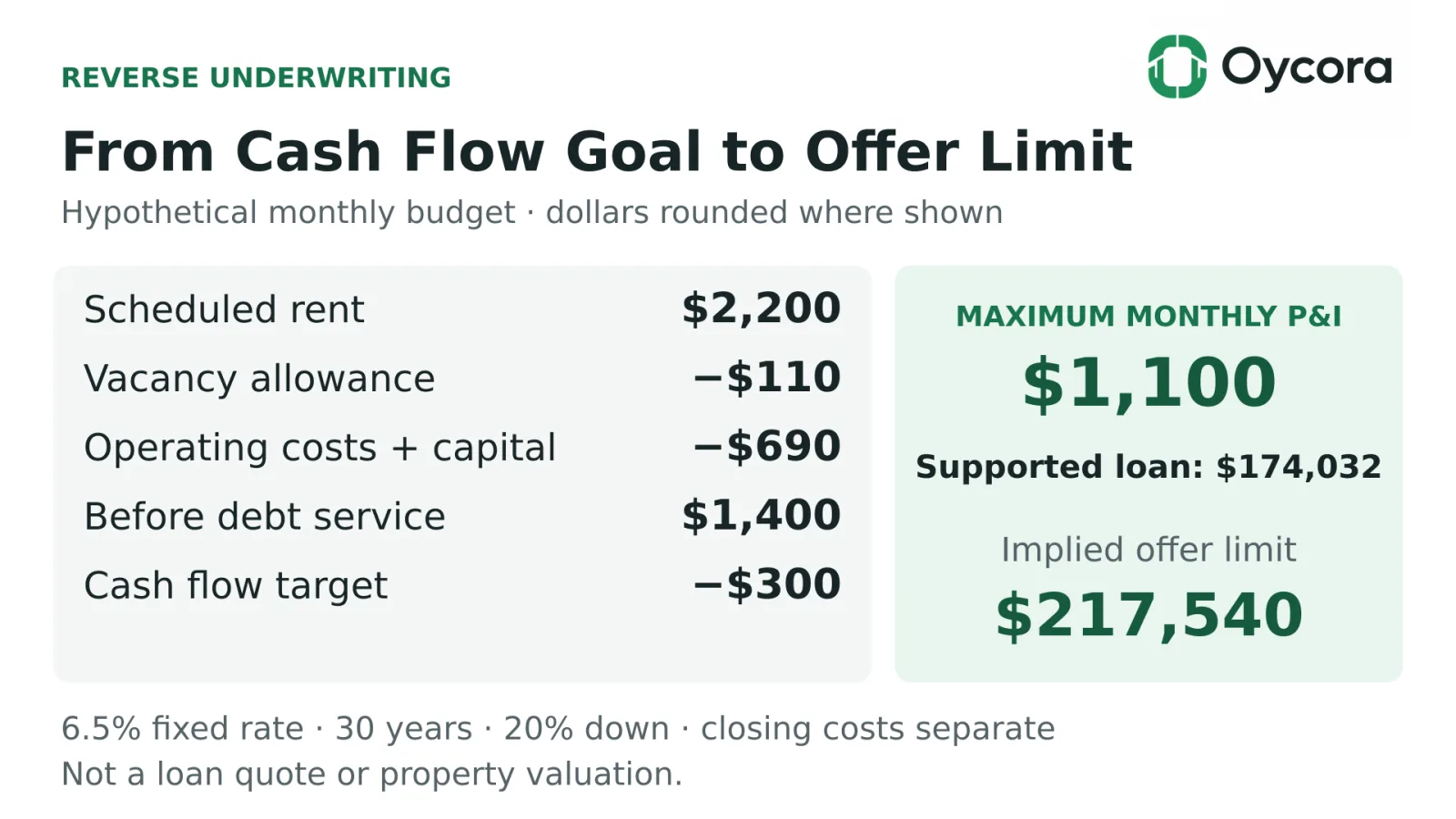
Consider a hypothetical rental expected to collect $2,200 a month when occupied. The investor uses a $110 monthly vacancy and collection-loss allowance, equal to 5% of scheduled rent. That leaves expected collected income of $2,090 a month.
For this teaching example, monthly operating costs are $250 for property taxes, $100 for property insurance, $150 for management, $100 for routine maintenance and $40 for owner-paid miscellaneous costs. Those costs total $640. A separate $50 capital replacement allowance brings total non-debt deductions after vacancy to $690.
That leaves $1,400 a month before principal and interest: $2,090 minus $690. The management amount is a fixed illustrative allowance, not a claim about a typical management fee. The property has no association dues or owner-paid utilities in this example; those exclusions would have to be verified for a real purchase. These deliberately simple assumptions are not recommended budgets for every property.
The investor wants to retain $300 a month after debt service. The maximum principal-and-interest payment is therefore $1,100: $1,400 minus the $300 target. Annualized, the model has $16,800 before principal and interest, permits $13,200 of annual debt service, and leaves $3,600 of projected annual cash flow.
Assume a fully amortizing, fixed-rate loan at 6.5% for 30 years, with 20% down and no mortgage insurance. These are hypothetical financing terms, not a current quote or assurance that a lender will offer them. Fees and closing costs are paid separately rather than financed.
At those terms, each $1,000 borrowed requires about $6.32 a month in principal and interest. A $1,100 payment supports a loan of approximately $174,032. Because the loan represents 80% of the purchase price, the implied price ceiling is about $217,540. The associated 20% down payment is about $43,508, before all other acquisition cash and reserves.
For a rounded $217,000 offer, the loan would be $173,600. It is sensible to rerun the exact proposed price rather than treating rounded figures as an exact payment quote. A calculator's rounding can also create small differences from a lender's disclosed payment.
The Formula Behind the Offer Limit
The first step is simple: maximum monthly principal and interest equals expected monthly collected income minus operating costs, reserve allowances and target cash flow.
For a standard fixed-rate amortizing loan, convert that payment into principal using this relationship: loan amount equals monthly payment multiplied by [1 minus (1 plus the monthly interest rate) raised to the negative number of payments], divided by the monthly interest rate. Use the annual note rate divided by 12 for the monthly rate and 360 payments for a 30-year term. Do not substitute APR for the note rate in this payment formula.
Then divide the supported loan by the financed share of the price. With 20% down, divide by 0.80, not by 0.20. That last distinction is easy to overlook and produces a dramatically different answer.
The shortcut assumes the rate, loan term, down-payment percentage and non-debt budget remain unchanged as price moves. If taxes depend on purchase price, financing costs are rolled into the balance, or a different loan size changes the quoted rate, recalculate those inputs too. In those cases, several rounds of adjustment may be necessary rather than one clean division.
Test the Assumptions That Could Move the Ceiling
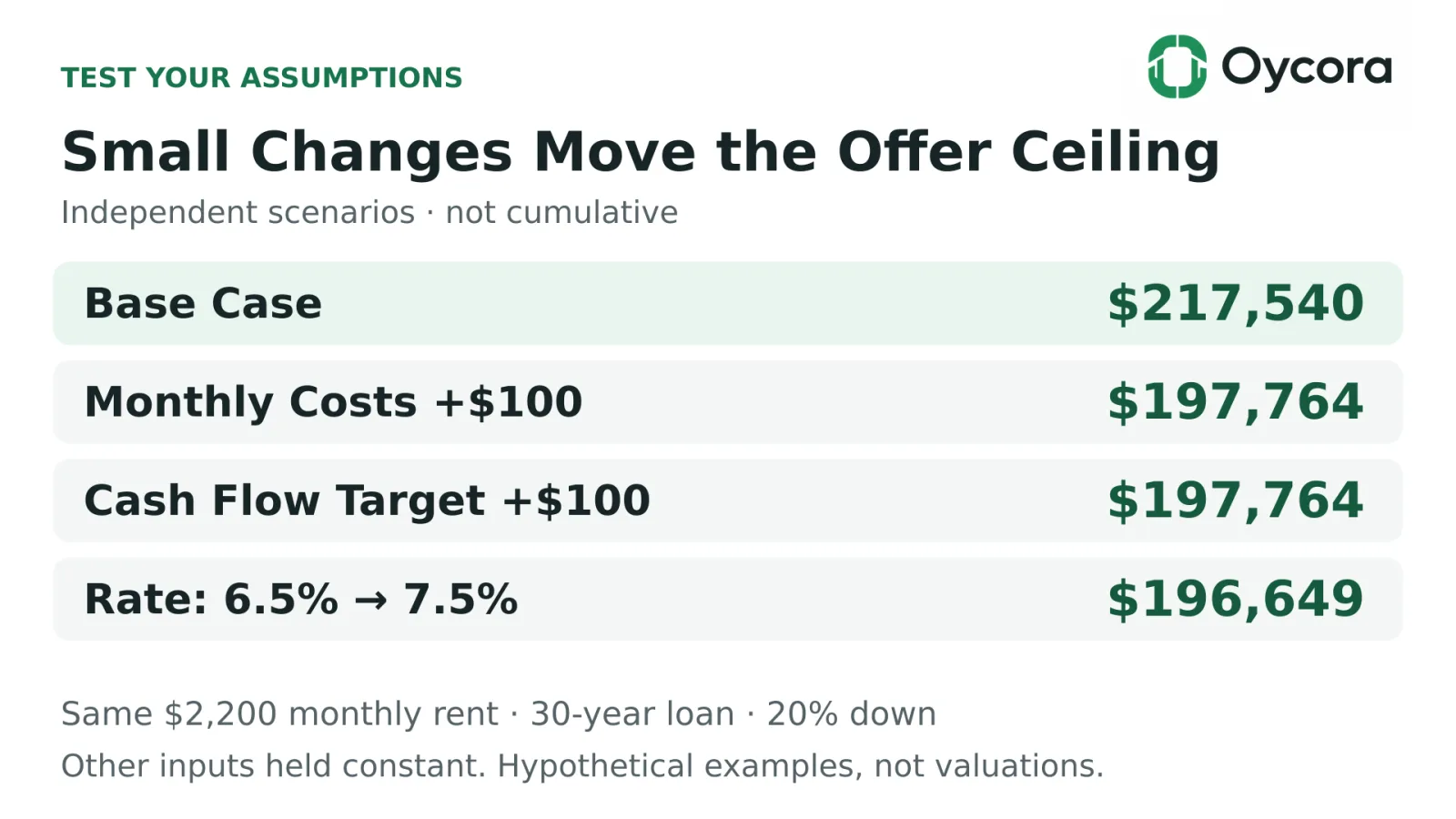
A price limit is only as sturdy as the budget beneath it. In the example, an additional $100 of monthly non-debt costs reduces the affordable mortgage payment to $1,000. With the same 6.5% rate, 30-year term and 20% down, the price ceiling falls to approximately $197,764. A modest recurring expense change has removed almost $19,800 of price capacity.
Alternatively, keeping the original budget but raising the cash-flow goal from $300 to $400 produces that same $1,000 payment limit and the same price ceiling. This does not mean one goal is objectively correct. It shows the cost of requiring a larger cash cushion from this particular financing structure.
Interest rates matter independently. If the hypothetical rate is 7.5% instead of 6.5%, the original $1,100 payment supports a price of about $196,649 with 20% down over 30 years. Do not present a price limit calculated with an old quote as though the financing were still available.
Test lower rent through the full budget, not simply by subtracting it from profit. Percentage-based management fees and vacancy allowances may also change when rent changes. Keep fixed costs fixed only when they genuinely are. A defensible downside case is more useful than an arbitrary optimistic and pessimistic number.
Check Your Cash Constraint Separately
A property can satisfy the monthly target and still be unaffordable to acquire safely. Your initial cash requirement includes the down payment, closing costs, immediate repairs and a post-closing reserve balance. An investor who uses every available dollar for the down payment has not solved the reserve problem.
The CFPB's explanation of mortgage costs distinguishes upfront charges from ongoing costs, including lender charges, third-party services and prepaids. Actual investment-property financing may use different documentation from a consumer mortgage; obtain written terms for the loan you are actually considering rather than assuming a particular disclosure form applies.
Putting more money down can lower the payment and raise the price the cash-flow target appears to support. It does not automatically improve the investment. You have committed more cash, and the cash-on-cash return may move differently from the monthly cash flow. Compare both results and preserve a workable reserve balance. Oycora's discussion of paying cash versus financing a rental explores that tradeoff in more detail.
CFPB: Understand upfront and ongoing mortgage costs.
Compare paying cash with financing a rental property.
Turn the Calculation Into a Negotiating Boundary
Suppose the seller asks $225,000. With the example's original financing, principal and interest would be approximately $1,137.72 a month, leaving $262.28 after the modeled non-debt deductions. That is not the $300 target, even if the listing looks attractive.
Your options are to negotiate the price, find genuinely better financing, improve verified operating economics, consciously accept a different target, or decline the property. Quietly shrinking the repair allowance until the spreadsheet reaches $300 is not a new investment strategy.
Nor does a $217,540 modeled ceiling mean the property is worth exactly that amount. Comparable sales, condition, competition, rental restrictions and the seller's alternatives still matter. The ceiling answers a narrower question: what price fits this income target under this set of assumptions? Another buyer may have a different answer.
Use the calculation as a boundary, not a demand that the market agree. Before an offer becomes a commitment, update the rent evidence, confirm financing and costs, inspect the property, and rerun the numbers. A disciplined offer is one you can explain without relying on an unverified future refinance, perfect occupancy or an unexpectedly inexpensive roof.