
Paying cash for a rental property removes the mortgage payment. Financing keeps more money outside the property. Both can be useful, but neither tells you whether the purchase price, rental income, and operating costs make sense.
The decision becomes clearer when you separate three questions: how the property performs, how much cash each purchase structure produces, and what happens to the money you do not put into the building. A larger monthly surplus and a higher percentage return are different outcomes. So are money available for emergencies and equity that would require a sale or new loan to access.
Start with the same property and realistic expenses. Then compare cash and financing without assuming appreciation, a future refinance, or a profitable use for every dollar left over. The examples below are fictional and educational, not individualized investment or tax advice.
Start With the Property, Before the Loan
A rental produces operating income regardless of how its owner pays for it. Collected rent and other operating income, less operating expenses, produce net operating income, or NOI. Property taxes, insurance, management, and routine maintenance still matter when there is no lender.
Under Oycora’s NOI methodology, financing and capital expenditures stay outside that operating calculation. Keeping them separate lets you compare the same building fairly. Changing the down payment alone should not improve its rent collection or reduce its maintenance needs.
For an initial comparison, hold the purchase price, rent, vacancy, and operating budget constant. If a cash offer could obtain a lower price, test that as another scenario supported by an actual negotiation. Do not quietly give the cash purchase a discount while presenting the result as a financing-only comparison.
Compare Spendable Cash and Cash Committed
After NOI, subtract an allowance for major replacements, principal-and-interest payments, and any recurring financing charges. That produces the reserve-adjusted pre-tax cash flow used here, consistent with Oycora’s cash-flow calculation. It is an underwriting estimate, not a forecast of the exact balance in a checking account.
The annual replacement allowance remains money set aside until it is spent. It reduces the amount treated as available for distribution. Keep it separate from routine maintenance, and avoid subtracting the same future project twice through both an allowance and an additional project charge.
Then total the cash committed to acquisition. A cash buyer contributes the purchase price plus closing costs and initial work. A financed buyer contributes the down payment, those other acquisition costs, and any additional loan charges paid upfront. Comparing annual cash flow with only the down payment overstates the financed buyer’s cash-on-cash return.
The Consumer Financial Protection Bureau’s explanation of mortgage costs distinguishes upfront lender charges from ongoing payments. Review both when comparing offers. Also separate taxes and insurance from principal and interest so escrow payments do not cause those expenses to be counted twice.
Put Both Purchase Structures Side by Side
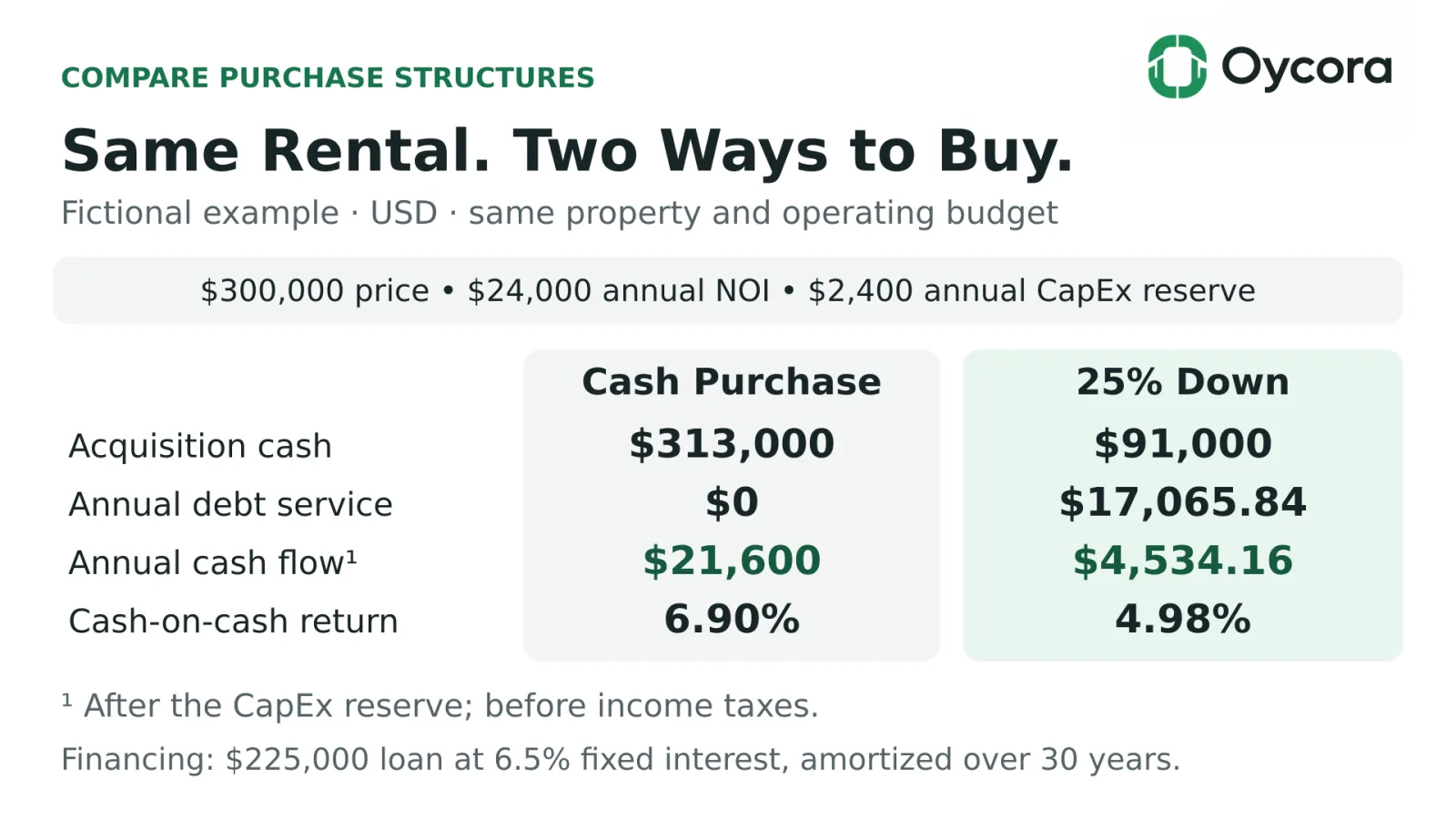
Consider a fictional $300,000 rental with $3,000 in scheduled monthly rent. The comparison covers twelve full operating months and twelve loan payments after acquisition. These are assumed figures, not market rent estimates or current lending quotes.
Real World Example: One Property, Two Purchase Structures
Identical property operations; cash purchase versus 25% down financing. All operating figures are annual unless labeled otherwise.
| Assumption | Both Structures Unless Noted |
|---|---|
| Purchase price | $300,000 |
| Scheduled rent | $36,000 annually ($3,000 monthly) |
| Vacancy allowance | 5%, or $1,800 annually |
| Collected rent; no other income | $34,200 |
| Operating expenses | $10,200 |
| NOI | $24,000 |
| Annual CapEx reserve allowance | $2,400 |
| Shared acquisition closing costs | $8,000 |
| Initial repairs, completed before the operating period | $5,000 |
| Financed option | $75,000 down; $225,000 loan; 6.5% fixed interest; 30-year amortization |
| Additional upfront financing costs | $3,000; not added to the loan |
| Result | Cash Purchase | 25% Down |
|---|---|---|
| Initial acquisition cash | $313,000 | $91,000 |
| Annual principal and interest | $0 | $17,065.84 |
| Annual cash flow after CapEx reserve | $21,600.00 | $4,534.16 |
| Monthly average cash flow after CapEx reserve | $1,800.00 | $377.85 |
| Cash-on-cash return | 6.90% | 4.98% |
Less Acquisition Cash Required With Financing
$222,000
$313,000 − $91,000
This is retained capital, not income or a return earned by the property.
The operating budget comprises $3,600 property taxes, $1,500 insurance, $2,400 management, $1,800 routine maintenance, and $900 other operating costs. For this example, they are fixed annual dollar assumptions. No mortgage insurance, recurring financing fees, income taxes, sale costs, or appreciation are modeled.
The loan payment is approximately $1,422.15 per month. Annual debt service uses the unrounded amortization calculation, so multiplying the displayed monthly amount by twelve can differ by a few cents. Initial repairs and closing costs enter acquisition cash, not the recurring operating budget.
Read the Results Without Making Leverage the Winner
The cash purchase produces $21,600 after the annual replacement allowance. Financing leaves $4,534.16, but requires $222,000 less acquisition cash. The cash buyer has more property income available; the financed buyer has more capital available elsewhere.
In this example, financing also lowers the cash-on-cash percentage, from 6.90% to 4.98%. A smaller denominator does not guarantee a larger return when debt payments reduce the numerator. Both structures have the same 8% cap rate because their $24,000 NOI and $300,000 price are unchanged.
An 8% cap rate exceeding a 6.5% interest rate is not enough to settle the decision. Cap rate excludes replacement reserves and acquisition costs, while the scheduled loan payment includes principal as well as interest. Those differences matter to cash available for distribution.
The mortgage also pays down approximately $2,514.88 of principal during the first twelve payments. That lowers the loan balance to about $222,485.12. The CFPB’s amortization explanation describes this division between principal and interest. Principal repayment builds equity, but it cannot pay an upcoming repair bill without another transaction. Keep it separate from cash-on-cash return.
Stress-Test the Structure Before Chasing the Return
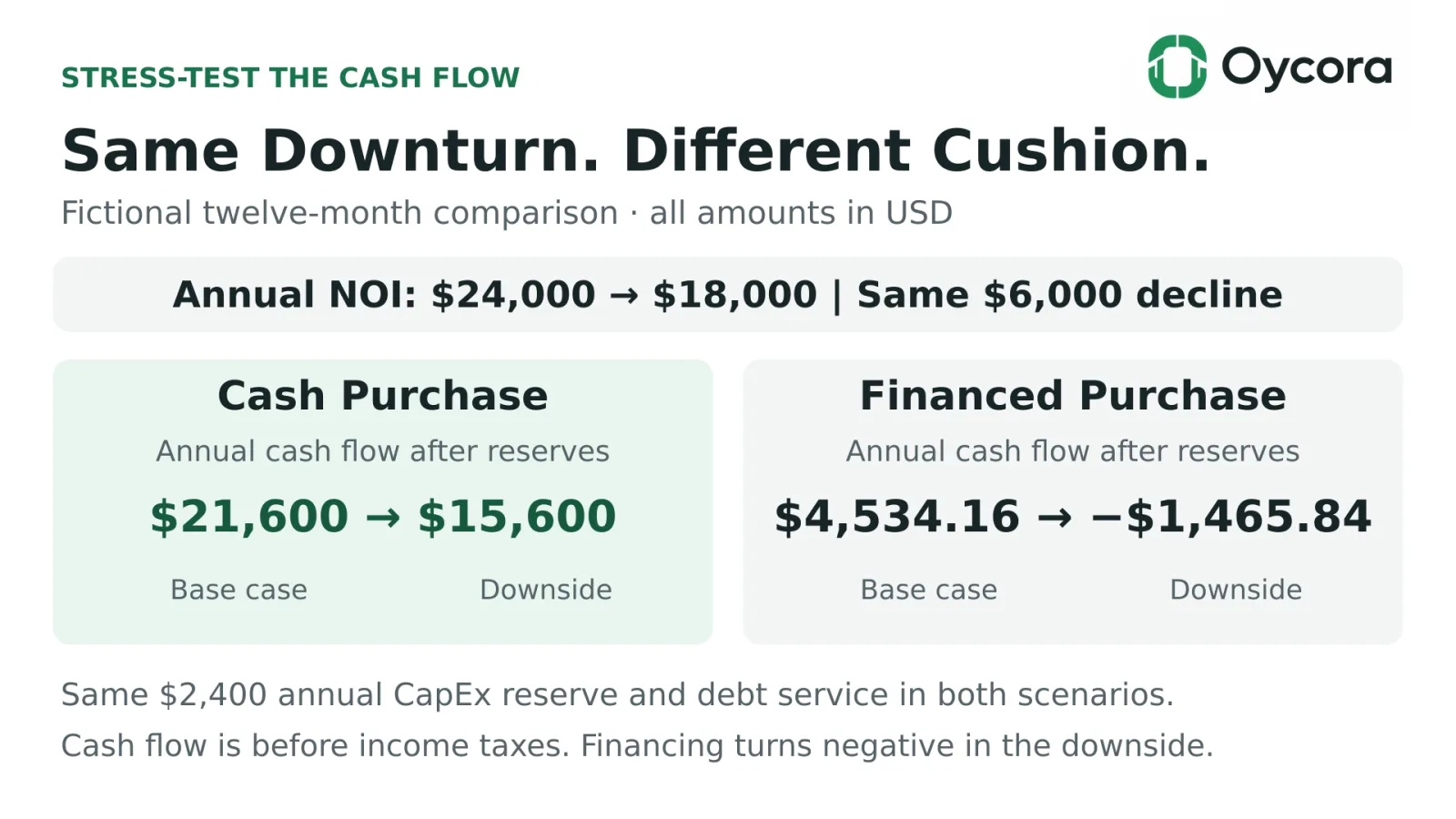
Now change the same twelve-month operating period: collected rent falls from $34,200 to $30,000, and operating expenses rise from $10,200 to $12,000. NOI falls to $18,000. Keep the $2,400 replacement allowance and the original loan terms unchanged.
- Cash purchase: $18,000 NOI − $2,400 reserve = $15,600 annual pre-tax cash flow, or $1,300 per month on average.
- Financed purchase: $18,000 NOI − $2,400 reserve − $17,065.84 debt service = a $1,465.84 annual shortfall, or about $122.15 per month on average.
Both owners experience the same $6,000 reduction in annual cash flow. Financing does not change that dollar decline; it leaves less starting surplus to absorb it. In the financed case, the owner must supply cash or reduce the planned reserve contribution. Reducing the allowance changes the budget, not the building’s eventual replacement needs.
NOI still covers the scheduled loan payments by about 1.05 times, yet cash flow after reserves is negative. That is why debt-service coverage alone cannot answer the cash-versus-finance question. For a cash purchase, Oycora reports DSCR as unavailable, rather than assigning an infinite coverage ratio.
Give Retained Capital Its Own Job
The example compares equal properties, not equal amounts of invested capital. A broader decision asks what each strategy does with the same starting budget. Suppose the owner has $328,000 available: the cash purchase leaves $15,000 outside acquisition, while financing leaves $237,000. The $222,000 difference is retained capital, not a return earned by the financed property.
Separate an emergency cushion from money genuinely available for another investment. If retained money earns interest or funds another rental, model that income, its costs, taxes, and risks separately. If it remains idle, do not credit it with a hypothetical investment return. Its liquidity may still be useful.
Buying several financed properties also changes the comparison. It increases total property exposure, management demands, debt payments, and potential repair bills. More doors do not automatically create diversification if the properties share the same market or risks. An equal-capital comparison needs the full portfolio and all remaining cash, not one property’s return percentage multiplied by the number of purchases.
Check Liquidity and Loan Terms Together
Paying cash can suit an owner who prioritizes a larger operating surplus and fewer required monthly payments. But using nearly every available dollar at closing may leave that owner unable to fund a vacancy or major repair. Debt-free ownership still needs a cash cushion.
Financing can preserve that cushion, provided the debt payment is manageable and the retained cash is actually kept available. Review the interest-rate structure, repayment schedule, maturity date, upfront charges, and any prepayment restrictions. A loan with a balloon payment or adjustable rate requires additional scenarios beyond the fixed-rate example.
Do not assume that buying with cash guarantees an easy refinance later. Future borrowing depends on the property, lender requirements, and terms available at that time. Likewise, a strategy that only works after a future rate reduction has a different risk profile from one supported by today’s agreed payments.
Keep Taxes From Becoming the Whole Argument
Mortgage interest may be deductible for a rental, subject to the applicable rules. The IRS’s residential-rental guidance also explains that rental losses can face limitations. A deduction therefore does not make borrowing free or guarantee an immediate tax benefit.
Compare the pre-tax operating results first, then have a qualified tax professional examine the owner-specific consequences. Include the treatment of interest, acquisition costs, depreciation, and any eventual sale. A cash purchase can still have depreciation deductions; financing is not what creates depreciation eligibility.
Build Both Versions Before Choosing
Run a cash purchase and a financed purchase with the same property assumptions. Compare acquisition cash, reserve-adjusted cash flow, principal repayment, and remaining liquid funds as separate results. Then repeat the exercise with lower collections, higher expenses, and any loan-specific risks.
Use Oycora’s Rental Property Calculator for the complete property model and the Mortgage Calculator to inspect payment and amortization. Named snapshots can be reviewed in Oycora’s comparison workspace. Keep outside investments in a separate analysis; the property calculation does not automatically assign a return to retained cash.
The useful choice is the structure whose cash requirements, liquidity, and downside exposure fit the owner’s circumstances. A higher return percentage is only one part of that decision, and a stronger cash purchase cannot make an overpriced or poorly operated property sound.