
A lower mortgage rate looks attractive on a rental-property spreadsheet. But if getting that rate requires another $2,000 at closing, the useful question is not simply whether the monthly payment falls. It is whether the savings justify the upfront cost before you sell, refinance, or otherwise repay that particular loan.
Mortgage points can make sense for a long-held loan with a meaningful rate reduction. They can also consume cash that would have been more useful for repairs, vacancy, or the next investment. Compare the actual loan offers, the likely loan lifespan, and your remaining reserves before deciding. The lowest advertised rate is not automatically the least expensive financing.
CFPB: How discount points and lender credits work.
What Mortgage Points Actually Buy
A discount point is an upfront charge linked to a lower interest rate. One point equals 1% of the loan amount, not 1% of the property price. On a $200,000 mortgage, one point costs $2,000. That definition does not mean the interest rate falls by one percentage point. The reduction depends on the lender and the specific offer.
Also distinguish discount points from an origination fee expressed as a percentage. A fee labeled a “point” does not necessarily buy a lower rate. Ask the lender exactly which charge changes the rate and request a comparable zero-discount-point option. The Consumer Financial Protection Bureau explains this distinction in the linked explanation above.
For a rental, keep the property analysis and the financing analysis separate. Points do not increase the rent, improve occupancy, or reduce the property's repair needs. They change the cost and timing of the borrowing used to purchase it. A financing improvement cannot rescue operating assumptions that were unrealistic in the first place.
Compare Like With Like Before Calculating Savings
Use offers with the same loan amount, term, repayment structure, and property use. Compare fixed-rate loans with fixed-rate loans rather than treating an adjustable or interest-only payment as equivalent. Keep the down payment and assumed closing date consistent. A lower payment produced by borrowing less is not evidence that points were worthwhile.
Look beyond the points line. If the lower-rate offer also has higher lender fees, include those differences in the comparison. Conversely, a credit that offsets another charge changes the upfront cost you are actually evaluating. Do not confuse a different estimate of property taxes or insurance with savings delivered by the lender.
When your lender provides a Loan Estimate, the CFPB's comparison checklist identifies the rate, loan amount, principal-and-interest payment, upfront loan costs, and lender credits as important comparison items. Ask for quotes on a consistent basis and close together in time, since pricing can change. For a business-purpose rental loan using different paperwork, ask for an equivalent itemized written comparison rather than assuming the consumer form applies.
CFPB: Compare Loan Estimates on a consistent basis.
Real World Example: Paying $2,000 to Save About $33 a Month
Consider two hypothetical offers for the same $200,000, 30-year, fully amortizing fixed-rate mortgage. These are educational assumptions, not current market quotes or a promise about how much any lender will reduce a rate.
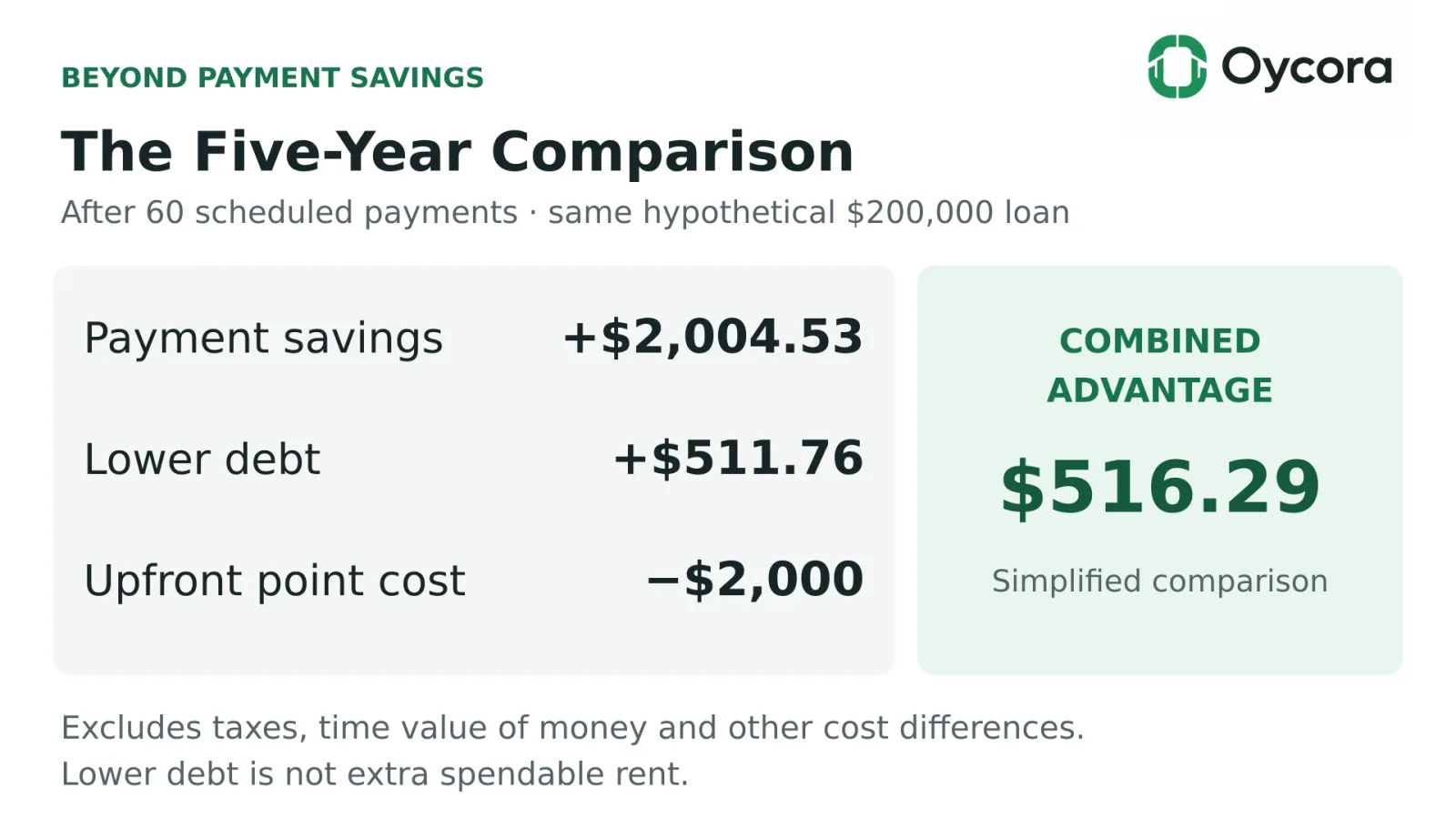
Offer A has a 7.00% interest rate and no discount points. Offer B has a 6.75% interest rate and one discount point paid in cash at closing. Assume all other fees, loan terms, and costs are identical. Neither offer has mortgage insurance, a prepayment penalty, or extra principal payments in this example.
Using the standard monthly amortization formula, Offer A has a principal-and-interest payment of $1,330.60 a month. Offer B has a payment of $1,297.20 a month. Using the unrounded payments, the monthly difference is about $33.41, or $400.91 over twelve months.
The simple cash-recovery calculation is: $2,000 upfront cost ÷ $33.4088 monthly payment savings = 59.86 months.
That means the cumulative scheduled payment savings first exceed the points cost at the sixtieth payment, roughly five years into the loan. The calculation uses unrounded values; displayed monthly amounts are rounded to cents, so multiplying rounded figures can differ slightly.
At 36 payments, the cumulative payment savings are approximately $1,202.72. Subtracting the $2,000 point leaves the points option $797.28 behind on this payment-only measure. At 60 payments, cumulative savings reach $2,004.53, just $4.53 beyond the initial cost. At 120 payments, they reach $4,009.06, or $2,009.06 beyond the point.
The five-year result is not a substantial cushion. A different fee, an earlier refinance, or a different use for the upfront cash could change the decision. A ten-year loan horizon produces a more meaningful payment benefit under these particular assumptions, but that is a scenario, not a forecast.
Cash Break-Even Is Not the Complete Economic Comparison
The payment calculation is a useful first screen, but it leaves out the remaining loan balance. Two mortgages with different rates amortize differently even when their starting balance and term match.
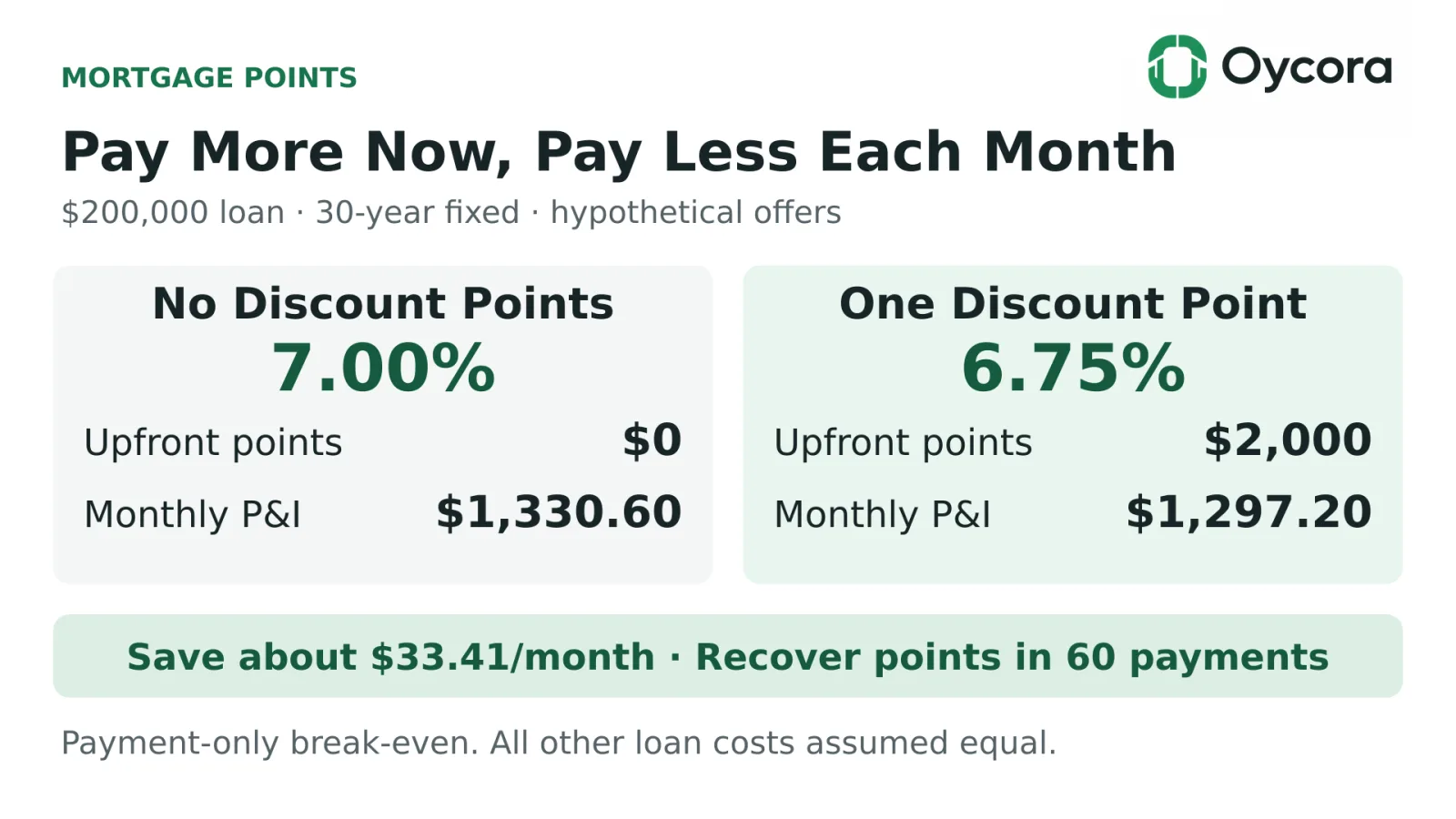
After 60 scheduled payments, Offer A's remaining principal is approximately $188,263.18. Offer B's is approximately $187,751.42. The points option therefore has about $511.76 less debt at that point, in addition to its cumulative payment savings.
If both loans were paid off immediately after payment 60, the simplified advantage of Offer B would be about $516.29: $2,004.53 of payment savings, plus $511.76 of lower principal, minus the $2,000 upfront point. This excludes taxes, the time value of money, and any other differing costs. It is not the same as saying the property generated another $516 of spendable rent.
For a fuller comparison, evaluate cash paid at closing, scheduled payments during the expected holding period, and the payoff balance at the end. Discount future savings if you want to account for the value of keeping cash available today. Do not add principal reduction twice: it is already captured when you compare the ending balances.
Oycora's explanation of mortgage amortization provides the background for understanding why payment savings and balance reduction are different benefits.
Read how mortgage amortization builds equity in a rental property.
Use the Loan Horizon, Not Just the Property Horizon
You might plan to own a rental for fifteen years but replace its mortgage after three. In that case, fifteen years is not the right period over which to count the original loan's rate savings. Those savings stop when that loan is repaid.
This matters when an investor expects to renovate, refinance, consolidate debt, or sell after a few years. Write down at least three possibilities: an early payoff, the most likely payoff, and a longer hold. Calculate each rather than choosing only the scenario that supports the rate you prefer.
In the example, a three-year payoff does not recover the $2,000 through lower payments. A five-year payoff is near the payment-only threshold. A ten-year loan hold creates more room for the points to work. The CFPB's research describes upfront cost divided by monthly savings as a rough break-even estimate, not a complete investment valuation.
Do not assume refinancing will be available simply because you expect rates to fall. Instead, test the decision both with and without the future refinance.
CFPB research: Discount points and rough break-even estimates.
Explore when refinancing a rental property may make sense.
Keep Reserves and Returns in Perspective
A $2,000 point is $2,000 that is no longer sitting in your operating account after closing. If paying it leaves you unable to absorb a repair or a vacancy, a lower monthly payment may be an unattractive trade. Decide on the reserve you need first, then compare points using the cash genuinely available beyond that amount.
In the hypothetical offers, the annual payment reduction is about $401. That can improve projected cash flow, but it is modest relative to many possible property expenses. Model the full rental rather than presenting the mortgage saving as protection against every surprise.
Points also affect the cash invested in the deal. If you use cash-on-cash return, record the extra upfront investment consistently rather than increasing the numerator with payment savings while leaving the denominator unchanged. Net operating income and cap rate, meanwhile, should not improve merely because you selected a cheaper mortgage: the property's operations have not changed.
The tax treatment of points is outside this illustration. Do not assume the entire payment creates an immediate deduction, or insert a tax benefit without verifying how it applies to the actual loan and ownership arrangement. Keep the first comparison before tax and obtain qualified advice for an after-tax version.
A Practical Way to Make the Decision
Start with a zero-point offer and one clearly priced alternative. Enter the same loan amount and term in the rental-mortgage calculator, changing only the rate. Record the payment difference, then separately record the incremental upfront cost. The calculator's lower payment is not, by itself, a recommendation to buy points.
Next, compare your early, likely, and long loan horizons. Check ending balances as well as payments if you want an economic comparison. Read the itemized charges and repayment conditions before treating either offer as settled. The CFPB's Loan Estimate explainer is useful when that form is part of your transaction; it also explains why the interest rate and broader measures of borrowing cost are not interchangeable.
Finally, ask whether the expected benefit is large enough to justify giving up the cash now. Paying points is easier to defend when the rate reduction is useful, the loan is likely to remain outstanding well beyond break-even, and adequate reserves remain. Keeping the zero-point loan can be reasonable when the payoff date is uncertain or liquidity matters more than a small monthly reduction.
The goal is not to win the lowest rate. It is to choose the financing cost and cash commitment that fit the rental you are actually buying and the loan you are likely to keep.