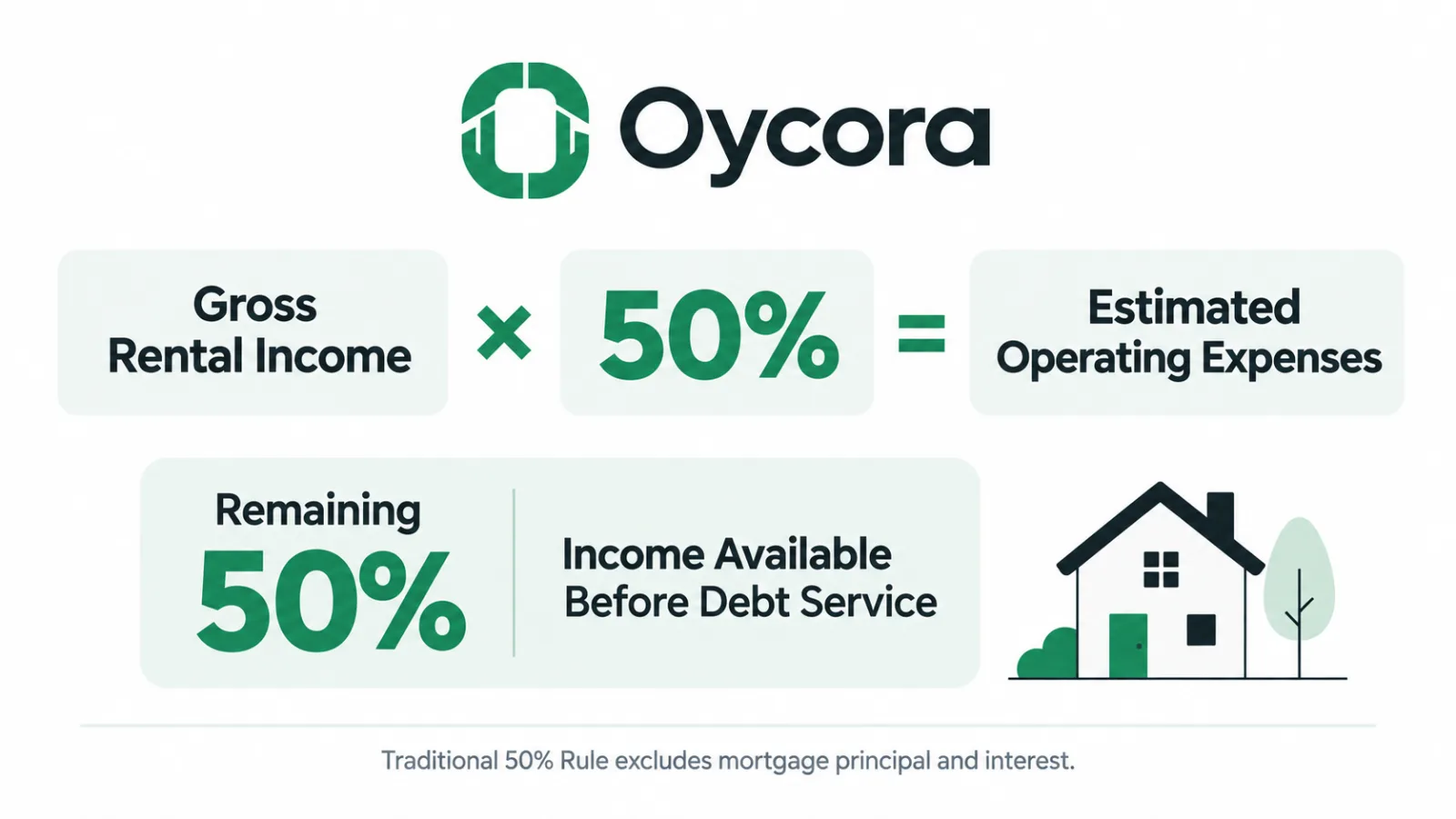
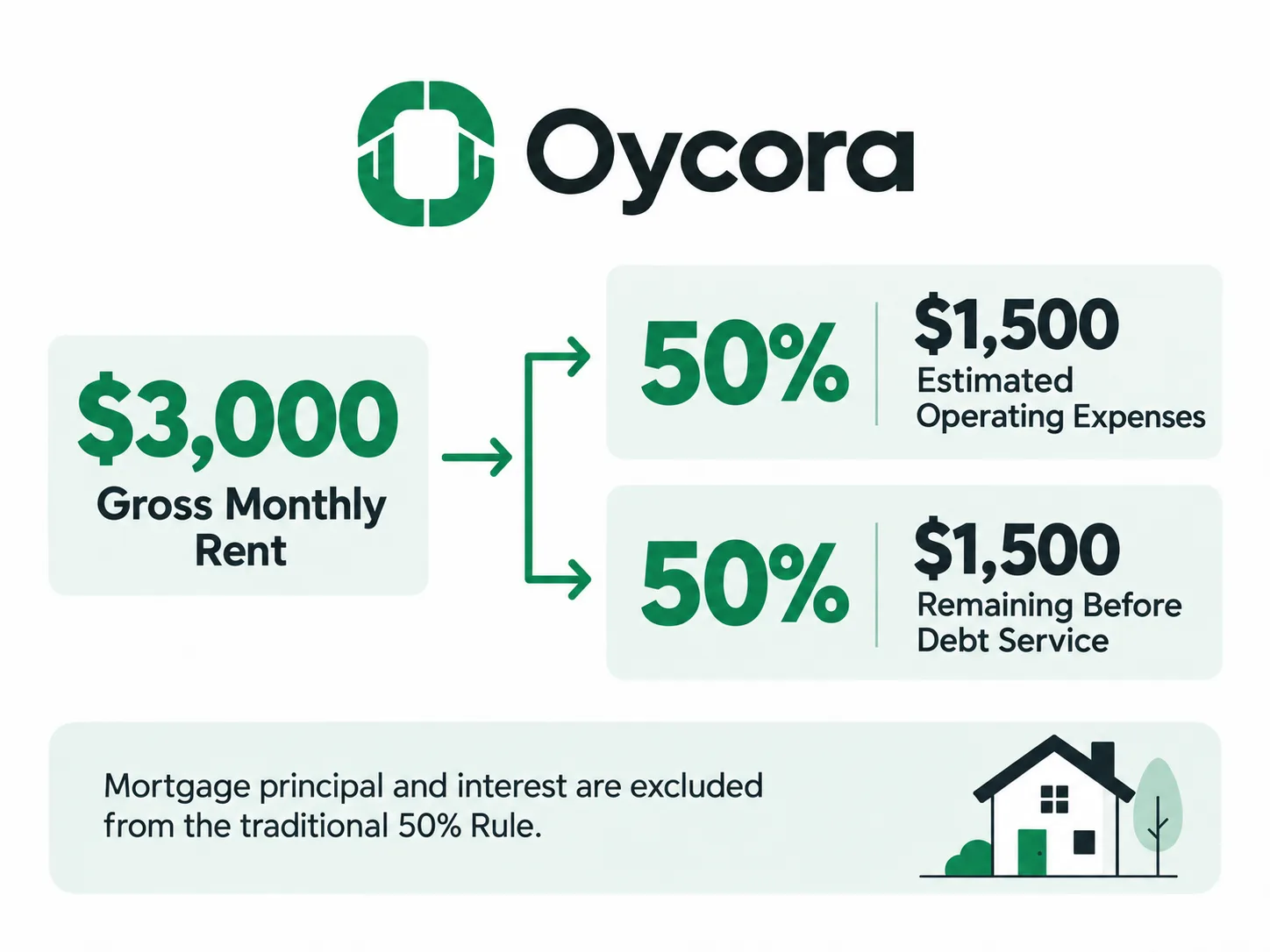
The 50% Rule is a rental-property shortcut built around a simple assumption: over time, roughly half of a property's gross rental income may be consumed by operating expenses, leaving the other half available before mortgage debt service. If a property produces $3,000 per month in rent, the rule would estimate approximately $1,500 per month in non-mortgage expenses.
That makes the rule convenient when an investor is screening listings and does not yet have reliable tax bills, insurance quotes, maintenance history, or utility information. Instead of building a detailed operating budget for every property, the investor can apply one rough expense assumption and decide which listings deserve more work. BiggerPockets and Stessa both describe the 50% Rule primarily as a quick rule of thumb rather than a substitute for complete underwriting.
The problem begins when the estimate is treated as a fact. Rental-property expense ratios can vary substantially based on taxes, insurance, management, age, condition, utilities, vacancy, and property type. The 50% Rule is useful precisely because it is rough; once better information exists, the rough estimate should give way to the actual property.
What Does the 50% Rule Actually Say?
The traditional idea can be written simply:
Estimated Operating Expenses = Gross Rental Income × 50%
The remaining 50% represents income available before debt service. If the property has financing, the mortgage payment is then deducted from that remaining amount to produce a rough cash-flow estimate.
For example, a property collecting $2,400 per month would produce an estimated $1,200 of monthly operating expenses under the rule. If principal and interest were another $900 per month, the simplified screen would leave roughly $300 before any differences between the rule and the property's real expenses are considered.
BiggerPockets describes the rule in essentially this form: around half of property income is assumed to go toward expenses, excluding the loan payment. Stessa similarly frames the 50% Rule as estimating operating expenses at approximately half of gross rental income while keeping the mortgage outside the estimate.
What Expenses Are Supposed to Be Included?
The exact explanation varies somewhat depending on the source, which is one reason the rule should be treated cautiously. Traditional versions generally intend the 50% expense estimate to capture the ordinary costs of operating the rental: property taxes, insurance, maintenance, repairs, vacancy, management, utilities where owner-paid, and other recurring property costs. BiggerPockets' explanations have also included turnover costs and an allowance for larger capital needs within the broad estimate.
Mortgage principal and interest are normally excluded because financing belongs to the investor's capital structure rather than the property's operating expenses. Stessa also separates mortgage payments, capital expenses, and depreciation from conventional operating expenses when explaining property-level analysis, even though reserve treatment can differ depending on the framework being used.
That distinction matters because the rule is not saying that 50% of rent disappears before the mortgage and another 50% disappears afterward. It is trying to produce a rough estimate of the property costs that sit between gross rent and income available for financing.
Oycora's full expense analysis should still keep the categories visible. Taxes, insurance, maintenance, management, reserves, and debt service do not all serve the same analytical purpose, even when a rule of thumb compresses them into one screening number.
Applying the 50% Rule
Assume a fictional rental property produces $3,000 per month in gross rent, or $36,000 per year. Under the 50% Rule:
| 50% Rule Estimate | Monthly | Annual |
|---|---|---|
| Gross rental income | $3,000 | $36,000 |
| Estimated operating expenses (50%) | −$1,500 | −$18,000 |
| Income remaining before debt service | $1,500 | $18,000 |
| Mortgage principal & interest | −$1,150 | −$13,800 |
| Estimated cash flow using the rule | $350 | $4,200 |
At first glance, the property appears to generate roughly $350 per month after estimated operating expenses and debt service.
Now compare the rule with a more detailed expense estimate:
| Actual Expense Estimate | Annual Amount |
|---|---|
| Property taxes | $4,500 |
| Insurance | $2,100 |
| Management | $2,880 |
| Maintenance & repairs | $2,400 |
| Vacancy allowance | $1,800 |
| Owner-paid utilities / services | $900 |
| Total estimated expenses | $14,580 |
Instead of $18,000, the detailed budget estimates $14,580 of annual expenses. Under those assumptions, the 50% Rule was conservative by $3,420.
That could easily move in the other direction. A property with high taxes, expensive insurance, frequent turnover, or aging systems might spend more than the 50% estimate. The rule did not become "wrong" in either case; it was simply never designed to know the details of the specific property.
Why Expense Ratios Can Vary So Much
Property taxes alone can create a major difference between two otherwise similar rentals. A property in a low-tax area may operate well below a 50% expense ratio, while a similar property in a high-tax jurisdiction can consume much more of its rent before financing is considered.
Insurance can create the same effect. Premiums vary by geography, construction, claims history, natural-hazard exposure, coverage, and other factors. Management also matters: an owner who self-manages may have lower direct expenses than one paying a professional manager, although the owner's time still has economic value.
Property age and condition are especially important because maintenance does not arrive evenly. A newer rental with recently replaced systems can have several inexpensive years, while an older property may face repeated repairs and higher reserve needs. Vacancy, turnover, and owner-paid utilities add further variation.
This is why historical BiggerPockets guidance has acknowledged that real expense ratios may fall closer to 40% in some cases and around 60% or more in others. The 50% figure is a midpoint-style heuristic, not a universal operating law.
Which Properties Are Most Likely to Deviate From 50%?
Properties with unusually high fixed costs are obvious candidates. High property taxes, HOA dues, insurance premiums, or owner-paid utilities can push operating expenses well above the traditional estimate even when maintenance remains ordinary.
Newer or recently renovated rentals may fall below 50% for periods of time if major systems are in good condition and tenant turnover is limited. That does not mean long-term capital costs have disappeared, but current operating expenses may genuinely be lower.
Small multifamily properties can behave differently from single-family rentals as well. Multiple units create additional turnover opportunities and more fixtures, appliances, and mechanical needs, but vacancy in one unit does not necessarily eliminate all rental income. A single-family rental has the opposite concentration: one vacancy can reduce rent to zero until the property is re-leased. The more unusual the property or expense structure, the less useful a generic 50% estimate becomes.
A Property Below 50% Is Not Automatically Better
Suppose a rental consistently operates at a 35% expense ratio. That can be attractive because more gross income survives as NOI, but the percentage needs context. Perhaps the property is new and genuinely inexpensive to operate, or perhaps the budget is missing management, maintenance reserves, or realistic vacancy.
Low historical expenses can also be temporary. One quiet repair year can make a property look exceptionally efficient even though a roof, HVAC system, or turnover expense is approaching. The useful question is not simply whether expenses are under 50%; it is whether the assumptions reasonably reflect the property over time.
The same applies to a property above 50%. Higher expenses do not automatically make the property unattractive. A rental with expensive taxes but a low purchase price and strong income might still perform well once financing and acquisition cost are considered. Expense ratio is one input, not a verdict.
50% Rule vs. a Full Operating-Expense Analysis
The 50% Rule starts with income and works backward into an expense estimate. A complete operating-expense analysis does the opposite: it identifies the actual cost categories, estimates each one separately, and adds them together.
That detailed approach can account for real property taxes, an insurance quote, management fees, expected maintenance, utilities, HOA costs, vacancy, recurring services, and whatever reserve treatment the analysis uses. Once those inputs are available, they are much more informative than a generic percentage.
Stessa explicitly recommends moving beyond the 50% Rule by using property-specific documents, comparable operating information, and local management knowledge when possible. That is consistent with Oycora's broader approach: rules of thumb are useful for screening, but detailed inputs should drive the final analysis. The 50% Rule is therefore most valuable before the full expense model exists. Afterward, the actual budget should win.
When the 50% Rule Is Still Useful
The rule is still useful when speed matters more than precision. If you are reviewing dozens of listings and know only their rent and rough financing, estimating expenses at 50% can quickly identify properties that appear unlikely to support the debt.
It can also serve as a reasonableness check. If your detailed analysis estimates operating expenses at only 15% of gross rent, comparing that result with the 50% heuristic may prompt you to check whether taxes, insurance, vacancy, management, maintenance, or reserves were omitted. The rule does not prove the 15% figure is wrong, but the difference deserves an explanation.
That is the right role for a screening heuristic: identify where more investigation is needed. It should not override verified numbers simply because the property's actual expense ratio happens to differ from 50%.
Use the 50% Rule as a Starting Point
The 50% Rule gives investors a fast way to estimate rental-property expenses when detailed information is unavailable. Multiply gross rental income by 50%, treat that amount as a rough operating-cost estimate, and evaluate whether enough income appears to remain before debt service. Then replace the shortcut with real information.
Verify property taxes. Get an insurance quote. Estimate maintenance based on the building's condition. Account for vacancy, management, utilities, recurring services, and future capital needs. Apply the actual financing structure and calculate the resulting cash flow.
A property does not know that investors invented a 50% Rule. Its expenses will be whatever the property, market, and ownership structure require. The rule is useful when it saves time. It becomes dangerous when it replaces the analysis it was supposed to lead into.