
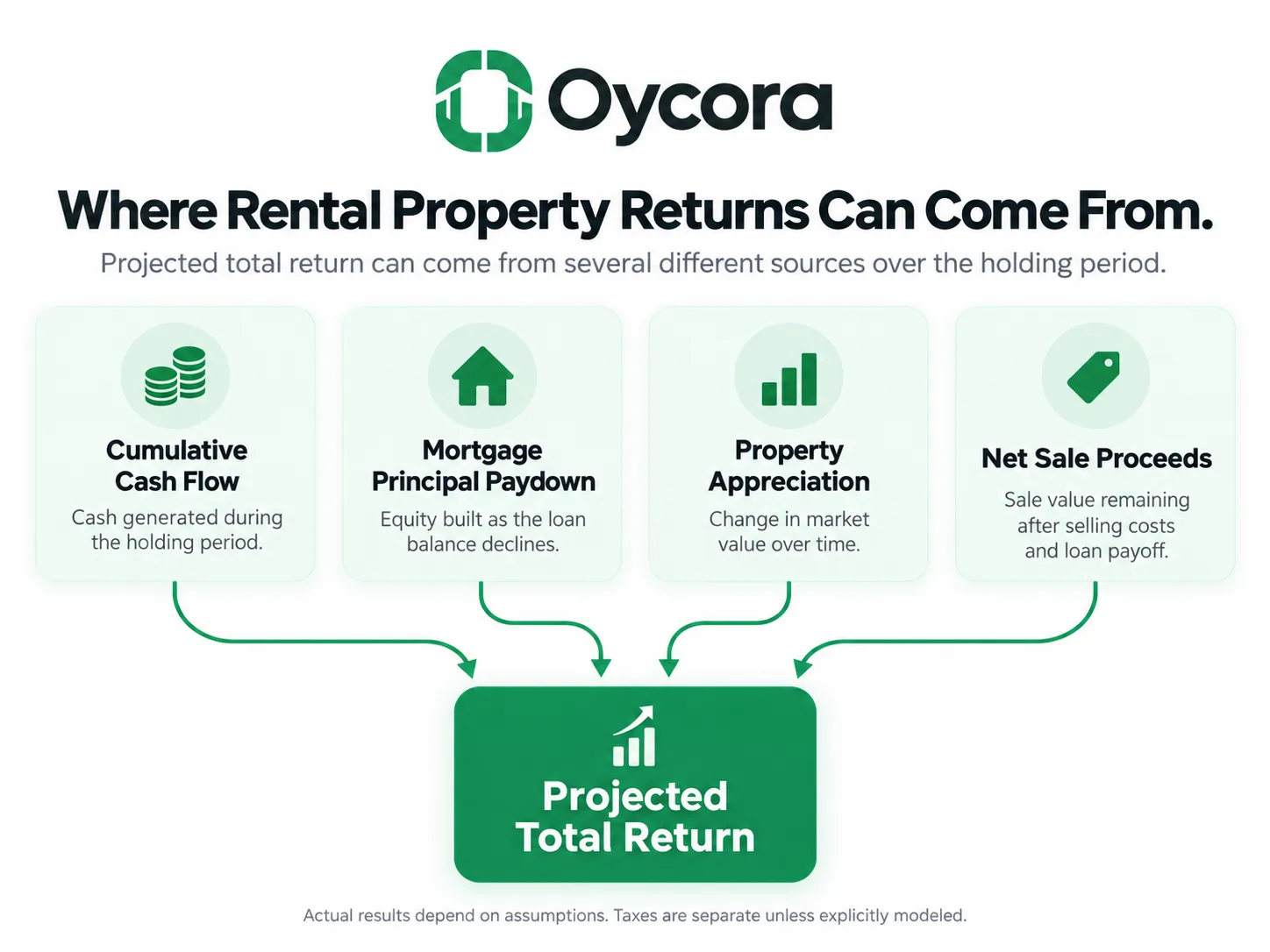
Rental property returns can come from more than the cash left over each month. During a multi-year holding period, an owner may receive rental cash flow, pay down mortgage principal, experience changes in property value, and eventually receive proceeds when the property is sold. Return on investment, or ROI, is a broader way of looking at those gains relative to the cash committed to the investment.
That makes ROI different from metrics such as cap rate and cash-on-cash return. Cap rate looks at property-level operating income relative to value, while cash-on-cash return generally focuses on annual pre-tax cash flow relative to actual cash invested. ROI can instead be used to examine the cumulative result of the investment over a longer period, although the exact definition of “ROI” can vary depending on the methodology being used. PropertyMetrics similarly notes that ROI is used in multiple ways and distinguishes it from single-year cash-on-cash return.
What Does ROI Mean for a Rental Property?
At its simplest, ROI compares the gain produced by an investment with the amount invested. A basic framework can be written as:
ROI = Total Investment Gain ÷ Total Cash Invested
Real estate makes that seemingly simple idea more complicated because returns can occur at different times and in different forms. A rental may generate cash every year, build equity as the loan balance declines, increase or decrease in market value, and incur selling costs when the property is eventually sold. A useful holding-period ROI therefore needs to define exactly which of those components are included rather than treating “return” as a vague synonym for cash flow.
This is also why two people can discuss the ROI of the same property and produce different percentages without either arithmetic calculation necessarily being wrong. One may be calculating simple appreciation relative to the purchase price, another may include rental cash flow, and another may include the entire projected holding period. Before comparing ROI figures, make sure the calculations are measuring the same thing.
The Main Components of Rental Property Return
Cumulative cash flow is the most visible return because it represents cash generated while the property is owned. If a rental produces $4,000 of pre-tax cash flow each year for five years, that creates $20,000 of cumulative cash flow before considering changes in rent, expenses, or other assumptions. Unlike a one-year cash-on-cash return, a holding-period analysis can account for cash flow across multiple years rather than evaluating only one snapshot.
Mortgage principal paydown can also increase the owner's equity. Part of an amortizing mortgage payment reduces principal, which lowers the outstanding loan balance over time. That principal reduction is not the same thing as spendable cash flow, but it can increase the owner's equity in the property and therefore affect the amount retained when the property is eventually sold.
Appreciation or depreciation in property value can become another major component. If a $300,000 property is later worth $350,000, the owner has an unrealized increase in value before selling costs, taxes, or other adjustments. Appreciation should always be modeled as an assumption rather than treated as guaranteed; a property can rise, stagnate, or decline in value depending on the market and property itself.
Finally, the sale of the property converts the remaining equity into cash. The gross sale price is not the same as the investor's proceeds because the outstanding mortgage balance and transaction costs must be accounted for. Tax consequences can also materially affect what the investor ultimately keeps, and the IRS notes that depreciation affects tax basis and may influence taxable gain when rental property is sold.
Why Cash-on-Cash Return and ROI Are Different
Cash-on-cash return generally asks how much annual pre-tax cash flow is being produced relative to the investor's cash contribution. That makes it extremely useful for evaluating current cash yield, but it deliberately leaves out several parts of the longer investment story. PropertyMetrics notes that cash-on-cash return does not account for all operating cash flows across a holding period or the proceeds received when the property is eventually sold.
Imagine a rental that produces modest annual cash flow but experiences substantial principal paydown and increases in value over ten years. Its cash-on-cash return may look relatively ordinary even though the investor eventually realizes a larger cumulative gain. Another property might produce excellent cash flow but experience declining value, making its long-term result weaker than the annual cash yield suggested.
Neither metric is inherently better. They answer different questions. Cash-on-cash return is primarily about current cash yield, while a holding-period ROI calculation can provide a broader picture of what happened or is projected to happen to the investor's capital over time.
Calculating a Five-Year Rental Property ROI
Assume an investor buys a fictional rental property for $300,000 and plans to hold it for five years. The following numbers are illustrative and are intentionally simplified to show how the pieces can fit together.
| Initial Investment | Amount |
|---|---|
| Down payment | $60,000 |
| Closing costs | $8,000 |
| Initial improvements | $7,000 |
| Total initial cash invested | $75,000 |
Now assume the investment produces the following results during the five-year holding period:
| Return Component | Five-Year Amount |
|---|---|
| Cumulative pre-tax cash flow | $25,000 |
| Mortgage principal paid down | $18,000 |
| Increase in property value | $45,000 |
| Less estimated selling costs | −$21,000 |
| Projected total gain | $67,000 |
Using a simplified ROI framework:
$67,000 ÷ $75,000 = 89.3% projected five-year ROI
That does not mean the property earns 89.3% every year. It means the modeled cumulative gain over the entire five-year holding period equals approximately 89.3% of the initial cash invested. It also does not represent an annualized return or account for the timing of each individual cash flow, which is why metrics such as internal rate of return can produce a different perspective when timing matters.
The example also depends heavily on assumptions. If appreciation is lower, selling costs are higher, or annual cash flow underperforms, the projected ROI falls. If the property performs better than modeled, the opposite may occur.
Appreciation Can Have an Outsized Effect
Appreciation often becomes one of the largest numbers in a long holding-period projection, which makes the assumption especially important. Even a modest annual appreciation rate compounds over time, and increasing the assumed rate by a small amount can materially change the projected sale price several years later. That sensitivity can make an otherwise average investment appear exceptional if the model uses aggressive appreciation assumptions.
For that reason, appreciation should usually be stress-tested rather than accepted as one fixed forecast. Compare the result under a base assumption with a lower-growth scenario and, when appropriate, a scenario where property value does not increase at all. The purpose is not to predict the exact future sale price but to understand how dependent the projected return is on rising property values.
This also prevents appreciation from hiding weak operating performance. A property that generates poor cash flow but only appears attractive because of aggressive future price growth has a very different return profile from one that performs well from rental operations alone.
Principal Paydown Builds Equity, but It Is Not Cash Flow
Mortgage principal paydown increases equity because every dollar of principal repaid reduces the loan balance. If the property value stays unchanged while the mortgage balance falls, the owner's equity still increases. Over a long enough holding period, this can become a meaningful part of the investment's overall return.
It is important not to double-count that equity, however. If a projection separately adds principal paydown to return and then calculates sale proceeds using the lower future loan balance, the same benefit can accidentally be counted twice. A well-structured model should clearly define how equity growth enters the calculation so each component appears only once.
Principal paydown also differs from cash flow because it is not immediately spendable money. The owner generally realizes that equity through refinancing or an eventual sale, so it should not be presented as though it were cash deposited into the investor's account each month.
Selling Costs Matter More Than They First Appear
Future sale value tends to receive most of the attention in a long-term projection, but the property's eventual selling price is not the amount the investor keeps. Brokerage commissions where applicable, transfer costs, legal or closing expenses, and other transaction costs can reduce the proceeds available at disposition. The remaining mortgage balance must also be paid before the investor receives the equity.
Tax treatment is another separate consideration. Rental-property depreciation reduces tax basis, and the IRS explains that depreciation and other basis adjustments can affect gain when property is sold. The tax result depends on the owner's circumstances and applicable law, so a general ROI model should not silently assume that projected pre-tax sale proceeds equal after-tax proceeds.
This is one reason Oycora should keep projected investment performance distinct from individualized tax advice. A financial model can show how operating cash flow, equity, and sale assumptions interact without pretending to calculate every investor's eventual tax liability.
Holding Period Changes the Return Story
A property's projected return can look very different over three, five, ten, or twenty years. A longer hold provides more time for rental cash flow to accumulate, the mortgage balance to decline, and appreciation assumptions to compound. It can also create more exposure to maintenance, capital expenditures, market cycles, selling conditions, and changes in rental demand.
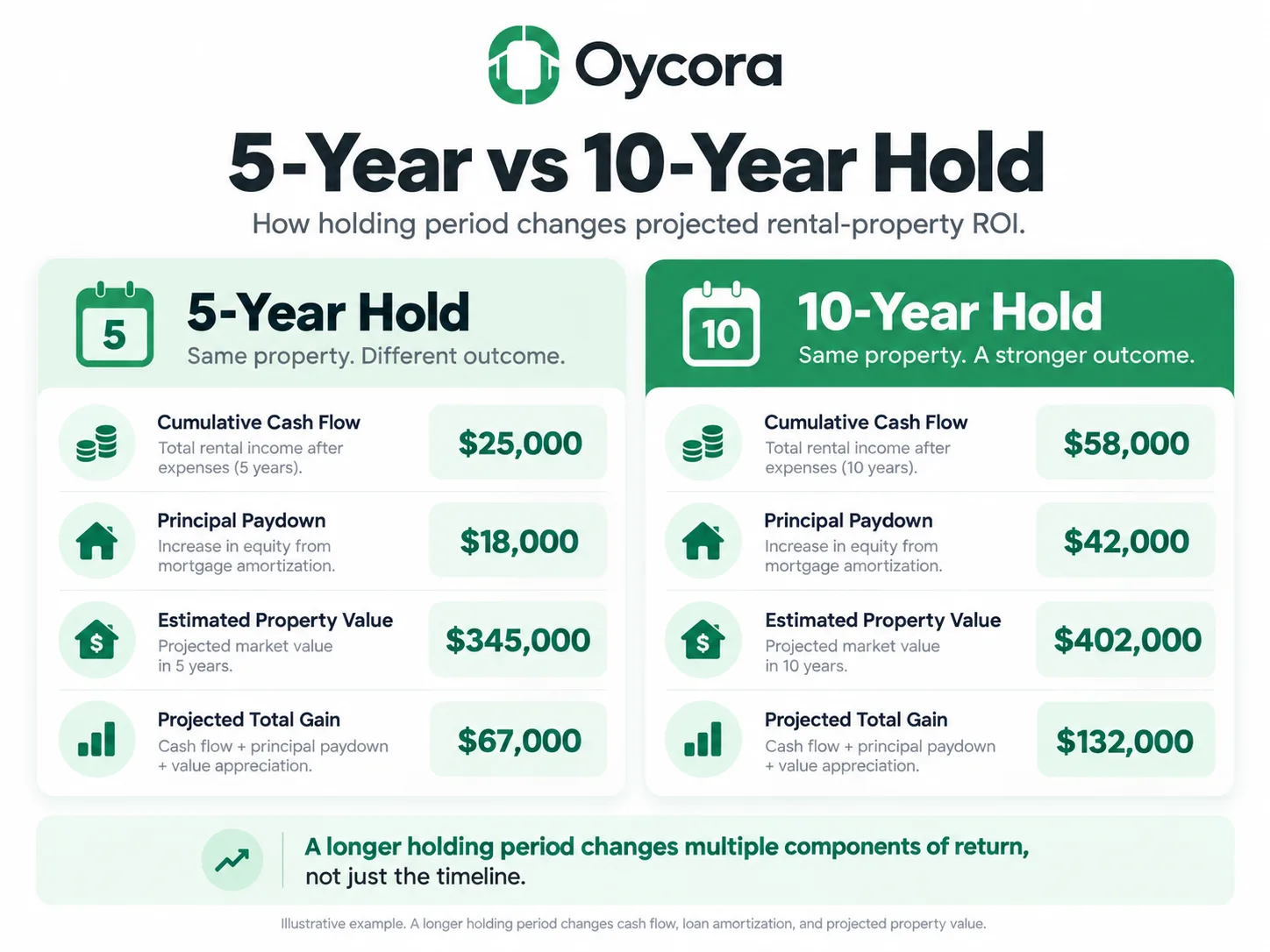
A ten-year projection therefore should not simply multiply the five-year result by two. Loan amortization changes from year to year, rent and expense assumptions may compound, and the projected sale value occurs at a different point in time. Holding period is itself one of the major assumptions driving a longer-term real-estate model.
Common Rental Property ROI Mistakes
One mistake is calling annual cash flow “ROI” without acknowledging the rest of the investment. Another is counting appreciation while ignoring transaction costs required to realize it. Investors can also overstate returns by forgetting closing costs and initial improvements when calculating how much cash they actually invested.
Double-counting equity is another problem. Principal paydown, outstanding loan balance, sale proceeds, and property value are interconnected, so those figures should be calculated within one consistent framework rather than independently added wherever they improve the result. Likewise, future appreciation should not be treated as guaranteed simply because the model needs a future sale value.
Finally, be careful when comparing a cumulative ROI with an annual percentage. A five-year total ROI and a one-year cash-on-cash return measure different periods and different types of return. Comparing the percentages directly can create the impression that they describe the same thing when they do not.
Treat Projected ROI as a Model, Not a Promise
Rental property ROI is most useful when it brings the different sources of return into one transparent model. Cash flow shows what the property may produce while it is owned, principal reduction can build equity, changes in property value influence eventual sale proceeds, and transaction costs determine how much of that value may ultimately be retained.
The calculation becomes less useful when those assumptions are hidden or overly optimistic. A precise projected ROI does not make appreciation certain, guarantee future cash flow, or determine what a property will sell for years from now. It tells you what the investment could produce if the assumptions in the model occur.
Use ROI alongside cash flow, cap rate, cash-on-cash return, DSCR, property condition, financing, and stress testing. The goal is not to find one percentage that decides whether a rental is attractive, but to understand where the projected return comes from and how much of it depends on the future going according to plan.