
A rental can leave money in your bank account while reporting a much smaller profit for tax purposes. It can also generate positive taxable rental income in a year when you feel short of cash. Neither result necessarily means the bookkeeping is wrong.
The difference comes from what each calculation measures. Cash flow follows money received and paid. A rental's tax calculation follows rules about income recognition, deductible expenses, and recovering the cost of property over time. Loan principal, depreciation, and money set aside for future repairs therefore receive different treatment.
Understanding that difference helps you avoid two costly assumptions: that every dollar left over is available to spend, or that every dollar paid out reduces your taxable income. Start with a common U.S. situation: an individual owning a residential property rented for profit, without personal use or hotel-like services. The discussion is educational, not individualized tax advice.
Two Calculations, Two Different Questions
Pre-tax cash flow asks how much cash the property produces after the costs included in your model. For a financed rental, that usually means collected rental income minus cash operating expenses and debt service. Actual capital spending can reduce it further. An underwriting model may also subtract an allowance for future replacements, even when that money has not yet been spent.
A tax calculation asks how much rental income remains after allowable deductions. Individual owners commonly report ordinary real-estate rental activity on Schedule E. In this article, “taxable rental income” means that property's net rental result before owner-level adjustments and loss limitations, not the owner's final taxable income or tax bill. The IRS describes the general reporting framework in Topic 414, Rental Income and Expenses.
For the simplified case examined here:
Pre-tax cash flow before reserves = rent collected − cash operating expenses − interest − principal.
Net rental income before limitations = reportable rent − deductible operating expenses − deductible interest − depreciation.
Those formulas deliberately omit acquisition spending, improvements, and timing differences. They make the central distinction visible: principal appears in the cash calculation, while depreciation appears in the tax calculation.
A Mortgage Payment Contains Two Different Things
When you make a principal-and-interest payment, both components leave your account. Both therefore reduce cash available that month. But principal repays borrowed money; it does not become a rental expense simply because it is included in a mortgage payment. The IRS specifically distinguishes principal payments from deductible expenses in Publication 527.
Interest attributable to the rental can generally be deductible, subject to applicable rules and limits. The Schedule E instructions explain interest reporting and why the use of loan proceeds matters. Borrowing against a rental does not automatically make every use of the borrowed money a rental expense.
For analysis, separate principal, interest, and any escrow component rather than labeling the entire bank withdrawal “mortgage expense.” If property taxes and insurance are already recorded in operating expenses, subtracting an escrow-inclusive payment as well can count them twice.
Principal repayment can improve your ownership position by reducing the loan balance, but it is not spendable income. A property can be building equity while offering only a thin cash cushion. Keeping that distinction visible is more useful than trying to force every financial benefit into a single profit number.
Depreciation Reduces Income Without a Matching Current Payment
Depreciation allocates a qualifying property's tax cost over time. You do not write a new check equal to the depreciation deduction each year. It can therefore lower the rental's tax result without lowering that year's operating cash balance. Land is not depreciable. See the IRS explanation in Topic 704, Depreciation.
For a typical U.S. residential rental building under the general depreciation system, the recovery period is 27.5 years, using straight-line depreciation and the mid-month convention. First- and last-year calculations differ from a full intervening year; other systems and assets can have different rules. Publication 946 explains those methods and conventions.
Suppose a building has a properly determined depreciable basis of $275,000, excluding land. A simplified full-year straight-line calculation is $275,000 ÷ 27.5 = $10,000. That annual deduction is unrelated to whether the owner repaid $3,000, $5,000, or $8,000 of mortgage principal during that year.
Depreciation also is not an estimate of how much cash the building needs for maintenance. A well-maintained property still needs a replacement budget. Nor should the deduction be described as permanently tax-free income: depreciation affects adjusted basis and can affect the tax consequences of a later sale. Publication 527 discusses the basis connection.
Reserves Reduce Available Cash, Not Automatically Taxable Income
Moving $200 each month from the property's checking account to a savings account can be sensible budgeting. It leaves $200 less available for an owner distribution. But the transfer itself has not paid a contractor, purchased an asset, or created a deductible rental expense.
This is why the label matters. “Cash flow after reserves” describes a budgeting result, while “cash flow before reserves” describes a different boundary. The money still belongs to the owner in either account. The cash-method framework generally ties deductions to paid expenses, subject to tax rules; it does not turn savings transfers into expenses. See the IRS's rental income and expense tax tips.
When money is eventually spent, classify the actual expenditure. A reserve account does not determine whether the payment qualifies for a current deduction or must be capitalized. Also avoid subtracting both a reserve allowance and the same reserve-funded project without explaining the purpose of the calculation. A normalized annual budget and a record of actual annual spending are different views.
Repairs and Improvements Can Create Another Timing Gap
A qualifying repair or maintenance expense may be currently deductible. A capital improvement generally must be capitalized and recovered under the applicable rules rather than deducted immediately as an ordinary repair. Improvements include certain betterments, restorations, and adaptations to a new or different use. The IRS's tangible property regulations overview describes this framework and available safe harbors.
The invoice label or dollar amount alone does not settle the treatment. Replacing a major building component can require different analysis from fixing an isolated defect. Elections, safe-harbor requirements, and the facts of the work can matter. Keep detailed invoices and ask a qualified tax professional to classify uncertain expenditures.
From a cash perspective, an owner paying a $12,000 project bill has $12,000 less cash. From a tax perspective, that same payment may produce deductions over time instead of an immediate $12,000 deduction. This is one reason a difficult cash year need not produce an equally large tax loss.
One Rental, Three Useful Results
Consider a fictional property rented throughout the year. The owner collects $3,000 a month, or $36,000 annually. Cash operating expenses total $12,000, and all qualify as current deductions in this example. Annual loan payments contain $10,000 of deductible interest and $5,000 of principal. These loan components are stipulated totals, not a quote for a particular loan.
The owner also allocates $2,400 to reserves. No capital projects occur during the year. The building has a $275,000 depreciable basis, with land excluded, and a simplified $10,000 full-year depreciation deduction.
This is an intervening full year after the property was placed in service, not an acquisition or disposition year. Assume cash-basis reporting and no personal use, vacancy, advance rent, deposit complications, prepaid expenses, financing fees, special depreciation, or interest limitations. The numbers isolate the accounting comparison rather than model a complete tax return.
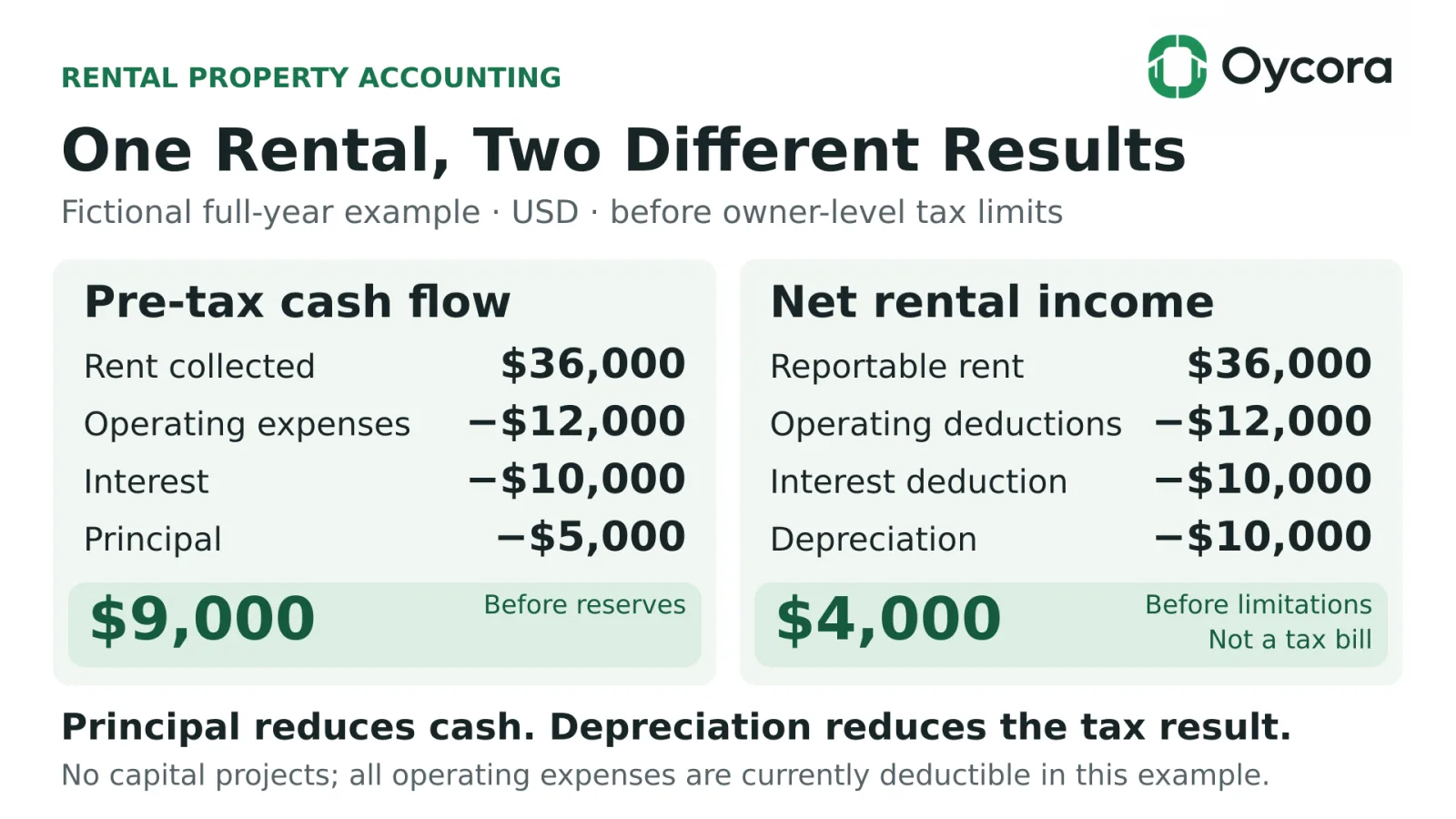
Real World Example
Fictional annual figures. All operating expenses and interest qualify for current deduction in this simplified case. The rental-income result is before owner-level adjustments and loss limitations, not a tax bill.
| Annual item | Cash-flow calculation | Rental-income calculation |
|---|---|---|
| Collected and reportable rent | $36,000 | $36,000 |
| Operating expenses | −$12,000 | −$12,000 |
| Interest | −$10,000 | −$10,000 |
| Principal repayment | −$5,000 | No deduction |
| Depreciation | No current cash payment | −$10,000 |
| Result before reserve allocation | $9,000 | $4,000 |
| Reserve allocation | −$2,400 available for distribution | No deduction |
| Cash available after reserves | $6,600 | Not applicable |
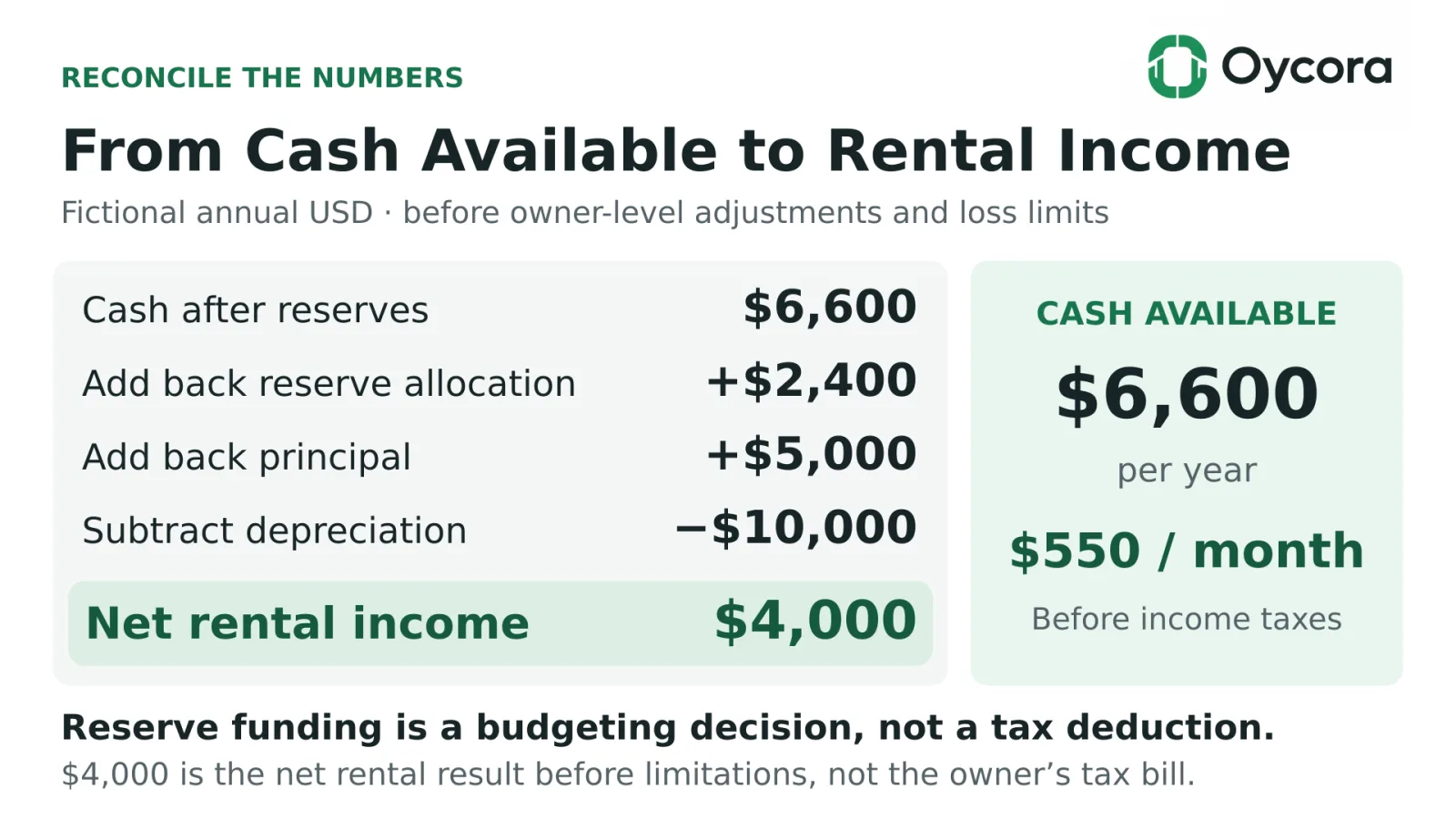
The rental produces $9,000 of pre-tax cash flow before reserves. The owner chooses to retain $2,400, leaving $6,600, or $550 per month on an annual-average basis, available before income taxes. Meanwhile, the simplified tax calculation shows $4,000 of net rental income before owner-level adjustments.
You can reconcile the numbers directly:
$6,600 cash after reserves + $2,400 reserve allocation + $5,000 principal − $10,000 depreciation = $4,000 net rental income.
Adding back the reserve allocation reverses a budgeting decision. Adding back principal reverses a cash payment that is not deductible. Subtracting depreciation introduces a deduction without a current-year cash payment. None of these adjustments changes the property's rent collection or operating performance.
A Rental Loss Is Not Automatically a Tax Saving
If the example's depreciation were larger, its net rental result could become negative while cash flow remained positive. That does not establish an immediate tax refund or permission to offset salary income.
Rental activities are generally passive for federal tax purposes, subject to exceptions. Passive-loss rules can defer deductions, and disallowed passive losses can carry forward. Active-participation provisions and qualifying real-estate-professional rules have their own conditions. The IRS summarizes these distinctions in Topic 425, Passive Activities. Other limitations may also apply.
Likewise, the example's $4,000 result is not a $4,000 tax bill. Calculating the actual tax effect requires the owner's broader return, applicable deductions and limitations, and relevant federal and state rules. Do not multiply an anticipated paper loss by a marginal tax rate and treat the result as guaranteed cash available to support the property.
Keep the Operating Decision and Tax Calculation Connected
Maintain three clearly labeled views: actual property cash movements, cash available after your reserve policy, and the rental's tax calculation. Reconcile differences rather than treating one view as a substitute for the others. That makes it easier to identify a missed loan split, a duplicated cost, or a reserve transfer incorrectly coded as an expense.
Use Oycora's Cash Flow Calculator to examine the pre-tax cash side of a rental. Keep the tax reconciliation separate and review it with a qualified professional. A lower taxable result may be valuable, but the property still needs enough real cash to pay its bills and fund its future work.