The listing says property taxes are $2,400 a year. The seller’s latest bill confirms it. A budget built with that number can still be wrong for the next owner. The bill tells you what was charged for a particular parcel, assessment and tax period. Before treating it as a permanent expense, find out whether those conditions will still apply to your purchase.
Start with the actual bill, then build a separate estimate for the period after closing. The listing number is evidence, not a forecast. This matters most when cash flow is thin: a few hundred dollars of extra annual tax could be manageable, while a four-figure change can take a property out of the running.
Start With the Actual Parcel and Tax Bill
Ask for the parcel identification number and look it up in the local assessor’s and tax collector’s records. Match the address and the structures to the property you are buying. A sale can include more than one parcel, and a listing sometimes shows a bill for only one. A recent bill is more useful than an annual tax figure copied forward by a listing service.
Write down the tax year, the assessed and taxable values shown, the deductions or exemptions listed, the total due and any separate charges printed on the bill. Check that you are reading a full year rather than a single installment. Do not simply double an installment unless the billing office confirms the payments are equal. If there is a special charge or delinquent amount, ask whether it recurs and who is responsible for it.
Keep the assessment notice and the bill separate. An assessed value does not tell you the final bill by itself. Indiana’s Department of Local Government Finance, for example, explains how assessed values, deductions, local rates and credits contribute to the calculation. An official explanation for your county or state is more useful than applying another market’s rate to your purchase.
Indiana Department of Local Government Finance: How Property Taxes Are Calculated
Check What Changes After a Sale
Ask what event can change the taxable value: a transfer, a regular reassessment cycle, new construction, a change of use, or an event specific to local rules. Then ask when a revised value would first be reflected in billing. Don’t assume every sale immediately resets the tax base, or that your contract price always equals the assessor’s value.
A specific example helps illustrate the timing problem. California’s Orange County assessor explains that a reassessable transfer can lead to a supplemental assessment, with the bill arriving months after escrow closes. That is an example of how one jurisdiction works, not a rule for properties elsewhere. A location that reassesses on another timetable can produce a different first-year cash requirement for the same annual tax estimate.
Ask whether the current owner has a deduction or exemption you won’t qualify for as a non-owner occupant. A home that the seller occupied and a house you intend to rent may not receive the same treatment. Confirm eligibility and effective dates in writing where practical. If you plan to occupy one unit while renting another, explain that arrangement when you ask instead of assuming either fully owner-occupied or fully non-owner-occupied treatment.
Orange County Assessor: Reassessment and Supplemental Bills
Keep the Closing Bill Separate From the Operating Budget
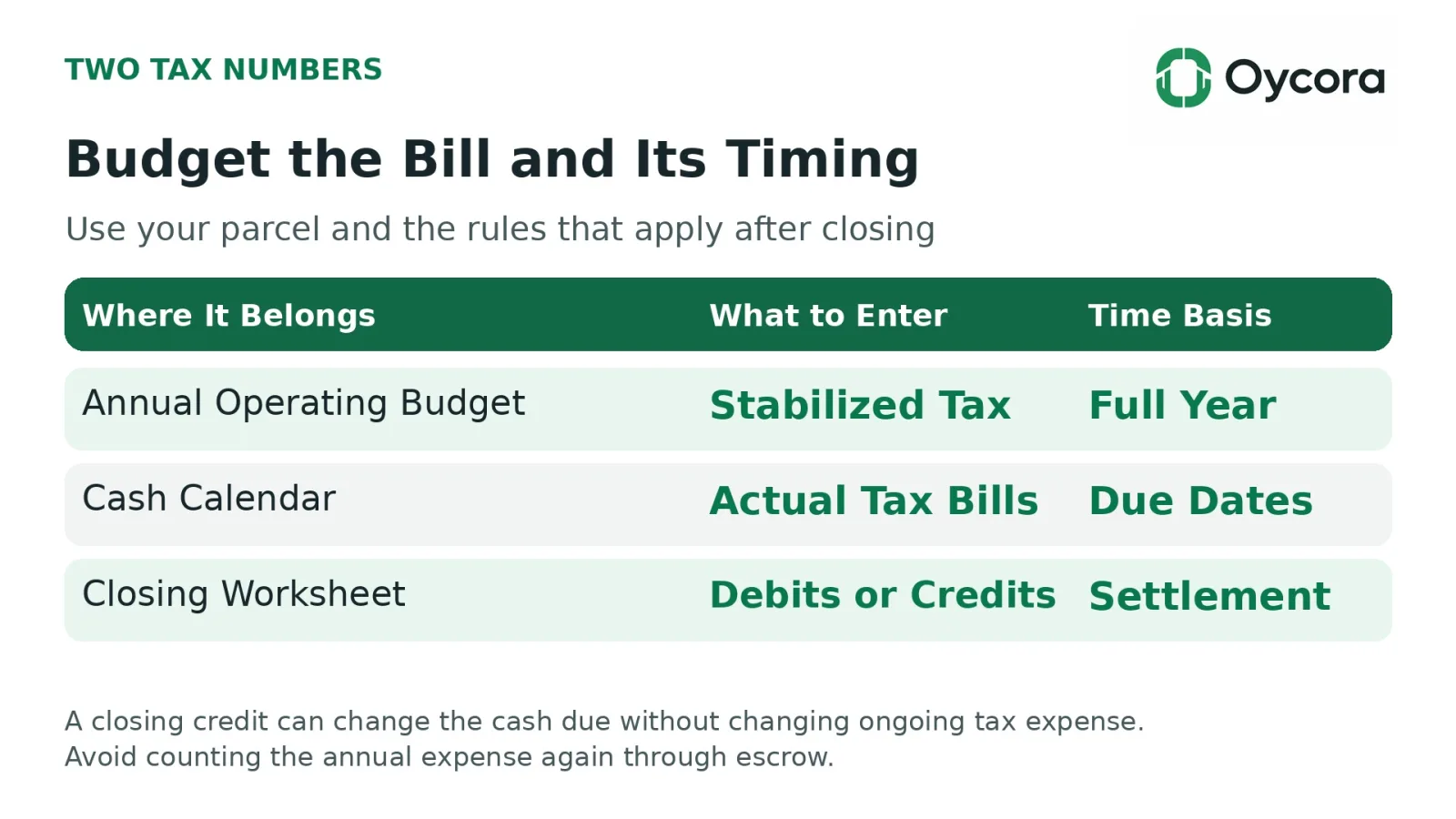
Build two lines: expected cash timing in the first twelve months after closing and the expected full-year tax expense once the post-purchase value and occupancy treatment are reflected. Ask the closing agent about amounts due or credited at settlement and the taxing office about bills that may follow. A credit at closing can affect your cash outlay without reducing the ongoing annual expense.
For the operating budget, convert a confirmed annual estimate to a monthly equivalent by dividing by twelve. This is how much of the year’s income the expense represents, not a prediction of when you will pay it. For your cash calendar, use the actual installment dates, escrow collection schedule and known supplemental billing dates instead. Avoid combining a prorated settlement charge, a tax escrow deposit and the full future annual bill as though each were an additional recurring operating expense.
If a lender collects taxes in escrow, use principal and interest in the debt-service entry when you have already entered property taxes separately under expenses. The CFPB’s explanation of mortgage payments distinguishes principal and interest from taxes and insurance that may be escrowed. Check the lender’s quote so your own worksheet uses the same boundary.
Consumer Financial Protection Bureau: Principal and Interest Versus the Total Payment
Real World Example
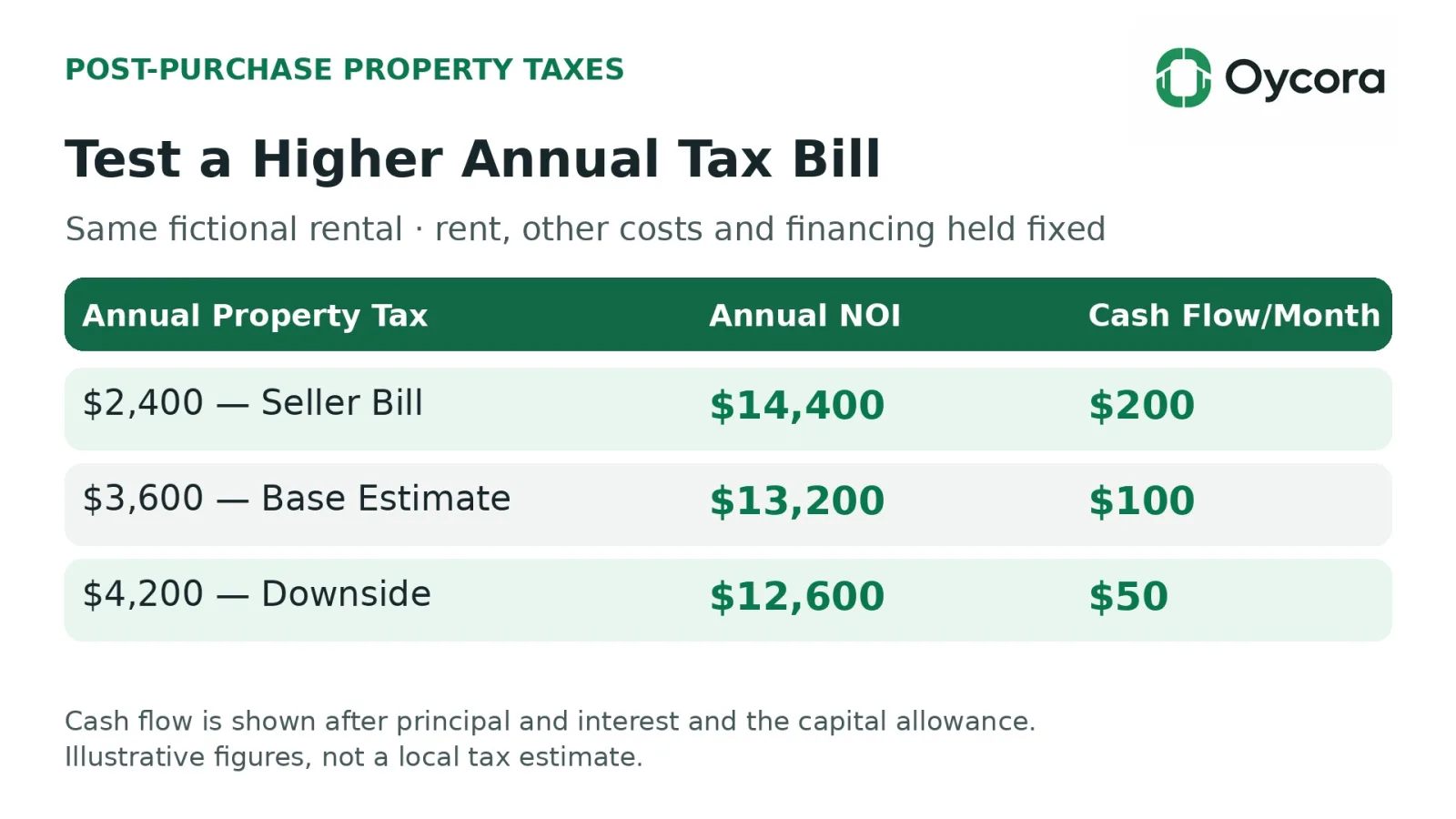
A hypothetical buyer is evaluating a $240,000 single-family rental. The current bill is $2,400 annually. After verifying the parcel and proposed use, the buyer uses a $3,600 annual post-purchase tax estimate for the base case and $4,200 for the downside. Those numbers are illustrative inputs rather than an estimate for a real jurisdiction.
Assume $24,000 annual scheduled rent, $1,200 vacancy and collection loss, and no other income. Effective income is $22,800. Other annual operating expenses are $6,000. Annual principal and interest is $10,800, and the buyer sets aside $1,200 annually for capital replacements. Rent, vacancy, other expenses, financing and the reserve are held fixed so the effect of the tax estimate is visible.
Using the seller’s tax bill gives $8,400 in operating expenses and $14,400 in NOI. After principal and interest and the capital allowance, the projected cash flow is $2,400 a year, or $200 a month. At $3,600 of taxes, NOI falls to $13,200 and projected cash flow falls to $1,200 annually, or $100 a month.
The $4,200 downside leaves $12,600 of NOI and $600 of annual cash flow, or $50 a month. At the same $240,000 purchase price, the three NOI figures imply cap rates of 6.00%, 5.50% and 5.25%. Financing did not change those cap rates; the operating tax line did.
Check Which Part of the Increase Actually Changes
If the bill changes, identify whether the difference came from the assessment, a deduction or credit, the rate, a separate charge, or a combination. This is useful because the parts don’t necessarily move together. For example, multiplying an old bill by the percentage increase in assessed value assumes everything besides the assessed value stays proportional. That shortcut can break if a fixed charge remains unchanged or a credit disappears after the sale.
In the worked example, the base increase is $1,200 per year. Holding every other entry fixed, it subtracts $100 from average monthly cash flow. It does not change how much the tenant pays, the mortgage’s principal-and-interest payment or the reserve allowance. If your lender later adjusts escrow to collect more, reconcile that increase to the same underlying tax expense rather than entering it twice. If the escrow adjustment also collects for a prior shortage, track that temporary cash demand separately from the ongoing tax amount.
Ask a specific question when you call the assessor or treasurer: “For this parcel, if I buy at this price and operate it as a non-owner-occupied rental, what could change first, and which dates and inputs should I use?” An office may explain the rules without offering an exact quote. That answer still improves the model because it tells you which assumptions need a range.
Use a Range When the Future Bill Is Uncertain
A taxing office may be able to tell you the applicable rule without predicting the exact future assessed value, rate, or credit. Write down the inputs it can confirm and keep the uncertain ones visible. A reasonable first pass might be a current bill, an estimate under the expected treatment, and a downside under a plausible higher assessment or lost deduction. Label which one is your buying assumption.
Give each number a date and source. If you use an official estimator, save the assumptions it asks for and note whether it includes local assessments or credits. If you cannot resolve a material uncertainty, carry a range rather than filling the gap with a precise-looking value. A deal that only works under the seller’s bill deserves a more conservative review before you rely on it.
Once you know the dollar spread, compare it with the cushion you intended to keep. In the example, the base estimate cuts the modeled $200 monthly cushion in half. If you had required $150, the original worksheet would pass and the revised one would fail. That is a useful reason to revisit the proposed price or collect better evidence before making a commitment.
Oycora: Work Backward From a Cash Flow Goal to an Offer
Update the Budget When the First New Bill Arrives
Save the numbers you used at purchase. When the first assessment notice or bill arrives, compare the taxable value, credits, installments and total charge with your estimate. Look for the actual source of the difference before updating the annual model. A one-time settlement adjustment belongs in the acquisition cash record; an ongoing change to the bill belongs in the operating budget.
Some purchases warrant a new call to the taxing office before your offer becomes binding. Ask which bill and effective date your estimate refers to, then have the closing professional tell you which amounts are being prorated or credited at settlement. This article offers an underwriting method, not a determination of anyone’s tax liability. Use the terms and rules that apply to your actual parcel.
Run the proposed purchase twice with identical rent, expenses and financing. Change only the annual property tax line. The difference will show how much of your cash-flow cushion depends on the seller’s number continuing after closing.
Oycora: Documents to Request Before Buying a Rental Property